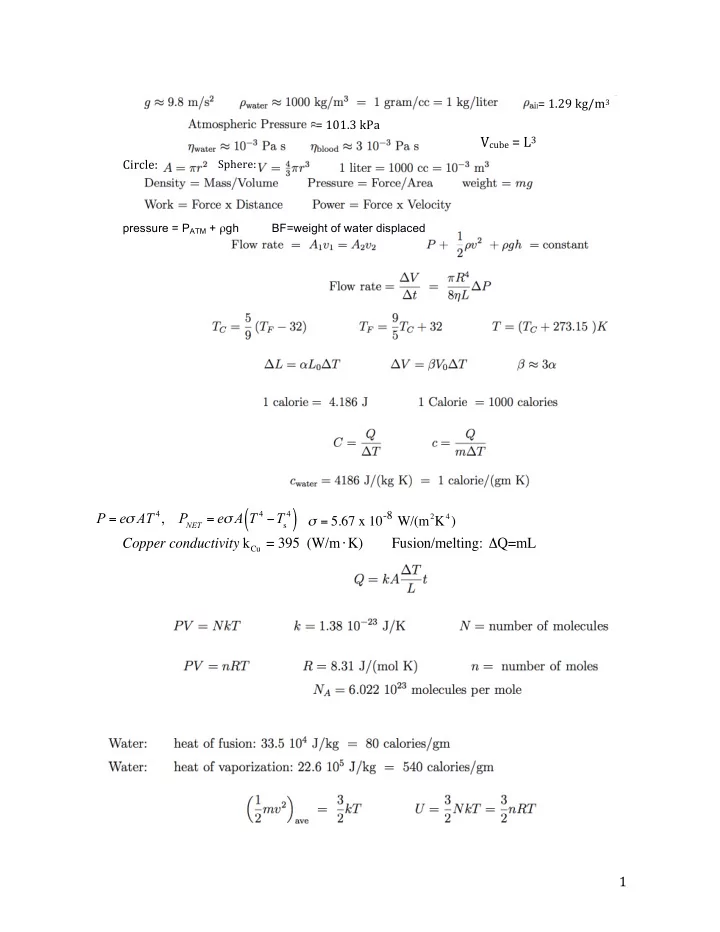
SLIDE 1 ¡ 1 ¡ P = eσ AT 4, P
NET = eσ A T 4 −Ts 4
( ) ¡ ¡σ = 5.67 x 10⁻⁸ W/(m2K4) ¡
Copper conductivity kCu = 395 (W/m⋅K) Fusion/melting: ΔQ=mL ¡
¡
Circle: ¡
Sphere: ¡
! Vcube!=!L3! ¡
= ¡101.3 ¡kPa ¡
pressure = PATM + ρgh BF=weight of water displaced ¡
= ¡1.29 ¡kg/m3 ¡
SLIDE 2
¡ 2 ¡ 1st Law ΔU = Q – W 2nd Law For a closed system ΔS > 0 or = 0 Constant P process Work = P ΔV Isothermal process Work = nRT ln ( Vf/Vi ) Ideal Gas PV = nRT = NkT U = 3/2nRT = 3/2NkT kB = 1.38 X 10 –23 J/K R = 8.31 Latent Heat L steam = 2.26 X 10⁶ J/kg Q = mL For reversible heat engines (Carnot) efficiency = 1 - Qc/ Qh = 1 - Tc/ Th Qh = Qc + W COP for Heat Pump = Qh / W COP for Refrigerator = Qc / W Entropy ΔS = ΔQ/T at constant T Electron charge 1.6 X 10⁻¹⁹ C Electron mass 9.11 X 10⁻³¹ kg Permittivity of Vacuum ε0 = 8.85 X 10 –12 k=1/(4πε0) F12=kQ1Q2/R2 Energy density in the Electric field is u = ε 0 E2 / 2 J/m3 Capacitance for a parallel plate capacitor with vacuum ε 0 A/d Farads Electric flux Φ = E A cosθ Gauss’s Law Total Electric Flux through closed surface = Q / ε 0 Electric field E = - ΔV/ Δs Capacitor Law: Q = CV Electric field due to point charge E = k Q/ R2 , k = 8.99 X 10⁹ Electric Potential due to point charge V = kQ/R Work done on charge = - Q ΔV Electric ¡ ¡Current ¡ ¡ ¡ ¡ ¡I ¡ ¡= ¡ ¡ΔQ/Δ ¡t ¡ ¡= ¡Rate ¡of ¡flow ¡of ¡ ¡ ¡electric ¡charge ¡ Ohm’s ¡Law ¡ ¡ ¡ ¡ ¡ ¡ ¡ ¡ ¡ ¡ ¡ ¡ ¡V ¡= ¡IR ¡ R ¡ ¡= ¡ ¡ ¡ρ ¡L/A ¡ ¡ ¡, ¡ ¡ρ ¡ ¡resistivity ¡ Series ¡ ¡ ¡ ¡R ¡ ¡ ¡= ¡ ¡ ¡R1 ¡ ¡ ¡+ ¡ ¡ ¡ ¡R2 ¡ ¡ ¡ ¡+ ¡.......... ¡ ¡ ¡ ¡ ¡ ¡Parallel ¡ ¡ ¡ ¡ ¡ ¡R-‑1 ¡ ¡ ¡= ¡ ¡ ¡ ¡R1-‑1 ¡ ¡+ ¡ ¡ ¡R2-‑1 ¡ ¡ ¡+ ¡........ ¡ Q ¡= ¡CV ¡ Series ¡ ¡ ¡ ¡C-‑1 ¡ ¡ ¡= ¡ ¡ ¡C1-‑1 ¡ ¡ ¡ ¡+ ¡ ¡ ¡ ¡ ¡C2-‑1 ¡ ¡ ¡ ¡+ ¡ ¡ ¡..... ¡Parallel ¡ ¡ ¡ ¡ ¡C ¡ ¡= ¡ ¡ ¡C1 ¡ ¡ ¡ ¡+ ¡ ¡ ¡ ¡ ¡C2 ¡ ¡ ¡ ¡+ ¡ ¡ ¡........... ¡ Charging ¡a ¡capacitor ¡in ¡an ¡RC ¡ ¡circuit ¡ ¡ ¡ ¡ Q(t) ¡ ¡= ¡ ¡Qmax( ¡1 ¡-‑ ¡ ¡e-‑t/τ ¡ ¡) ¡ ¡τ ¡= ¡ ¡ ¡RC ¡, ¡ ¡Qmax ¡= ¡max ¡charge ¡on ¡ ¡C ¡(at ¡t=infinity)=CE ¡ ¡ FB ¡ ¡ ¡= ¡ ¡ ¡ ¡q ¡v ¡B ¡ ¡Sin ¡(θ) ¡ ¡ ¡ ¡[use ¡RHR], ¡ ¡ ¡ ¡FE ¡ ¡ ¡ ¡= ¡ ¡ ¡ ¡q ¡E ¡ ¡ ¡ ¡(on ¡a ¡charge ¡ ¡q ¡) ¡ Work ¡ ¡= ¡ ¡ ¡q ¡ ¡V ¡ Kinetic ¡energy ¡for ¡mass ¡m, ¡speed ¡v ¡= ¡½ ¡mv2 ¡ ¡ ¡ FB ¡ ¡ ¡ ¡ ¡= ¡ ¡ ¡I ¡l ¡B ¡Sin ¡(θ) ¡ ¡(on ¡ ¡wire ¡with ¡length ¡ ¡l ¡) ¡ Torque ¡ ¡on ¡coil ¡of ¡N ¡loops ¡ ¡ ¡= ¡ ¡ ¡N ¡I ¡B ¡A ¡Sin( ¡θ) ¡ Force ¡per ¡unit ¡length ¡between ¡parallel ¡ ¡currents ¡ ¡ ¡= ¡ ¡μ0 ¡I1 ¡I2 ¡/ ¡2π ¡D ¡ D ¡is ¡distance ¡between ¡ ¡wires ¡ Magnetic ¡Permeability ¡ ¡ ¡of ¡ ¡ ¡ ¡Vacuum ¡ ¡ ¡ ¡ ¡ ¡ ¡μ0 ¡= ¡ ¡ ¡4 ¡π ¡ ¡x ¡ ¡10 ¡-‑7 ¡ ¡ Power ¡ ¡= ¡ ¡ ¡ ¡V ¡I ¡ ¡ ¡ Loop ¡ ¡ ¡ ¡ ¡ ¡ ¡Rule ¡ ¡ ¡ ¡ ¡ ¡ ¡ ¡ ¡Sum ¡of ¡ ¡Voltage ¡Drops ¡around ¡any ¡ ¡Loop ¡ ¡= ¡ ¡Zero ¡ ¡ ¡ Junction ¡ ¡ ¡Rule ¡ ¡ ¡ ¡ ¡ ¡ ¡ ¡Sum ¡of ¡Currents ¡ ¡ ¡In ¡ ¡ ¡= ¡ ¡ ¡Sum ¡of ¡Currents ¡ ¡Out ¡ ¡ ¡ ¡ ¡ ¡ ¡ ¡at ¡any ¡ ¡junction ¡ ¡ Magnetic ¡field ¡at ¡distance ¡R ¡from ¡a ¡long ¡straight ¡wire ¡with ¡current ¡ ¡I ¡ ¡ ¡ B ¡ ¡= ¡ ¡ ¡2 ¡X ¡10-‑7 ¡I/R ¡ ¡ ¡ Cyclotron ¡formula ¡ ¡for ¡charged ¡particle ¡moving ¡perpendicular ¡to ¡ ¡uniform ¡field ¡ ¡B ¡ R ¡= ¡ ¡ ¡ ¡mv/(qB) ¡ ¡, ¡ ¡ ¡R ¡radius ¡of ¡the ¡circular ¡trajectory ¡
SLIDE 3
¡ 3 ¡ Solenoid ¡field ¡B ¡= ¡μ0 ¡N ¡I ¡/ ¡l ¡ ¡(N ¡turns ¡over ¡length ¡l ¡) ¡ ¡ Energy ¡in ¡inductor ¡U=LI2 ¡/ ¡2, ¡ ¡field ¡energy ¡density ¡uB ¡= ¡B2/ ¡(2 ¡µ0 ¡), ¡ ¡ Transformers: ¡ ¡(V2 ¡/ ¡V1 ¡) ¡= ¡(N2 ¡/ ¡N1 ¡) ¡ ¡= ¡ ¡(I1 ¡/ ¡I2 ¡) ¡ Inductance ¡L ¡= ¡ΔΦm ¡/ ¡ΔI ¡ ¡ ¡ ¡Inductance ¡of ¡solenoid ¡ ¡(N ¡turns, ¡length ¡l ¡): ¡L= ¡μ0 ¡N2 ¡A ¡/ ¡l ¡ ¡ ¡ τ ¡= ¡ ¡L/ ¡R ¡ V ¡= ¡Vmax ¡sin ¡( ¡ ¡ωt), ¡ ¡V ¡RMS ¡= ¡Vmax ¡/ ¡√2 ¡, ¡ ¡I ¡RMS ¡= ¡V ¡RMS ¡ ¡ ¡/ ¡X ¡, ¡ ¡XC ¡= ¡1 ¡/(ωC) ¡, ¡ ¡XL= ¡ωL ¡ Z= ¡√ ¡[R2 ¡+ ¡(XL ¡– ¡XC ¡)2 ¡], ¡ ¡resonant ¡freq ¡ω0 ¡= ¡1 ¡/√[LC] ¡
¡ scratch ¡paper ¡
SLIDE 4
¡ 4 ¡
¡
¡ ¡