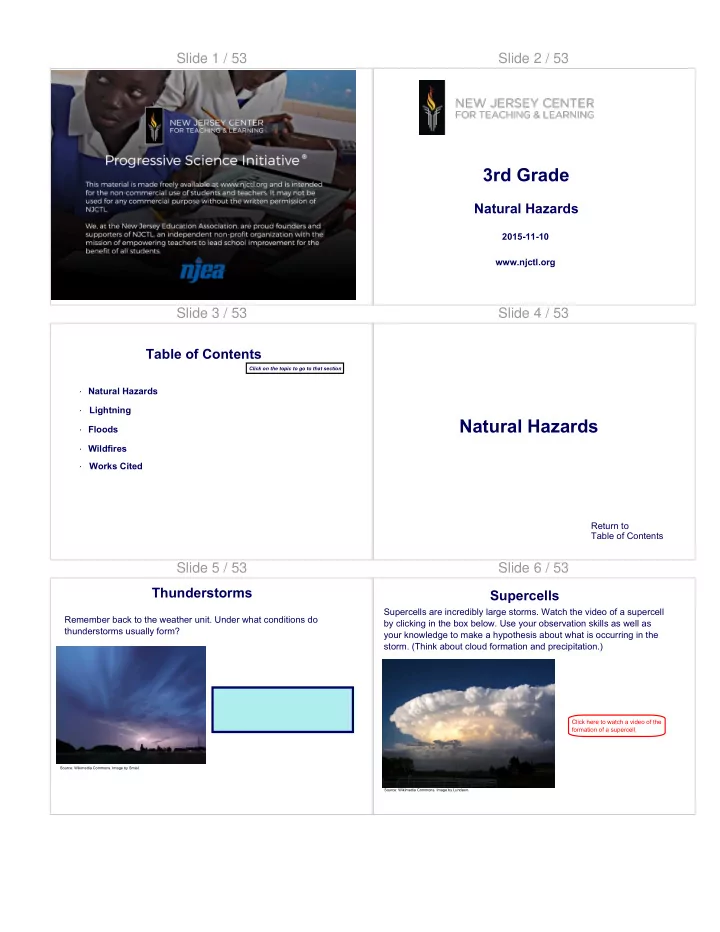
3rd Grade Natural Hazards 2015-11-10 www.njctl.org Slide 3 / 53 - - PDF document

3rd grade
SMART_READER_LITE
LIVE PREVIEW

3rd Grade Natural Hazards 2015-11-10 www.njctl.org Slide 3 / 53 - - PDF document

Slide 1 / 53 Slide 2 / 53 3rd Grade Natural Hazards 2015-11-10 www.njctl.org Slide 3 / 53 Slide 4 / 53 Table of Contents Click on the topic to go to that section Natural Hazards Lightning Natural Hazards Floods Wildfires


slide-1
SLIDE 1

Slide 1 / 53 Slide 2 / 53

3rd Grade

Natural Hazards

2015-11-10 www.njctl.org

Slide 3 / 53 Table of Contents

Click on the topic to go to that section

· Natural Hazards · Wildfires · Floods · Lightning · Works Cited

Slide 4 / 53

Natural Hazards

Return to Table of Contents

Slide 5 / 53 Thunderstorms

Remember back to the weather unit. Under what conditions do thunderstorms usually form? Thunderstorms often form during a cold front when cold air quickly approaches warm air.

Source: Wikimedia Commons. Image by Smial.

Slide 6 / 53 Supercells

Supercells are incredibly large storms. Watch the video of a supercell by clicking in the box below. Use your observation skills as well as your knowledge to make a hypothesis about what is occurring in the

  • storm. (Think about cloud formation and precipitation.)

Source: Wikimedia Commons. Image by Lundeen.

Click here to watch a video of the formation of a supercell.

slide-2
SLIDE 2

Slide 7 / 53 Supercells

Supercells can form when cold, dry air meets warm, humid air. Remember that warm air always rises above cold air. When the two types of air masses collide, the cold air creates strong downdrafts while the warm air creates strong updrafts. Watch the beginning of the video again. Can you see air being pulled upwards?

Source: Wikimedia Commons. Image by Kelvinsong.

Slide 8 / 53 Supercells

Supercells are capable of creating incredibly high winds, hail and the strongest tornados. They create damage to homes and landscapes and can injure animals and humans. Think back about how supercells are

  • formed. Is there any way that humans

can prevent the formation of supercells?

Source: Wikimedia Commons.

Slide 9 / 53 Supercells

Supercells arise out of natural processes. There is no way that humans can prevent supercells from occurring. However, by studying them, we can come up with ideas that will minimize the damage they do. Do you have any ideas about how we can prevent the damage of supercells? Write your ideas below.

Slide 9 (Answer) / 53 Supercells

Supercells arise out of natural processes. There is no way that humans can prevent supercells from occurring. However, by studying them, we can come up with ideas that will minimize the damage they do. Do you have any ideas about how we can prevent the damage of supercells? Write your ideas below.

[This object is a pull tab]

Answer Possible ideas: · Build houses/buildings to be more wind resistant. · Learn how to predict supercells so that people can evacuate an area.

Slide 10 / 53 Natural Hazards

A supercell is a type of natural hazard. A natural hazard is an extreme event that occurs from natural processes. Can you think of any other examples of natural hazards? Write your examples below.

Slide 10 (Answer) / 53 Natural Hazards

A supercell is a type of natural hazard. A natural hazard is an extreme event that occurs from natural processes. Can you think of any other examples of natural hazards? Write your examples below.

[This object is a pull tab]

Answer Examples: · tornadoes · earthquakes · volcanoes · hurricanes · ice storms · avalanche · flash floods

slide-3
SLIDE 3

Slide 11 / 53 Natural Hazards

Source: Wikimedia Commons. Image by Averette.

There are many different types of natural hazards. In this unit, we will focus on lightning, floods and wildfires.

Source: Wikimedia Commons. Image by Smial. Source: Wikimedia Commons. Image by Farmartin.

Slide 12 / 53

1 Natural hazards: A are caused by humans. B are completely unpredictable. C are caused by natural processes. D only occur where air masses collide.

Slide 12 (Answer) / 53

1 Natural hazards: A are caused by humans. B are completely unpredictable. C are caused by natural processes. D only occur where air masses collide.

[This object is a pull tab]

Answer

C

Slide 13 / 53

2 Humans can eliminate natural hazards. True False

Slide 13 (Answer) / 53

2 Humans can eliminate natural hazards. True False

[This object is a pull tab]

Answer

False Humans cannot eliminate natural hazards but can take steps to reduce their impact.

Slide 14 / 53

Lightning

Return to Table of Contents

slide-4
SLIDE 4

Slide 15 / 53 Making Lightning Activity

Investigate how lightning occurs in this activity.

Source: Wikimedia Commons. Image by Clark.

Slide 16 / 53 Lightning

Lightning is an electrical charge. During a storm, particles in the clouds are constantly rubbing together. This creates a charge. These charges are able to connect to other charges. When this happens, it creates a spark of electricity. We see this as lightning. Lightning can occur within the same cloud, between different clouds or from a cloud down to the ground.

Source: Wikimedia Commons. Image by Fir0002. Source: Wikimedia Commons. Image by Griffinstorm.

Cloud to cloud lightning Cloud to ground lightning

Click here to view a map of where lightning is currently striking in the United States.

Slide 17 / 53 Lightning

Lightning is a serious natural hazard. Thousands of people are killed worldwide every year by lightning strikes. People who survive strikes

  • ften have symptoms that last for the rest of their lives!

Click in the red box to watch a video about lightning. As you watch, write down three interesting facts about lightning. Be ready to share your answers! Fact #1 Fact #2 Fact #3

Click here to watch a video about lightning.

Slide 18 / 53 Lightning

Suppose there is a thunderstorm outside your window. Where do you think lightning will most likely strike: A, B or C? A B C

Slide 19 / 53 Lightning

Lightning occurs between different charges. It will happen in the shortest distance possible. The lightning in this thunderstorm will hit the tallest item on the ground. A B C

Slide 20 / 53 Dangers of Lightning

Lightning is an unpredictable natural hazard and is dangerous for many reasons. · Can cause injury or death. · Can cause fires. · Can cause power surges that destroy electronic equipment.

Source: Wikimedia Commons. Image by Bresson.

slide-5
SLIDE 5

Slide 21 / 53 Lightning Rods

Lightning is not something that can be prevented by humans. However, we can try to minimize the damage done by lightning. A lightning rod is composed of three parts: a metal rod, a wire and a ground rod. Look at the image below. Use your knowledge to predict how a lightning rod can minimize damage from lightning.

Source: Wikimedia Commons. Image by Wdchk.

Slide 22 / 53 Lightning Rods

Source: Wikimedia Commons. Image by Wdchk.

Since the metal rod sticks up above the roof of the building, lightning will strike the rod instead of the building. The electricity from the lightning will travel down the wire instead of traveling through the building. The electricity will be dispersed underground by the ground rod. Click in each box to see how each component works.

Slide 23 / 53

3 Lightning occurs between: A positive charges. B negative charges. C positive and negative charges.

Slide 23 (Answer) / 53

3 Lightning occurs between: A positive charges. B negative charges. C positive and negative charges.

[This object is a pull tab]

Answer

C

Slide 24 / 53

4 Will Iightning hit the shortest item on the ground? Yes No

Slide 24 (Answer) / 53

4 Will Iightning hit the shortest item on the ground? Yes No

[This object is a pull tab]

Answer

No Lightning will most likely hit the tallest item on the ground.

slide-6
SLIDE 6

Slide 25 / 53

5 What do lightning rods do? A They conduct lightning into the ground instead of through a building. B They reflect lightning back up into a storm. C Create a warning system so that people know to evacuate. D They repel lightning away from a building.

Slide 25 (Answer) / 53

5 What do lightning rods do? A They conduct lightning into the ground instead of through a building. B They reflect lightning back up into a storm. C Create a warning system so that people know to evacuate. D They repel lightning away from a building.

[This object is a pull tab]

Answer

A

Slide 26 / 53

6 Lightning would hit a lightning rod instead of a house because lightning most often strikes the tallest structure and the rod extends higher than the house. True False

Slide 26 (Answer) / 53

6 Lightning would hit a lightning rod instead of a house because lightning most often strikes the tallest structure and the rod extends higher than the house. True False

[This object is a pull tab]

Answer

True

Slide 27 / 53

Floods

Return to Table of Contents

Slide 28 / 53 Flooding

Whenever it rains, the ground soaks up the water that falls on it. Sometimes, water falls faster than the ground is able to absorb it. When this happens, water builds up and flooding occurs.

Source: Wikimedia Commons. Image by Bidgee.

slide-7
SLIDE 7

Slide 29 / 53 Flooding

Floods can occur for many different reasons. How many can you think of? After you brainstorm with a partner, click below to see some examples.

Snow melt in the spring Excessive rainfall A levee or dam breaks Excessive wind blows water onto land

Source: Wikimedia Commons. Image by Oikos-team. Source: Wikimedia Commons. Image by Dawg. Source: Wikimedia Commons. Image by Infrogmation. Source: Wikimedia Commons. Image by Lefterov.

Slide 30 / 53 Floods

Flood waters can be incredibly destructive. They can move bridges, houses, trees and cars. In the United States, floods kill about 140 people a year and cause about $6 million in damage.

Source: Wikimedia Commons. Image by Averette.

Click here to see footage of rushing water due to heavy rainfall.

Slide 31 / 53 Floods

Floods are a natural hazard. This means that humans ___________ stop them from happening but we can _____________ the damage that they cause. (Write in correct terms to complete the statement.) How many different ways can you think of for humans to do this?

Slide 31 (Answer) / 53 Floods

Floods are a natural hazard. This means that humans ___________ stop them from happening but we can _____________ the damage that they cause. (Write in correct terms to complete the statement.) How many different ways can you think of for humans to do this?

[This object is a pull tab]

Answer This means that humans CANNOT stop them from happening but we can MINIMIZE the damage that they cause.

Slide 32 / 53 Levees

A levee is a structure, man-made or natural, that attempts to control

  • flooding. Most levees are constructed to run beside rivers that are

prone to flooding.

Source: Wikimedia Commons. Image by Hathorn. Source: Wikimedia commons. Image by Gatley.

Man-made levee Natural levee Levees have both positive and negative aspects. Can you think of one of each?

Slide 33 / 53 Analyzing Levees Activity

One method that humans use to minimize damage from floods is to build levees. Analyze how levees work as well as their positive and negative aspects in this activity.

Source: Wikimedia Commons. Image by Indolences.

slide-8
SLIDE 8

Slide 34 / 53 Levees Fail

Unfortunately, levees can fail in several ways. Watch the video below to see how this can happen.

Source: Water Education Foundation

Click here to watch a video about different ways that levees can fail.

Slide 35 / 53

7 Flooding occurs when the ground soaks up water faster than it falls. True False

Slide 35 (Answer) / 53

7 Flooding occurs when the ground soaks up water faster than it falls. True False

[This object is a pull tab]

Answer

False Flooding occurs when the ground soaks up water slower than it falls.

Slide 36 / 53

8 Levees are indestructible. True False

Slide 36 (Answer) / 53

8 Levees are indestructible. True False

[This object is a pull tab]

Answer

False Levees can fail in several ways.

Slide 37 / 53

Wildfires

Return to Table of Contents

slide-9
SLIDE 9

Slide 38 / 53 The Fire Triangle Activity

Before we learn about wildfires, let's take a look at fire in general. There are three requirements for a fire to be sustained. This is called the fire triangle. Discover the components of the fire triangle in this activity.

Slide 39 / 53 Wildfires

Wildfires are uncontrolled fires that occur in the wilderness.

Source: Wikimedia Commons. Image by McColgan.

In 2012, there were 1,270 wildfires in the US that destroyed 4,244 structures.

Slide 40 / 53 Wildfires

Wildfires destroy an average of 4-5 million acres in the US every year. Watch the video about wildfires. Can you find the answers to the questions in the video? Click in the boxes to check your answers. What type of fire spreads the fastest? Why are eucalyptus forest fires so intense? Grass fires spread up to 60 mph! Eucalyptus trees burn intensely because they are filled with flammable eucalyptus oil.

Click here to watch footage from different types of wildfires.

Slide 41 / 53 What causes wildfires?

Remember that fire needs three things to ignite: fuel, oxygen and heat. Wilderness areas are rich in oxygen and fuel. What types of heat sources do you think start wildfires? Although humans are responsible for starting many fires, think about wildfires from a natural hazard point of view. What natural processes could start a wildfire? Write your ideas below.

Slide 42 / 53 What causes wildfires?

Source: FAO.org. Image by Palmer.

Heat Drought Lightning A common way for wildfires to start is during drought conditions because dry vegetation burns easily. Heat from the sun raises the

  • temperature. If lightning strikes, this creates the spark necessary to

ignite a fire.

Source: Wikimedia Commons. Image by Griffinstorm. Source: Wikimedia Commons. Image by Ciomas.

Slide 43 / 53 Wildfire Control

Remember that, as a natural hazard, wildfires cannot be prevented. However, there are several way to try to control them. Think about the fire triangle. If any of these fire ingredients are removed, then the fire will extinguish. Can you think of any ways to eliminate the ingredients from a wildfire? Heat Fuel Oxygen

slide-10
SLIDE 10

Slide 44 / 53 Water and Retardant

Firefighters on the ground as well as in aircraft try to cover the flames with water and fire retardant. How can these stop a fire? Click in the boxes to see. Water removes heat from the fire. Fire retardants can remove heat as well. By covering the fire, fire retardants also remove oxygen.

Source: Wikimedia Commons. Image by Kudenko. Source: Wikimedia Commons. Image by Ebdon.

Slide 45 / 53 Firebreaks

A firebreak is an area around a fire that is cleared of all vegetation and debris. This prevents fire from spreading by removing fuel from the fire.

Source: Wikimedia Commons. Image by Pollinator.

This plow is removing vegetation to create a firebreak in a forest in South Carolina.

Slide 46 / 53

9 What does fire need to survive? Select all that apply. A heat B oxygen C moisture D fuel

Slide 46 (Answer) / 53

9 What does fire need to survive? Select all that apply. A heat B oxygen C moisture D fuel

[This object is a pull tab]

Answer

A, B, D

Slide 47 / 53

10 Lightning often provides the spark to start a wildfire. True False

Slide 47 (Answer) / 53

10 Lightning often provides the spark to start a wildfire. True False

[This object is a pull tab]

Answer

True

slide-11
SLIDE 11

Slide 48 / 53

11 Fire retardant stops which part of the fire triangle? Select all that apply. A heat B fuel C oxygen

Slide 48 (Answer) / 53

11 Fire retardant stops which part of the fire triangle? Select all that apply. A heat B fuel C oxygen

[This object is a pull tab]

Answer

A, C

Slide 49 / 53

12 Firebreaks stop which part of the fire triangle? Select all that apply. A heat B fuel C oxygen

Slide 49 (Answer) / 53

12 Firebreaks stop which part of the fire triangle? Select all that apply. A heat B fuel C oxygen

[This object is a pull tab]

Answer

B

Slide 50 / 53 Be Prepared Activity

Predict and prepare for natural hazards in your local community. Click the pictures to go to the RAFT Idea Sheet.

Slide 51 / 53

Works Cited

Return to Table of Contents

slide-12
SLIDE 12

Slide 52 / 53

Averette, Marc 2005, Flood102405.jpg, photograph, viewed 13 February 2015, < http://commons.wikimedia.org/wiki/File:Flood102405.JPG>. Bresson, Thomas 2009, Thomas Bresson – Eclairs-1(by).jpg, photograph, viewed 13 February 2015, < http://commons.wikimedia.org/wiki/File:Thomas_Bresson_-_Eclairs-1_(by).jpg>. Ciomas 2012, El Solsticio.jpeg, photograph, viewed 13 February 2015, < http://commons.wikimedia.org/wiki/File:El_Solsticio.jpeg>. Clark, C. 1978, Cloud-to-ground Lightning2 – NOAA.jpg, photograph, viewed 13 February 2015, < http://commons.wikimedia.org/wiki/File:Cloud-to-ground_lightning2_-_NOAA.jpg>. D’arco, Sebastien 2006, Lightnings Sequence 2 animation.gif, animation, viewed 13 February 2015, < http://commons.wikimedia.org/wiki/File:Lightnings_sequence_2_animation.gif>. Dawg, Zink 2010, Snow on the Mountains of Southern California.jpg, photograph, viewed 13 February 2015, < http://commons.wikimedia.org/wiki/File:Snow_on_the_mountains_of_Southern_California.jpg>. Ebdon 2008, Tora Fire Break 08.jpg, photograph, viewed 13 February 2015, < http://commons.wikimedia.org/wiki/File:Tora_Fire_Break_08.JPG>. Farmartin 2011, 2011-08-04 20 00 00 Susie Fire in the Adobe Range west of Elko, Nevada.jpg, photograph, viewed 13 February 2015, < http://commons.wikimedia.org/wiki/File:2011-08-04_20_00_00_Susie_Fire_in_the_Adobe_Range_west_of_Elko,_Nevada.jpg>. Fir0002 2008, Cloud to cloud lightning strike nov08.jpg, photograph, viewed 13 February 2015, < http://commons.wikimedia.org/wiki/File:Cloud_to_cloud_lightning_strike_nov08.jpg>. Gatley, Dave 1998, FEMA – 1323 – Photograph by Dave Gatley taken on 02-26-1998 in California.jpg, photograph, viewed 16 February 2015, <http://commons.wikimedia.org/wiki/File:FEMA_-_1323_-_Photograph_by_Dave_Gatley_taken_on_02-26-1998_in_California.jpg>. Griffinstorm 2013, Stacotto Lightning.jpg, photograph, viewed 13 February 2015, < http://en.wikipedia.org/wiki/File:Staccoto_Lightning.jpg>. Bidgee 2008, Rapid Creek Flooding 1.jpg, photograph, viewed 13 February 2015, < http://commons.wikimedia.org/wiki/File:Rapid_Creek_flooding_1.jpg>.

Slide 53 / 53

Hathorn, Billy 2010, Arkansas River in downtown Pueblo, CO IMG5116.jpg, photograph, viewed 16 February 2015, <http://commons.wikimedia.org/wiki/File:Arkansas_River_in_downtown_Pueblo,_CO_IMG_5116.JPG>. Indolences 2007, Sacramento River Levee.jpg, photograph, viewed 13 February 2015, < http://commons.wikimedia.org/wiki/File:Sacramento_River_Levee.jpg>. Infrogmation 2005, GretnaLevee.jpg, photograph, viewed on 13 February 2015, < http://commons.wikimedia.org/wiki/File:GretnaLevee.jpg>. Kelvinsong 2013, Supercell.svg, diagram, viewed 13 February 2015, < http://commons.wikimedia.org/wiki/File:Supercell.svg>. Kudenko, Alexey 2010, RIAN archive 733844 Forest Fires Ravaging near Novovoronezh Nuclear Power Plant.jpg, photograph, viewed 13 February 2015, < http://commons.wikimedia.org/wiki/File:RIAN_archive_733844_Forest_fires_ravaging_near_Novovoronezh_Nuclear_Power_Plant.jpg>. Lefterov, Edal Anton 2011, Rain-on-Thassos.jpg, photograph, viewed 13 February 2015, < http://commons.wikimedia.org/wiki/File:Rain-on-Thassos.jpg>. Water Education Foundation 2014, Levee Break, photograph, viewed 16 February 2015, <http://www.watereducation.org/sites/main/files/file-attachments/2008/01/levee-break-_2-pfs.jpg>. Lundeen, Greg 2004 , Chaparral Supercell2.jpg, photograph, viewed 13 February 2015, <http://commons.wikimedia.org/wiki/File:Chaparral_Supercell_2.JPG>. McColgan, John 2000, Deerfire high res edit.jpg, photograph, viewed 13 February 2015, < http://commons.wikimedia.org/wiki/File:Deerfire_high_res_edit.jpg>. Oikos-team 2007, Seawallventnor.jpg, photograph, viewed 13 February 2015, < http://commons.wikimedia.org/wiki/File:Seawallventnor.jpg>. Palmer, A.R., n.d., The Bedford Dry Grassland Unit, photograph, viewed 13 February 2015, < http://www.fao.org/docrep/008/y8344e/y8344e08.htm>. Pollinator 2004, Fireplow0179.jpg, photograph, viewed 13 February 2015, < http://commons.wikimedia.org/wiki/File:Fireplow0179.JPG>. Shelfcloud.jpg, 2013, n.a., photograph, viewed 13 February 2015, < http://commons.wikimedia.org/wiki/File:Shelfcloud.jpg>. Smial 2009, Blitze IMGP6376wp.jpg, photograph, viewed 13 February 2015, <http://commons.wikimedia.org/wiki/File:Blitze_IMGP6376_wp.jpg>. Wdchk 2011, Lightning-rod-diagram.svg, diagram, viewed 13 February 2015, < http://commons.wikimedia.org/wiki/File:Lightning-rod-diagram.svg>.