Summary Status Report on LBNO Francesca Di Lodovico 4 th October - - PowerPoint PPT Presentation

summary status report on lbno
SMART_READER_LITE
LIVE PREVIEW

Summary Status Report on LBNO Francesca Di Lodovico 4 th October - - PowerPoint PPT Presentation

Summary Status Report on LBNO Francesca Di Lodovico 4 th October 2012 NNN12 Next Generation Nucleon Decay and Neutrino Detectors Fermilab, Batavia Summary Outline Introduction to LAGUNA-LBNO Requirements Beam from CERN Near detector,


slide-1
SLIDE 1

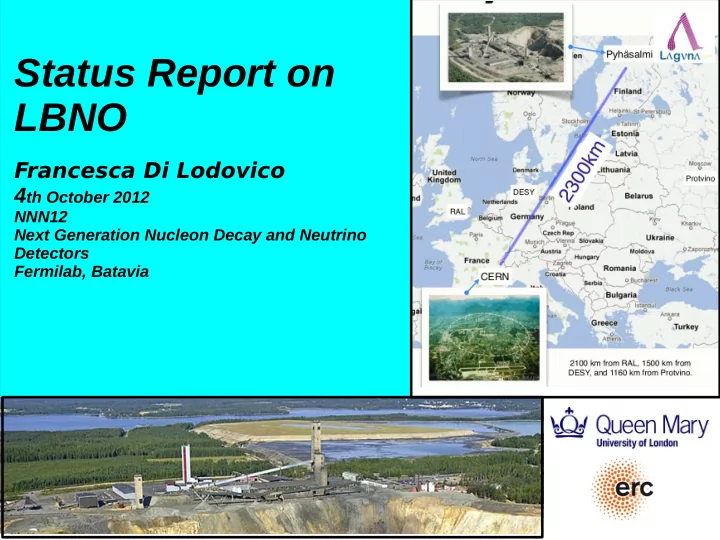
Summary Status Report on LBNO

Francesca Di Lodovico 4th October 2012

NNN12 Next Generation Nucleon Decay and Neutrino Detectors Fermilab, Batavia
slide-2
SLIDE 2

2

Summary Outline

Introduction to LAGUNA-LBNO Requirements Beam from CERN Near detector, hadron production The far site: Pyhäsalmi The far detector(s) Timeline Conclusions

slide-3
SLIDE 3

3

Summary Introduction to LAGUNA

Wide coverage of all aspects of geological, environmental, engineering

  • etc. issues

Strong links with industrial partners Study of 3 technologies (Water Cherenkov (WC), liquid argon (LAr), liquid scintillator (LSc)) LAGUNA outcomes and physics allowed good consensus in down- selecting among (7×3 + combinations) options Large Apparatus for Grand Unification and Neutrino Astrophysics (EC FP7 Design Study) LAGUNA (2008-2011) successfully concluded ~100 members; 10 Countries 1500 pages report Full studies for 7 sites, different baselines (130 →2300 km)

slide-4
SLIDE 4

4

Summary Introduction to LAGUNA-LBNO

LAGUNA‐LBNO (Long Baseline Neutrino Oscillations): EC FP7- funded consortium 2011 – 2014 ~300 Members; 14 countries Prioritizing the LBL neutrino oscillation had an influence on the site down-selection and detector technology prioritisation. New focus items: neutrino LBL, incremental approach Proton decay, cosmic neutrinos programme as before As a consequence for LAGUNA: 1st priority: LAr, LSc at the longest baseline (2300km @ Pyhäsalmi), high energy wide band beam (neutrinos >1 GeV) 2nd priority: WCD at the shortest long baseline (130km @ LSM Frejus), low energy beam (neutrinos < 1 GeV) Re-optimize LBL strategy in view of T2K/Daya Bay and other recent results and averages on θ13

slide-5
SLIDE 5

5

Summary LAGUNA-LBNO consortium

Switzerland University Bern University Geneva ETH-Zürich (coordinator) Lombardi Enginnering* Finland University Jyväskylä University Helsinky University Oulu Rockplan Oy Ltd* France CEA CNRS-IN2P3 Sofregaz* Germany TU Munich University Hamburg Max-Planck- Gesellschaft Aachen University Tubingen Poland IFJ PAN IPJ University Silesia Wroklaw UT KGHM CUPRUM* Greece Demokritos CERN Spain LSC UA Madrid CSIC/IFIC ACCIONA* United Kingdom Imperial College Durham Oxford QMUL Liverpool Sheffield Sussex RAL Warwick Technodyne Ltd* Alan Auld Ltd* Ryhal Engineering* Romania IFIN-HN Univ.e Bucharest Japan KEK Russia INR PNPI Italy AGT* Denmark Aahrus

(*industrial partners)

14 Countries, 47 Institutions, ~300 members

slide-6
SLIDE 6

6

Summary LAGUNA-LBNO Main Physics Goals

Long baseline neutrino oscillations: Appearance νµ → νe, νµ→ ντ and disappearance νµ→νµ, neutral currents Separately for ν and ν Measure 1st and 2nd oscillation maxima → break params degeneracy Direct observation of the energy dependence of the oscillation probabilities induced by matter effects and CP-phase terms, for ν and ν Direct determination of neutrino mass hierarchy (MH) and leptonic CPV Break parameter degeneracy between MH and CP phase (Eν coverage and large L) Nucleon decay searches - unique probe for BSM up to the GUT Atmospheric neutrino detection Oscillation measurements and Earth spectroscopy Astrophysical neutrino detection Galactic supernova burst Search for unknown sources of neutrinos (e.g. DM annihilation) First very long baseline experiments, towards the neutrino factory (NF) Optimized distance of 2300km is also optimal for NF and large θ13

slide-7
SLIDE 7

7

Summary The LBNO Experimental Requirements

Beam Fully exploit long baseline neutrino pattern Perform L/E analysis over large energy range (1st and 2nd maxima) Wide Band Beam (WBB) Eν

2nd max ≥ 0.5 GeV ⇒ L ≥ 1000 Km

Detector Better signal efficiency and background rejection with a comparable mass 20kton fine sampling tracking device and magnetized muon detector

ρ = traversed matter density in the constant density approximation. Laguna-LBNO EoI

slide-8
SLIDE 8

8

Summary CERN-Pyhäsalmi: spectral info νµ → νe

Laguna-LBNO EoI

slide-9
SLIDE 9

9

Summary CERN-Pyhäsalmi: spectral info νµ → νe

→ very clear signature for MH !

Laguna-LBNO EoI

slide-10
SLIDE 10

10

Summary Neutrino Beam Requirements

Requirements: Medium energy to cover at Eν≈3 GeV (1st maximum) Horn focussed, wide band to cover 1st and 2nd maximum Small tail at high energy Positive and negative focus (ν and ν beams) High beam power (starting at 700 kW) Point to Pyhäsalmi (10 deg dip angle, distance 2300 km) Muon monitors Near neutrino detector Submitted to CERN an Expression of Interest (EoI) for a very long baseline neutrino oscillation experiment (~230 authors, 51 institutes) to engage in a collaborative effort to prepare a full engineering design of the CN2PY beam. Assumptions in the EoI and plots in this talk: (0.8-1.3)×1020POT/year depending on the "sharing" with other fixed target programmes (compared to CNGS 4.5×10¹⁹POT/year)

http://cdsweb.cern.ch/record/1457543

slide-11
SLIDE 11

11

Summary CERN ν-beam to Pyhäsalmi: CN2PY

CN2PY beam: Phase 1: use the proton beam extracted beam from SPS

  • 400 GeV, max 7.0×10¹³ protons every 6 sec, ≈770 kW nominal beam

power, 10 μs pulse Phase 2: use the proton beam from the new HP-PS

  • 50(30) GeV, 1.33 Hz, 1.9×10¹⁴ ppp, 2 MW nominal beam power, 4 μs

pulse Requirements – layout: Use the same secondary beam elements for both beams

  • sufficient shielding to contain the produced radiation

– including muons, water and soil activation

  • target and focusing elements (horns) with similar parameters

– same layout or allow variations already from the design phase – don’t have to be identical since anyhow are to be exchangeable

Use the same beam decay volume, dump and near detector

  • deposited energy in target, shielding and dump would be × 2.7 higher

for the Phase-II beam

slide-12
SLIDE 12

12

Summary CERN ν-beam to Pyhäsalmi: CN2PY

CN2PY initial beam parameters:

  • 400 GeV protons from SPS
  • SPS Extraction:
  • Fast extraction preferred,
  • Fast-slow option (~ms) also

acceptable

  • Possibilities:
  • Use existing fast extraction for

LHC - TI2 beam line in LSS6

  • Use existing slow extraction

for North Area in LSS2

  • Survey info:
  • CERN (TCC2 target station -NA)

46°15'26.27"N, 6° 3'8.19"E

  • Inmet Mine (Finland):

63°39'30.92"N, 26° 2'47.65"E

  • distance: 2296 km
  • dip angle : 10.4 deg, 181 mrad

CN2PY layout consideration:

  • Design guidelines from our experience in

CNGS and other ν-beam lines (T2K, NuMI)

  • Several issues being investigated, e.g.:
  • Depth and slope of the installations
  • Proton beam
  • Targe station requirements, etc.
slide-13
SLIDE 13

13

Summary Near Detector and Hadron Production

Aim: systematic errors for signal and backgrounds in the far detectors below ±5%, possibly at the level of ±2% → control of fluxes, cross-sections, efficiencies,etc. Design: 10 bar gas argon-mixture surrounded by scintillator bar tracker embedded in an instrumented magnet with field 0.5T. 270 kg argon mass, of which ~100kg fiducial 0.2 event/spill @700kW O(100'000) events/year Hadron-production measurements with thin or replica target are really crucial for precision neutrino experiments (e.g. K2K, T2K, MINOS). CERN NA61 acceptance study for 400 GeV incident protons Precision neutrino cross-section measurements: e.g. MINERVA, T2K- ND280, also nuSTORM (FNAL LoI)

slide-14
SLIDE 14

14

Summary Flux Optimization

Maximize two conditions: (1) event rate at first maximum and (2) ratio of 2nd/1st maximum flux

Work in progress

  • A. Rubbia
slide-15
SLIDE 15

15

Summary The Pyhäsalmi Far Site Location

Pyhäjärvi (Holy Lake), 450 km north

  • f Helsinki and 150 km south of Oulu

Oldest operating metal mine in Finland and deepest in Europe The hard and very old bedrock of Finland provides one of the best locations to dig very large and deep caverns for the LAGUNA detectors. A small cosmic ray experiment (EMMA) is already located in the mine.

slide-16
SLIDE 16

16

Summary The Pyhäsalmi Far Site Location

Chosen as several optimal conditions are satisfied simultaneously: Infrastructure in perfect state b/c of current exploitation of the mine Unique assets available (shafts, services, ventilation, water pumping station, pipes for liquids...) Very little environmental water Could be dedicated to science activities after around 2018 One of the deepest location in Europe (4000 m.w.e.) The distance from CERN (2300 km) offers unique long baseline

  • pportunities. It is 1160km from

Protvino. Lowest reactor neutrino background in Europe.

slide-17
SLIDE 17

17

Summary Neutrino from CERN to Pyhäsalmi

Distance CERN-Pyhäsalmi = 2288 km Deepest point = 103.8 km Abundant geophysical data about crust and upper mantle available Densities = 2.4÷3.4 g/cm3 Remaining uncertainty has small effect

  • n neutrino oscillations (assumed

equivalent to ±4% global change in matter density)

slide-18
SLIDE 18

18

Summary LBNO Layout at Pyhäsalmi

Available space for 2x50 kton LAr + 50 kton LSc 879000 m3 excavation Design to be finalized within LAGUNA- LBNO by 2014

slide-19
SLIDE 19

19

Summary LBNO Tentative Layout

Fiducial mass at least equal to that of SuperK (≈20kton)

Clean neutrino detection in the energy range 0.5<Eν<10 GeV ( multi‐prong events, ➞ not only QE) Fine granularity for clean νμ→νe appearance signal Neutrino energy resolution ΔEν/Eν < 10% to observe L/E Full kinematical reconstruction, e.g. for νμ→ντ 4π acceptance for all tracks and neutrals Charge and momentum determination for muons, to e.g. study νμ/νμ

Liquid argon TPC (GLACIER) complemented by magnetized iron detector (MIND)

slide-20
SLIDE 20

20

20 kton double phase LAr LEM TPC (GLACIER): best detector for electron appearance measurements with excellent energy resolution and small systematic errors Very fine grain tracking-calorimeter Exclusive final states, low energy thresholds Excellent ν energy resolution and reconstruction ability from sub GeV to a few GeV, from single prong to high multiplicity Suitable for spectrum measurement with needed wide energy coverage Excellent π0/electron discrimination Best detector for baselines > 300km

35 kton magnetized Muon Detector (MIND): iron with scintillator slabs (MINOS like). Conventional and well-proven detector for muon CC, and NC

muon momentum & charge determination, inclusive total neutrino energy 3cm Fe plates, 1cm scintillator bars, B=1.5- 2.5 T

Summary Glacier with Magnetized Detector

Design based on extensive experience with smaller scale devices

slide-21
SLIDE 21

21

Summary LAr Detector Prototyping Efforts

slide-22
SLIDE 22

22

Summary Real Cosmic Rays

Cosmic track in double phase 80x40cm2 LAr-LEM TPC with adjustable gain: S/N > 100 for mip.

slide-23
SLIDE 23

23

Summary e-like CC sample (+)

Laguna-LBNO EoI

slide-24
SLIDE 24

24

Summary Neutrino/antineutrinos and MH

Laguna-LBNO EoI

slide-25
SLIDE 25

25

Summary µ-like CC sample (+)

Laguna-LBNO EoI

slide-26
SLIDE 26

26

Summary LBNO sensitivity for MH & CPV

We estimate the significance C.L. with a χ2 method, with which we can 1) exclude the opposite mass hierarchy and 2) exclude δCP = 0 or π (CPV) We minimize χ2 w.r.t to the known 3-flavor oscillations and the nuisance parameters using Gaussian constraints

Conservative Errors

slide-27
SLIDE 27

27

Summary MH and CPV sensitivities

Estimation using systematic errors mentioned previously. Nominal beam power scenarios (700kW) For sin22θ13=0.1, approximately (at 90%C.L.): MH: 100% coverage at >5σ in a few years

  • f running

CPV: ≈60% coverage and evidence for maximal CP (π/2, 3π/2) at 3 ∼ σ in 10y

  • CPV coverage already sensitive to systematic
  • errors. With more details studies and a better

definition of the near detector, hadron production measurements, and other auxiliary measurements, they might be reduced.

  • In case of negative result, the CPV sensitivity can be improved with longer

running periods and/or an increase in beam power and far detector mass. E.g, CPV becomes accessible at > 3σ’s C.L. for 75% of the δCP parameter space with a three-fold increase in exposure, if systematic errors well below the 5% level.

Laguna-LBNO EoI Eν spectrum and PT

miss

Eν spectrum

slide-28
SLIDE 28

28

Summary LENA

LAGUNA/Liquid Scintillator (Low Energy Neutrino Astronomy, LENA)

  • ptimized for Neutrino Detection in the MeV energy range

Extremely rich physics program includes: Supernova Neutrinos, Solar Neutrinos, Geo Neutrinos, Reactor Neutrinos, Neutrino Oscillometry, Indirect Dark Matter Searches, Proton Decay. Significant progress with tracking in the GeV energy range. Work on neutral current background is ongoing.

slide-29
SLIDE 29

29

Summary Milestones - Timescale

LAGUNA Design Study funded for site studies Categorize the sites and down-select Start of LAGUNA-LBNO Submission of LBNO EoI to CERN Pyhäsalmi extended site investigation End of LAGUNA-LBNO DS: technical designs, layouts, liquids handling&storage, safety, ... Critical decision Excavation-construction (incremental) LBL physics start 2008-2011 Sept.2010 2011 2012 2013 2014 2015? 2016-2021? 2023???

slide-30
SLIDE 30

30

Summary Conclusions

LBNO defines a clear upgrade path (long term vision / incremental approach) to fully explore CPV. LBNO, to be located underground at Pyhäsalmi 2300km away from CERN. ➡ all transitions (e/μ/τ) measurable in ν/ν in a single experiment ➡ a fully conclusive mass hierarchy determination ➡ a very good chance to find CPV with the spectral information providing unambiguous oscillation parameters sensitivity. With 10 years at 700kW SPS and 20 kton LAr+MIND (=initial phase), the reach is ≈60% CPV coverage at 90% C.L. ➡ Non LB-oscillation physics can be addressed: >x10 better sensitivity in several nucleon decay channels, detection of several astrophysical sources (SN,...) and fresh new look at atmospheric neutrinos with high granularity and resolution (atm τ appearance, atm MH, ...). All aspects of the experiment being under study and defined. Collaboration is “open” to new interested parties. We have called on CERN, EoI submitted to CERN SPSC, to engage in a collaborative effort with the LBNO Collaboration to prepare a full engineering design of the CN2PY beam

slide-31
SLIDE 31

31

Summary Acknowledgments

FP7 Research Infrastructure “Design Studies” LAGUNA (Grant Agreement

  • No. 212343 FP7-INFRA-2007-1) and LAGUNA-LBNO (Grant Agreement No.

284518 FP7-INFRA-2011-1) We are grateful to the CERN Management for supporting the LAGUNA- LBNO design study. We thank the CERN staff participating in LAGUNA-LBNO, in particular M.Benedikt, M.Calviani, I.Efthymiopoulos, A.Ferrari, R.Garoby, F.Gerigk, B.Goddard, A.Kosmicki, J.Osborne, Y.Papaphilippou, R.Principe, L.Rossi, E.Shaposhnikova and R.Steerenberg. The contributions of Anselmo Cervera are also recognized.

slide-32
SLIDE 32

32

Summary Additional Slides

slide-33
SLIDE 33

33

Summary Neutrino Beam Layout

slide-34
SLIDE 34

34

Summary The Neutrino Focussing

slide-35
SLIDE 35

35

Summary The Pyhäsalmi Far Site Layout

LBNO: GLACIER @ 900m True potential for a facility allowing multiple detectors, incremental or staged approach Allows to build 10-20kt GLACIER before ultimate detector Allows to add magnetized detector or spectrometer Low-E programme ICARUS has demonstrated ability to trigger on 2MeV isolated electrons But LSc still ideal for the task (+ complementarity) LENA @ 1400m, maximum overburden

slide-36
SLIDE 36

36

Summary LAGUNA-LBNO neutrino beamline

CN2PY horn focused neutrino beam towards Pyhäsalmi Starting point is SPS and CNGS operation (achieved 420kW) Design optimized target and horn focusing systems. Afford relatively short decay tunnel ≈300m, but 10deg dip angle Near detector station to achieve target systematic errors Consider dedicated set of hadron-production measurements Benefit from improved performance of SPS+injectors for LHC-HL; consider further options to upgrade power of SPS: SPS intensity is upgraded to 7e13 ppp @ 400 GeV (6 s cycle). Yearly integrated pot = (0.8–1.3)x 1e20 pot / yr Total integrated (12 years) = (1–1.5)x 1e21 pot Range corresponds to sharing 60–85% Studies ongoing within CERN acc. Team Upgrade path (three options): SPS upgrades (800 GeV) → 2 MW New HP-PS accelerator (50 GeV) → 2 MW NF storage ring

slide-37
SLIDE 37

37

Summary Present Status of the Pyhäsalmi Mine

Present: The Pyhäsalmi mine (Inmet Mining Ltd., Canada) Produces Cu, Zn, and FeS2 The deepest mine in Europe Depths down to 1400m (4000m.w.e.) possible The most efficient mine of its size and type Very modern infrastructure lift (of 21.5 tons of ore of 20 people) down to 1400 m takes ~3min via 11Km long decline it takes ~40min (by truck) good communication systems Operation time still 7-8 years with currently known ore reserves (presumably until 2018) Compact mine, small 'foot print' water pumping and other maintenance works not major issues

slide-38
SLIDE 38

38

Summary Glacier Design

Simple, scalable (1→100 ktons) detector design, concept unchanged from 2003 (hep-ph/0402110) Single module non-evacuable cryo-tank based on industrial LNG technology Industrial conceptual design (Technodyne Ltd, AAE, Ryhal engineering, TGE, GTT) Three volumes (20, 50, 100 kton) Liquid filling, purification, and boiloff recondensation Industrial conceptual design for LAr process (Sofregaz), 70kW total cooling power @87K Purity <10 ppt O2 equivalent Single long vertical drift paths with full active mass Double Phase Readout with adjustable gain at top Immersed high voltage multiplier for drift field Immersed light readout system Charge readout (e.g. 20 kton fiducial volume): 23'072 kton active, 824 m2 active area, 844 readout planes, 277'056 channels tot. Light readout: 804 8''PMT WLS- coated below cathode

slide-39
SLIDE 39

39

Summary Scaling Design Parameters

slide-40
SLIDE 40

40

Summary LBNO with T2K and NOvA

The power of combining several different baselines L: LBNO 20kton(5+5)+T2K(5+0)+NOvA(3+3)~40-45% CPV at 3σ C.L Sensitivity combining T2K (295km), NOvA(810km) and LBNO (2300km)

slide-41
SLIDE 41

41

Summary Atmospheric Neutrinos

Neutrino oscillation physics complementary to long baseline beam Clean νe & νµ CC over all range of energies (GeV, MultiGeV) Good neutrino energy and angular reconstruction Recoil hadronic system on an event by event basis Statistical separation of ν and ν by esclusive final states νµ → ντ appearance significance >3σ after 3y exposure (≈12 ντ CC/y)

slide-42
SLIDE 42

42

Summary Proton Decay Sensitivity

Expect ≈linear sensitivity improvement with exposure until 1000 kton/y For an exposure of 10 years (200 kton x year) - JHEP 0704 (2007) 041

slide-43
SLIDE 43

43

Summary Supernova Detection Channels

Unique sensitivity to electron neutrino favour (most other SK- detector detect w/ inverse beta decays Combined analysis of all the reaction modes Neutrino mass via TOF

JCAP 0310 (2003) 009 JCAP 0408 (2004) 008

For a SN explosion at the distance of 5 pcs. Events