36 x 25 Strategies versus recall Understandings mental? Sequence - - PDF document

36 x 25
SMART_READER_LITE
LIVE PREVIEW

36 x 25 Strategies versus recall Understandings mental? Sequence - - PDF document

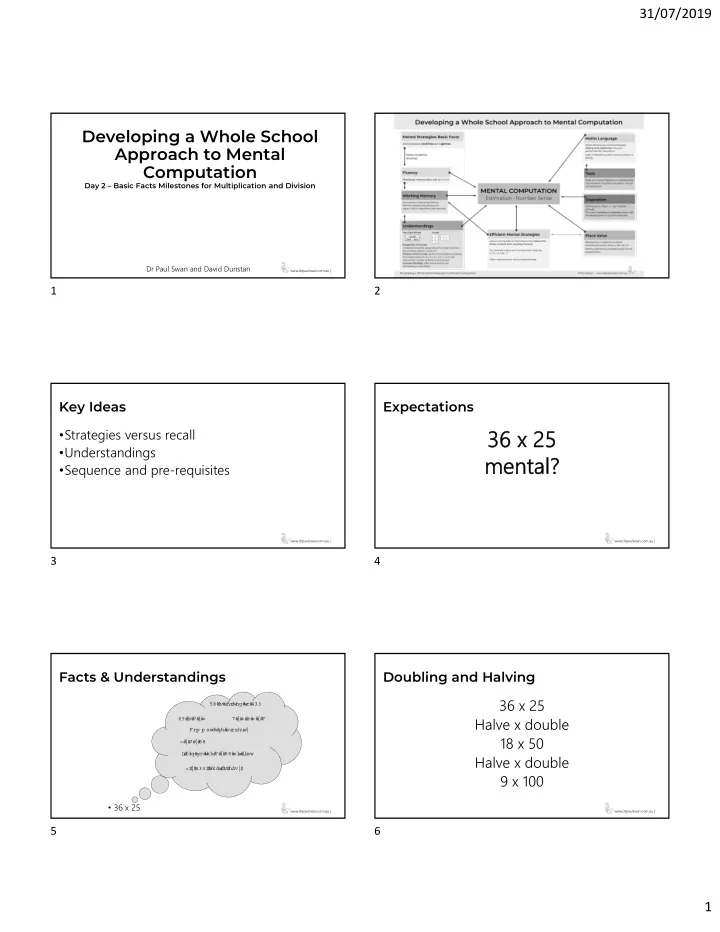
31/07/2019 Developing a Whole School Approach to Mental Computation Day 2 Basic Facts Milestones for Multiplication and Division Dr Paul Swan and David Dunstan www.drpaulswan.com.au | 1 2 Key Ideas Expectations 36 x 25 Strategies


slide-1
SLIDE 1

31/07/2019 1

www.drpaulswan.com.au |

Developing a Whole School Approach to Mental Computation

Day 2 – Basic Facts Milestones for Multiplication and Division Dr Paul Swan and David Dunstan

www.drpaulswan.com.au |

Key Ideas

  • Strategies versus recall
  • Understandings
  • Sequence and pre-requisites

www.drpaulswan.com.au |

Expectations

36 x 25 mental?

www.drpaulswan.com.au |

Facts & Understandings

  • 36 x 25
  • www.drpaulswan.com.au |

Doubling and Halving

36 x 25 Halve x double 18 x 50 Halve x double 9 x 100

1 2 3 4 5 6

slide-2
SLIDE 2

31/07/2019 2

www.drpaulswan.com.au |

Pre - requisites

  • Trigger number (25)
  • Double and halve strategy
  • Number Sense
  • Strategies
  • Bank of facts

www.drpaulswan.com.au |

Factors and properties of number

36 x 25 4 x 9 x 25 (why not 6 x 6 x 25?) 9 x 4 x 25 (property?) 9 x (4 x 25) 9 x 100

www.drpaulswan.com.au |

36 x 25

  • What is going wrong?

www.drpaulswan.com.au |

Multiplication & Division

  • How do you teach
  • How do children learn tables?
  • Teaching vs testing

www.drpaulswan.com.au |

Learning a new set of multiplication facts

  • 18 x table
  • What do we know?
  • 0 x 18 = 18
  • 1 x 18 = 18
  • What strategies can we use to derive more?
  • Doubling
  • 1 x 18 = 18
  • Double
  • 2 x 18 = 36
  • What would 4 x 18 =?
  • What about 8 x 18?

www.drpaulswan.com.au |

Learning the 18 x Table

  • What would 10 x 18 =?
  • Can I work out 5 x 18?
  • What facts have I worked out
  • 1 x 18
  • 2 x 18
  • 4 x 18
  • 5 x 18
  • 8 x 18
  • 10 x 18
  • Can I work out 3 x 18, 6 x 18, 9 x 18
  • What different strategies could I use?
  • Could I become fluent?

7 8 9 10 11 12

slide-3
SLIDE 3

31/07/2019 3

www.drpaulswan.com.au |

Plan - Milestones

  • What are the expectations?
  • When do they need to know

them?

  • How will we know they’ve got

it?

Dr Paul Swan and David Dunstan Developing a Whole School Approach 13 www.drpaulswan.com.au |

AC: Basic facts x ÷ (Year 2)

1. “Lots of”

  • 2. “Groups of”

www.drpaulswan.com.au |

AC: Basic facts x ÷ (Year 2)

  • 3. Array model understanding of multiplication.

Dr Paul Swan and David Dunstan Developing a Whole School Approach 15

4 rows of 3 3 rows of 4

www.drpaulswan.com.au |

AC: Basic facts x ÷ (Year 3)

Yr 3 ACMNA056

  • Recall multiplication facts of two, three,

five and ten and related division facts.

Dr Paul Swan and David Dunstan Developing a Whole School Approach 16 www.drpaulswan.com.au |

Connected Chart

  • Factor Factor Product

x 1 2 3 4 5 6 7 8 9 10 1 1 2 3 4 5 6 7 8 9 10 2 2 4 6 8 10 12 14 16 18 20 3 3 6 9 12 15 18 21 24 27 30 4 4 8 12 16 20 24 28 32 36 40 5 5 10 15 20 25 30 35 40 45 50 6 6 12 18 24 30 36 42 48 54 60 7 7 14 21 28 35 42 49 56 63 70 8 8 16 24 32 40 48 56 64 72 80 9 9 18 27 36 45 54 63 72 81 90 10 10 20 30 40 50 60 70 80 90 100 Factor Factor Product

www.drpaulswan.com.au |

Multiplication property

  • f zero
  • 21 facts 0 x 0, 0 x 1, 0 x 2, 0 x 3, 0 x 4, 0 x 5,

0 x 6, 0 x 7, 0 x 8, 0 x 9 0 x 10 and related facts

x 1 2 3 4 5 6 7 8 9 10 1 1 2 3 4 5 6 7 8 9 10 2 2 4 6 8 10 12 14 16 18 20 3 3 6 9 12 15 18 21 24 27 30 4 4 8 12 16 20 24 28 32 36 40 5 5 10 15 20 25 30 35 40 45 50 6 6 12 18 24 30 36 42 48 54 60 7 7 14 21 28 35 42 49 56 63 70 8 8 16 24 32 40 48 56 64 72 80 9 9 18 27 36 45 54 63 72 81 90 10 10 20 30 40 50 60 70 80 90

100

13 14 15 16 17 18

slide-4
SLIDE 4

31/07/2019 4

www.drpaulswan.com.au |

Grid paper: Arrays

www.drpaulswan.com.au |

Multiplication property of one

19 new facts:

  • 1 x 1,
  • 1 x 2,
  • 1 x 3,
  • 1 x 4,
  • 1 x 5,
  • 1 x 6,
  • 1 x 7,
  • 1 x 8,
  • 1 x 9,
  • 1 x 10
  • and related facts

x 1 2 3 4 5 6 7 8 9 10 1 1 2 3 4 5 6 7 8 9 10 2 2 4 6 8 10 12 14 16 18 20 3 3 6 9 12 15 18 21 24 27 30 4 4 8 12 16 20 24 28 32 36 40 5 5 10 15 20 25 30 35 40 45 50 6 6 12 18 24 30 36 42 48 54 60 7 7 14 21 28 35 42 49 56 63 70 8 8 16 24 32 40 48 56 64 72 80 9 9 18 27 36 45 54 63 72 81 90 10 10 20 30 40 50 60 70 80 90

100 www.drpaulswan.com.au |

Commutative Property

  • f Multiplication
  • Each fact is related, that is 4 x 3 produces

the same result as multiplying 3 x 4

x 1 2 3 4 5 6 7 8 9 10 1 1 2 3 4 5 6 7 8 9 10 2 2 4 6 8 10 12 14 16 18 20 3 3 6 9 12 15 18 21 24 27 30 4 4 8 12 16 20 24 28 32 36 40 5 5 10 15 20 25 30 35 40 45 50 6 6 12 18 24 30 36 42 48 54 60 7 7 14 21 28 35 42 49 56 63 70 8 8 16 24 32 40 48 56 64 72 80 9 9 18 27 36 45 54 63 72 81 90 10 10 20 30 40 50 60 70 80 90

100

4 rows of 3 3 rows of 4

www.drpaulswan.com.au |

x2 Facts

  • Relate to doubles addition facts (Year 2)

Dr Paul Swan and David Dunstan Developing a Whole School Approach 22 www.drpaulswan.com.au |

x5 and x10 facts

Ideal time to introduce:

  • Halving
  • Doubling

Dr Paul Swan and David Dunstan Developing a Whole School Approach 23

x 1 2 3 4 5 6 7 8 9 10 1 1 2 3 4 5 6 7 8 9 10 2 2 4 6 8 10 12 14 16 18 20 3 3 6 9 12 15 18 21 24 27 30 4 4 8 12 16 20 24 28 32 36 40 5 5 10 15 20 25 30 35 40 45 50 6 6 12 18 24 30 36 42 48 54 60 7 7 14 21 28 35 42 49 56 63 70 8 8 16 24 32 40 48 56 64 72 80 9 9 18 27 36 45 54 63 72 81 90 10 10 20 30 40 50 60 70 80 90

100 www.drpaulswan.com.au |

Exposure to Doubling

Five rows of 2 Five rows of 4 Ten rows of 2

19 20 21 22 23 24
slide-5
SLIDE 5

31/07/2019 5

www.drpaulswan.com.au |

x3 Facts

  • Page 40 Tackling Tables

www.drpaulswan.com.au |

Array Game

  • See Tackling tables p. 32 - 33

www.drpaulswan.com.au |

Strategy: Relate to a known fact

  • Implies that students have learned some facts
  • Askew, M. (1998). Teaching primary mathematics: A guide for newly

qualified and student teachers. London: Hodder & Stoughton

KNOWN NUMBER FACTS DERIVE NUMBER FACTS ARE USED TO HELP BUILD MORE Askew, M. (1998). Teaching primary mathematics: A guide for newly qualified and student teachers. London: Hodder & Stoughton.

www.drpaulswan.com.au |

Calculation in NAPLAN

  • www.drpaulswan.com.au |

Start of Yr 4

  • 2 – 4 weeks review of:
  • addition and subtraction facts
  • 2, 3, 5 and 10 facts
  • Assess

www.drpaulswan.com.au |

What to do in Year 4

  • Facts to be learned in Yr 4

Dr Paul Swan and David Dunstan Developing a Whole School Approach 30

x 1 2 3 4 5 6 7 8 9 10 1 1 2 3 4 5 6 7 8 9 10 2 2 4 6 8 10 12 14 16 18 20 3 3 6 9 12 15 18 21 24 27 30 4 4 8 12 16 20 24 28 32 36 40 5 5 10 15 20 25 30 35 40 45 50 6 6 12 18 24 30 36 42 48 54 60 7 7 14 21 28 35 42 49 56 63 70 8 8 16 24 32 40 48 56 64 72 80 9 9 18 27 36 45 54 63 72 81 90 10 10 20 30 40 50 60 70 80 90

100

25 26 27 28 29 30

slide-6
SLIDE 6

31/07/2019 6

www.drpaulswan.com.au |

What number facts Year 4?

  • Recall multiplication facts to 10 x 10 (ACMNA075)
  • Use known multiplication facts to calculate related division facts
  • Develop efficient mental … strategies for x and ÷ (no remainder)

(ACMNA076)

  • Using known facts and strategies such as commutativity, doubling and halving and

connect to division

www.drpaulswan.com.au |

Connection to Division

  • Factor Factor Product Cards

Dr Paul Swan and David Dunstan Developing a Whole School Approach 32 www.drpaulswan.com.au |

Multispin, Spindiv & Race Car Rally 2, 3, 5

www.drpaulswan.com.au |

Division - Sharing (Partition)

  • The number of groups is known
  • The size of each group is found by a process of sharing

Sharing Problem

  • There are 18 bananas in a bunch
  • Three people will share them
  • How many for each person?

www.drpaulswan.com.au |

Quotition (repeated subtraction)

  • The size of each group is known
  • The number of groups is found by a process of repeated subtraction

(quotition) Quotition Problem:

  • There are 18 sunflowers
  • Three flowers are to be placed in each vase
  • How many vases are needed?

www.drpaulswan.com.au |

Recording the operation

  • uses arrays

)

18 divided by 3

3 6

31 32 33 34 35 36

slide-7
SLIDE 7

31/07/2019 7

www.drpaulswan.com.au |

Array for Division

)

3 6

18 divided by 6

www.drpaulswan.com.au |

Language

  • Sharing language eventually

replaced by the more formal language of ‘divided by’

  • ‘goes into’ (gzinta) and ‘how many

… in’ typically link to the repeated subtraction idea of division.

  • Note ÷ symbol and ) symbol read

in different ways. (read left to right, right to left)

www.drpaulswan.com.au |

Thinking about the recording

)

Number sharing Number to be shared Number each gets

www.drpaulswan.com.au |

Introducing remainders

  • Share 17 among 3

)

3 5 r 2

  • 17 shared among 3 is 5 each; 2 remain

www.drpaulswan.com.au |

Division with and without remainders

Dr Paul Swan and David Dunstan Developing a Whole School Approach 41

See Pocket Dice Book B pages 28/29 – “Diviso” See Pocket Dice Book C page 22 – “Diviso Remainders”

www.drpaulswan.com.au |

Division Decision Game

Dr Paul Swan and David Dunstan Developing a Whole School Approach 42

37 38 39 40 41 42

slide-8
SLIDE 8

31/07/2019 8

www.drpaulswan.com.au |

x9 Facts

Pattern

Relate to a known fact:

  • 1 x 9 = 1 x 10 - 1
  • 2 x 9 = 2 x 10 - 2
  • 3 x 9 = 3 x 10 - 3
  • 4 x 9 = 4 x 10 - 4
  • 5 x 9 = 5 x 10 - 5
  • 6 x 9 = 6 x 10 - 6
  • 7 x 9 = 7 x 10 - 7

www.drpaulswan.com.au |

Doubling

Five rows of 2 Five rows of 4 Dice Games for Tables

www.drpaulswan.com.au |

x4 Facts

  • Relate to x2, x4
  • Teach as a cluster

www.drpaulswan.com.au |

x8 Facts

  • Relate to x 2 , x 4
  • Teach as a cluster
  • Includes hardest table fact

Five rows of 2 Five rows of 4 Five rows of 8

www.drpaulswan.com.au |

Known - unknown

  • 7 x 8 hard table to learn
  • 6 x 8 = 48 and one more 8 is 56

6 rows of 8 1 more row of 8

www.drpaulswan.com.au |

Another way

  • 7 x 8 = 56
  • 56 = 7 x 8 (5 6 7 8)

43 44 45 46 47 48

slide-9
SLIDE 9

31/07/2019 9

www.drpaulswan.com.au |

x6 Facts

  • Further Resources

Dr Paul Swan and David Dunstan Developing a Whole School Approach 49 Networking Tables x6 Book Tackling Tables Page 43 Multispin / Spindiv 6 Race Car Rally 6 www.drpaulswan.com.au |

x7 Facts

  • Single fact left to learn: 7 x 7

Dr Paul Swan and David Dunstan Developing a Whole School Approach 50 Networking Tables x6 Book Tackling Tables Page 43 Multispin / Spindiv 6 Race Car Rally 6 www.drpaulswan.com.au |

Doubling and Halving

Yr 5 and 7 NAPLAN, 2008

  • 8 x 3 = 4 x 6

www.drpaulswan.com.au |

Square Numbers

Square numbers form squares. Factor repeated.

Pattern

www.drpaulswan.com.au |

Continued Practise

  • COMBO Cards

www.drpaulswan.com.au |

Link Problem Solving and Fluency with Multo

  • 1 x 1 – 10 x 10
  • Use products only once
  • Download stickers from

www.drpaulswan.com.au

49 50 51 52 53 54

slide-10
SLIDE 10

31/07/2019 10

www.drpaulswan.com.au |

Student 1’s Multo Board

12 5 29 36 28 46 87 50 81 54 14 8 63 10 7 35

  • Idea from Mathematics Assessment for

Learning: Rich Tasks & Work Samples by Clarke et. al. www.drpaulswan.com.au |

Student 2’s Multo Board

1 2 3 4 20 81 90 49 18 25 9 10 32 35 36 28

www.drpaulswan.com.au |

Student 3’s Multo Board

16 9 18 24 5 21 6 30 14 40 72 45 12 10 8 20

www.drpaulswan.com.au |

Multo 1x 1 – 10 x 10 Chances

4 Chances 3 Chances 2 Chances 1 Chance 0 Chances 6 4 2 1 11 8 9 3 25 13 10 16 5 49 17 . 36 7 64 . . . 81 . . . 100 . .

9 4 23 6 58

www.drpaulswan.com.au |

Positioning on the board

  • Where numbers

have been positioned makes a difference.

www.drpaulswan.com.au |

Factors

  • Factor trees
  • 55

56 57 58 59 60

slide-11
SLIDE 11

31/07/2019 11

www.drpaulswan.com.au |

Factors

  • Divide by prime numbers and continue as much as possible
  • 60 ÷ 2 = 30
  • 30 ÷ 2 = 15
  • 15 ÷ 3 = 5 (5 is a prime number)
  • Thus 60 = 2 x 2 x 3 x 5.
  • Knowledge of prime and composite numbers is handy.

www.drpaulswan.com.au |

Divisibility: Ending rules

Multiples of:

  • 2
  • 5 and
  • 10

1 2 3 4 5 6 7 8 9 10 11 12 13 14 15 16 17 18 19 20 21 22 23 24 25 26 27 28 29 30 31 32 33 34 35 36 37 38 39 40 41 42 43 44 45 46 47 48 49 50 51 52 53 54 55 56 57 58 59 60 61 62 63 64 65 66 67 68 69 70 71 72 73 74 75 76 77 78 79 80 81 82 83 84 85 86 87 88 89 90 91 92 93 94 95 96 97 98 99

100

www.drpaulswan.com.au |

Divisibility: Sum of Digits

  • Multiples of:
  • 3 and
  • 9

1 2 3 4 5 6 7 8 9 10 11 12 13 14 15 16 17 18 19 20 21 22 23 24 25 26 27 28 29 30 31 32 33 34 35 36 37 38 39 40 41 42 43 44 45 46 47 48 49 50 51 52 53 54 55 56 57 58 59 60 61 62 63 64 65 66 67 68 69 70 71 72 73 74 75 76 77 78 79 80 81 82 83 84 85 86 87 88 89 90 91 92 93 94 95 96 97 98 99

100

www.drpaulswan.com.au |

Develop Fact Families

Learn one thing, get five things free:

  • 7 x 8 = 56
  • 8 x 7 = 56
  • 56 ÷ 7 = 8
  • 56 ÷ 8 = 7
  • 1/7 of 56 = 8 (yr 6)
  • 1/8 of 56 = 7 (yr 6)
  • Make the links explicit

www.drpaulswan.com.au |

Fractions of

Dr Paul Swan and David Dunstan Developing a Whole School Approach 65 Pocket Dice Book C Page 39 www.drpaulswan.com.au |

Extended Basic Facts

Dr Paul Swan and David Dunstan Developing a Whole School Approach 66

61 62 63 64 65 66

slide-12
SLIDE 12

31/07/2019 12

www.drpaulswan.com.au |

Cut and Count

Partitioning

  • DeNardi, E. (2004). Avanti Mental Maths, p. 45

Partitioning: Multiplication

  • DeNardi, E. (2004). Avanti Mental Maths, p. 136

www.drpaulswan.com.au |

Area model

  • www.drpaulswan.com.au |

Area model (3a + 7)(2a + 5)

  • www.drpaulswan.com.au |

Routine: If I know … then I also know…

10 x 5 = 50 11 x 5 = 9 x 5 = 5 x 5 = 50 ÷ 5 = 10 x 50 = 10 x 0.5 = Explain why you know. Show how each calculation is related.

www.drpaulswan.com.au |

I can also see …

12 x 18 2 x 2 x 3 x 18 12 x 2 x 9 12 x 3 x 6 2 X 6 x 18 3 x 4 x 3 x 6 Are some calculations easier to complete that the original? Explain. 3 x 72 6 x 9 x 2 x 2

www.drpaulswan.com.au |

I can also see… strategies

  • Use of factors
  • Doubling and halving
  • Properties of number
  • Commutativity
  • Associative property of multiplication

67 68 69 70 71 72

slide-13
SLIDE 13

31/07/2019 13

www.drpaulswan.com.au |

Take it Easy

  • If you had one wish and could change one number in the following

question which one would you change and why? 17 x 9 I would change … because

www.drpaulswan.com.au |

Take it Easy

  • Students might choose the ‘relate to a known fact strategy
  • 17 x 10
  • Leads to the opportunity to discuss compensation 17 x 10 - 7
  • Or maybe doubling
  • 18 x 9
  • 2 x 9 x 9
  • 2 x 81 = 162
  • Then discuss compensation need to subtract 9 from 162.

73 74