3) Questionnaire for teachers : a survey which all the participating - - PowerPoint PPT Presentation

3 questionnaire for teachers a survey which all the
SMART_READER_LITE
LIVE PREVIEW

3) Questionnaire for teachers : a survey which all the participating - - PowerPoint PPT Presentation

CASTLE RESEARCH PROBLEM : Can CASTLE activities help in improving cognitive, meta-cognitive and psychomotor skills? OBJECTIVE OF THE RESEARCH : - Check whether the psychomotor activities on giant chess potentiate the psychomotor skills; - Check


slide-1
SLIDE 1

CASTLE RESEARCH PROBLEM: Can CASTLE activities help in improving cognitive, meta-cognitive and psychomotor skills? OBJECTIVE OF THE RESEARCH:

  • Check whether the psychomotor activities on giant chess potentiate the psychomotor skills;
  • Check whether the game of chess powers logical-mathematical ability;
  • Check whether the game of chess enhances the metacognitive skills

ASSUMPTIONS:

  • Chess improves logical-mathematical skills (range 8-11 years)
  • Chess improves metacognitive skills (range 5-11 years)
  • Psychomotor activities on giant chess board improves psychomotor skills of children (range 5-7 years)

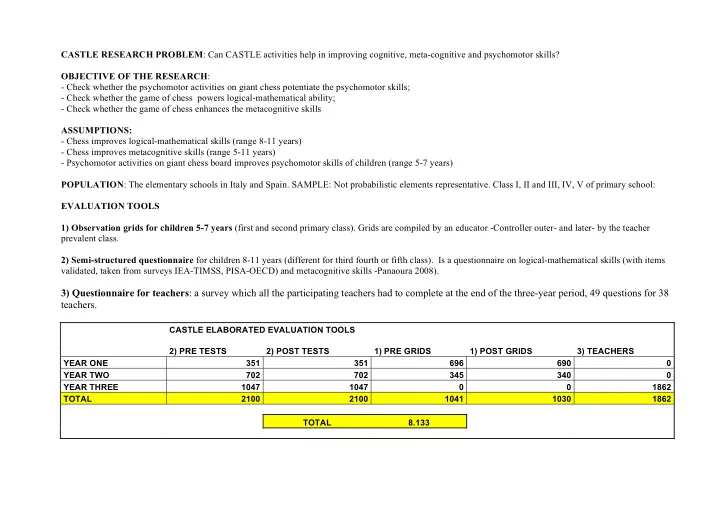
POPULATION: The elementary schools in Italy and Spain. SAMPLE: Not probabilistic elements representative. Class I, II and III, IV, V of primary school: EVALUATION TOOLS 1) Observation grids for children 5-7 years (first and second primary class). Grids are compiled by an educator -Controller outer- and later- by the teacher prevalent class. 2) Semi-structured questionnaire for children 8-11 years (different for third fourth or fifth class). Is a questionnaire on logical-mathematical skills (with items validated, taken from surveys IEA-TIMSS, PISA-OECD) and metacognitive skills -Panaoura 2008).

3) Questionnaire for teachers: a survey which all the participating teachers had to complete at the end of the three-year period, 49 questions for 38 teachers.

CASTLE ELABORATED EVALUATION TOOLS 2) PRE TESTS 2) POST TESTS 1) PRE GRIDS 1) POST GRIDS 3) TEACHERS YEAR ONE 351 351 696 690 YEAR TWO 702 702 345 340 YEAR THREE 1047 1047 1862 TOTAL 2100 2100 1041 1030 1862 TOTAL 8.133

slide-2
SLIDE 2

FASE STRUMENTO CAMPIONE ATTENZIONE LINK PER IL CARICAMENTO ITALIA LINK PER CARICAMENTO PARTNER TEMPO DI SOMMINISTRAZIO NE STIMATO CHI QUANDO OUTPUT DI RICERCA PRE TEST TERZA QUESTIONARIO UNICO MATEMATICA + METACOGNIZION E TERZA PRIMARIA ( 8 ANNI CIRCA) GRUPPO SPERIMENTALE + GRUPPO DI CONTROLLO (CONDIZIONI DI PARTENZA QUANTO PIU’ OMOGENEE POSSIBILI) TUTTI GLI ALUNNI DEVONO ESSERE IN POSSESSO DEL CODICE ALFANUMERICO IL CODICE VERRA’ UTILIZZATO PER TUTTO IL TRIENNIO, PER TUTTE LE ATTIVITA’. Il codice deve essere riportato nei campi appositi degli strumenti di rilevazione (questionari o griglie di osservazione ed è sempre lo stesso) SI VEDA TABELLA CODICI CASTLE . I CODICI NON POSSONO ESSERE MODIFICATI http://www.edurete.org/ c/crichiam.asp?codice =castlemit1415i psw: donnae4 Spagna http://www.edurete.

  • rg/c/crichiam.asp?

codice=castlemes14 15i psw caballoa1 GERMANIA: NON PERVENUTA LA TRADUZIONE DEFINITIVA sono tutte on line su www.edurete.org/c password compilatori:

  • finale scacchi:

alfiered1

  • osservazione pre:

alfiered2

  • osservazione post:

alfierec4

  • diario: alfieree5

1 ORA PIENA (IN CONDIZIONI DI MASSIMA ATTENZIONE E RIGORE) (ES: EVITARE L’ULTIMA ORA DI UN GIOVEDI’ POMERIGGIO) CONTROLLER PRIMA DI AFFRONTARE QUALSIASI ATTIVITA’ FORMATIVA LEGATA AGLI SCACCHI QUESTIONA RI CARICATI ON LINE (NON SI ACCETTAN O CARTACEI) PRE TEST QUARTA QUESTIONARIO UNICO MATEMATICA + METACOGNIZION E CLASSE QUARTA QUARTA PRIMARIA ( 9 ANNI CIRCA) GRUPPO SPERIMENTALE + GRUPPO DI CONTROLLO (CONDIZIONI DI PARTENZA QUANTO PIU’ OMOGENEE POSSIBILI) TUTTI GLI ALUNNI DEVONO ESSERE IN POSSESSO DEL CODICE ALFANUMERICO IL CODICE VERRA’ UTILIZZATO PER TUTTO IL TRIENNIO, PER TUTTE LE ATTIVITA’. Il codice deve essere riportato nei campi appositi degli strumenti di rilevazione (questionari o griglie di

  • sservazione

ed è sempre lo stesso) SI VEDA TABELLA CODICI CASTLE . I CODICI NON POSSONO ESSERE MODIFICATI RISPETTO ALL’ANNO PRECEDENTE

http://www.edurete .org/c/crichiam.as p?codice=castlem at1516i psw cavalloh1

DA INSERIRE spagna 1 ORA PIENA (IN CONDIZIONI DI MASSIMA ATTENZIONE E RIGORE) (ES: EVITARE L’ULTIMA ORA DI UN GIOVEDI’ POMERIGGIO) CONTROLLER PRIMA DI AFFRONTARE QUALSIASI ATTIVITA’ FORMATIVA LEGATA AGLI SCACCHI QUESTIONA RI CARICATI ON LINE (NON SI ACCETTAN O CARTACEI) PRE TEST PRIMA E SECONDA GRIGLIE DI OSSERVAZIONE (SOLO PER BAMBINI DI 6 E 7 ANNI CHE SEGUIRANNO LE ATTIVITA’ DI PSICOMOTRICITA’ PRIMA E SECONDA PRIMARIA (6-7 ANNI CIRCA) GRUPPO SPERIMENTALE + GRUPPO DI Attenzione al codice alfanumerico Dalla prima alla seconda, cambia solo il percorso di stimolo in palestra, la griglia rimane uguale http://www.edurete.org/ c/crichiam.asp?codice =castlegi1415i PSW: gioco Spagna CASTLE – FOR PRE OBSERVACIONES – PRIMERO Y SEGUNDO DE PRIMARIA 10 MINUTI PER BAMBINO OSSERVATORE ESTERNO + INSEGNANTI DI CLASSE PRIMA DI AFFRONTARE QUALSIASI ATTIVITA’ SU SCACCHIERA GIGANTE GRIGLIE DI OSSERVAZI ONE CARICATE ON LINE (NON SI ACCETTAN O

slide-3
SLIDE 3

SU SCACCHIERA GIGANTE CONTROLLO (CONDIZIONI DI PARTENZA QUANTO PIU’ OMOGENEE POSSIBILI) http://www.edurete.

  • rg/c/crichiam.asp?

codice=castleges14 15i Psw: alfilc7 GERMANIA: NON PERVENUTA LA TRADUZIONE DEFINITIVA CARTACEI) SPERIMENT AZIONE SCACCHI DIARIO SUL PROTOCOLLO CASTLE GRUPPO SPERIMENTALE Attenzione al codice alfanumerico http://www.edurete.org/ c/crichiam.asp?codice =castlediai1415 Psw pedoneb4 SPAGNA? MANCA CHIEDERE A SANDRO INSEGNANTI E FORMATORI SCACCHI DURANTE LE ORE DI ATTIVITA’ PREVISTE DAL PROTOCOLLO DARIO DI OSSERVAZI ONE CARICATO ON LINE DAGLI INSEGNANT I NON SI ACCETTAN O CARTACEI O ALTRI FORMAT ( SPERIMENT AZIONE SU SCACCHIER A GIGANTE DIARIO SUL PROTOCOLLO CASTLE GRUPPO SPERIMENTALE Attenzione al codice alfanumerico IDEM COME SOPRA CHIEDERE A SANDRO PSICOMOTRICISTI + INSEGNANTI DURANTE LE ORE DI ATTIVITA’ PREVISTE DAL PROTOCOLLO IDEM COME SOPRA POST TEST TERZE QUESTIONARIO UNICO POST MATEMATICA +METACOGNIZIO NE TERZE GRUPPO SPERIMENTALE + GRUPPO DI CONTROLLO Attenzione al codice alfanumerico http://www.edurete.org/ c/crichiam.asp?codice =castlemit1415f psw: scozzese61 http://www.edurete.

  • rg/c/crichiam.asp?

codice=castlemes14 15f psw indiana88 1 ORA PIENA (IN CONDIZIONI DI MASSIMA ATTENZIONE E RIGORE) (ES: EVITARE L’ULTIMA ORA DI UN GIOVEDI’ POMERIGGIO) CONTROLLER NELLA SETTIMANA SUCCESSIVA LA CHIUSURA DELLE ATTIVITA’ DI SPERIMENTAZI ONE QUESTIONA RI CARICATI ON LINE (NON SI ACCETTAN O CARTACEI) POST TEST QUARTA QUESTIONARIO UNICO POST MATEMATICA +METACOGNIZIO NE QUARTE GRUPPO SPERIMENTALE + GRUPPO DI CONTROLLO Attenzione al codice alfanumerico DA CARICARE il link dopo i pre per evitare pasticci 1 ORA PIENA (IN CONDIZIONI DI MASSIMA ATTENZIONE E RIGORE) (ES: EVITARE L’ULTIMA ORA DI UN GIOVEDI’ POMERIGGIO) CONTROLLER NELLA SETTIMANA SUCCESSIVA LA CHIUSURA DELLE ATTIVITA’ DI SPERIMENTAZI ONE QUESTIONA RI CARICATI ON LINE (NON SI ACCETTAN O CARTACEI)

slide-4
SLIDE 4

POST TEST QUESTIONARIO ABILITA’ SCACCHISTICHE SOLO GRUPPO SPERIMENTALE Attenzione al codice alfanumerico http://www.edurete.org/ c/crichiam.asp?codice =castlesca1415f psw francese45 http://www.edurete.

  • rg/c/crichiam.asp?

codice=castleadj141 5f PSW indiana89 CHIEDERE A SANDRO SANDRO O STAFF SCACCHI NELLA SETTIMANA SUCCESSIVA LA CHIUSURA DELLE ATTIVITA’ DI SPERIMENTAZI ONE QUESTIONA RI CARICATI ON LINE (NON SI ACCETTAN O CARTACEI POST TEST PRIMA E SECONDA GRIGLIE DI OSSERVAZIONE POST (SOLO PER BAMBINI DI 6 E 7 ANNI CHE NON POSSONO COMPILARE IL QUESTIONARIO GRUPPO SPERIMENTALE + GRUPPO DI CONTROLLO Attenzione al codice alfanumerico http://www.edurete.org/ c/crichiam.asp?codice =castlegi1415f psw cavallo http://www.edurete.

  • rg/c/crichiam.asp?

codice=castleges14 15f psw: indiana90 10 MINUTI PER BAMBINO OSSERVATORE ESTERNO + INSEGNANTI NELLA SETTIMANA SUCCESSIVA LA CHIUSURA DELLE ATTIVITA’ DI SPERIMENTAZI ONE GRIGLIE DI OSSERVAZI ONE CARICATE ON LINE (NON SI ACCETTAN O CARTACEI

slide-5
SLIDE 5

CASTLE – FOR PRE-POST OBSERVATION - FIRST AND SECOND CLASS PRIMARY SCHOOL

Code of studend Enter the alphanumeric code of the subject Classroom and School Example: classroom III B in school W. Shakespeare (London) Date Enter the date of observation Observation Pre- activity Post-activity Special remarks

  • n

experimentation es: observation at the gym, or with teacher in the classroom, or in particular circumstances ... (describe it…)

Notes for compilation: The first grid (with green border) should be completed by an outside observer. He, with specific games perfomed in the gym (if possible), observes the children individually and select the presence/absence of certain skills. The second grid (with red border) should be completed by the teacher on the basis of his/her knowledge of the student.

Ability to observe (by observer) Absent (skills not present) Base (skill present if driven) Intermediate (skill present with autonomic response) Advanced (skill present with autonomic response manifested with particular mastery) Observer notes 1. Orient itself in space (delivery of the observer: go left, go right) 1 2 3 2. Moves itself in a coordinated manner (eg: hopping alternating the jump with two feet to one foot, like the “game of the week”) 1 2 3 3. Uses body language to express their moods, emotions and feelings (eg: move like I was very angry, happy, scared, etc.) 1 2 3 4. Performs properly delivery similar to the game on the chessboard (eg: come on in the room diagonally or

  • bliquely)

1 2 3 5. Counts objects or events, with the voice and mentally, in the sense of progressive and regressive and jumps of two, three. (Eg: touch the first, third and sixth in a series

  • f pins or cones or other objects arranged in a row)

1 2 3 6. Uses terms inside / outside correctly to indicate objects in a certain position 1 2 3 7. Runs a simple path that describes (IMPORTANT: do not dictate the individual moves one at a time, but ask you to perform all the way, albeit brief) 1 2 3 8. Provides correct information to another person to perform a simple path (eg: go ahead three pass, then turn right and go forward two steps) 1 2 3 Ability to observe (by teacher) Absent (skills not present) Base (skill present if driven) Intermediate (skill present with autonomic response) Advanced (skill present with autonomic response manifested with particular mastery) Observer notes 1. After the telling of a story can answer comprehension questions 1 2 3 2. Is able to tell a personal or fantastic story respecting the chronological order and / or logical 1 2 3 3. Respects his/her turn to speak or play 1 2 3 4. Puts pertinent questions about what is happening and/or will happen 1 2 3 5. Demonstrates ability to attention during lectures in class. 1 2 3 6. Demonstrates self-control. 1 2 3 7. Demonstrates ability to reflect on situations before making decisions. 1 2 3 8. Demonstrates interest and willingness to learn (raises questions, demonstrates commitment etc ...) 1 2 3 9. Demonstrates the ability to collaborate with others to achieve a goal 1 2 3

  • 10. Finalizes the tasks assigned.

1 2 3
slide-6
SLIDE 6

Castle 2014-2015 - Math and Metacognition INITIAL Test

Castle Team

In the questionnaire you will find some mathematical

  • questions. Try to answer

selecting the right option, without getting help from teachers or classmates. If you do not know the answer, do not worry: Please tick 'I do not know the answer' for that question. Have fun!

  • 1. Write your name in lowercase letters (e.g.

robert):

  • 2. Write the first letter of your surname (initials) in a lowercase letter (e.g.

write w for Washington):

  • 3. Write the color of your choice that you have already written in your

exercise book, in lowercase letters (e.g. yellow):

  • 4. Write the number of your choice between 1 to 99 that you have already

chosen and written in your exercise book (e.g. 24): Now answer the following questions for your information

  • 5. Write the class and section that you are studying in (e.g. 3B):
  • 6. Write the name of your school (e.g. Jean Piaget

School):

  • 7. Write the name of the city where your school is located (e.g.

Birmingham):

  • 8. Are you a boy or a girl?

1 Little Boy 2 Little Girl Pagina 1 di 6 castlemat1415i 16/01/2015 http://www.edurete.org/c/richiama.asp

slide-7
SLIDE 7
  • 9. Write how old you are (e.g. 8):

Below you will find some questions. If you do not know the answer do not worry, you can choose the last option: 'I do not know the answer’ to this question

  • 10. Paint comes in 5 liter cans. Sean needs 37 liters of paint. How many cans

must he buy? 7 5 6 8 9 I do not know the answer

  • 11. On the following figure, there are six dice named with letters (a) to (f).

For all the dice, the following rule applies: Sum of the total points on two

  • pposite faces is always equal to seven. What is the number of points of the

face opposite to the face of the die (d), as shown in the picture? 5 1 2 3 4 I do not know the answer

  • 12. The graph shows the number of blue, red, and black pens the teacher has

in his desk: Pagina 2 di 6 castlemat1415i 16/01/2015 http://www.edurete.org/c/richiama.asp

slide-8
SLIDE 8

How many more red pens are there than black pens? 10 more 6 more 4 more 2 more 8 more I do not know the answer

  • 13. Mary left Apton and rode at the same speed for 2 hours. She reached this

sign: Mary continues to ride at the same speed to Brandon. How many hours will it take her to ride from the sign to Brandon? Two hours One hour and half Three hours Pagina 3 di 6 castlemat1415i 16/01/2015 http://www.edurete.org/c/richiama.asp

slide-9
SLIDE 9

Three hours and half Four hours I do not know the answer

  • 14. The school playground is a square 100 meters long. Ruth walks all the way

around edge of playground. How far does she walk? 10000 meters 400 meters 100 meters 200 meters 800 meters I do not know the answer

  • 15. Ariana found the following patterns to make closed containers. Which

pattern actually makes container shown beside it? None of the above The pattern C The pattern B The pattern A Pagina 4 di 6 castlemat1415i 16/01/2015 http://www.edurete.org/c/richiama.asp

slide-10
SLIDE 10

The pattern D I do not know the answer Now answer the following questions on your way to study

  • 16. I know how well I have understood a subject I have studied

1 Never 2 Seldom 3 Sometimes 4 Often 5 Always

  • 17. My performance depends on my will and my effort

1 Never 2 Seldom 3 Sometimes 4 Often 5 Always

  • 18. I can learn more about a subject on which I have previous knowledge

1 Never 2 Seldom 3 Sometimes 4 Often 5 Always

  • 19. I define specific goals before my attempt to learn something

1 Never 2 Seldom 3 Sometimes 4 Often 5 Always

  • 20. I examine my own performance while I am studying a new subject

1 Never 2 Seldom 3 Sometimes 4 Often 5 Always

  • 21. When I finish my work I wonder whether I have learned new important

things 1 Never 2 Seldom 3 Sometimes 4 Often 5 Always

  • 22. After I finish my work I repeat the most important points in order to be

sure that I have learned them 1 Never 2 Seldom 3 Sometimes 4 Often 5 Always

  • 23. I use different ways to learn something according to the subject

1 Never 2 Seldom 3 Sometimes 4 Often 5 Always

  • 24. I know ways to remember knowledge I have learned in Mathematics

1 Never 2 Seldom 3 Sometimes 4 Often 5 Always

  • 25. I understand a problem better if I write down its data

1 Never 2 Seldom 3 Sometimes 4 Often 5 Always

  • 26. When I try to solve a problem I pose questions to myself in order to

concentrate my attention on it 1 Never 2 Seldom 3 Sometimes 4 Often 5 Always

  • 27. When I encounter a difficulty that confuse me in my attempt to solve a

problem I try to solve it again 1 Never 2 Seldom 3 Sometimes 4 Often 5 Always

  • 28. While I am solving a problem I wonder whether I answer its major question

1 Never 2 Seldom 3 Sometimes 4 Often 5 Always Pagina 5 di 6 castlemat1415i 16/01/2015 http://www.edurete.org/c/richiama.asp

slide-11
SLIDE 11
  • 29. Before I present the final solution of a problem, I try to find some other

solutions as well 1 Never 2 Seldom 3 Sometimes 4 Often 5 Always

  • 30. After I finish my work I know how well I performed on it

1 Never 2 Seldom 3 Sometimes 4 Often 5 Always Now click on the button Invia i dati / Send the data to end the Test: Inserire i dati, avendo cura di completare i campi obbligatori (campi con sfondo giallo), se presenti. Una volta completato, il modulo potrà essere inviato al server. Pagina 6 di 6 castlemat1415i 16/01/2015 http://www.edurete.org/c/richiama.asp

slide-12
SLIDE 12

2014-I-IT02-KA 201-003456 CASTLE PROJECT: REPORT ON TEACHERS’ ASSESSMENT Page

Years of teaching experience: Realised activity in the school: 2015-17: CHESS ON BOARD PSYCHOMOTRICITY CHESS ON BOARD AND PSYCHOMOTRICIY SECTION A Totally 1 Partly 2 Sufficient 3 Insufficient 4

  • 1. Have the activities proposed

been interesting enough for you?

  • 2. Do you feel motivated to repeat

the experience?

  • 3. Have the training activities for

teachers been sufficient?

  • 4. Have the implementation of

teacher training activities been efficient?

  • 5. Would you like to become a

teacher trainer in the future?

  • 6. Have you encountered difficulties

to implement the activities needed?

  • 7. If so, which type of difficulties? Please, describe

…………………………………………………………………………………………………………… …………………………………………………………………………………………………………… ……………………………………………………………………………………………………………

  • 8. Which aspects do you think presented most difficulties, those related to the chess on board or to

psychomotricity? …………………………………………………………………………………………………………… ……………………………………………………………………………………………………………

  • 9. Which were the strongest aspects of the activities proposed for “chess on board”?

…………………………………………………………………………………………………………… …………………………………………………………………………………………………………… ……………………………………………………………………………………………………………

slide-13
SLIDE 13

2014-I-IT02-KA 201-003456 CASTLE PROJECT: REPORT ON TEACHERS’ ASSESSMENT Page

  • 10. Which ones were the strongest aspects of the activities proposed for psychomotricity”?

…………………………………………………………………………………………………………… …………………………………………………………………………………………………………… …………………………………………………………………………………………………………… SECTION B -1 Totally 1 Partly 2 Sufficient 3 Insufficient 4

  • 1. Do you believe that the activity

has deepened your knowledge and skills about the problems encountered when it comes to teaching chess in school?

  • 2. Do you believe that the activity

has fostered a full insight over the skills to develop?

  • 3. Do you believe that the activity

has offered the students adequate information and/or improved the classroom trajectory, so that a personal plan for inclusion could be drawn?

  • 4. Do you believe the activity has

provided students with activities that have made learners become "protagonists" of their own learning and/or "process solving"?

  • 5. Do you believe the activity has

helped to identify the causes of the

  • bstacles found by the students?
  • 6. Do you believe the activity has

fostered the use of technology among teachers and/or helps include innovative teaching strategies?

  • 7. Do you believe that the activity

has deepened your knowledge and skills about the problems encountered when it comes to

slide-14
SLIDE 14

2014-I-IT02-KA 201-003456 CASTLE PROJECT: REPORT ON TEACHERS’ ASSESSMENT Page

teaching chess in school?

  • 8. Do you believe that the activity

has fostered a full insight over the skills to develop?

  • 9. Do you believe that the activity

has offered the students adequate information and/or improved the classroom trajectory, so that a personal plan for inclusion could be drawn?

  • 10. Do you believe the activity has

provided students with activities that have made learners become "protagonists" of their own learning and/or "process solving"?

  • 11. Do you believe the activity has

helped to identify the causes of the

  • bstacles found by the students?
  • 12. Do you believe that he activity

has fostered the use of technology among teachers and/or helps include innovative teaching strategies? Section B2

  • 1. ¿Cree que la actividad ha

mejorado su capacidad de participar de manera productiva en el desarrollo del trabajo en grupo, favorece la creación de grupos de trabajo? 2.¿Cree que la actividad favorece la identificación de elementos innovadores necesarios en el contexto escolar?

slide-15
SLIDE 15

2014-I-IT02-KA 201-003456 CASTLE PROJECT: REPORT ON TEACHERS’ ASSESSMENT Page

  • 3. ¿Cree que la actividad ha

mejorado su disposición a debatir con otros sobre su práctica docente?

  • 4. ¿Cree que ha experimentado

estrategias interesantes para enfrentarse al tema de la inclusión educativa?

  • 5. ¿Se podría pensar que la

actividad ha propiciado mejores

  • portunidades y estrategias de

participación de las familias en la vida escolar? Sección B-3 ¿Cree que sabría transmitir de manera eficaz su práctica docente en estas actividades a otros (compañeros del centro, familias, etc.)?

  • 2. ¿Cree que sabría cómo redactar,

a partir de la reflexión sobre su práctica de las actividades del proyecto CASTLE, informaciones concretas o instrucciones para rediseñar nuevas actividades de enseñanza?

  • 3. ¿Cree que sabría elegir las

situaciones educativas relacionadas con el proyecto CASTLE, que puedan ser útiles en el trabajo conjunto con sus compañeros? Sección C –1 (relativa a las actividades del proyecto con los alumnos) completament e 4 En parte 3 Suficiente 2 insuficiente 1

slide-16
SLIDE 16

2014-I-IT02-KA 201-003456 CASTLE PROJECT: REPORT ON TEACHERS’ ASSESSMENT Page

  • 1. Las actividades educativas están

diseñadas para apoyar el aprendizaje antes que la adquisición de contenidos.

  • 2. Los alumnos, incluso aquellos que

parecen más desmotivados, participan en las actividades educativas propuestas.

  • 3. Los alumnos tienen la
  • portunidad de participar en

actividades en pareja y en grupo, además del trabajo individual.

  • 4. Los alumnos tienen acceso a los

contenidos adaptados a su ritmo de aprendizaje

  • 5. Los alumnos plantean preguntas

entre ellos para ayudarse en el aprendizaje 6.Los alumnos se escuchan los unos a los otros como parte de las actividades

  • 7. Los alumnos con un rendimiento

diferente colaboran entre ellos

  • 8. Los alumnos trabajan con los

docentes para ayudar a sus compañeros a mejorar el aprendizaje

  • 9. La variedad de idiomas de los
slide-17
SLIDE 17

2014-I-IT02-KA 201-003456 CASTLE PROJECT: REPORT ON TEACHERS’ ASSESSMENT Page

alumnos se utiliza para desarrollar las habilidades lingüísticas de todos.

  • 10. Los alumnos están

acostumbrados a compartir sus experiencias en la superación de las dificultades encontradas

  • 11. Los resultados de los alumnos

con necesidades educativas especiales sirven como elementos de análisis para reflexionar sobre los factores que determinan las barreras del aprendizaje 12.Los profesores de apoyo trabajan en conjunto con toda la clase 13.Los profesores de apoyo participan sistemáticamente en el diseño y en la verificación de las actividades de aprendizaje.

  • 14. Todos los alumnos,

independientemente de sus capacidades, participan en las actividades. Seccion C-2

  • 1. ¿Las actividades han ayudado a

mejorar la satisfacción profesional de los profesores?

  • 2. ¿Las actividades realizadas con

los alumnos han ayudado a crear un clima positivo en el aula?

  • 3. ¿Las actividades realizadas con

los alumnos han ayudado a mejorar los procesos de inclusión en su escuela?

slide-18
SLIDE 18

2014-I-IT02-KA 201-003456 CASTLE PROJECT: REPORT ON TEACHERS’ ASSESSMENT Page