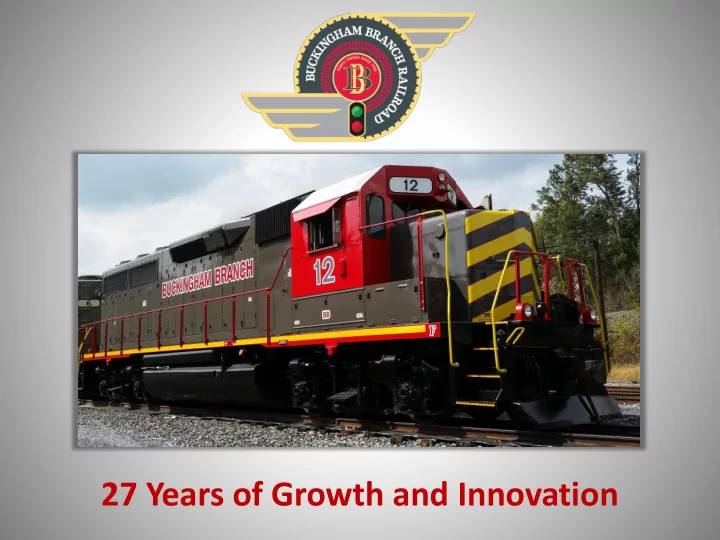
SLIDE 1
27 Years of Growth and Innovation
SLIDE 2 Freight Rail in the Shenandoah Valley
- 1. Short Line - What is a short line railroad and how does it
fit into the national rail system?
- 2. Buckingham Branch - What is the background on the
Buckingham Branch Railroad?
- 3. Regional Impact - What is rail’s impact on the region and
what is the importance of rail to regional economic development?
- 4. Challenges - What challenges does the Buckingham
Branch face in terms of infrastructure, access and other issues?
- 5. Highway Traffic - Can rail make a difference on the I-64
Corridor traffic congestion?
SLIDE 3
What is a short line railroad and how does it fit into the national transportation system?
SLIDE 4 “Short Line” Railroad
- Number - Approximately 600 short line railroads in the US
- Track Miles – Short Lines operate 47,500 miles of track (29% of all
freight track) compared to 95,000 miles for Class 1 RRs
- Small Business – Average 30 employees; operate 79 miles of track
Class 1 Railroads Short Line and Regional Railroads
SLIDE 5 “Short Line” Railroad
- Revenue definition - Annual Operating
Revenue less than $36.6 million
- Connectivity - Connect thousands of
customers to the US main line rail network to offer seamless service for shipping lane
- Rail Preservation - Typically operating on
track that would have otherwise been abandoned by a larger railroad
Short Line Railroad Miles Operated By Type
Self-owned Leased Trackage Rights Government Owned Other
SLIDE 6 Hallmarks of the Short Line Industry
- Customer Focus - flexible and responsive to the unique needs of each
customer
- Enteprenuerial Spirit – success is dependent on aggressively pursuing business,
advocating for customers, and investing in track
- Connecting to Markets – Short Lines are often the only direct link to national
rail network for rural and small town America
- Business Development – Focused regional marketing & sales relationship and
transload offerings
SLIDE 7
What is the background of the Buckingham Branch Railroad?
SLIDE 8 1988 2017
2 Employees 84 17 Miles of Track 275 1 Locomotives 17
1988 BBRR Founded March 6, 1989 Ran First Train 1999, 10 years 7 Employees Dec 21, 2004 R&A Division leased from CSX 2005 56 Employees Spring 2007 BB takes over 24/7 Dispatching & Signals 73 Employees May 2009 VA Southern Division Begins 77 Employees October 2014 25th Anniversary 99 Employees Present 84 Employees
SLIDE 9
SLIDE 10 Charlottesville Staunton
Richmond
Roanoke Port of Hampton Roads Wash, DC, Baltimore & Philadelphia PA, NY, NE Loulsville & St. Louis Atlanta Jacksonville
Waynesboro Clifton Forge Doswell Burkeville
Greensboro
Strathmore Dillwyn Clarksville Gordonsville Orange Lexington
Lynchburg Danville
Ashland
Buckingham Branch RR
Interchange with CSX Interchange with NS Interchange with SVRR
Chase City Keysville Mineral Louisa Goshen Millboro
Virginia
SLIDE 11
- 7 train crews running 30 trains a week
- ≈ 12,500 Carloads/year
- Local - 1000
- NS – 3000
- CSX - 8500
Current Operation
- Approximately 20 CSX Overhead trains each
week.
- 170,000 Empty cars/year
- Amtrak’s “Cardinal” runs both
directions 3 days a week amidst local and CSX Westbound traffic
SLIDE 12
Safety is No 1 and the Buckingham Branch is heavily regulated
SLIDE 13 Training and Management Critical to Regulatory Compliance
Selected Regulatory Agencies -
- FRA
- FCC
- OSHA
- EPA
- FMCSA
- PHMSA
- TSA
- FEMA
- Va SCC
SLIDE 14 Investing In Our People
- Safety and Training Days are held each
quarter for transportation, track, mechanical, and signal departments
- Hands-on and classroom training
- Safety training is held for all staff
including office personnel
SLIDE 15 To remain viable, BB must make significant capital investment each year
- Investment in:
- Primary funding sources are Buckingham
Branch and Virginia Rail Preservation Fund
Track Bridges Signals Highway Crossings Rolling Stock Heavy Equipment Vehicles Maintenance Facilities
SLIDE 16 Investing in our Infrastructure : R&A Division
➢ Tie Replacement
- 140,000 completed, 60,000 to go
- 600 Tons of Ballast per mile
- 1,000 ties per mile
➢ Rail Replacement
- ≈ ½ mile curve patch each year
- 10 mile CWR on Piedmont this
year ➢ Undercutting
- Surface Improvement
- Joint Replacement
- Improved Drainage
➢ New Siding
- More efficient movement of
empty trains ➢ Crossing surface replacements
SLIDE 17
SLIDE 18 Tie and Surface Upgrades
Completed Work Not Yet Completed
SLIDE 19 Investing in our equipment
New Power - GP 38-2’s
SLIDE 20
SLIDE 21
State-of-the Art Buckingham Branch Technology
LED light upgrades at grade crossings for improved reliability and visibility Fiber optic in RoW Tablets for train crews
SLIDE 22
Samsung tablets enable train crews to update car deliveries and pick-ups in real time
SLIDE 23 R&A Wayside Signal Upgrade
- 125 miles
- Replacing existing open pole lines
with new electronic track circuits
- Existing pole line being removed
- 9 phases
- Final Cutover was October 2016
Clifton Forge Goshen Staunton Charlottesville Gordonsville Orange
SLIDE 24 State-of-the-Art Technology
- LED light upgrades at grade crossings for
improved reliability and visibility
reliable or safe
- New signals travel through
the rail
SLIDE 25
What is rail impact on the region?
SLIDE 26
Overall Regional Rail Impact
1. Buckingham Branch freight customers 2. Shenandoah Valley Railroad freight customers 3. Norfolk Southern freight customers (north- south lines through Charlottesville and Waynesboro) 4. Amtrak passenger service from Charlottesville to Staunton (Cardinal Line from DC to Chicago)
SLIDE 27
Selected BB Customers Across I-64
SLIDE 28
Other Selected BB Customers
SLIDE 29
What are challenges for BB?
SLIDE 30
Primary challenges
1. Rail funding - Threat to state Rail Preservation funding 2. Capital investment - Constant BB capital investment requirement – while competing with trucks that use publicly funded highways 3. Lack of viable sites – Jurisdictions not rail oriented – very limited rail-served sites and buildings available between Staunton and Charlottesville 4. US Industrial Economy – Sluggish growth 5. Supply Chain – Just-in-time shipping trend favors speed and inventory reductions vs. lower freight costs
SLIDE 31
Can rail make a difference in corridor traffic congestion?
SLIDE 32
How can rail make a difference
1. Rail served projects – Every rail car takes 3-5 trucks off the highway for new or expanded manufacturing / distribution projects located on rail 2. Transload/Intermodal – Enables companies not located on rail to ship by rail / truck combination 3. Passenger service – Continued support for Amtrak service and future consideration of local passenger service /commuter service
SLIDE 33 Buckingham Branch Transload – Intermodal Service
- 70+% of future, new rail freight business will
come from transload / intermodal
- 3 existing BB transload locations in corridor –
- Staunton (C&O Flats)
- Fishersville (Downtown)
- Keswick (Louisa Road & Hunt Club Road)
SLIDE 34 BB Transload Locations
Potential Transload Sites
Fishersville
Existing Track & Land Land Available
Keswick Clarksville Staunton Orange Doswell Keysvlle Richmond Dillwyn
SLIDE 35
Transload Example - Doswell Trans-load Facility Partner with Houff and ABC Trucking
Customer – Nestle-Purina Freight – Bentonite (Powdered Clay) from Wyoming by rail to Doswell Use – Trucked to Purina’s kitty litter facility in King William