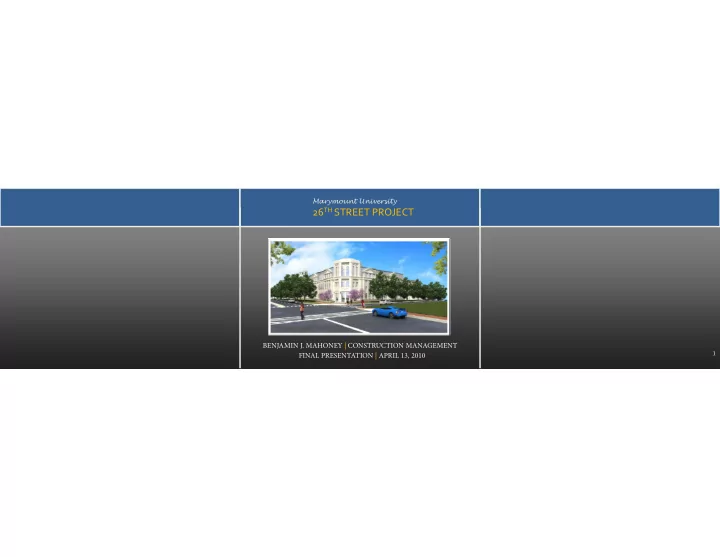
26 TH STREET PROJECT BENJAMIN J. MAHONEY | CONSTRUCTION MANAGEMENT - - PowerPoint PPT Presentation
Marymount University 26 TH STREET PROJECT BENJAMIN J. MAHONEY | CONSTRUCTION MANAGEMENT 1 FINAL PRESENTATION | APRIL 13, 2010 Marymount University 26 TH STREET PROJECT BENJAMIN J. MAHONEY | CONSTRUCTION MANAGEMENT FINAL PRESENTATION | APRIL
Presentation Outline
Marymount University
26TH STREET PROJECT
BENJAMIN J. MAHONEY | CONSTRUCTION MANAGEMENT FINAL PRESENTATION | APRIL 13, 2010
Presentation Outline
I. Project Overview II. Introduction to Analyses III. Analysis I: Short Interval Production Scheduling IV. Analysis II: MEP Coordination V. Analysis III: Green Roof Design
- Structural Breadth
- Mechanical Breadth
VI. Lessons Learned
- VII. Acknowledgements
- VIII. Questions
2
Project Overview Presentation Outline
Marymount University
26TH STREET PROJECT
BENJAMIN J. MAHONEY | CONSTRUCTION MANAGEMENT FINAL PRESENTATION | APRIL 13, 2010
Project Overview
Location 4763 Old Dominion Drive Arlington, VA Owner Marymount University Catholic University
Presentation Outline
I. Project Overview II. Introduction to Analyses
- III. Analysis I: Short Interval Production Scheduling
- IV. Analysis II: MEP Coordination
V. Analysis III: Green Roof Design
Catholic University 3,600 Students. Project Goals Expand Academic Spaces Expand Student Housing Expand Parking Capacity
y g
- Structural Breadth
- Mechanical Breadth
- VI. Lessons Learned
- VII. Acknowledgements
VIII.Questions
3
Project Overview Presentation Outline
Marymount University
26TH STREET PROJECT
BENJAMIN J. MAHONEY | CONSTRUCTION MANAGEMENT FINAL PRESENTATION | APRIL 13, 2010
Project Overview
Occupancy Type Residential, Business, Storage/Garage & Assembly Size 267,000 Square Feet Number of Stories (4) Below Grade Parking (3) Above Grade + Penthouse
Presentation Outline
I. Project Overview II. Introduction to Analyses
- III. Analysis I: Short Interval Production Scheduling
- IV. Analysis II: MEP Coordination
V. Analysis III: Green Roof Design
(4) Below Grade Parking, (3) Above Grade + Penthouse Construction Dates April 2009 – September 2010 Building Cost $42 Million Delivery Method Design‐Bid‐Build w/ CM Agent
y g
- Structural Breadth
- Mechanical Breadth
- VI. Lessons Learned
- VII. Acknowledgements
VIII.Questions
4
Project Overview Presentation Outline
Marymount University
26TH STREET PROJECT
BENJAMIN J. MAHONEY | CONSTRUCTION MANAGEMENT FINAL PRESENTATION | APRIL 13, 2010
Project Overview
Residential Facility 62 Units Housing 239 Students 77,000 Square Feet Academic Facility 52,000 Square Feet Laboratories Classrooms Offices
Presentation Outline
I. Project Overview II. Introduction to Analyses
- III. Analysis I: Short Interval Production Scheduling
- IV. Analysis II: MEP Coordination
V. Analysis III: Green Roof Design
Laboratories, Classrooms, Offices Below Grade Parking Garage 138,000 Square Feet
y g
- Structural Breadth
- Mechanical Breadth
- VI. Lessons Learned
- VII. Acknowledgements
VIII.Questions
5
Project Team Presentation Outline
Marymount University
26TH STREET PROJECT
BENJAMIN J. MAHONEY | CONSTRUCTION MANAGEMENT FINAL PRESENTATION | APRIL 13, 2010
Project Team Presentation Outline
I. Project Overview II. Introduction to Analyses
- III. Analysis I: Short Interval Production Scheduling
- IV. Analysis II: MEP Coordination
V. Analysis III: Green Roof Design
Owner: Marymount University Owner's Representative/CM: Stranix Associates General Contractor: James G. Davis Construction Corp. Architect: Davis, Carter, Scott LTD. Structural Engineer: Structura, Inc. MEP Engineer: GHT Limited PROJECT TEAM
y g
- Structural Breadth
- Mechanical Breadth
- VI. Lessons Learned
- VII. Acknowledgements
VIII.Questions
6
Civil Engineer: VIKA Landscape Architect: Lewis Scully Gionet LEED Consultant: Sustainable Design Consulting Cast‐In Place Concrete Subcontractor: Brothers Concrete Construction, Inc. Pre‐Cast Concrete Subcontractor: Arban & Carosi Mechanical/Plumbing Subcontractor: Tyler Mechanical Contracting, Inc. Electrical Subcontractor: Power Design, Inc.
Presentation Outline
Marymount University
26TH STREET PROJECT
BENJAMIN J. MAHONEY | CONSTRUCTION MANAGEMENT FINAL PRESENTATION | APRIL 13, 2010
Introduction to Analyses Presentation Outline
I. Project Overview II. Introduction to Analyses
- III. Analysis I: Short Interval Production Scheduling
- IV. Analysis II: MEP Coordination
V. Analysis III: Green Roof Design
Introduction to Analyses
Analysis I: Short Interval Production Scheduling Analysis II: MEP Coordination Techniques Analysis III: Green Roof Design y g
- Structural Breadth
- Mechanical Breadth
- VI. Lessons Learned
- VII. Acknowledgements
VIII.Questions
7
Presentation Outline
Marymount University
26TH STREET PROJECT
BENJAMIN J. MAHONEY | CONSTRUCTION MANAGEMENT FINAL PRESENTATION | APRIL 13, 2010
Analysis I: Short Interval Production Scheduling Presentation Outline
I. Project Overview II. Introduction to Analyses
- III. Analysis I: Short Interval Production Scheduling
- IV. Analysis II: MEP Coordination
V. Analysis III: Green Roof Design
Analysis I: Short Interval Production Scheduling
Problem Statement:
The repetitive nature of the activities involved with this phase of the project provides an opportunity to attempt to bring the efficiencies of the “manufacturing process” to the construction industry.
y g
- Structural Breadth
- Mechanical Breadth
- VI. Lessons Learned
- VII. Acknowledgements
VIII.Questions
8
Goal:
This type of work will allow the workforce to maximize their productivity, without sacrificing quality. In turn, this will create a schedule that is more predictable, easier to track, and easier to communicate.
Presentation Outline
Marymount University
26TH STREET PROJECT
BENJAMIN J. MAHONEY | CONSTRUCTION MANAGEMENT FINAL PRESENTATION | APRIL 13, 2010
Current Project Schedule Presentation Outline
I. Project Overview II. Introduction to Analyses
- III. Analysis I: Short Interval Production Scheduling
- IV. Analysis II: MEP Coordination
V. Analysis III: Green Roof Design
Current Project Schedule
February 2010 – September 2010 26 Week Duration Dependent upon the Building Dry Milestone February 19, 2010 Involves all Interior Finish Activities for the Residential Facility
y g
- Structural Breadth
- Mechanical Breadth
- VI. Lessons Learned
- VII. Acknowledgements
VIII.Questions
9
Presentation Outline
Marymount University
26TH STREET PROJECT
BENJAMIN J. MAHONEY | CONSTRUCTION MANAGEMENT FINAL PRESENTATION | APRIL 13, 2010
Current Project Schedule Presentation Outline
I. Project Overview II. Introduction to Analyses
- III. Analysis I: Short Interval Production Scheduling
- IV. Analysis II: MEP Coordination
V. Analysis III: Green Roof Design
Current Project Schedule
February 2010 – September 2010 26 Week Duration Dependent upon the Building Dry Milestone February 19, 2010 Involves all Interior Finish Activities for the Residential Facility
y g
- Structural Breadth
- Mechanical Breadth
- VI. Lessons Learned
- VII. Acknowledgements
VIII.Questions
10
Presentation Outline
Marymount University
26TH STREET PROJECT
BENJAMIN J. MAHONEY | CONSTRUCTION MANAGEMENT FINAL PRESENTATION | APRIL 13, 2010
Development of a SIP Schedule
Level Zones Occupancy G3 5 26 G2 7 36 Building Zones
Presentation Outline
I. Project Overview II. Introduction to Analyses
- III. Analysis I: Short Interval Production Scheduling
- IV. Analysis II: MEP Coordination
V. Analysis III: Green Roof Design
Development of a SIP Schedule
Break the Building down into Zones/Sections 52 Zones, In Total 1 Zone ~ 900 Square Feet
G2 7 36 G1 7 36 L1 9 42 L2 12 53 L3 12 53 Totals 52 246
y g
- Structural Breadth
- Mechanical Breadth
- VI. Lessons Learned
- VII. Acknowledgements
VIII.Questions
11
Presentation Outline
Marymount University
26TH STREET PROJECT
BENJAMIN J. MAHONEY | CONSTRUCTION MANAGEMENT FINAL PRESENTATION | APRIL 13, 2010
Development of a SIP Schedule
Number Color Critical Activity Number Color Critical Activity
Presentation Outline
I. Project Overview II. Introduction to Analyses
- III. Analysis I: Short Interval Production Scheduling
- IV. Analysis II: MEP Coordination
V. Analysis III: Green Roof Design
Development of a SIP Schedule
Break the Building down into Zones/Sections 52 Zones, In Total 1 Zone ~ 900 Square Feet Determine the Sequence of the Critical Path
Number Color Critical Activity 1 Frame Metal Studs 2 Rough‐In MEP 3 Preform In Wall QC 4 Hang/Tape/Finish GWB 5 Prime Walls 6 Point‐Up Drywall 7 Paint Final Coat Number Color Critical Activity 1 Frame Metal Studs 2 Rough‐In MEP 3 Preform In Wall QC 4 Hang/Tape/Finish GWB 5 Prime Walls 6 Point‐Up Drywall 7 Paint Final Coat
y g
- Structural Breadth
- Mechanical Breadth
- VI. Lessons Learned
- VII. Acknowledgements
VIII.Questions
12
8 Install Ceramic Tile 9 Install Plumbing Fixtures 10 Install Millwork & Countertops 11 Install VCT & Carpet 8 Install Ceramic Tile 9 Install Plumbing Fixtures 10 Install Millwork & Countertops 11 Install VCT & Carpet
Presentation Outline
Marymount University
26TH STREET PROJECT
BENJAMIN J. MAHONEY | CONSTRUCTION MANAGEMENT FINAL PRESENTATION | APRIL 13, 2010
Development of a SIP Schedule
Number Color Critical Activity Number Color Critical Activity
Presentation Outline
I. Project Overview II. Introduction to Analyses
- III. Analysis I: Short Interval Production Scheduling
- IV. Analysis II: MEP Coordination
V. Analysis III: Green Roof Design
Development of a SIP Schedule
Break the Building down into Zones/Sections 52 Zones, In Total 1 Zone ~ 900 Square Feet Determine the Sequence of the Critical Path Level Resources to Ensure Consistent Durations
Number Color Critical Activity 1 Frame Metal Studs 2 Rough‐In MEP 3 Preform In Wall QC 4 Hang/Tape/Finish GWB 5 Prime Walls 6 Point‐Up Drywall 7 Paint Final Coat Number Color Critical Activity 1 Frame Metal Studs 2 Rough‐In MEP 3 Preform In Wall QC 4 Hang/Tape/Finish GWB 5 Prime Walls 6 Point‐Up Drywall 7 Paint Final Coat
y g
- Structural Breadth
- Mechanical Breadth
- VI. Lessons Learned
- VII. Acknowledgements
VIII.Questions
13
8 Install Ceramic Tile 9 Install Plumbing Fixtures 10 Install Millwork & Countertops 11 Install VCT & Carpet 8 Install Ceramic Tile 9 Install Plumbing Fixtures 10 Install Millwork & Countertops 11 Install VCT & Carpet
Presentation Outline
Marymount University
26TH STREET PROJECT
BENJAMIN J. MAHONEY | CONSTRUCTION MANAGEMENT FINAL PRESENTATION | APRIL 13, 2010
Development of a SIP Schedule Presentation Outline
I. Project Overview II. Introduction to Analyses
- III. Analysis I: Short Interval Production Scheduling
- IV. Analysis II: MEP Coordination
V. Analysis III: Green Roof Design
Development of a SIP Schedule
Break the Building down into Zones/Sections 52 Zones, In Total 1 Zone ~ 900 Square Feet Determine the Critical Path of the Schedule Level Resources to Ensure Consistent Durations Create the SIPS Schedule
y g
- Structural Breadth
- Mechanical Breadth
- VI. Lessons Learned
- VII. Acknowledgements
VIII.Questions
14
Create the SIPS Schedule
Presentation Outline
Marymount University
26TH STREET PROJECT
BENJAMIN J. MAHONEY | CONSTRUCTION MANAGEMENT FINAL PRESENTATION | APRIL 13, 2010
SIP Schedule Presentation Outline
I. Project Overview II. Introduction to Analyses
- III. Analysis I: Short Interval Production Scheduling
- IV. Analysis II: MEP Coordination
V. Analysis III: Green Roof Design
SIP Schedule
Typical Zone Duration 17 Working Days February 2010 – August 2010 24 Week Duration
y g
- Structural Breadth
- Mechanical Breadth
- VI. Lessons Learned
- VII. Acknowledgements
VIII.Questions
15
Presentation Outline
Marymount University
26TH STREET PROJECT
BENJAMIN J. MAHONEY | CONSTRUCTION MANAGEMENT FINAL PRESENTATION | APRIL 13, 2010
Conclusions & Recommendations Presentation Outline
I. Project Overview II. Introduction to Analyses
- III. Analysis I: Short Interval Production Scheduling
- IV. Analysis II: MEP Coordination
V. Analysis III: Green Roof Design
Conclusions & Recommendations
Activity Shortened by 10 Working Days (8% Reduction) Reduces General Conditions Costs Delays or Stoppages will be Accounted For Potential for Early Project Completion Avoid Liquidated Damages Schedule can be Utilized as Visual Tool
y g
- Structural Breadth
- Mechanical Breadth
- VI. Lessons Learned
- VII. Acknowledgements
VIII.Questions
16
Schedule can be Utilized as Visual Tool Extremely Predictable Easy to Communicate Easy to Track
Presentation Outline
Marymount University
26TH STREET PROJECT
BENJAMIN J. MAHONEY | CONSTRUCTION MANAGEMENT FINAL PRESENTATION | APRIL 13, 2010
Analysis II: MEP Coordination Techniques Presentation Outline
I. Project Overview II. Introduction to Analyses
- III. Analysis I: Short Interval Production Scheduling
- IV. Analysis II: MEP Coordination
V. Analysis III: Green Roof Design
Analysis II: MEP Coordination Techniques
Problem Statement:
The coordination of the MEP Systems have the potential to be extremely problematic. The practice of 3D Coordination has proven itself to be an extremely effective and efficient alternative to 2D Coordination. However, it has yet to become an Industry Standard P ti
y g
- Structural Breadth
- Mechanical Breadth
- VI. Lessons Learned
- VII. Acknowledgements
VIII.Questions
17
Practice.
Goal:
Generate a survey that will help establish motives as to why this practice is not being utilized more frequently within the Organization, and more specifically the Construction Industry
Presentation Outline
Marymount University
26TH STREET PROJECT
BENJAMIN J. MAHONEY | CONSTRUCTION MANAGEMENT FINAL PRESENTATION | APRIL 13, 2010
Current MEP Coordination Method Presentation Outline
I. Project Overview II. Introduction to Analyses
- III. Analysis I: Short Interval Production Scheduling
- IV. Analysis II: MEP Coordination
V. Analysis III: Green Roof Design
Current MEP Coordination Method
Project Team Utilized “Traditional” Coordination 2D Composite Drawings Very Time Consuming Generating Composite Drawings Approval Process Coordination Meetings
y g
- Structural Breadth
- Mechanical Breadth
- VI. Lessons Learned
- VII. Acknowledgements
VIII.Questions
18
Coordination Meetings Multiple Parties Involved Clashes are Inevitable Generate Unnecessary Change Orders Cause Schedule Delays
Presentation Outline
Marymount University
26TH STREET PROJECT
BENJAMIN J. MAHONEY | CONSTRUCTION MANAGEMENT FINAL PRESENTATION | APRIL 13, 2010
3D MEP Coordination Presentation Outline
I. Project Overview II. Introduction to Analyses
- III. Analysis I: Short Interval Production Scheduling
- IV. Analysis II: MEP Coordination
V. Analysis III: Green Roof Design
3D MEP Coordination
Computer Software the Combines 3D Modeling & Clash Detection Numerous Initial and Long‐Term Benefits Initial Benefits Efficient Coordination of an Intricate System Provides a 3D Model that is Easily Visualized
y g
- Structural Breadth
- Mechanical Breadth
- VI. Lessons Learned
- VII. Acknowledgements
VIII.Questions
19
Provides a 3D Model that is Easily Visualized Increased Interaction Between trades
Presentation Outline
Marymount University
26TH STREET PROJECT
BENJAMIN J. MAHONEY | CONSTRUCTION MANAGEMENT FINAL PRESENTATION | APRIL 13, 2010
3D MEP Coordination Presentation Outline
I. Project Overview II. Introduction to Analyses
- III. Analysis I: Short Interval Production Scheduling
- IV. Analysis II: MEP Coordination
V. Analysis III: Green Roof Design
3D MEP Coordination
Numerous Initial and Long‐Term Benefits Long‐Tem Benefits 3D Model can be Utilized for Digital Fabrication Evaluating Model Promotes an Increased Productivity Decreases the number of RFI’s and Change Orders
y g
- Structural Breadth
- Mechanical Breadth
- VI. Lessons Learned
- VII. Acknowledgements
VIII.Questions
20
Decreases the number of RFI s and Change Orders Owner Provided with a Higher Quality Product Physical Model serves as a 3D “As‐Built”
Presentation Outline
Marymount University
26TH STREET PROJECT
BENJAMIN J. MAHONEY | CONSTRUCTION MANAGEMENT FINAL PRESENTATION | APRIL 13, 2010
MEP Coordination Survey Presentation Outline
I. Project Overview II. Introduction to Analyses
- III. Analysis I: Short Interval Production Scheduling
- IV. Analysis II: MEP Coordination
V. Analysis III: Green Roof Design
MEP Coordination Survey
Distributed to Representative from James G. Davis Construction Generated Ten Responses Included Project Engineers to Senior Vice Presidents Completely Anonymous 10 Total Questions 4 Questions Regarding 2D Coordination
Num. Current Position Years of Experience 1 Senior Project Manager 12 2 Project Engineer 3 3 Project Manager 13 4 Virtual Construction Manager 2 5 Project Engineer 4 6 Project Executive 11 Survey Participants Num. Current Position Years of Experience 1 Senior Project Manager 12 2 Project Engineer 3 3 Project Manager 13 4 Virtual Construction Manager 2 5 Project Engineer 4 6 Project Executive 11 Survey Participants
y g
- Structural Breadth
- Mechanical Breadth
- VI. Lessons Learned
- VII. Acknowledgements
VIII.Questions
21
4 Questions Regarding 2D Coordination 6 Questions Regarding 3D Coordination
j 7 Senior Vice President 32 8 Project Engineer 11 9 Project Executive 12 10 Senior Vice President 19 j 7 Senior Vice President 32 8 Project Engineer 11 9 Project Executive 12 10 Senior Vice President 19
Presentation Outline
Marymount University
26TH STREET PROJECT
BENJAMIN J. MAHONEY | CONSTRUCTION MANAGEMENT FINAL PRESENTATION | APRIL 13, 2010
MEP Coordination Survey Results Presentation Outline
I. Project Overview II. Introduction to Analyses
- III. Analysis I: Short Interval Production Scheduling
- IV. Analysis II: MEP Coordination
V. Analysis III: Green Roof Design
MEP Coordination Survey Results
Questions Regarding 2D MEP Coordination What resources are typically involved with the MEP Coordination process? What is the typical turn‐around time for receiving “approved” it d i ?
y g
- Structural Breadth
- Mechanical Breadth
- VI. Lessons Learned
- VII. Acknowledgements
VIII.Questions
22
composite drawings? Is there money allocated in your budget for MEP Coordination?
Presentation Outline
Marymount University
26TH STREET PROJECT
BENJAMIN J. MAHONEY | CONSTRUCTION MANAGEMENT FINAL PRESENTATION | APRIL 13, 2010
MEP Coordination Survey Results Presentation Outline
I. Project Overview II. Introduction to Analyses
- III. Analysis I: Short Interval Production Scheduling
- IV. Analysis II: MEP Coordination
V. Analysis III: Green Roof Design
MEP Coordination Survey Results
Questions Regarding 3D MEP Coordination Are you aware if any trades are beginning to model equipment / components in 3D? What trade would be most likely to accept / reject the change to 3D MEP C di ti ?
y g
- Structural Breadth
- Mechanical Breadth
- VI. Lessons Learned
- VII. Acknowledgements
VIII.Questions
23
MEP Coordination? What have been reasons for not pursing 3D MEP Coordination on projects that you have been involved with in the past?
Presentation Outline
Marymount University
26TH STREET PROJECT
BENJAMIN J. MAHONEY | CONSTRUCTION MANAGEMENT FINAL PRESENTATION | APRIL 13, 2010
Organizational Impacts Presentation Outline
I. Project Overview II. Introduction to Analyses
- III. Analysis I: Short Interval Production Scheduling
- IV. Analysis II: MEP Coordination
V. Analysis III: Green Roof Design
Organizational Impacts
80% of Employees feel that that they can successfully manage the 3D MEP Coordination process James G. Davis is currently utilizing 3D Coordination on 3 projects Committed to utilizing it on major projects in the future To ensure that the Projects are Successful, a new role within the Organization has been developed
y g
- Structural Breadth
- Mechanical Breadth
- VI. Lessons Learned
- VII. Acknowledgements
VIII.Questions
24
Organization has been developed.
Presentation Outline
Marymount University
26TH STREET PROJECT
BENJAMIN J. MAHONEY | CONSTRUCTION MANAGEMENT FINAL PRESENTATION | APRIL 13, 2010
Integrated Construction Engineer (ICE) Presentation Outline
I. Project Overview II. Introduction to Analyses
- III. Analysis I: Short Interval Production Scheduling
- IV. Analysis II: MEP Coordination
V. Analysis III: Green Roof Design
Integrated Construction Engineer (ICE)
Educational program that provides employees with the adequate knowledge base to successfully manage 3D Coordination efforts Currently, 11 ICEs within the Organization Former Project Engineers Former Asst. Superintendants Former Layout Engineers
y g
- Structural Breadth
- Mechanical Breadth
- VI. Lessons Learned
- VII. Acknowledgements
VIII.Questions
25
Former Layout Engineers Main Role: Guide project teams through this process Remain intact within Project Teams
Presentation Outline
Marymount University
26TH STREET PROJECT
BENJAMIN J. MAHONEY | CONSTRUCTION MANAGEMENT FINAL PRESENTATION | APRIL 13, 2010
Conclusions & Recommendations Presentation Outline
I. Project Overview II. Introduction to Analyses
- III. Analysis I: Short Interval Production Scheduling
- IV. Analysis II: MEP Coordination
V. Analysis III: Green Roof Design
Conclusions & Recommendations
Project Team Guidelines Seek assistance from an ICE Start the Coordination Process as soon as possible If possible, involve the Engineer / Designer Establish a clear order of Coordination Foreman should be involved during clash resolution
y g
- Structural Breadth
- Mechanical Breadth
- VI. Lessons Learned
- VII. Acknowledgements
VIII.Questions
26
Foreman should be involved during clash resolution
Presentation Outline
Marymount University
26TH STREET PROJECT
BENJAMIN J. MAHONEY | CONSTRUCTION MANAGEMENT FINAL PRESENTATION | APRIL 13, 2010
Analysis III: Green Roof Design Presentation Outline
I. Project Overview II. Introduction to Analyses
- III. Analysis I: Short Interval Production Scheduling
- IV. Analysis II: MEP Coordination
V. Analysis III: Green Roof Design
Analysis III: Green Roof Design
Problem Statement:
Design a Green Roof that will increase the thermal efficiency of the building’s envelope, improve stormwater management, and increase the durability of the roofing membrane.
y g
- Structural Breadth
- Mechanical Breadth
- VI. Lessons Learned
- VII. Acknowledgements
VIII.Questions
27
Goal:
Increasing the thermal efficiency of the building’s envelope will help to reduce the overall loads on the HVAC System. The higher initial costs of a Green Roof are expected to be offset by the extended lifecycle and energy savings.
Presentation Outline
Marymount University
26TH STREET PROJECT
BENJAMIN J. MAHONEY | CONSTRUCTION MANAGEMENT FINAL PRESENTATION | APRIL 13, 2010
Current Roofing System Presentation Outline
I. Project Overview II. Introduction to Analyses
- III. Analysis I: Short Interval Production Scheduling
- IV. Analysis II: MEP Coordination
V. Analysis III: Green Roof Design
Current Roofing System
White, Fully Adhered, Thermoplastic Polyefin (TPO) Membrane Covers Entire Roofing Area Residential Facility Roof Area ~ 11,500 Square Feet Academic Facility Roof Area ~ 16,900 Square Feet Membrane adhered to Extruded Polystyrene Insulation
y g
- Structural Breadth
- Mechanical Breadth
- VI. Lessons Learned
- VII. Acknowledgements
VIII.Questions
28
Presentation Outline
Marymount University
26TH STREET PROJECT
BENJAMIN J. MAHONEY | CONSTRUCTION MANAGEMENT FINAL PRESENTATION | APRIL 13, 2010
Green Roof Selection Presentation Outline
I. Project Overview II. Introduction to Analyses
- III. Analysis I: Short Interval Production Scheduling
- IV. Analysis II: MEP Coordination
V. Analysis III: Green Roof Design
Green Roof Selection
Extensive V. Intensive Green Roofs Extensive Lightweight Low Maintenance Costs No Irrigation Required Intensive
y g
- Structural Breadth
- Mechanical Breadth
- VI. Lessons Learned
- VII. Acknowledgements
VIII.Questions
29
Intensive Better Insulating Value Better Stormwater Management Generally Accessible
Presentation Outline
Marymount University
26TH STREET PROJECT
BENJAMIN J. MAHONEY | CONSTRUCTION MANAGEMENT FINAL PRESENTATION | APRIL 13, 2010
Marymount University Green Roof Presentation Outline
I. Project Overview II. Introduction to Analyses
- III. Analysis I: Short Interval Production Scheduling
- IV. Analysis II: MEP Coordination
V. Analysis III: Green Roof Design
Marymount University Green Roof
Sika Sarnafil Extensive Green Roof System Lightweight System will have Minimal Impact on the PT Roof Deck Indigenous Vegetation Requires no Irrigation Maintenance Costs Comparable to Existing Roofing System Soil Cover Protects the Membrane from Ultra‐Violet Light Potential Reduction in Energy Costs
y g
- Structural Breadth
- Mechanical Breadth
- VI. Lessons Learned
- VII. Acknowledgements
VIII.Questions
30
Potential Reduction in Energy Costs Reduction in Stormwater Run‐Off
Presentation Outline
Marymount University
26TH STREET PROJECT
BENJAMIN J. MAHONEY | CONSTRUCTION MANAGEMENT FINAL PRESENTATION | APRIL 13, 2010
Green Roof: Structural Breadth Presentation Outline
I. Project Overview II. Introduction to Analyses
- III. Analysis I: Short Interval Production Scheduling
- IV. Analysis II: MEP Coordination
V. Analysis III: Green Roof Design
Green Roof: Structural Breadth
Original Design Criterion Academic Facility Slab Thickness = 9” Post‐Tensioned Concrete Live Loads = 30 PSF f’c = 5,000 psi
y g
- Structural Breadth
- Mechanical Breadth
- VI. Lessons Learned
- VII. Acknowledgements
VIII.Questions
31
Residential Facility Slab Thickness = 7” Post‐Tensioned Concrete Live Loads = 30 PSF f’c = 5,000 psi
Presentation Outline
Marymount University
26TH STREET PROJECT
BENJAMIN J. MAHONEY | CONSTRUCTION MANAGEMENT FINAL PRESENTATION | APRIL 13, 2010
New Design Criterion
TOTAL DEAD LOAD ‐ Residential Facility Green Roof TOTAL DEAD LOAD ‐ Residential Facility Green Roof
Presentation Outline
I. Project Overview II. Introduction to Analyses
- III. Analysis I: Short Interval Production Scheduling
- IV. Analysis II: MEP Coordination
V. Analysis III: Green Roof Design
New Design Criterion
Loads: Framing Dead Load = Self‐Weight Superimposed Dead Load = 40 psf (Green Roof) Live Load = 30 psf (Section 1607.0, IBC) Snow Load = 20 psf Concrete:
Mark Density Total (lbs.) Total (psf) Growth Media 85.00 327618.33 28.333 Separation Layer 0.03 38.54 0.003 Drainage Pannel 60.00 115630.00 10.000 XPS Insulation 1.80 6937.80 0.600 Waterproofing Membrane 0.14 1618.82 0.140 40 11563.00 1.00 11563.00 0.17 TOTAL 11563.00 1.00 11563.00 0.33 TOTAL DEAD LOAD Residential Facility Green Roof Area (sf.) Area Comparison 11563.00 0.33 Mark Density Total (lbs.) Total (psf) Growth Media 85.00 327618.33 28.333 Separation Layer 0.03 38.54 0.003 Drainage Pannel 60.00 115630.00 10.000 XPS Insulation 1.80 6937.80 0.600 Waterproofing Membrane 0.14 1618.82 0.140 40 11563.00 1.00 11563.00 0.17 TOTAL 11563.00 1.00 11563.00 0.33 TOTAL DEAD LOAD Residential Facility Green Roof Area (sf.) Area Comparison 11563.00 0.33 Mark Density Total (lbs ) Total (psf) Area (sf ) Area Comparison TOTAL DEAD LOAD ‐ Academic Facility Green Roof Mark Density Total (lbs ) Total (psf) Area (sf ) Area Comparison TOTAL DEAD LOAD ‐ Academic Facility Green Roof
y g
- Structural Breadth
- Mechanical Breadth
- VI. Lessons Learned
- VII. Acknowledgements
VIII.Questions
32
Concrete: f’c = 5,000 psi Rebar: fy =60,000 psi PT: Un‐Bonded Tendons = ½”, 7‐Wire Strands
Mark Density Total (lbs.) Total (psf) Growth Media 85.00 478720.00 28.333 Separation Layer 0.03 56.32 0.003 Drainage Pannel 60.00 168960.00 10.000 XPS Insulation 1.80 10036.22 0.594 Waterproofing Membrane 0.14 2365.44 0.140 40 TOTAL 16896.00 1.00 16896.00 0.17 16896.00 0.33 Area (sf.) Area Comparison 16896.00 0.33 16896.00 1.00 Mark Density Total (lbs.) Total (psf) Growth Media 85.00 478720.00 28.333 Separation Layer 0.03 56.32 0.003 Drainage Pannel 60.00 168960.00 10.000 XPS Insulation 1.80 10036.22 0.594 Waterproofing Membrane 0.14 2365.44 0.140 40 TOTAL 16896.00 1.00 16896.00 0.17 16896.00 0.33 Area (sf.) Area Comparison 16896.00 0.33 16896.00 1.00
Presentation Outline
Marymount University
26TH STREET PROJECT
BENJAMIN J. MAHONEY | CONSTRUCTION MANAGEMENT FINAL PRESENTATION | APRIL 13, 2010
Two-Way Post-Tension Design Presentation Outline
I. Project Overview II. Introduction to Analyses
- III. Analysis I: Short Interval Production Scheduling
- IV. Analysis II: MEP Coordination
V. Analysis III: Green Roof Design
Two-Way Post-Tension Design
Slab Design: Slab Thickness = 8” Bottom Bars = #5 @ 10 in. O.C. Top Bars = 6 ‐ #5 @ Int. Supports = 6 ‐ #5 @ Ext. Supports PT Tendons 22 Un bonded Tendons
y g
- Structural Breadth
- Mechanical Breadth
- VI. Lessons Learned
- VII. Acknowledgements
VIII.Questions
33
PT Tendons = 22, Un‐bonded Tendons Supporting Columns: OK Residential Columns Extended
Presentation Outline
Marymount University
26TH STREET PROJECT
BENJAMIN J. MAHONEY | CONSTRUCTION MANAGEMENT FINAL PRESENTATION | APRIL 13, 2010
Green Roof: Mechanical Breadth Presentation Outline
I. Project Overview II. Introduction to Analyses
- III. Analysis I: Short Interval Production Scheduling
- IV. Analysis II: MEP Coordination
V. Analysis III: Green Roof Design
Green Roof: Mechanical Breadth
Annual Energy Savings Q = Area (ft2) * (Cumulative Ann Savings) * (Hr/Day) * (Day/Yr) Q = (28,450 ft2) * (1.9 BTU/HR*ft2) * (24 Hr/D) * (365 D/Yr) Q = 473,521,800 BTU/Year Annual Energy Savings $2 705
y g
- Structural Breadth
- Mechanical Breadth
- VI. Lessons Learned
- VII. Acknowledgements
VIII.Questions
34
Annual Energy Savings = $2,705
Presentation Outline
Marymount University
26TH STREET PROJECT
BENJAMIN J. MAHONEY | CONSTRUCTION MANAGEMENT FINAL PRESENTATION | APRIL 13, 2010
LEED NCv2 2 Analysis Presentation Outline
I. Project Overview II. Introduction to Analyses
- III. Analysis I: Short Interval Production Scheduling
- IV. Analysis II: MEP Coordination
V. Analysis III: Green Roof Design
LEED NCv2.2 Analysis
Green Roof Direct Impacts Sustainable Sites Credit 5.1: Site Development Credit 6.1: Stormwater Design Water Efficiency Credit 2 0: Innovation Wastewater Technologies
y g
- Structural Breadth
- Mechanical Breadth
- VI. Lessons Learned
- VII. Acknowledgements
VIII.Questions
35
Credit 2.0: Innovation Wastewater Technologies Innovation & Design Process Credit 1.4: Green Roof Design Project Score = 33 LEED Silver
Presentation Outline
Marymount University
26TH STREET PROJECT
BENJAMIN J. MAHONEY | CONSTRUCTION MANAGEMENT FINAL PRESENTATION | APRIL 13, 2010
Cost Impacts Presentation Outline
I. Project Overview II. Introduction to Analyses
- III. Analysis I: Short Interval Production Scheduling
- IV. Analysis II: MEP Coordination
V. Analysis III: Green Roof Design
Cost Impacts
Green Roof Cost Impacts
TPO Membrane Extensive Green Roof Cost $11.00/SF $20.00/SF Roofing System Cost Comparison TPO Membrane Extensive Green Roof Cost $11.00/SF $20.00/SF Roofing System Cost Comparison
y g
- Structural Breadth
- Mechanical Breadth
- VI. Lessons Learned
- VII. Acknowledgements
VIII.Questions
36
Lifecycle 15 Years 40 Years Initial Cost $312,950.00 $709,000 Energy Savings ‐ $2,705 Lifecycle 15 Years 40 Years Initial Cost $312,950.00 $709,000 Energy Savings ‐ $2,705
Presentation Outline
Marymount University
26TH STREET PROJECT
BENJAMIN J. MAHONEY | CONSTRUCTION MANAGEMENT FINAL PRESENTATION | APRIL 13, 2010
Schedule Impacts Presentation Outline
I. Project Overview II. Introduction to Analyses
- III. Analysis I: Short Interval Production Scheduling
- IV. Analysis II: MEP Coordination
V. Analysis III: Green Roof Design
Schedule Impacts
Existing Fully Adhered, White, TPO Roofing Membrane 62 Days Sika Sarnafil Extensive Green Roof 69 Days
y g
- Structural Breadth
- Mechanical Breadth
- VI. Lessons Learned
- VII. Acknowledgements
VIII.Questions
37
Presentation Outline
Marymount University
26TH STREET PROJECT
BENJAMIN J. MAHONEY | CONSTRUCTION MANAGEMENT FINAL PRESENTATION | APRIL 13, 2010
M A E Requirement Presentation Outline
I. Project Overview II. Introduction to Analyses
- III. Analysis I: Short Interval Production Scheduling
- IV. Analysis II: MEP Coordination
V. Analysis III: Green Roof Design
M.A.E. Requirement
Incorporation of a Green Roof System AE 597D: Sustainable Building Construction LEED Analysis AE 542: Building Enclosure Science and Design
y g
- Structural Breadth
- Mechanical Breadth
- VI. Final Conclusions
- VII. Acknowledgements
VIII.Questions
38
AE 542: Building Enclosure Science and Design Evaluation of the Building Envelope
Presentation Outline
Marymount University
26TH STREET PROJECT
BENJAMIN J. MAHONEY | CONSTRUCTION MANAGEMENT FINAL PRESENTATION | APRIL 13, 2010
Conclusions & Recommendations Presentation Outline
I. Project Overview II. Introduction to Analyses
- III. Analysis I: Short Interval Production Scheduling
- IV. Analysis II: MEP Coordination
V. Analysis III: Green Roof Design
Conclusions & Recommendations
Financial Impacts Increased Thermal Efficiency Generates $2,705 Annually Higher Initial Costs offset by Lifecycle Costs 30 Year Return on Initial Investment Sustainable Impacts
y g
- Structural Breadth
- Mechanical Breadth
- VI. Lessons Learned
- VII. Acknowledgements
VIII.Questions
39
Sustainable Impacts Reduces Overall Load on the Mechanical Equipment Extended Lifespan LEED Silver Status
Presentation Outline
Marymount University
26TH STREET PROJECT
BENJAMIN J. MAHONEY | CONSTRUCTION MANAGEMENT FINAL PRESENTATION | APRIL 13, 2010
Lessons Learned Presentation Outline
I. Project Overview II. Introduction to Analyses
- III. Analysis I: Short Interval Production Scheduling
- IV. Analysis II: MEP Coordination
V. Analysis III: Green Roof Design
Lessons Learned
Analysis I: Short Interval Production Scheduling A repetitive schedule is an efficient schedule Reduces the total duration and generates savings Analysis II: MEP Coordination Techniques Employees need to be educated on new technologies
y g
- Structural Breadth
- Mechanical Breadth
- VI. Lessons Learned
- VII. Acknowledgements
VIII.Questions
40
Employees need to be educated on new technologies Very time & resource extensive process Analysis III: Green Roof Design Higher initial cost can be offset by durability Different systems have varying levels of sustainability
Presentation Outline
Marymount University
26TH STREET PROJECT
BENJAMIN J. MAHONEY | CONSTRUCTION MANAGEMENT FINAL PRESENTATION | APRIL 13, 2010
Special Thanks Presentation Outline
I. Project Overview II. Introduction to Analyses
- III. Analysis I: Short Interval Production Scheduling
- IV. Analysis II: MEP Coordination
V. Analysis III: Green Roof Design
Special Thanks
Penn State Faculty
- Mr. James Faust
- Dr. Chris Magent
- Dr. David Riley
- Mr. Craig Dubler
Marymount University
- Dr. Ralph Kidder
- Mr. Upen Malani
- Dr. James Bundschuh
St i A i t
y g
- Structural Breadth
- Mechanical Breadth
- VI. Lessons Learned
- VII. Acknowledgements
VIII.Questions
41
Davis Construction Erik Kaniecki Rami Natour Aaron Galvin Stranix Associates
- Ms. Bhavna Mistry Lee
Others Maddie My Family & Friends
Presentation Outline
Marymount University
26TH STREET PROJECT
BENJAMIN J. MAHONEY | CONSTRUCTION MANAGEMENT FINAL PRESENTATION | APRIL 13, 2010
Presentation Outline
I. Project Overview II. Introduction to Analyses
- III. Analysis I: Short Interval Production Scheduling
- IV. Analysis II: MEP Coordination
V. Analysis III: Green Roof Design
QUESTIONS?
y g
- Structural Breadth
- Mechanical Breadth
- VI. Lessons Learned
- VII. Acknowledgements