22/12/2016 A Gentle Introduction to Signal Processing M. Iqbal - - PDF document

22 12 2016
SMART_READER_LITE
LIVE PREVIEW

22/12/2016 A Gentle Introduction to Signal Processing M. Iqbal - - PDF document

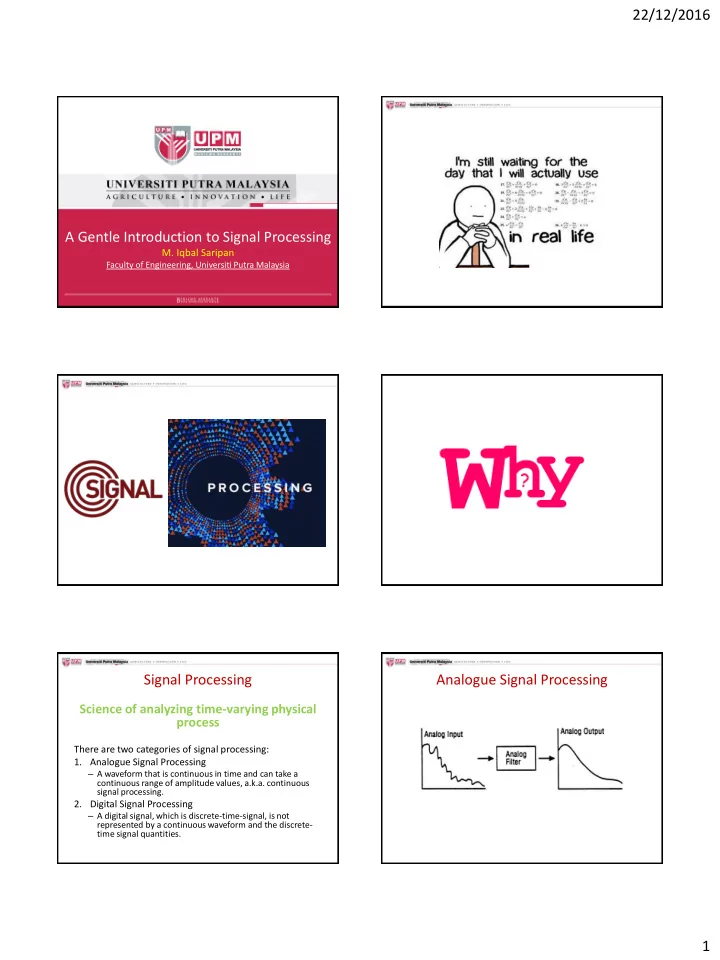
22/12/2016 A Gentle Introduction to Signal Processing M. Iqbal Saripan Faculty of Engineering, Universiti Putra Malaysia Signal Processing Analogue Signal Processing Science of analyzing time-varying physical process There are two categories


slide-1
SLIDE 1

22/12/2016 1 A Gentle Introduction to Signal Processing

  • M. Iqbal Saripan

Faculty of Engineering, Universiti Putra Malaysia

Science of analyzing time-varying physical process

There are two categories of signal processing:

  • 1. Analogue Signal Processing

– A waveform that is continuous in time and can take a continuous range of amplitude values, a.k.a. continuous signal processing.

  • 2. Digital Signal Processing

– A digital signal, which is discrete-time-signal, is not represented by a continuous waveform and the discrete- time signal quantities.

Signal Processing Analogue Signal Processing

slide-2
SLIDE 2

22/12/2016 2 Digital Signal Processing

A/D Converter Digital Signal Processor D/A Converter

Analog I/P Signal Digital I/P Signal Digital O/P Signal Analog O/P Signal

ADC

  • Sampling
  • Quantization
  • 1. Flexibility of the system offered by the

software component

  • 2. Better control of accuracy requirements, i.e.

no problem with external effects

  • 3. Ease of storage and offline processing
  • 4. Lower cost of processors
  • 5. Compression and coding techniques are

efficient to implement

Benefits: Digital Signal Processing over Analogue Signal Processing

  • Speed of operation of digital processors
  • Noise due to sampling and quantization (ADC)

Limitations of Digital Signal Processing DSP in STEM DSP As Enabling Technology (Texas)

slide-3
SLIDE 3

22/12/2016 3

  • Telecommunication

– Multiplexing – Compression – Echo Control

  • Audio Processing

– Music – Speech generation – Speech recognition

Examples of DSP Technology

  • Echo Location

– Sonar – Radar – Reflection Seismology

  • Image Processing

– Camera – Medical – Satellite

  • Compression: Fast, efficient, reliable

transmission and storage of data

  • Applied on audio, image and video data for

transmission over the Internet, storage

  • Examples: CDs, DVDs, MP3, MPEG4, JPEG

Multimedia Applications JPEG

43K 13K 3.5K

  • JPEG uses Discrete-Cosine Transform

(similar to Fourier Transform)

  • Examples:

– Brain signals (EEG) – Cardiac signals (ECG) – Medical images (x-ray, PET, MRI)

  • Goals:

– Detect abnormal activity (heart attack, seizure) – Help physicians with diagnosis

Biological Signal Analysis

  • Brain waves are usually contaminated by

noise and hard to interpret

slide-4
SLIDE 4

22/12/2016 4

  • Identifying a person using physiological

characteristics

  • Examples:

– Fingerprint Identification – Face Recognition – Voice Recognition

Biometrics

  • Active noise cancellation:Adaptive filtering

– Headphones used in cockpits

  • Digital Audio Effects

– Add special music effects such as delay, echo, reverb

  • Audio signal separation

– Separate speech from interference – Wind sound from music in cars

Audio Signal Processing

  • Filtering

Major Areas in DSP

New Algorithms in DSP

  • Adaptive
  • Multi-rate
  • Mixed Analogue/Digital
  • Non-linear
  • Filters are signal conditioners
  • Filter functions by accepting an input signal,

blocking prespecified frequency components and passing the original signal minus those components to the output.

Filters

slide-5
SLIDE 5

22/12/2016 5

  • Lowpass- Allows only low frequency signals to its
  • utputs.
  • Highpass-Allows only high frequency signals to its
  • utputs.
  • Bandpass-Allows only output signals within its

narrow, government-authorized range of frequency spectrum.

  • Bandstop-Allows both low and high frequencies,

but blocks a predefined range of frequencies.

Digital Filters Convolution

The P-DSPs are specially designed for digital signal processing application. The main components of P- DSPs are:

  • 1. Multiplier & Multiplier Accumulator (MAC)

– It requires array multiplication. The multiplication as well as accumulating to be carried out using hardware elements by two ways:

  • A dedicated MAC unit implemented in hardware which has

integrated multiplier and accumulator in a single hardware unit.

  • Use of multiplier and accumulator separately.

Programmable DSPs (P-DSP)

  • 2. The Processor Architecture

– There are mainly two types of architecture of microprocessor: Von Neumann Architecture

– In this architecture a single address bus and a single data bus for accessing the programme as well as data memory area.

Processing Unit Control Unit Data and Program Memory

Harvard Architecture

– Separate buses for the programme and data memory

Processing Unit Control Unit Program Memory Data Memory

slide-6
SLIDE 6

22/12/2016 6 Future of Signal Processing (Texas) Evolution of DSP Chip (Texas)

  • Very low power
  • High speed operation
  • Reconfigurable processor
  • Customizable processor
  • DSP chip with multiple integer and floating

point MACs

DSP Chip for the Future

Disclaimer: All contents of this presentation are a compilation of publicly available information in the web. The data were published by either the publicly available presentation or publicly available statistical information (e.g. Texas, Bell Lab, etc.). No data are my own data.