22/09/2014 Communicating research: How to present research results - - PDF document

22 09 2014
SMART_READER_LITE
LIVE PREVIEW

22/09/2014 Communicating research: How to present research results - - PDF document

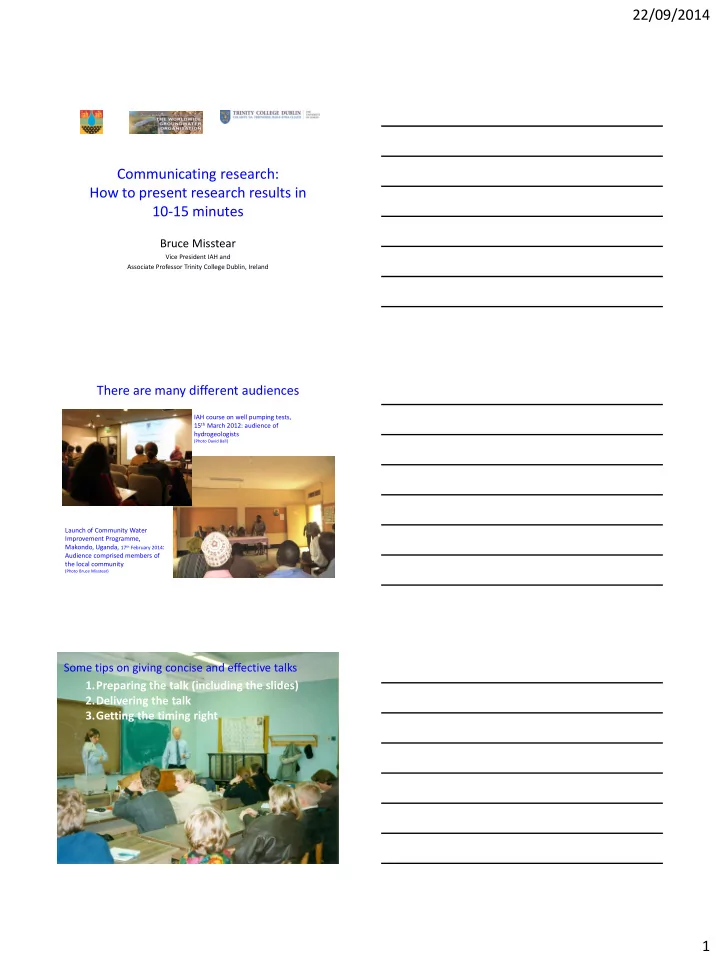
22/09/2014 Communicating research: How to present research results in 10-15 minutes Bruce Misstear Vice President IAH and Associate Professor Trinity College Dublin, Ireland There are many different audiences IAH course on well pumping


slide-1
SLIDE 1

22/09/2014 1 Communicating research: How to present research results in 10-15 minutes

Bruce Misstear

Vice President IAH and Associate Professor Trinity College Dublin, Ireland

There are many different audiences

IAH course on well pumping tests, 15th March 2012: audience of hydrogeologists

(Photo David Ball)

Launch of Community Water Improvement Programme, Makondo, Uganda, 17th February 2014: Audience comprised members of the local community

(Photo Bruce Misstear)

Some tips on giving concise and effective talks 1.Preparing the talk (including the slides) 2.Delivering the talk 3.Getting the timing right

slide-2
SLIDE 2

22/09/2014 2

  • First: ask yourself: what does the audience want from

your presentation?

– What aspects of your research are the audience likely to be interested in?

  • An audience will only remember 3 or 4 points from your

talk, so you need to make these clear

  • When making a significant point, make it memorable by

including a striking image

  • Do not put too much text on slides
  • Illustrations should be simple and attractive
  • Do not put your Acknowledgments as your last slide –

better to include them earlier and then leave your Conclusions slide up on the screen when you finish

Preparing the talk (including the slides)

The version on the left has too much detail for a presentation

(Turk & Kirkman, 1989)

slide-3
SLIDE 3

22/09/2014 3

World scaled according to public health spending (2006) http://www.worldmapper.org/index.html Including an extract of this chart helps communicate the message that an earthquake in far away Indonesia can affect groundwater levels in Ireland

2012

This graph shows calculated screen upflow head losses

(calculated using Manning-type formula; 24 m slotted pipe)

(Misstear, 2012)

Graphs should be simple

slide-4
SLIDE 4

22/09/2014 4

Economic optimisation of well design

(in extensive uniform aquifers)

s w

KL Q s 2 

Applying a simple equilibrium relationship for well design, and substituting screen length (Ls) for aquifer thickness:

w s

s Q KL T 2  

(Misstear, 2012)

Economic optimisation of well design

Minimum total cost Operating costs Capital costs

Cost (PV) Screen length (m)

(Misstear, 2012)

(IAH Netherlands Chapter)

Simple sketches can be effective

slide-5
SLIDE 5

22/09/2014 5

(Thomsen et al., HJ, 2004)

Photo: D. Daly Photo: Salmon Ireland www.wfdvisual.com Photo: B. Misstear Photo: D. Daly (Slide prepared by Jenny Deakin)

slide-6
SLIDE 6

22/09/2014 6

0.02 0.04 0.06 0.08 0.1 0.12 0.14 1 2 3 4 5 6 7 8 9 10 11

Orthophosphate (mg/l P) Nitrate (mg/l N) Mattock nutrient mixing model

Outlet Feb 2012 Headwaters Feb 2012 Overland flow Land drains Bedrock groundwater Subsoil BHs Ditches Outlet Jun 2012 Headwaters Jun 2012

Baseflow Quick flow

0.035 mg/l PO4 as P 37.5 mg/l NO3 as NO3 8 mg/l NO3 as NO3

Slide from my presentation on Thursday So, I don’t always follow my own advice!

‘More people die from unsafe water than from all forms of violence, including war.’

UN Secretary-General Ban Ki-moon, 22nd March 2010

Sometimes a quotation can be effective in emphasising the importance of our work

Delivering the talk

  • Do not read your presentation:

– Reading the slides directly is very boring and takes a lot of time – Remember: the audience can read the slides much faster than you can say them out loud – Just use the slides (or a few notes on cards) as a guide to your talk, but try and be spontaneous

  • Be enthusiastic
  • Do not stand in front of the screen
  • Don’t mumble or speak in a monotone
slide-7
SLIDE 7

22/09/2014 7

Getting the timing right

  • An audience will forgive you almost anything

provided you finish on time

  • Don’t spend too long on your introduction,

background and methodology

  • Make sure you leave enough time to cover your

results and your conclusions

  • You can save time by saying e.g.:

– “I don’t have time to discuss my sampling protocols in detail, but I would be happy to answer questions” By saying this, you are also engaging with the audience

  • Finally: practice!

http://www.greenpowerconferences.com/home/downloads/Harvard-Business-Review_How-To-Give-a-Killer-Presentation.pdf