2019/3/3 Object-oriented Analysis and Design Object-oriented - - PDF document

2019 3 3
SMART_READER_LITE
LIVE PREVIEW

2019/3/3 Object-oriented Analysis and Design Object-oriented - - PDF document

2019/3/3 Object-oriented Analysis and Design Object-oriented Analysis and Design Chapters Object oriented analysis and design 1. Iterative, evolutionary, and agile Applying UML and Patterns 2. Case study 3. An Introduction to Text book,


slide-1
SLIDE 1

2019/3/3 1

Software Engineering

1 Object-oriented Analysis and Design

Applying UML and Patterns

An Introduction to Object-oriented Analysis and Design and Iterative Development Part I - Introduction Software Engineering

2 Object-oriented Analysis and Design

Chapters

1.

Object oriented analysis and design

2.

Iterative, evolutionary, and agile

3.

Case study Text book, page 3-44

Software Engineering

3 Object-oriented Analysis and Design

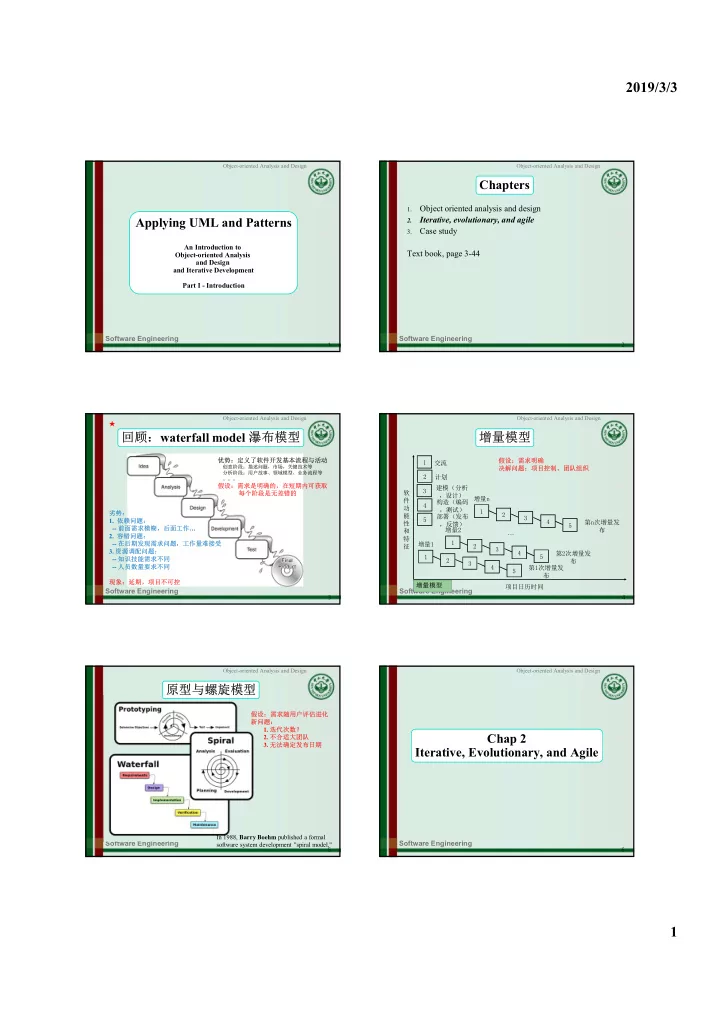
回顾:waterfall model 瀑布模型

优势:定义了软件开发基本流程与活动

创意阶段:描述问题,市场,关键技术等 分析阶段:用户故事、领域模型、业务流程等 。。。

假设:需求是明确的,在短期内可获取 每个阶段是无差错的 劣势:

  • 1. 依赖问题:
  • - 前面需求模糊,后面工作…
  • 2. 容错问题:
  • - 在后期发现需求问题,工作量难接受
  • 3. 资源调配问题:
  • - 知识技能需求不同
  • - 人员数量要求不同

现象:延期,项目不可控 ★

Software Engineering

4 Object-oriented Analysis and Design

增量模型

1 2 3 4 5 第2次增量发 布 增量2 1 2 3 4 5 第n次增量发 布 增量n 1 2 3 4 5 第1次增量发 布 增量1 … 项目日历时间 软 件 功 能 性 和 特 征 5 部署(发布 ,反馈) 4 构造(编码 ,测试) 3 建模(分析 ,设计) 2 计划 1 交流 增量模型 假设:需求明确 决解问题:项目控制、团队组织

Software Engineering

5 Object-oriented Analysis and Design

原型与螺旋模型

假设:需求随用户评估进化 新问题:

  • 1. 迭代次数?
  • 2. 不合适大团队
  • 3. 无法确定发布日期

In 1988, Barry Boehm published a formal software system development "spiral model,"

Software Engineering

6 Object-oriented Analysis and Design

Chap 2 Iterative, Evolutionary, and Agile

slide-2
SLIDE 2

2019/3/3 2

Software Engineering

7 Object-oriented Analysis and Design

迭代、敏捷地开发

 为什么迭代、敏捷开发是OOAD的关键“最佳实践”

CHANGE

( us e a m i rr

  • r

t

  • s

ee t he ans w er)

Software Engineering

8 Object-oriented Analysis and Design

Unified Process

 The Unified Process (UP) represents a mainstream

approach for software development across the spectrum

  • f project scales.

 The process is scalable: you need not use the entire

framework of the process for every project, only those that are effective.

 The process is effective: it has been successfully

employed on a large population of projects.

 Improves productivity through use of practical methods

that you’ve probably used already (but didn’t know it).

 Iterative and incremental approach allows start of work

with incomplete, imperfect knowledge.

Software Engineering

9 Object-oriented Analysis and Design

Unified Process Workflows

 Workflows define a set of activities that are performed  Workflows cut across the phases, but with different

levels of emphasis in each phase

 The core workflows Business Modeling Requirements analysis Design Implementation Test and Integration ★ ★

Software Engineering

10 Object-oriented Analysis and Design

The Core Workflows 1

 Business Modeling Develop and refine the problem definition Identify stakeholder needs Define system features to be considered Define the system scope Build the use-case model  Requirements Analysis Refine use-case model Define the domain model Define a candidate architecture (transitions to design) Refine the architecture (transitions to design)

Software Engineering

11 Object-oriented Analysis and Design

The Core Workflows 2

 Design Design the physical realizations of the use cases Develop the design model Develop the deployment model  Implementation Plan subsystem implementation Implement components: classes, objects, etc. Perform unit-level testing Perform component and system integration  Test and Integration Build the test model: test cases and expected results Plan, design, implement, execute, and evaluate tests

Software Engineering

12 Object-oriented Analysis and Design

Use Case Driven

 Use case A prose representation of a sequence of actions Actions are performed by one or more actors (human or non-

human) and the system itself

These actions lead to valuable results for one or more of the

actors—helping the actors to achieve their goals

 Use cases are expressed from the perspective of the users, in natural

language, and should be understandable by all stakeholders

 Use-case-driven means the development team employs the use

cases from requirements gathering through code and test

★ ★

slide-3
SLIDE 3

2019/3/3 3

Software Engineering

13 Object-oriented Analysis and Design

Architecture Centric

 Software architecture captures decisions about: The overall structure of the software system The structural elements of the system and their interfaces The collaborations among these structural elements and

their expected behavior

 Architecture-centric: software architecture provides the

central point around which all other development evolves

Provides a ‘big picture’ of the system Provides an organizational framework for development,

evolving the system by attending to modifiability qualities

  • f the system

Facilitates reuse ★ ★

Software Engineering

14 Object-oriented Analysis and Design

Iterative and Evolutionary 1

 An iterative and evolutionary approach allows start of

development with incomplete, imperfect knowledge

 Iterative and evolutionary the following advantages: Logical progress toward a robust architecture(逐步趋向

稳定)

Effective management of changing requirements(有效

管理需求变化)

Continuous integration(持续集成) Early understanding of the system (‘Hello world!’ effect)

(尽早接触整个系统)

Ongoing risk assessment(在线风险评估) ★ ★

Software Engineering

15 Object-oriented Analysis and Design

Iterative and Evolutionary 2

Requirements Design Implementation & Test & Integration & More Design Final Integration & System Test Requirements Design 3 weeks (for example) The system grows incrementally. Feedback from iteration N leads to refinement and adaptation of the requirements and design in iteration N+1. Iterations are fixed in length, or timeboxed. Time Implementation & Test & Integration & More Design Final Integration & System Test

Software Engineering

16 Object-oriented Analysis and Design

Iterative and Evolutionary 3

Early iterations are farther from the "true path" of the system. Via feedback and adaptation, the system converges towards the most appropriate requirements and design. In late iterations, a significant change in requirements is rare, but can occur. Such late changes may give an organization a competitive business advantage.
  • ne iteration of design,
implement, integrate, and test

Software Engineering

17 Object-oriented Analysis and Design

Iterative and Evolutionary 4

Iteration 1 Iteration 2 Iteration 3 Iteration 4 Iteration 5 20% 2% requirements software 30% 5% requirements software 50% 8% 90% 90% 20% 10% requirements workshops Imagine this will ultimately be a 20- iteration project. In evolutionary iterative development, the requirements evolve
  • ver a set of the early
iterations, through a series of requirements workshops (for example). Perhaps after four iterations and workshops, 90% of the requirements are defined and refined. Nevertheless, only 10% of the software is built. 1 2 3 4 5 ... 20 week 1 M T W Th F week 2 M T W Th F week 3 M T W Th F kickoff meeting clarifying iteration goals with the team. 1 hour team agile modeling & design, UML whiteboard sketching. 5 hours start coding & testing a 3-week iteration de-scope iteration goals if too much work final check-in and code- freeze for the iteration baseline demo and 2-day requirements workshop next iteration planning meeting; 2 hours Most OOA/D and applying UML during this period Use-case modeling during the workshop

Software Engineering

18 Object-oriented Analysis and Design

迭代UP vs. Scrum术语

Agile Iterative UP Scrum Iteration(迭代周期) Sprint(冲刺) Use cases(用例)或 Story(故事) Backlog(产品条目,特征) Kickoff meeting(启动会议) Sprint plan meeting Workshop(工作会议) Daily meeting(每日例会) Demo(演示) Sprint demo Review & next Plan(回顾与下个迭代计划) Sprint review(冲刺回顾) Coffee Time(私下交流时间) Phase(阶段) Disciplines(科目) Mile stone(里程碑)

slide-4
SLIDE 4

2019/3/3 4

Software Engineering

19 Object-oriented Analysis and Design

Agile Methods and Attitudes

 Agile Methods: However,

short timeboxed iterations with evolutionary refinement of plans, requirements, and design

Other:simplicity, lightness, communication, self-organizing

teams, etc.

Scrum, XP……  The Agile Manifesto Individuals and interactions over processes and tools Working software over comprehensive documentation Customer collaboration over contract negotiation Responding to change over following a plan ★

Software Engineering

20 Object-oriented Analysis and Design

Agile Methods and Attitudes

 The Agile Principles

  • 1. Our highest priority is to satisfy the customer through early and continuous delivery of

valuable software.

  • 2. Welcome changing requirements, even late in development.
  • 3. Deliver working software frequently.
  • 4. Business people and developers must work together daily throughout the project.
  • 5. Build projects around motivated individuals.
  • 6. Face-to-face conversation.
  • 7. Working software is the primary measure of progress.
  • 8. Agile processes promote sustainable development.
  • 9. The sponsors, developers, and users should be able to maintain a constant pace

indefinitely.

  • 10. Continuous attention to technical excellence and good design enhances agility.
  • 11. Simplicity-the art of maximizing the amount of work not doneis essential.
  • 12. The best architectures, requirements, and designs emerge from self-organizing teams.
  • 13. At regular intervals, the team reflects on how to become more effective, then tunes and

adjusts its behavior accordingly.

Software Engineering

21 Object-oriented Analysis and Design

Agile Modeling

 Adopting an agile method does not mean avoiding any modeling  The purpose of modeling and models is primarily to support

understanding and communication, not documentation.

 Don't model or apply the UML to all or most of the software design.  Use the simplest tool possible.  Don't model alone, model in pairs (or triads) at the whiteboard.  Create models in parallel.  Use "good enough" simple notation while sketching with a pen on

whiteboards.

 Know that all models will be inaccurate, and the final code or

design different sometimes dramatically different than the model.

 Developers themselves should do the OO design modeling, for

themselves.

Software Engineering

22 Object-oriented Analysis and Design

Unified Process Phases 1

Software Engineering

23 Object-oriented Analysis and Design

Unified Process Phases 2

inc. elaboration construction transition iteration phase development cycle release A stable executable subset of the final

  • product. The end of

each iteration is a minor release. increment The difference (delta) between the releases of 2 subsequent iterations. final production release At this point, the system is released for production use. milestone An iteration end- point when some significant decision

  • r evaluation
  • ccurs.

Software Engineering

24 Object-oriented Analysis and Design

Core Workflows and Phases 1

slide-5
SLIDE 5

2019/3/3 5

Software Engineering

25 Object-oriented Analysis and Design

Core Workflows and Phases 2

Sample UP Disciplines Business Modeling Requirements Design Implementation ... The relative effort in disciplines shifts across the phases. This example is suggestive, not literal. incep- tion elaboration construction transi- tion ...

Software Engineering

26 Object-oriented Analysis and Design

Core Workflows and Phases 3

Software Engineering

27 Object-oriented Analysis and Design

Artifacts, Workers, and Activities 1

 An artifact is a piece of information that is used as input

to, changed by, or output from a process

 Examples include: Models — use-case, domain, and design Model elements—use case, domain class, design class Diagrams and documents Source code Executable elements ★

Software Engineering

28 Object-oriented Analysis and Design

Artifacts, Workers, and Activities 2

 Workers define the behavior and responsibilities of an

individual or a team

Examples:

Architect, use-case engineer, component engineer, system integrator

 Some important distinctions: Workers participate in the development of the system Actors are outside the system and have usage relationships

with the system

Stakeholders encompass both actors and workers, as well

as others involved with the project

Software Engineering

29 Object-oriented Analysis and Design

Artifacts, Workers, and Activities 3

 Activities are the tasks performed within a workflow  Activities can describe a wide range of abstraction

levels, from high-level (‘construct domain model’) to low-level (‘implement class’)

Examples include: Plan iteration Find use cases and actors Execute integration test Review test results

Software Engineering

30 Object-oriented Analysis and Design

The Agile Unified Process

 The Unified Process has been designed from the outset as: Lightweight: ‘Pay as you go.’ Use only the parts that are

essential and effective for your project. When in doubt, leave it out.

Non-predictive: Requirements and design build gradually as

development proceeds rather than being completed before any work can begin.

Adaptable: Planning and risk analysis/assessment are on-

going and process can be adapted accordingly.

slide-6
SLIDE 6

2019/3/3 6

Software Engineering

31 Object-oriented Analysis and Design

Sample Development Case

… … agile PM daily Scrum meeting Project Management … test-driven dev. pair programming continuous integration coding standards Implementation r s Data Model s SW Architecture Document r s Design Model agile modeling test-driven dev. Design r s Glossary r s Supplementary Specification r s Vision r s Use-Case Model

  • req. workshop vision box

exercise dot voting Requirements s Domain Model agile modeling req. workshop Business Modeling

T1..T2 C1..Cn E1..En I1

Iteration

Trans. Const. Elab. Incep.

Artifact Practice Discipline

Software Engineering

32 Object-oriented Analysis and Design

过程总结

 过程(资产)建设在软件企业中的重要性 ISO-9000,CMMI 认证  瀑布模型、增量模型、螺旋模型的优缺点 风险(需求),规模(工作量),工期的控制分析  UP 工作流与瀑布模型的关系  UP 的三大特征  UP 的四个阶段,阶段的划分与增量模型、螺旋模型

的关联,它是如何克服基本模型的缺陷的?

 UP 与敏捷实践的关系  UP 的术语