
SLIDE 1
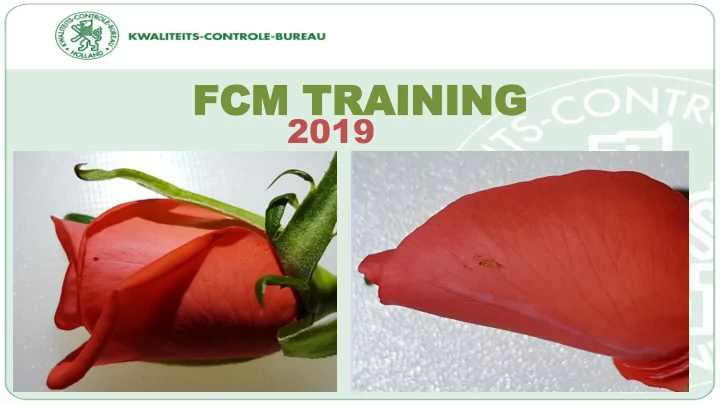
2019 2019 2 My name: Kees van der Vijver Regional phytosanitary - - PowerPoint PPT Presentation
FCM FCM TRAINING TRAINING 2019 2019 2019 2 My name: Kees van der Vijver Regional phytosanitary specialist Amsterdam Airport/ Flower auction FloraHolland First line inspector 3 The purpose of my presentation: To tell something
2
My name: Kees van der Vijver Regional phytosanitary specialist Amsterdam Airport/ Flower auction FloraHolland First line inspector
3
The purpose of my presentation:
To tell something about import inspections How do you recognize damage caused by caterpillars What are the main characteristic differences between the Helicoverpa and Thaumatotibia (FCM) caterpillars/ eggs To practice with the participants the Quiz “who am I ?”
5
6
7
Specifications recognized phytosanitary import inspection post
least 1 m2
led light between 3000 – 5000 k
table
8 Sample size import inspection cutflowers per shipment Number of stems per genus number of stems to inspect
< 400 50% 400 – 10.000 200 stems 10.001 – 25.000 300 stems 25.001 – 40.000 400 stems 40.001 – 55.000 500 stems 55.001 – 70.000 600 stems 70.001 – 85.000 700 stems 85.001 – 100.000 800 stems 100.001 – 125.000 900 stems 125.001 – 150.000 1000 stems 150.001 – 200.000 1100 stems > 200.000 1200 stems
Samples for at least out of 2 boxes. A maximum of 200 stems per box
Damage caterpillar
10
11
Caterpillars Noctuidae mostly found eating on the outer petals Caterpillar Thaumatotibia eating from the outside of the rosebud towards the stamens
16
18
19
11
Noctuidae (including Helicoverpa a.) Tortricidae ( includingThaumatotibia l.)
Crochets in a row Crochets in a complete circle
Noctuidae Tortricidae
2 Lateral- setae on Thorax1 3 Lateral setae on Thorax1
L1 and L2 L1, L2 and L3
22
Helicoverpa fam.Noctuidae Thaumatotibia subfam.Olethreutinae
A9 A9 Pinaculum with 2 setae (2 hairs) A9 Pinaculum with 1 setae (hair)
23
Helicoverpa Thaumatotibia (FCM)
The younger caterpillars: Orange in color, the head and thorax shield are brown. The younger caterpillars: Color is somewhat white, both the head and thorax shield are dark brown
Helicoverpa Thaumatotibia
short spines are closer to each other than Helicoverpa The skin is covered with clear visible sharp spines/ thorns
25
Different stages Thaumatotibia leucotreta (FCM)
26
Larvae of Helicoverpa armigera
First instar dorsal
Second instar dorsal
Third instar dorsal
Fourth instar dorsal lateral view
lateral view
Lateral view
Lateral view
Spodoptera frugiperda - Noctuidae ( an increasing number
Pinacula on A8 in a square Pinacula on A9 like a trapezium Ringed pinaculum SD1
Info: idtools.org/id/leps/lepintercept
Eggs….
Eggs
Helicoverpa Thaumatotibia Egg is laid separate on the outside of rosebud. The egg has ribs and on top there is Bump. The egg is laid seperately and is quite flat. The egg looks like a fried egg
Eggs Spodoptera sp.
Eggs always placed in egg packages covered with hair
Flowchart caterpillars most found in Roses Kenya
4 pair prolegs
Pinaculum
Thaumatotibia leucotreta (FCM) = Q EU
Noctuidae Skin covered with sharp spines
Helicoverpa No Q
No spines, dark spots on T1
Spodoptera littoralis = Q EU
Q = Quarantine organism Info: idtools.org/id/leps/lepintercept
No spines, A8 pinacula in a square, A9 in a trapezium
Spodoptera frugiperda = Q EU
33
34
35
36
37
38
39
40
41
42
43