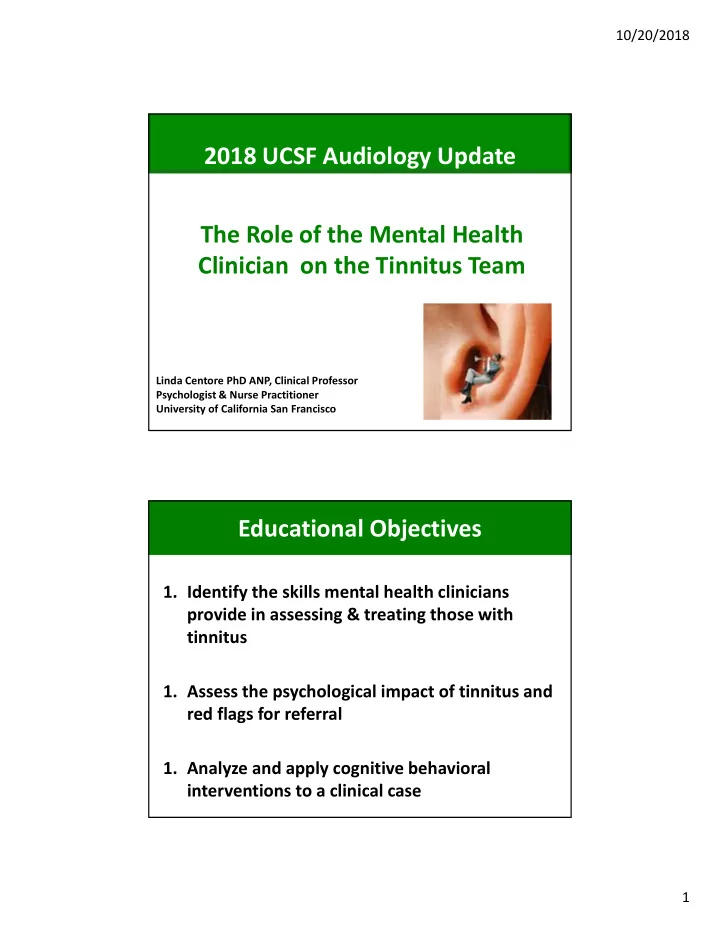
2018 UCSF Audiology Update The Role of the Mental Health Clinician on - - PDF document

2018 ucsf audiology update the role of the mental health
SMART_READER_LITE
LIVE PREVIEW

2018 UCSF Audiology Update The Role of the Mental Health Clinician on - - PDF document

10/20/2018 2018 UCSF Audiology Update The Role of the Mental Health Clinician on the Tinnitus Team Linda Centore PhD ANP, Clinical Professor Psychologist & Nurse Practitioner University of California San Francisco Educational Objectives 1.


slide-1
SLIDE 1

10/20/2018 1

Linda Centore PhD ANP, Clinical Professor Psychologist & Nurse Practitioner University of California San Francisco

2018 UCSF Audiology Update The Role of the Mental Health Clinician on the Tinnitus Team Educational Objectives

  • 1. Identify the skills mental health clinicians

provide in assessing & treating those with tinnitus

  • 1. Assess the psychological impact of tinnitus and

red flags for referral

  • 1. Analyze and apply cognitive behavioral

interventions to a clinical case

slide-2
SLIDE 2

10/20/2018 2

Health Care Professional Skills

  • Communicate effectively
  • Set realistic expectations
  • Assess patient’s ability to adapt
  • Monitor patient’s ability to cope
  • Don’t take behavior personally
  • Know your limits
  • Ask for help

Tolerate Expression of Strong Emotion Have Compassion / Retain Objectivity Be Responsive / Have Boundaries

Emotional Requirements of Audiologist

slide-3
SLIDE 3

10/20/2018 3

Pandora’s Box

Emotional Requirements of Patients

Move from Denial to Acceptance Form a Good Faith Relationship Be Willing to Use New Tools

slide-4
SLIDE 4

10/20/2018 4

Narrow Window of Comfort Intolerant

  • f Health

Problems Grief of loss of Perfect Health Searching for Cause

  • r Cure

Paralyzing Doubt Cognitive Distortions Easily Irritable Treasures Silence

Barriers to Adapting to Tinnitus Evaluation of Tinnitus

How is the patient managing? Impact on quality

  • f life?

Able to sleep and concentrate? Use cognitive behavioral strategies If overwhelmed or in crisis

By Audiologist Refer to Mental Health

slide-5
SLIDE 5

10/20/2018 5

Red Flags for Mental Health Referral

  • Loss of interest or pleasure in all activities
  • Withdrawal from family / friends
  • Increased alcohol or substance use
  • Difficulty getting to / staying asleep
  • Panic attacks or near panic
  • Despair / depression daily or almost daily
  • Overwhelmed /Frequent Crying / in Crisis
  • Suicidal statements /Cry for help

Mental Health Clinician Skills

  • Assess impact of new or worsening physical

symptom on ability to function

  • Work with grief due to loss of perfect health &

impact on current responsibilities

  • Work collaboratively on the emotional impact

and acceptance of TX plan recommendations

slide-6
SLIDE 6

10/20/2018 6

Which of the following is most harmful to the patient?

a) Not spending enough time with a patient b) Not giving the patient enough strategies on how to cope c) Telling a patient there’s nothing we can do for you a) Telling a patient not to worry

Iatrogenic Despair

Which must be present for a successful doctor‐patient relationship?

a) a willingness to change & adapt b) a persistence to be heard & understood c) a participatory decision‐making style d) an ability to trust the clinician

Good Faith Relationship

slide-7
SLIDE 7

10/20/2018 7

Challenging Behavior

slide-8
SLIDE 8

10/20/2018 8

slide-9
SLIDE 9

10/20/2018 9

Audience Activity

  • What are the positive aspects in working

with individuals with tinnitus?

  • What are the challenges in working with

individuals with tinnitus?

Take about 10 minutes to discuss

slide-10
SLIDE 10

10/20/2018 10

Quadruple Aim

Triple Aim -Institute for Healthcare Improvement 2008 Quadruple Aim - Michigan Institute for HealthCare Improvement (MiHIA) 2016

The Fourth Quadruple Aim Self‐Care for the Audiologist

slide-11
SLIDE 11

10/20/2018 11

Lack of Self‐Care Consequences

BURN OUT COMPASSION FATIGUE CAREER DISSATISFACTION NEGATIVE EMOTIONAL REACTION TO PATIENT

Clinical Case

slide-12
SLIDE 12

10/20/2018 12

Setting and Context

  • In your clinic, the person who sees tinnitus

patients is out so patients with tinnitus have been added to all schedules.

  • You’ve already had a hard week & you’re not

looking forward to this.

  • And, it’s a few weeks until your vacation which

you really feel like you need right now

Clinical Case

  • 67 year old male with a 3 month exacerbation of pre‐existing
  • tinnitus. He reports 9/10 loudness tinnitus that sounds like

“eeeeee.” Associated features: sound sensitivity. “I have trouble sleeping and can’t concentrate to read….I had to take time off work.” He confides it’s causing some marital problems because he is curt and snaps at his spouse. He states: “You have to do

  • something. There’s got to be a way to make go back down to

being mild or I can’t function!”

  • Exam findings: Symmetrical, mild sensorineural hearing loss at

6000 – 8000 Hz bilaterally. Normal tympanograms bilaterally.

slide-13
SLIDE 13

10/20/2018 13

Self‐Reflection

Or Understanding the Mylanta Moment

Audience Activity

  • 1. What is most challenging aspect about this for you?
  • 2. Does anything concern you about this patient?
  • 3. What counseling advice would you provide?
slide-14
SLIDE 14

10/20/2018 14

Management of Tinnitus

Provide Hope Continuous Sleep Preferred Sound Habituation Stress Management Non‐Pharmacologic Interventions

Behavioral Tools

  • Restorative Sleep
  • Soothing Preferred Sound
  • Engage in Activities
  • Avoid Monitoring
  • Avoid the Internet Chat Rooms
  • Cognitive Behavioral Therapy
  • Mindfulness Meditation
  • Medical Therapy/Pharmacology

“There is something in between never and forever…”

slide-15
SLIDE 15

10/20/2018 15

Cognitive Distortions

  • All or nothing thinking
  • Overgeneralization
  • Disqualifying the positive
  • Jumping to conclusions
  • Catastrophizing
  • Emotional reasoning
  • Labeling or mislabeling
  • Personalization
  • Fallacy of Fairness
  • Control fallacy

Last Audience Question

Which cognitive distortion is represented by the statement: “If the tinnitus is bad now, it’s just going to get worse and worse!” a) Catastrophic thinking b) Disqualifying the positive c) Fallacy of fairness d) All or nothing thinking What would you say in response to this patient reaction?

slide-16
SLIDE 16

10/20/2018 16

Thank you for your attention

slide-17
SLIDE 17

10/20/2018 17

Additional Resources

  • 1. National Guideline Clearing House. Agency for Health Care

Research and Quality Guidelines (AHRQ) at www.guideline.gov for management of anxiety, depression, insomnia.

  • 2. Vandekieft, GK (2001). Breaking bad news. American Family
  • Physician. December 64 (12); 1975‐78. Located at

http://www.aafp.org/afp/2001/1215/p1975.pdf

  • 3. Compassion Fatigue in Health Care Providers Awareness Project

at http://www.compassionfatigue.org/index.html

  • 4. Pomm HA, Shahady E, and Pomm RM. (2004) The CALMER Approach:

Teaching Learners Six Steps to Serenity When Dealing With Difficult

  • Patients. Family Medicine 36 (7); 467‐69. Located at

http://www.stfm.org/fmhub/fm2004/July/Heidi467.pdf