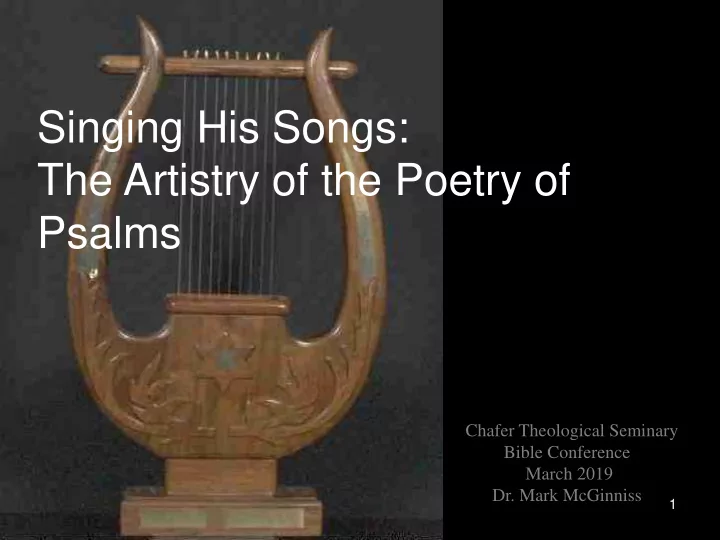
Singing His Songs: The Artistry of the Poetry of Psalms Chafer - - PowerPoint PPT Presentation

singing his songs the artistry of the poetry of psalms
SMART_READER_LITE
LIVE PREVIEW

Singing His Songs: The Artistry of the Poetry of Psalms Chafer - - PowerPoint PPT Presentation

Singing His Songs: The Artistry of the Poetry of Psalms Chafer Theological Seminary Bible Conference March 2019 Dr. Mark McGinniss 1 Lament Psalms The psalms do not simply express emotions: when sung in faith, they actually shape the


slide-1
SLIDE 1

Chafer Theological Seminary Bible Conference March 2019

  • Dr. Mark McGinniss

1

Singing His Songs: The Artistry of the Poetry of Psalms

slide-2
SLIDE 2

Lament Psalms

“The psalms do not simply express emotions: when sung in faith, they actually shape the emotion of the godly. The emotions are therefore not a problem to be solved but are part of the raw material of now-fallen humanity that can be shaped to good and noble ends.”

22

slide-3
SLIDE 3

Lament Psalms

Lament psalms “gives voice to our sorrow.”

Westermann

33

slide-4
SLIDE 4

Lament Psalms

“The theological significance of the personal lament lies first of all in the fact that it gives voice to

  • suffering. The lament

is the language of suffering: in it, suffering is given the dignity of language.”

Westermann

4

slide-5
SLIDE 5

Lament Psalms

“The secret of the language of the psalms lies in the fact that many people and many succeeding generations can recognize and utter it as their own prayer.”

Derek Kidner

5

slide-6
SLIDE 6

“The one who laments his suffering to God does not remain in his lament.”

Westermann

6

slide-7
SLIDE 7

Interpreting the Lament Psalms

  • Read the lament in its literary and historical

context

  • Apply the conventions of ancient Semitic

poetry

  • Try to discover the reason for the lament
  • Explore the theological teaching of the

lament

  • Reflect on the lament’s appeal to our

emotion and will

7

slide-8
SLIDE 8

Exhortations to Application

  • Preach/teach the psalms
  • Use the psalms in worship
  • Use the psalms in counseling
  • Use the psalms in evangelism

8

slide-9
SLIDE 9

The Form of the Lament Psalm of the Individual.

Address, with introductory cry for help or turning to God The Lament (i.e. the problem) Confession of trust Petition

  • for God to be favorable
  • for God to intervene

Assurance of Being Heard 2nd Wish or petition for God’s intervention (2nd time re: #4) Vow of Praise Praise of God

9

slide-10
SLIDE 10

The Form of the Lament Psalm 69

Address, with introductory cry for help or turning to God The Lament (i.e. the problem) Confession of trust Petition

  • for God to be favorable
  • for God to intervene

Assurance of Being Heard 2nd Wish or petition for God’s intervention (2nd time re: #4) Vow of Praise Praise of God

10

slide-11
SLIDE 11

The Form of the Lament Psalm 55

Address, with introductory cry for help or turning to God The Lament (i.e. the problem) Confession of trust Petition

  • for God to be favorable
  • for God to intervene

Assurance of Being Heard 2nd Wish or petition for God’s intervention (2nd time re: #4) Vow of Praise Praise of God

11

slide-12
SLIDE 12

The Form of the Lament Psalm 102

Address, with introductory cry for help or turning to God The Lament (i.e. the problem) Confession of trust Petition

  • for God to be favorable
  • for God to intervene

Assurance of Being Heard 2nd Wish or petition for God’s intervention (2nd time re: #4) Vow of Praise Praise of God

12

slide-13
SLIDE 13

The Form of the Lament: “Cliff Notes”

The Lament (i.e. the problem) Petition Expression of Confidence & Promise of Praise

13

slide-14
SLIDE 14

The Form of the Lament: Psalm 13

The Lament (i.e. the problem) Petition Expression of Confidence & Promise of Praise

14

slide-15
SLIDE 15

“The question is specifically the utterance of one who is experiencing a suffering that seems determined to

  • continue. Here, time, itself

becomes the destructive force, wearing down a man’s ability to hold out and intensifying the suffering to an inhuman level.”

Westermann, 71.

15

slide-16
SLIDE 16

“The suffer is alone, and suffering in loneliness aggravates the anguish.”

VanGemeren

16

slide-17
SLIDE 17

Pain is self-centering: How many times is the 1st person used?

17

slide-18
SLIDE 18

Is it okay to complain?

18

slide-19
SLIDE 19

“We may not complain

  • f Him but we may

complain to Him.”

Spurgeon

19

slide-20
SLIDE 20

20

God

A believer’s emotions

slide-21
SLIDE 21

Lament Psalms

“The psalms do not simply express emotions: when sung in faith, they actually shape the emotion

  • f the godly. The emotions are

therefore not a problem to be solved but are part of the raw material of now-fallen humanity that can be shaped to good and noble ends.”

2121