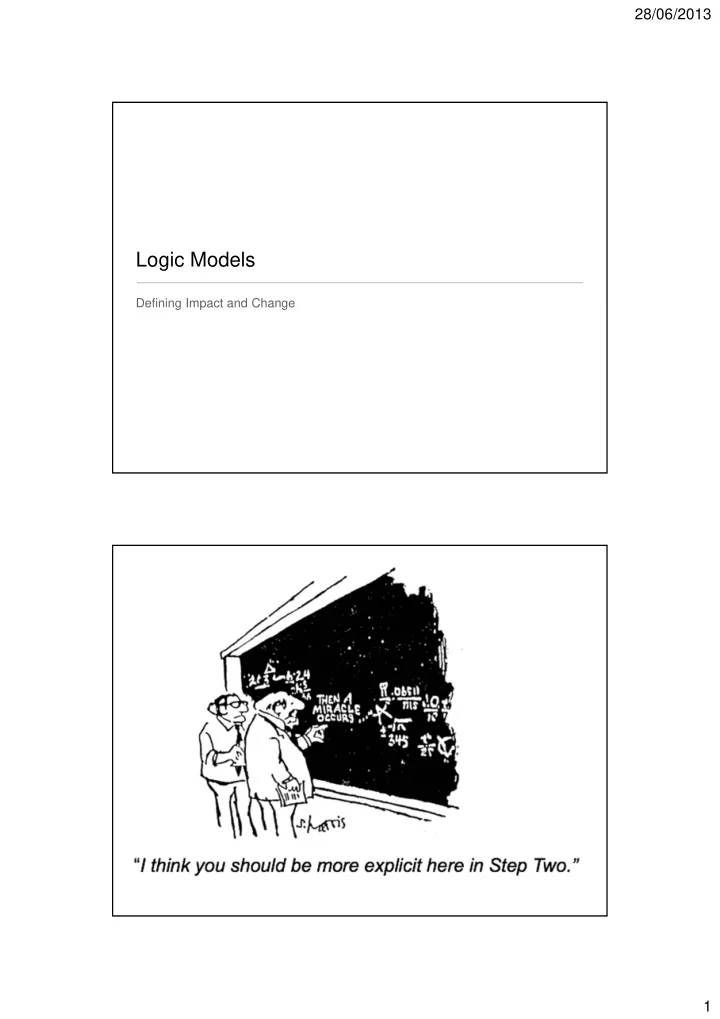
Logic Models Defining Impact and Change 1 28/06/2013 One Tool, - - PDF document

logic models
SMART_READER_LITE
LIVE PREVIEW

Logic Models Defining Impact and Change 1 28/06/2013 One Tool, - - PDF document

28/06/2013 Logic Models Defining Impact and Change 1 28/06/2013 One Tool, Many Names Logic Models or intended impact models Simplification of a program, initiative, or intervention that is a response to a given situation. These tools have


slide-1
SLIDE 1

28/06/2013 1

Logic Models

Defining Impact and Change

slide-2
SLIDE 2

28/06/2013 2

One Tool, Many Names

Logic Models or intended impact models Simplification of a program, initiative, or intervention that is a response to a given situation. Roadmap for program management

These tools have real potential but there are some challenges to overcome.

How is social impact achieved?

Inputs Activities Outputs Outcomes Impact

slide-3
SLIDE 3

28/06/2013 3

Why Logic Models?

Motivated by a real desire to increase operational effectiveness Driven by competition. Fueled by interest among funders in performance accountability.

What is a Logic Model?

Set of claims about how an organization produces something

  • f value.

Starts with inputs and leads to outcomes/impacts. Shows the logical relationships among the resources that are invested, the activities that take place, and the benefits or changes that result. Usually causal in nature. Tells an organization’s story and explains why the

  • rganization exists.
slide-4
SLIDE 4

28/06/2013 4

Elements of a Logic Model

INPUTS: What an organization needs to do its work (facilities, staff, volunteers, grants, etc.) ACTIVITIES: The work that is done in an organization’s main programs OUTPUTS: Units of production (number of hours of service delivered, number of clients served, etc.) OUTCOMES: What happens to clients (new skills gained, milestones reached: short, medium, and long term) IMPACT: Ultimate result of achieving mission

Types of Logic Models

Circular Logic Model to show Program evaluation support Logic Model explaining longterm outcomes

slide-5
SLIDE 5

28/06/2013 5

Types of Logic Models Two Levels, Two Targets

  • A logic model can be focused on an entire
  • rganization or it can cover a program

within the organization

  • Logic models can be focused on the work of

grantees or funders

slide-6
SLIDE 6

28/06/2013 6

Shoes Education about shoe wearing for general public Program staff TOMS logistics Health fairs Educational programs Rural outreach Specific health programs # of shoes # of children reached over & over with replenishment shoes # of communities helped # of families reached with concurrent education

increased kids at school increased protection against soil-transmitted and other diseases reduced intestinal parasite prevalence (community) and load (average per child) increased emphasis from the community on wearing own shoes (very long- term) HEALTH: increased community health; decreased anemia, physical and mental stunting childhood deaths EDUCATION: increased educational achievement rates CULTURE SHIFTS: increase in % of children wearing

  • wn (not donated)

shoes (very long- term) PUBLIC HEALTH: integration of shoe giving into major programming

INPUTS ACTIVITIES OUPUTS OUTCOMES IMPACTS

slide-7
SLIDE 7

28/06/2013 7

Gardens for Health

INPUTS: PLWHA Community Associations Land Seeds Tools Agronomists Nutritionists ACTIVITIES: Access to Land Community Gardens Home Gardens Training in sustainable agriculture Training in HIV/AIDS specific nutrition Advocacy OUTPUTS: Harvests from community gardens Harvests from home gardens Saved seeds Trained PLWHA agricultural cooperatives OUTCOMES: Improved nutritional status Improved food security Improved knowledge

  • f HIV/AIDS specific

nutritional needs PLWHA community

  • rganization and

mobilization around sustainable agriculture IMPACT: Every HIV+ individual will have access to nutritious food, grown by members of their immediate community Slower disease progression and improved quality of life for PLWHA

Example: RGK Center

INPUTS

Grants Contracts Endowment Staff Faculty

ACTIVITIES

Research Teaching Engagement

OUTPUTS

Number of publications Number of UT classes and students Number of

  • exec. educ.

courses and participants #consulting projects

OUTCOMES

Increased knowledge base Trained and skilled leaders for nonprofit sector

IMPACT

A stronger more effective nonprofit sector

slide-8
SLIDE 8

28/06/2013 8

How Do You Use a Logic Model?

Drive planning Guide implementation Connect to performance measurement Improve internal alignment and commitment Secure external support

Real World Social Challenges

Causality weakens as one moves left to right. The time horizon of programs and patience of funders are too short to measure many long-term outcomes.

slide-9
SLIDE 9

28/06/2013 9

One Major Limitation

The problem of “noise” is most fields where problems are complex and important (Low r-square associated with most models)

Adjusting to What Is Possible

slide-10
SLIDE 10

28/06/2013 10

slide-11
SLIDE 11

28/06/2013 11

FD Logic Model

INPUTS

  • Campers
  • Staff
  • Board
  • Volunteer
  • Grants
  • Event revenue
  • Donations
  • Founder
  • Equipment
  • Infrastructure
  • In kind gifts
  • Media
  • Alums
  • Community

ACTIVITIES

  • Kayak trips
  • Rafting
  • Mountain climbing
  • Bridge Jumps
  • Google groups
  • Emb. Program
  • Community events

OUTPUTS

  • #campers
  • #camps
  • #camper days
  • #locations
  • #ref. docs
  • Geographical

dispersion

  • Diversity
  • New vs.

returning campers

  • #of messages
  • n google
  • #facilities visited
  • #cancer prof

reached

  • #articles placed
  • #new people

reached

  • #emb engaged

OUTCOMES

Short term

  • Escape
  • Skills built
  • Renewed interest

in activity

  • Sense of

confidence and community

  • Network of support
  • Remove crutch

Long term

  • Confidence to live

to fullest

  • Letting people

breathe

  • Altering rel. with

cancer

  • Turning victims

into survivors into masters

  • Extending life

IMPACT

  • Define and draw

attention to the 18-39 cancer pop.

  • Altering

perspective on cancer

  • Creating a

movement

  • Reduce impact of

cancer on society

El Museo del Barrio: Outreach Programs

INPUTS

Donors Volunteers Board/Staff Grants/Corp. support/ Fees Partner Organizations/ Schools Theater and Building

ACTIVITIES

Festivals Educational Outreach Programs Public Programs

OUTPUTS

# festivals hosted / # participants # educational programs offered/ # students & participants # art educator training programs

  • ffered/

# participants # distinct communities/ schools served # education- related theater rentals

OUTCOMES

Increased public understanding

  • f C&L art

New generation

  • f C&L museum

goers cultivated Art educators are trained and engaged

IMPACT

Caribbean and Latin American cultural identity appreciated and enhanced

slide-12
SLIDE 12

28/06/2013 12

Example: Episcopal Diocese of MA

INPUTS

Bishop Clergy Congregations Funding Buildings Identity

ACTIVITIES

Theological Ordinations Confirmations Social Urban Work Overseas work Outreach Financial Grants Spending Redistribution $ Managerial Governance Training Education

OUTPUTS

  • # of members
  • Average

Sunday attendance

  • # of religious

services

  • Amount of

grants

  • # of outreach

activities

  • Hours of

training

  • # of new

congregations

  • # kids at

camp

OUTCOMES

Vital congregations Shaping public policy Strengthening faith Growth of leadership Human transformation

IMPACT

Just and Peaceable Kingdom

slide-13
SLIDE 13

28/06/2013 13

Program staff Volunteers Educational material Classroom- style educational programs Rural outreach Specific public health programs (showers, etc.) # of children in programs # of nearby villages affected # of hours of instruction

increased kids attending educational programs increased protection against youth gangs increased protection against child prostitution reduced exposure to various diseases and infections Public health: increased community health; decreased child mortality Education: increase in % of children with higher literacy Empowerment: increase in % of children continuing education beyond train platform

INPUTS ACTIVITIES OUPUTS OUTCOMES IMPACTS

Three Lenses of Logic Models

Accountability Performance Knowledge Building

slide-14
SLIDE 14

28/06/2013 14

Other examples

Nontraditional Employment for Women

NEW creates long-term, livable wage employment

  • pportunities for women

who had been victims of domestic violence.

slide-15
SLIDE 15

28/06/2013 15

1 2 3 3 3 4

MPower Labs

INPUTS

Capital Infrastructure

ACTIVITIES

Invest in early- stage companies Provide low-cost “back-office” services Provide expert capacity-building consulting Provide access to proprietary technology & infrastructure

OUTPUTS

# Successful companies serving underserved markets #companies screened #hrs of consulting given to portfolio companies $ leveraged from other investors

OUTCOMES

Company Reduced product to market time Improved product quality Integrated, global network

  • f products and services

Community Increase the number of products and services for underserved markets Increase access to basic financial services Increase access to relevant asset-building products Reduce number of people who operate in cash economy

IMPACT

Underserved communities are financially empowered