2017 Railway Infrastructure and Vehicle Inspection Technology - - PowerPoint PPT Presentation

2017 railway infrastructure and vehicle inspection
SMART_READER_LITE
LIVE PREVIEW

2017 Railway Infrastructure and Vehicle Inspection Technology - - PowerPoint PPT Presentation

2017 Railway Infrastructure and Vehicle Inspection Technology Conference John Cech AVP & CHIEF ENGINEER SYSTEM MAINTENANCE & PLANNING 6/20/17 BNSF is a Leading U.S. Railroad A Berkshire Hathaway company 41,000


slide-1
SLIDE 1

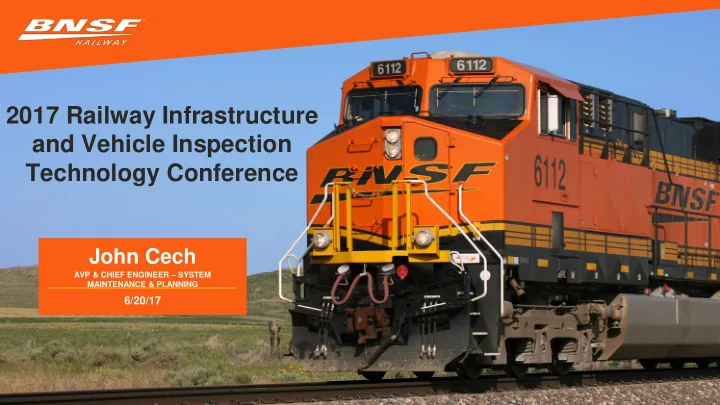
2017 Railway Infrastructure and Vehicle Inspection Technology Conference

John Cech

AVP & CHIEF ENGINEER – SYSTEM MAINTENANCE & PLANNING

6/20/17
slide-2
SLIDE 2

2

  • A Berkshire Hathaway company
  • 41,000 employees*
  • Approximately 8,000 locomotives
  • Moves one-fourth of the nation’s rail freight
  • Operates over 1,200 freight trains per day
  • A leader in the industry in technological

innovation

BNSF is a Leading U.S. Railroad

*BNSF Railway employees as of Dec. 31, 2016

slide-3
SLIDE 3
  • 32,500 route miles

in 28 states and three Canadian provinces

  • 13,000 bridges and

88 tunnels

  • Serves over 40

ports

BNSF is a Leading U.S. Railroad

3

slide-4
SLIDE 4
  • First ever to be focused on the advancements and applications of the ever increasing array of new

technologies to improve railway safety, operations, and efficiency.

  • Bring together the railroad and rail transit community to exchange information and advance the state of

the art with objectives of:

  • Improving the effectiveness of existing technologies
  • Development and implementation of new technologies
  • Research on emerging technologies with the potential to improve rail transport
  • Goal of connecting industry needs with the people and organizations that can develop solutions

“Discuss yours and BNSF’s perspective, vision, and leadership regarding inspections technologies and their vital importance to the future of rail safety, efficiency, and reliability.”

Rail Infrastructure and Vehicle Inspection Technology Conference

4

slide-5
SLIDE 5

3.39 2.31 3.31 1.93 0.00 1.00 2.00 3.00 4.00 5.00

2007 2008 2009 2010 2011 2012 2013 2014 2015 2016 Industry Reportable Total REI Rate BNSF Reportable Total REI Rate 5

Rail Equipment Incidents

Since 2007, the industry rail equipment incident rate has been reduced by 32% and BNSF’s rail equipment incident rate has been reduced by 42%

Incidents per million train-miles

Source: FRA 1.12 – Ten Year Accident/Incident Overview. Excludes Highway Crossing Accidents

slide-6
SLIDE 6

6

On BNSF All Types of Incidents Have Declined

0.53 0.19 0.97

0.00 0.20 0.40 0.60 0.80 1.00 1.20 1.40 1.60 2007 2008 2009 2010 2011 2012 2013 2014 2015 2016 Track-Caused Equipment-Caused Human Factor-Caused

  • 51%
  • 50%

Incidents per million train-miles

Source: FRA 1.12 – Ten Year Accident/Incident Overview. Excludes Highway Crossing Accidents.

  • 32%
slide-7
SLIDE 7

7

Prevention: Reducing Risk

Equipment/Mechanical

  • Ultrasonic inspection
  • Detector network - dragging equipment
  • Technology
  • Thermal/infrared scanning for

warm bearing detection Our ongoing focus is on instilling a culture of commitment and compliance – a culture that is sensitive to exposure and risk.

Track/Signal

  • Enhanced track inspection

training

  • Continued elimination of

jointed rail & joints in CWR

  • Strong capital program in

rail, tie, and ballast renewal

  • Technology - enhanced

geometry testing, aggressive rail detection program, improved use of data

Human Factor

  • Training
  • Remote monitoring
  • Positive Train Control
  • Self reporting protocol
slide-8
SLIDE 8

8

Inspection Capabilities and Methods

Railcar – Equipment Detection Track Inspection Structures Inspection

MECHANICAL ENGINEERING

Locomotive – RM&D

slide-9
SLIDE 9

Prevention: Equipment Detection Technology

  • More than 2,000 trackside detectors
  • Hot Box Detector (HBD)
  • Wheel Load Impact Detector (WILD)
  • Trackside Acoustical Detector (TADS)
  • Sonic Cracked Wheel/Axle Detector

(CWAD)

  • Machine Vision Systems
  • Magnetic Particle Inspection
  • Warm Bearing Detection System

(WBDS)

  • Hot Wheel Detectors (HWD)
  • Truck Performance Detectors (TPD)

Optical Geometry Detector Acoustic Bearing Detector Cold Wheel Detector Wheel Impact Load Detector Truck Performance Detector Machine vision System Cracked Wheel Detector Truck Hunting Detector Hot box Detector Hot Wheel Detector

9

slide-10
SLIDE 10

10

Technology driven risk reduction – 2001 – 2016 Mechanical Derailments

Mechanical Derailment Frequency by Year per Million Train Miles

All Mechanical Derailment CAGR

Mechanical (‘01-’16)

  • 6.33%

Bearing related HWD, HBD, ABD -11% Wheel related WILD

  • 2%

Truck related TPD

  • 5%

1 2 3 4

Technology / Processes

WILD and TPD Initial Installations

1

Warm Bearing Analysis and Acoustic Bearing Detectors

2 3

WILD increased coverage and process improvements Machine Vision – Coupler Carrier/ Cross Key

4 5 5

Comprehensive Mechanical Equipment Health (CMEH) Cars Out of Storage Process

6 6

slide-11
SLIDE 11

11

Service Interruptions (2010 – Present)

1 2 3 4 5 6 Air hose Brakes Knuckle Bearing UDE Car body Wheel defect Count of SI's (Thousands)

Primary Cause Service Interruptions (SI) by Category

slide-12
SLIDE 12

Body

12

Detector Network Overview

Failure modes driving continued development

Bearings Wheels Brakes Trucks

slide-13
SLIDE 13

Technology Description Acoustic Bearing Detector (ABD) Identifies defects on specific internal bearing components (e.g. cup, cone, roller and cage) based on acoustic signature. Hot Bearing Detector (HBD) Measures surface temperature of bearing to identify defects associated to improper installation or internal damage. Warm Bearing System (WB) Rules Engine including bearing temperature trending and composites with ABD / WILD.

13

Detector Network Overview

Bearing Monitoring

slide-14
SLIDE 14

Technology Description Truck Geometry Detector (TGD) Identifies worn wheels and truck steering related issues. Can be used to identify wheel manufacturer by plate shape. Spring / Wedge Detector (SWD) Measures and inspects truck springs and friction wedges for worn, broken or missing components. Truck Performance / Hunting Detectors (TPD / THD) Measures forces applied to rail associated to poorly steering trucks or truck hunting.

14

Detector Network Overview

Truck Evaluation

slide-15
SLIDE 15

Technology Description Machine Vision – Undercarriage Inspection (AISC) Identifies missing fasteners, broken welds and damaged structural components. Can be used to detect dragging equipment. Machine Vision – Coupler Securement Systems:

  • Coupler Carrier Plate

(CCP)

  • Coupler Cross Key (CCK)

Detects missing fasteners, broken welds and damaged structural components and missing cotter keys and / or cross key retainers.

15

Detector Network Overview

Car Body Inspection

slide-16
SLIDE 16

Technology Description Machine Vision – Brake Shoe Detector (BSD) Determines presence of brake shoe, if the brakes are applied and measures remaining brake shoe thickness. Hot / Cold Wheel Detectors (HWD / CWD) Measures wheel plate temperature to identify hot or cold wheels due to dragging / sticking or ineffective brakes. Machine Vision – Low Air Hose Detector (LAHD) * Identifies low air hoses and / or hose damage.

16

Detector Network Overview

Brake Evaluation

slide-17
SLIDE 17

Technology Description Cracked Wheel / Axle Detector (CWAD) Measures the energy generated by wheels / axles to determine good from bad (cracked). Machine Vision – Wheel Tread Detector (WTD) Visually identifies wheel surface wear and / or defects. Wheel Impact Load Detector (WILD) Measures vertical wheel force on rail to identify surface defects and out-of-round. Machine Vision – Wheel Profile Detector (WPD) Measures wheel dimensions to identify worn or loose wheels.

17

Detector Network Overview

Wheel Inspection

slide-18
SLIDE 18

New Technology – MVS TreadView

slide-19
SLIDE 19

New Technology – MVS TreadView

slide-20
SLIDE 20

New Technology – MVS TreadView

slide-21
SLIDE 21

21

New Technology – MVS Air Hose Inspection

slide-22
SLIDE 22

22

Trends and Future Needs - Mechanical

  • Enhanced use of existing data
  • Incorporate all relevant data sources
  • Condition-Based, Maintenance planning
  • Composite rules leverage complementary detector data
  • Optimize detector set points and setout locations
  • Continued development and use of technologies
  • Increase use of high speed imaging
  • Re-purpose / refine existing technologies
  • Explore use of emerging technologies
  • Fiber optic
  • Onboard monitoring
  • Strategically expand network coverage
  • Increase detector density
  • Provides redundancy
  • Reduces spacing
  • Facilitates trending
slide-23
SLIDE 23

0.00 0.10 0.20 0.30 0.40 0.50 0.60 0.70 '00 '02 '04 '06 '08 '10 '12 '14 '16 '18 '20

Derailments per Million Train Miles

23

Derailment Prevention Vision

1 2 3 4 5

Next Step Level Improvement?

slide-24
SLIDE 24

$ Billions

BNSF’s Capital Investments

slide-25
SLIDE 25

2017 Capital Investments $3.4B

slide-26
SLIDE 26

26

Visual Inspection: Over 10 million miles of track annually visually inspected by over 650 Track inspectors

  • Many core subdivisions across the BNSF network are inspected up to 7 times per

week in many cases

  • Robust Track Inspector Certification initiative

Automated Track Geometry Inspection

  • Fleet of cars for high speed laser/inertia test systems collect track condition

information including Holland Star Cars which collect geometry data utilizing track loading capability

  • Generates a Surface Quality Index rating for every ¼ mile of track used to

prioritize surfacing investment over time

  • Many core routes are inspected up to 6 times per year

Ultrasonic Internal Rail Flaw Detection

  • Intervals between inspections are as frequent as every 16 days on the highest

density lines Tie Inspection

  • Visioning system gathers condition of ties which is utilized to prioritize annual tie

replacement cycles Ground Penetrating Radar (GPR) Ballast Inspection

  • GPR used to plan undercutting, or 8’-10’ below rail ballast replacement, to improve

support of track structure

Engineering: Track Inspection Programs

slide-27
SLIDE 27

27

Engineering: Track Inspection Fleet

STAR Car UAV (Drone)

slide-28
SLIDE 28

28

Rail Detection

  • More than 200,000 miles tested per year
  • Preventing broken rail service interruptions and derailments
  • Uses Ultrasonic shear waves
  • Suspect indications are hand-tested to verify
  • Emerging technologies in:
  • Ultrasonic guided waves
  • Ultrasonic phased arrays

Track Geometry Cars

  • 140,000 miles tested in 2015
  • 260,000 miles tested in 2016

Engineering: Rail and Automated Inspection

slide-29
SLIDE 29

29

Supplemental track and structure inspection

  • Small multi-rotor aircraft
  • Operations governed by FAA Section

333 Exemption

Track integrity flights for key train

  • peration
  • Larger fixed wing aircraft
  • Initially governed by FAA Research

Agreement (CRDA)

Unmanned Aerial Vehicles

BNSF is one of only a few companies in the United States – and the first railroad – to take the lead in the use of Unmanned Aerial Vehicles (UAVs)

slide-30
SLIDE 30

30

Analytics: Engineering Dashboards

Utilization & Performance Visualization Tools (Territory Health) Window Analysis vs Baselines Clustering Heat Maps

slide-31
SLIDE 31

31

Tremendous opportunity to improve in the implementation of new technology:

  • “Big Data” analytics
  • The pace technology is changing makes

“implementation” difficult Lessons learned

  • Legacy processes are hard to change
  • Collaboration is critical
  • Scope matters
  • Curve Relay
  • Predictive tags/CSP
  • Track Inspection

Technology & Inspection Assessment

BNSF is leveraging technology and analytics more than ever with significant improvements in safety, reliability, and efficiency. However…………..

slide-32
SLIDE 32

32

  • Help with big data analytics
  • Ballast Maintenance
  • How do we leverage GPR?
  • Track lifting versus undercutting versus surfacing; Effectiveness of SBC
  • Repeat red tags – subgrade analysis
  • Concrete tie renewal strategy
  • Wood tie life (asset life extension in general)
  • Non-destructive rail neutral temperature measurement
  • Reduce track occupancy with inspection systems

BNSF Needs

slide-33
SLIDE 33

33

Future Technology Plays a Key Role in Driving Safety Improvements, Efficiency, and Reliability

slide-34
SLIDE 34

34