SLIDE 8 2016‐10‐16 8
Lessons learned in the case of ImmunizeCA: 1. Provincial health privacy legislation will not apply because this app is not considered a Health Information Custodians or an agent under PHIPA, and similar legislation, since it does not provide,
- r facilitate the provision of healthcare.
2. PIPEDA does not apply if the app is not engaged in commercial activity. ImmunizeCA is not a profit generating app and fundraising is not considered a commercial activity under PIPEDA. ImmunizeCA’s initial funding was made possible through government grants. Even if it would generate revenue in the future, the sole purpose of that revenue would be for maintaining and developing the app—not generating profit. These two points illustrate how ImmunizeCA, and similar apps fall within the regulatory gaps of the current health privacy framework. It is not governed by health-sector specific legislation, since it is not a health information custodian; and it is not subject to PIPEDA since it is not a commercial entity.
2
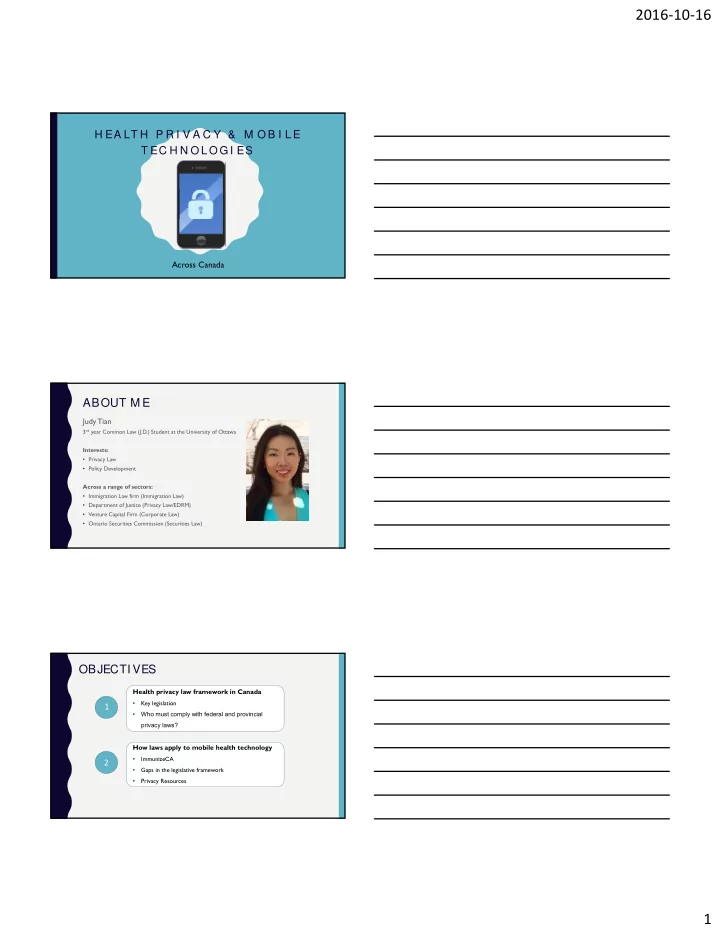
understand how these laws apply to electronic records and mobile technologies
How laws apply to mobile health technology
- ImmunizeCA case
- Gaps in the legislative framework
- Privacy Resources
KEY TAKEAW AYS
Most mobile apps will be subject to PIPEDA: since they are commercial entities with the aim of generating a profit. The ImmunizeCA case is a unique example because it is neither a health information custodian, not a commercial entity. Through this research we have learned the following lessons:
- A separate privacy regime has been created for the health sector: legislators
have recognizes that Personal Health Information is considered highly sensitive and should be treated differently than other forms of personal information. However, most health privacy laws were drafted with paper records in mind—the legislator did not contemplate the onset of mobile health technologies at the time the statutes were drafted.
- Mobile health apps should be governed by health-sector specific legislation
such as PHIPA: However, since personal health information is recognized for its unique and sensitive nature, these apps should be governed by health-sector specific legislation.
- Health privacy laws, such as PHIPA, should be amended in order to address the
changing reality of information handling: the onset of mobile technologies in the health sector demonstrate that the traditional definition of Health Information Custodian should be revisited to include mobile health apps within their regulatory purview.
- The IPC’s Privacy Impact Assessment Guidelines for the Ontario Personal Health
Information Protection Act Serves as a self-assessment tool to assist health information custodians in reviewing the impact that a proposed information system, technology or program may have on the privacy of an individual’s personal health information under PHIPA. https://www.ipc.on.ca/wp-content/uploads/Resources/phipa_pia-e.pdf
- The IPC’s Guide: Good Privacy Practices for Developing Mobile Apps
This guidance has been prepared jointly by the Office of the Privacy Commissioner of Canada and the Offices of the Information and Privacy Commissioner of Alberta and British Columbia to draw your attention to key privacy considerations when designing and developing mobile apps. https://www.oipc.bc.ca/guidance-documents/1426
2
understand how these laws apply to electronic records and mobile technologies
How laws apply to mobile health technology
- ImmunizeCA case
- Gaps in the legislative framework
- Privacy Resources