#2: Gravity & Energy Recall from Lecture 1: m e = 5.97 10 24 kg - - PowerPoint PPT Presentation

2 gravity energy
SMART_READER_LITE
LIVE PREVIEW

#2: Gravity & Energy Recall from Lecture 1: m e = 5.97 10 24 kg - - PowerPoint PPT Presentation

13.3-13.5 #2: Gravity & Energy Recall from Lecture 1: m e = 5.97 10 24 kg e = 6.37 10 6 m r # & = 6.67 10 11 N m 2 ( 5.97 10 24 kg b = G m e m b 2 m b = 9.8 N F kg m b % r 2 kg 2 ( ) $ ' 6.37 10 6 m g = G m


slide-1
SLIDE 1

#2: Gravity & Energy

13.3-13.5 Recall from Lecture 1:

me = 5.97×1024kg r

e = 6.37×10⁶m

 F

b = G memb

r2 = 6.67×10⁻¹¹N m2 kg2 # $ % & ' ( 5.97×1024kg 6.37×10⁶m

( )

2 mb = 9.8 N

kg mb

g = G me r

e 2
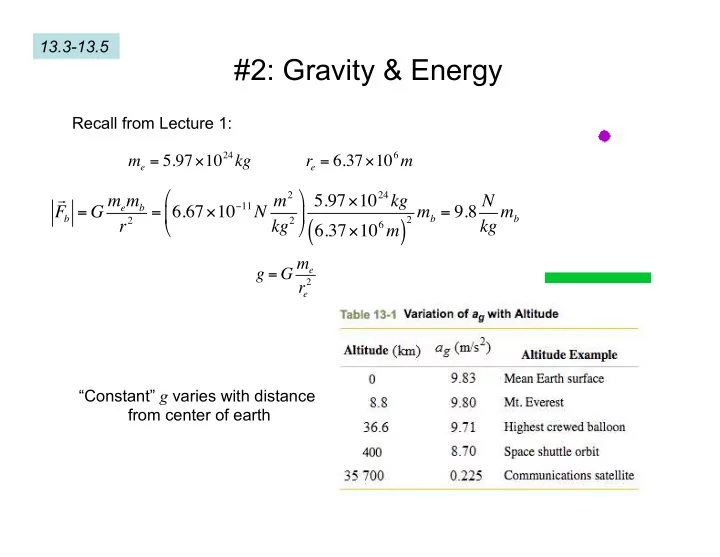
“Constant” g varies with distance from center of earth

slide-2
SLIDE 2
  • 1. Earth is not a perfect sphere

Reality is more complicated

6378 km 6357 km

  • 2. Earth's mass is not distributed uniformly
  • 3. The Earth rotates

 F

net =

 FN − mag = −mω 2r  FN = mag − mω 2r

ω 2r = 2π 86,400s ! " # $ % &

2

r

e = 0.03 m

s2

slide-3
SLIDE 3

Let’s take a journey through the earth.

As you go into earth, does the force that you feel from gravity:

  • A. Increase,
  • B. Decrease,
  • C. Stay the same?

If the density of earth was uniform: At a radius r, only mass enclosed contributes

menc = ρ 4 3 πr3 ! " # $ % & = me r3 r

e 3

ar = G menc r2 = Gρ 4 3 πr ! " # $ % & ag = G me r

e 2 = Gρ 4

3 πr

e

! " # $ % & ar ag = r r

e

But this is a bad assumption: 30% of mass in core (10% volume)

ar = ?

slide-4
SLIDE 4

The figure gives the gravitational acceleration ag for four planets as a function of the radial distance r from the center of the planet, starting at the surface of the planet (at radius R1, R2, R3, or R4). Rank the four planets according to: (a) mass and (b) mass per unit volume, greatest first.

slide-5
SLIDE 5

Gravitational Potential Energy

Wg =  F

g •

 d = mg hi − hf

( )

Near the surface of the earth

 F

g = −mgˆ

j = constant

Ug = mgh Wg = −ΔU NOT Near the surface of the Earth

Let’s send a rocket into space! x

Wg =  F

g ⋅d

r = −GMm r−2

r

i

∫ ∫

dr dWg =  F

g ⋅d

r = −G Mm r2 dr

Wg =

r

i

GMmr−1

= −G Mm r

i

Wg = −ΔU =Ui = −G Mm r

i

Ug = −G Mm r

Escape speed for rocket to leave Earth

E = K +U > 0

1 2 mv2 > G Mm r

i

v > 2GM r

i

= (11 km/s)

slide-6
SLIDE 6

The figure shows six paths by which a rocket

  • rbiting a moon might move from point a to

point b. Rank the paths according to (a) the corresponding change in the gravitational potential energy of the rocket- moon system and (b) the net work done on the rocket by the gravitational force from the moon, greatest first.

slide-7
SLIDE 7

The three spheres with masses mA =80g, mB =10g, and mC =20g, have their centers

  • n a common line, with L=12 cm and

d=4.0 cm. You move sphere B along the line until its center-to-center separation from C is 4.0 cm. How much work is done

  • n sphere B: (a) by you and (b) by the net

gravitational force on B due to spheres A and C?

Ug = −G Mm r UT = −G m1m2 r

12

+ m2m3 r

23

+ m1m3 r

13

" # $ % & '

(3 particles)

slide-8
SLIDE 8

The figure gives the potential energy function U(r) of a 25.0 kg projectile, plotted

  • utward from the surface of a planet of

radius Rs. (a) What speed is required of a projectile launched at the surface if the projectile is to “escape” the planet? (b) If the particle is launched at half that speed, what will be its turning point relative to Rs?