CEE 772: Instrumental Methods in Environmental Analysis Lecture #1 - - PDF document

cee 772 instrumental methods in environmental analysis
SMART_READER_LITE
LIVE PREVIEW

CEE 772: Instrumental Methods in Environmental Analysis Lecture #1 - - PDF document

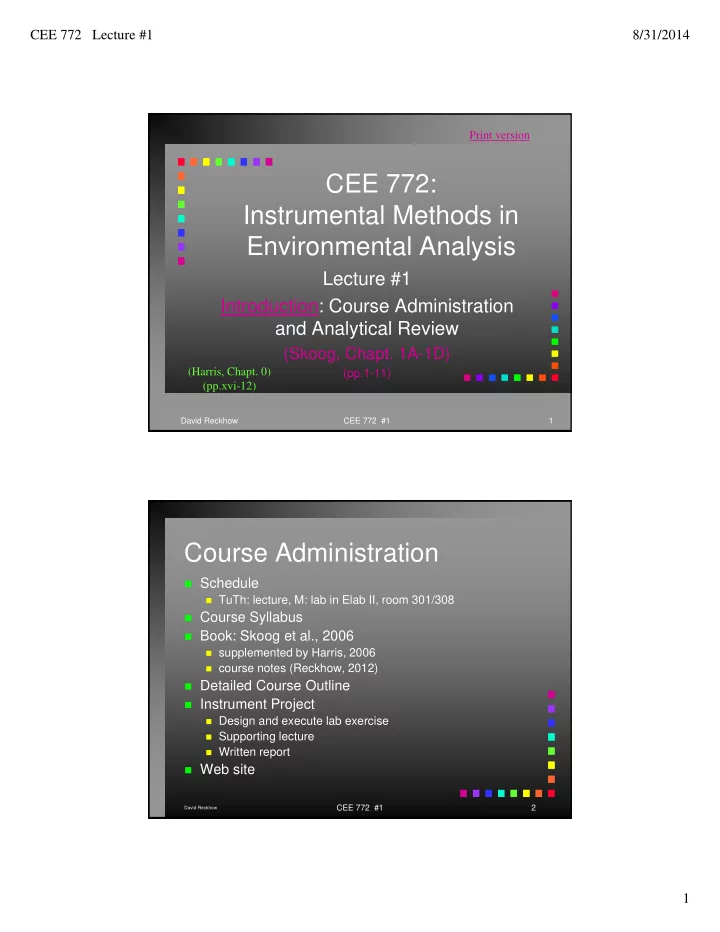
CEE 772 Lecture #1 8/31/2014 Print version CEE 772: Instrumental Methods in Environmental Analysis Lecture #1 Introduction: Course Administration and Analytical Review (Skoog, Chapt. 1A-1D) (Harris, Chapt. 0) (pp.1-11) (pp.xvi-12)


slide-1
SLIDE 1

CEE 772 Lecture #1 8/31/2014 1

David Reckhow CEE 772 #1 1

CEE 772: Instrumental Methods in Environmental Analysis

Lecture #1 Introduction: Course Administration and Analytical Review

(Skoog, Chapt. 1A-1D)

(pp.1-11) (Harris, Chapt. 0) (pp.xvi-12) Print version

David Reckhow

CEE 772 #1 2

Course Administration

 Schedule

 TuTh: lecture, M: lab in Elab II, room 301/308

 Course Syllabus  Book: Skoog et al., 2006

 supplemented by Harris, 2006  course notes (Reckhow, 2012)

 Detailed Course Outline  Instrument Project

 Design and execute lab exercise  Supporting lecture  Written report

 Web site

slide-2
SLIDE 2

CEE 772 Lecture #1 8/31/2014 2

David Reckhow

CEE 772 #1 3

Relation with Environmental Engineering

Environmental Engineering Math Biology Physics Chemistry

David Reckhow

CEE 772 #1 4

Relation with other Chemistry Disciplines

Chemistry

Physical Chemistry Kinetics Thermodynamics Analytical Chemistry

680

Inorganic Chemistry Organic Chemistry

690K

 First of two courses on chemical analysis

slide-3
SLIDE 3

CEE 772 Lecture #1 8/31/2014 3

David Reckhow

CEE 772 #1 5

Questions for Environmental Analytical Chemists

 How do we assess water quality?

 What to measure, when and why

 How do we do it?

 Gravimetry, titrimetry, spectrophotometry, chromatography

 What can chemical analysis tell us?

 What can’t it be used for?

 What is the significance of WQ parameters?

 Metals, nutrients, solids, organics?

 How should samples be collected and preserved?

 How do we spot blunders?

 How sure can we be of the measurements?

David Reckhow

CEE 772 #1 6

Why learn WQ analysis?

 You may have to make these measurement

yourself

 As a consultant  As a utility or industrial employee  As a graduate student

 You may need to interpret and critique water

quality data collected by others

 You may need to select the types of water quality

analyses required for a particular job

slide-4
SLIDE 4

CEE 772 Lecture #1 8/31/2014 4

David Reckhow

CEE 772 #1 7

Review

 Laboratory Basics

 CEE 577  Early Chapters in Harris

 Units

 Mass based  Molarity  Molality  Normality  Mole fraction  Atmospheres

 Chemical

Stoichiometry

 mass balance  balancing equations

 Thermodynamics

 law of mass action  types of equilibria

David Reckhow

CEE 772 #1 8

slide-5
SLIDE 5

CEE 772 Lecture #1 8/31/2014 5

David Reckhow

CEE 772 #1 9

Chemical Equilibria

 Law of mass action

 equilibrium quotients

 Examples

 ion product of water  acid dissociation  precipitation  redox  adsorption  volatilization

David Reckhow

CEE 772 #1 10

Personal Safety

 Lab coats

 Recommended for protection from acids & bases

 Goggles

 Especially important if you don’t wear shatter-

proof glasses

 Gloves

 Latex: good flexibility, but leaky  Butyl rubber: much better

 General

 Avoid loose fitting clothing

slide-6
SLIDE 6

CEE 772 Lecture #1 8/31/2014 6

David Reckhow

CEE 772 #1 11

Lab Safety

 Washes

 Eye wash

 Squeeze bottle  Plumbed fixture

 Drench Shower

David Reckhow

CEE 772 #1 12

Eye wash

 In Attleboro

WTP

slide-7
SLIDE 7

CEE 772 Lecture #1 8/31/2014 7

David Reckhow

CEE 772 #1 13

Lab Safety

 Fire

 Extinguisher  Fire blanket

 General: EH&S safety manual

 http://www.umass.edu/safety/lhs.html

David Reckhow

CEE 772 #1 14

Vapors

 Fume hood

 Face velocities  Sash position  EH&S standards

 http://www.umass.edu/safety/fume-hood.html

slide-8
SLIDE 8

CEE 772 Lecture #1 8/31/2014 8

David Reckhow

CEE 772 #1 15

Disposal

 General waste

 Non recyclables

 Recyclable materials

 Paper, plastic

 Non hazardous Chemical waste

 Organic waste (container with EH&S hazardous waste label)  Aqueous waste (flushed down a drain after pH

neutralization)

 Hazardous wastes

 Definitions  Typical Examples

David Reckhow

CEE 772 #1 16

 To next lecture