2/4/16 Sim 1 February 3, 2016 Sim 1 Lab Results - - PDF document

2 4 16
SMART_READER_LITE
LIVE PREVIEW

2/4/16 Sim 1 February 3, 2016 Sim 1 Lab Results - - PDF document

2/4/16 Sim 1 February 3, 2016 Sim 1 Lab Results Extracellular recording Potential changes in response to a 0.1 n A current pu lse a t Potential changes in response


slide-1
SLIDE 1

2/4/16 1

February ¡ 3, ¡2016 Sim 1 Lab ¡Results Extracellular ¡recording

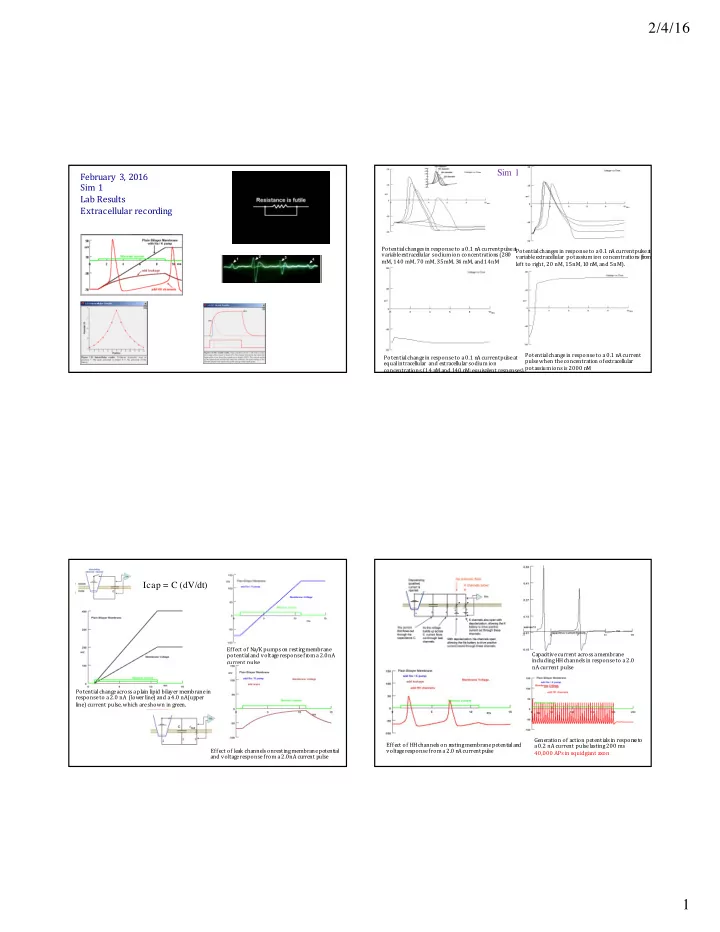
Potential ¡change ¡in ¡response ¡to ¡a ¡0.1 ¡n A ¡current ¡pu lse ¡at ¡ equal ¡intracellular ¡ and ¡extracellular ¡sodium ¡ion ¡ concentrations ¡(14 ¡n M ¡and ¡1 40 ¡n M; ¡equivalent ¡responses) . Potential ¡changes ¡in ¡response ¡to ¡a ¡0.1 ¡n A ¡current ¡pu lse ¡a t ¡ variable ¡extracellular ¡ sodium ¡ion ¡concentration s ¡(28 0 ¡ mM, ¡140 ¡mM, ¡70 ¡mM, ¡35 ¡mM, ¡3 4 ¡mM, ¡and ¡14 ¡nM Potential ¡changes ¡in ¡response ¡to ¡a ¡0.1 ¡n A ¡current ¡pu lse ¡a t ¡ variable ¡extracellular ¡ potassium ¡ion ¡concentration s ¡( fr

  • m ¡

left ¡to ¡right, ¡20 ¡nM, ¡15 ¡nM, ¡1 0 ¡n M, ¡and ¡5 ¡nM). Potential ¡change ¡in ¡response ¡to ¡a ¡0.1 ¡n A ¡current ¡ pulse ¡when ¡the ¡concentration ¡of ¡extracellular ¡ potassium ¡ions ¡is ¡2000 ¡n M

Sim 1

Potential ¡change ¡across ¡a ¡plain ¡lipid ¡bilayer ¡membrane ¡in ¡ response ¡to ¡a ¡2.0 ¡nA ¡ ¡(low er ¡line) ¡and ¡a ¡4.0 ¡nA ¡(up per ¡ line) ¡current ¡pulse, ¡which ¡are ¡shown ¡in ¡green. Effect ¡of ¡Na/K ¡pumps ¡on ¡restin g ¡membrane ¡ potential ¡and ¡voltage ¡response ¡fr

  • m ¡a ¡2.0

¡nA ¡ current ¡pulse Effect ¡of ¡leak ¡channels ¡on ¡resting ¡membrane ¡potential ¡ and ¡voltage ¡response ¡from ¡a ¡2.0 ¡nA ¡cu rrent ¡p ulse

Icap = C (dV/dt)

Effect ¡of ¡HH ¡channels ¡on ¡r esting ¡membrane ¡potential ¡an d ¡ voltage ¡response ¡from ¡a ¡2.0 ¡n A ¡current ¡pu lse Capacitive ¡current ¡across ¡a ¡membrane ¡ including ¡HH ¡channels ¡in ¡response ¡to ¡a ¡2.0 ¡ nA ¡current ¡pulse Generation ¡of ¡action ¡potentials ¡in ¡respon s e ¡to ¡ a ¡0.2 ¡nA current ¡pulse ¡lasting ¡200 ¡ms 40,000 ¡APs ¡in ¡squid ¡giant ¡axon

slide-2
SLIDE 2

2/4/16 2

Summary Sim 1 Hodgkin and Huxley Membrane Model What’s different in signal shape? Voltage divider Lab 1 Neurons: 0.01- 1mm Space constant Changes in Rinput reflect changes in Rm Calculation of Rinput experimentally from a neuron?? V= IRin Rin= V/I

slide-3
SLIDE 3

2/4/16 3

Cm = 1 µF/cm2

Neurons: 1 - 20 ms 200 ms in very large cells Time constant Material basis of thinking RC circuit Synaptic Integration Extracellular Recording

Extracellular recording example: Lobster chemoreceptor response

Extracellular recording example: Lobster stomach motor pattern

slide-4
SLIDE 4

2/4/16 4

Traveling action potential Extracellular Field Potentials Attenuation of signal AP current field Extracellular AP shapes- biphasic Making “sense” of extracellular AP shapes Extracellular AP shapes- monophasic

slide-5
SLIDE 5

2/4/16 5

Extracellular AP shapes- complex Extracellular AP shapes- complex

Data from Gigi and Marek Picture credit: Joannalyn

Complex extracellular AP shapes due to multiple current pathways in saline

Many resistive pathways for current to flow Summary: Recording geometry too complicated to give mechanistic information

Different recording geometries produce different extracellular AP shapes

slide-6
SLIDE 6

2/4/16 6

Hook electrode Suction electrode Also patch clamp

Increase signal strength: Incr ease voltage difference between le ads

Pin electrodes insulated with vasoline

V = IR Amplifier Axon Extracellular fluid

resting potential

Membrane AP to amplifier output How do we apply Ohm’s law?