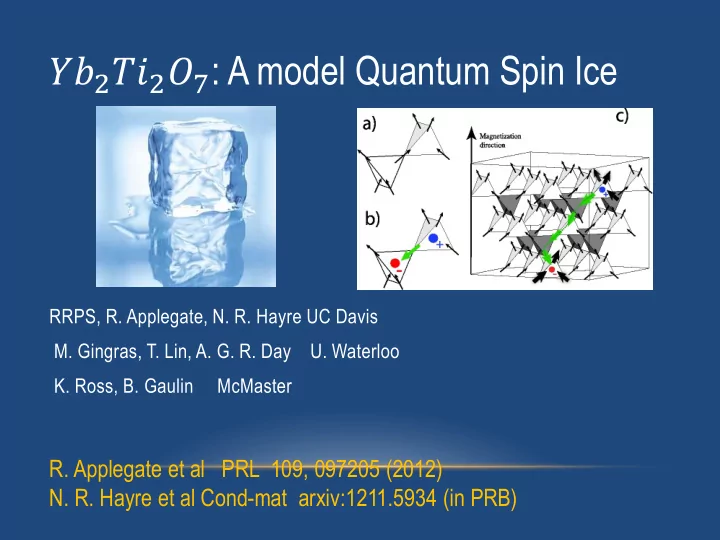
2 2 7 : A model Quantum Spin Ice RRPS, R. Applegate, N. R. Hayre - - PowerPoint PPT Presentation

2 2 7 a model quantum spin ice
SMART_READER_LITE
LIVE PREVIEW

2 2 7 : A model Quantum Spin Ice RRPS, R. Applegate, N. R. Hayre - - PowerPoint PPT Presentation

2 2 7 : A model Quantum Spin Ice RRPS, R. Applegate, N. R. Hayre UC Davis M. Gingras, T. Lin, A. G. R. Day U. Waterloo K. Ross, B. Gaulin McMaster R. Applegate et al PRL 109, 097205 (2012) N. R. Hayre et al


slide-1
SLIDE 1

RRPS, R. Applegate, N. R. Hayre UC Davis

  • M. Gingras, T. Lin, A. G. R. Day U. Waterloo
  • K. Ross, B. Gaulin McMaster

𝑍𝑐2𝑈𝑗2𝑃7: A model Quantum Spin Ice

  • R. Applegate et al PRL 109, 097205 (2012)
  • N. R. Hayre et al Cond-mat arxiv:1211.5934 (in PRB)
slide-2
SLIDE 2
  • Introduction: Frustrated Quantum Spin Systems
  • Ice rules, Spin Ice and Quantum Spin Ice
  • 𝒁𝒄𝟑𝑼𝒋𝟑𝑷𝟖: A model Quantum Spin Ice
  • Is it a Quantum Spin Liquid?
  • Summary and Future Directions

OUTLINE

slide-3
SLIDE 3

Triangle of AFM Ising spins: 6 out of 8 states are ground states

uud udu duu udd dud ddu TLIM: T=0 critical point (Wannier) Ground state entropy under 50% of total entropy KLIM: Finite (short) correlation length even at T=0 Ground state entropy about 72% of total entropy

?

Frustration leads to many degenerate ground states In classical spin systems

slide-4
SLIDE 4

Quantum Fluctuations in a degenerate system can lead to

Selection of Classical Order (Order by Disorder) Lifting of accidental degeneracy due to fluctuations or disorder

Selection of Collinear Order in J1-J2 Heisenberg Model at large J2 Relevant to the Iron Pnictide family Selection of order in XY spin-ice Er2Ti2O7 (Savary et al, Zhitomirsky et al)

slide-5
SLIDE 5

Quantum Fluctuations in a degenerate system can lead to

Novel Order Parameters (e.g. Valence Bond Order)

Quantum superposition allows formation of Valence Bond Singlet pairs Valence Bond Order on a lattice breaks translational symmetry Majumdar-Ghosh Model 1D J1-J2 model Sandvik’s J-Q Model Best studied 2D Model with VBS order

slide-6
SLIDE 6

Quantum Fluctuations in a degenerate system can lead to

A highly resonating quantum superposition --- A Quantum Spin Liquid With Exotic Emergent Properties (RVB): P. W. Anderson Fractional Excitations, Topological Order

Absence of Broken Symmetries, Delocalized spinons

slide-7
SLIDE 7

Essential Ingredients For realistic QSL (in d>1)? Honeycomb Lattice Hubbard Model (Intermediate U? Assaad) Triangular Lattice Hubbard Model (Intermediate U? Motrunich) (Spinon Fermi Surface?) Triangular Lattice Heisenberg Model (LRO) Kagome Lattice Heisenberg Model (Z2 QSL) (Yan, Huse, White) Maximal Frustration? Low dimensionality? Low spin? Near Metal-Insulator Transition?

slide-8
SLIDE 8

Can have fully frustrated systems in 3D (corner sharing tetrahedra) Large J systems can be effectively S=1/2 with strong anisotropy Certain phases are believed to be unstable in 2D not in 3D U(1) QSL What about Quantum Spin Liquids in d=3? Frustration not dimensionality is key for d>1

slide-9
SLIDE 9

ICE RULES AND RESIDUAL ENTROPY

Bernal-Fowler rules for proton configurations in Ice Leads to residual entropy Pauling

slide-10
SLIDE 10

ICE RULES AND SPIN ICE

Spins (on Pyrochlore lattice) are analogs of ice with the same residual entropy (Anderson) Ramirez et al Dy2Ti2O7 Nature 1999 Classical Spin Liquid with Monopoles/Spinons Classical Gauge Fields Castelnovo et al

slide-11
SLIDE 11

POWER-LAW DIPOLAR CORRELATIONS LEAD TO PINCH POINTS IN NEUTRON SCATTERING

Fennel et al Science Ho2Ti2O7

slide-12
SLIDE 12

ADDING QUANTUM FLUCTUATIONS TO SPIN ICE QUANTUM SPIN ICE

Quantum Spin Liquid? (Hermele, Fisher, Balents) (Weak quantum fluctuations on top of a highly degenerate subspace) RVB phase is an emergent Quantum Electrodynamics With 2 sets of conjugate vector gauge fields (E, B) Out of an ensemble of spins can EMERGE – a novel phase with Charges, Monopoles & Photons– a full fledged fictitious Quantum Electrodynamics Second Ice Age --- Leon Balents

slide-13
SLIDE 13

Degenerate Perturbation Theory in the Spin Ice subspace No selection in first two orders

slide-14
SLIDE 14

Effective Hamiltonian is Off-Diagonal Promotes a Highly Resonating State One can add a chemical potential for alternating ring configurations Fine tuning leads to Kivelson-Rokhsar `equal superposition’ state Numerical Support: Bannerjee, Isakov, Damle and Kim PRL 2008 Shannon, Sikora, Pollman, Penc and Fulde PRL 2012

slide-15
SLIDE 15

IS EMERGENT QED REALIZED IN REAL MATERIALS?

NON-ZERO QUANTUM TERMS ARE PRESUMABLY ALWAYS PRESENT

(Dy2Ti2O7, Ho2Ti2O7)? Quantum Fluctuations can not be too small

  • -Will be overwhelmed by classical selection (Dipolar energies)
  • -Time scales will diverge at low T leading to a glassy state (Ice)

Yb2Ti2O7 –substantial quantum fluctuations Exchange Dominated Effective Spin-half Model (Gingras) Best characterized QSI material

slide-16
SLIDE 16

Yb2Ti2O7: Yb Spins on pyrochlore lattice (Ti is non-magnetic) Crystal-field ground state is a Kramer’s doublet well isolated from other states Effective spin-half model Heat capacity shows two peaks. Blote et al 1970s, Ross et al, Youanc et al A broad hump above 2K A sharp peak above 200 mK suggesting a first order phase transition Data has remained largely unexplained for 40 years

slide-17
SLIDE 17

Yb2Ti2O7: Neutron Scattering Ross et al PRL 2009 Neutron Scattering in zero-field shows diffuse Rods along 111--- typical of spin ices but without pinch points Sharpen into Bragg peaks at low T? (Related to the 250mK peak in C?) No sharp spin-waves at low T seen in zero field. Sharp spin-waves appear in a high field Compare from Ho2Ti2O7 Fennel et al Science

slide-18
SLIDE 18

Does this model describe the thermodynamic behavior of Yb2Ti2O7? How do we determine the exchange constants? Nearest neighbor model that respects symmetry of pyrochlore lattice What is a suitable model Hamiltonian? Kramer’s Doublet

slide-19
SLIDE 19

Ross et al PRX : High Field Spectra can be fit to SWT to determine exchange parameters Lack of sharp excitations in low fields suggests QSL

Determining Exchange Parameters Spin-waves in a large polarizing field

slide-20
SLIDE 20

3 VERY DIFFERENT SETS OF EXCHANGE PARAMETERS CLAIMED

Ross et al (PRX 2012) (High field neutron spin-wave spectra) Jzz=0,17 \pm 0.04, Jpm =0.05 \pm 0.01, Jpmpm=0.05 \pm 0.01, Jzpm=-0.14\pm 0.01 (meV) Thompson et al, Chang et al (RPA based fits of zero-field structure factor) Jzz=0.01, Jpm=0.035, Jpmpm=0.01 Jzpm=-0.0424 Can any of these describe the observed thermodynamic behavior (Note Jzz leads to classical spin ice)

slide-21
SLIDE 21

HIGH TEMPERATURE EXPANSIONS

Coefficients can be calculated by Linked Cluster Method (LCM) Oitmaa, Hamer, Zheng (Book) How well does this model describe thermodynamic properties?

slide-22
SLIDE 22

HIGH FIELD EXPANSIONS

Treat H1 as perturbation. Use interaction representation to expand extensive properties In powers of J/h (at T=0) + exponentially small corrections at low-T (exp(-c h/T)) Coefficients can be calculated by Linked Cluster Methods

slide-23
SLIDE 23

EXACT DIAGONALIZATION

Easy if cluster size is small enough Need PBC to avoid huge finite size effects Becomes less useful with increased dimensionality and coordination number

slide-24
SLIDE 24

NUMERICAL LINKED CLUSTER EXPANSION

Combines Linked Cluster + ED (Rigol, Bryant, RRPS PRL)

Obtained for any set of parameters (T, h, J, ……) Numerically exact at high T (builds in HTE) Numerically exact at high fields (builds in HFE) Correct short distance Physics Ideal for Spin-Ice (Using tetrahedral clusters)

slide-25
SLIDE 25

High Temperature Expansions: Weights of larger cluster are down by powers of 1/T High Field Expansions: Weights of larger clusters are down by powers

  • f 1/h.

ED: Exact short distance physics Tetrahedral Clusters: `Ice rules’ always have a chance to hold. Classical Ising Model: First Order NLC – Single Tetrahedron– Pauling Approximation

NUMERICAL LINKED CLUSTER EXPANSION

slide-26
SLIDE 26

NUMERICAL LINKED CLUSTER EXPANSION T=0 ENTROPY (ISING MODEL ON PYROCHLORE)

P = 𝑀 𝑑 ∗ 𝑋(𝑑) (Lattice Constant L, Weight W) Cluster 0: Single Site: S(0) = ln(2); W(0) = ln(2); L(0)=1;

S/N=ln(2)

Cluster 1: One tetrahedron: S(1) =ln(6); W(1)=ln(6)-4ln(2)= ln(6/16); L(1)=1/2;

S/N=ln(2) + (1/2) ln(6/16)= (1/2) ln(3/2) (Pauling) Ist Order NLC: Corresponds to Pauling Approx. Accurate to a few percent down to T=0 for S, C, χ RRPS and J. Oitmaa PRB 2012

slide-27
SLIDE 27

NLC TO 4TH ORDER

13 site clusters with no lattice symmetry 8192x8192 complex matrices ED required 2-4 GB of memory Next order: 16-site clusters memory goes up by factor of 64 Euler Extrapolation: Eliminates Leading Alternation (which sets in at low temperatures) Missing: How to extrapolate for singular behavior and long-range correlations

slide-28
SLIDE 28

Specific Heat: YbTO (Ross et al parameters)

slide-29
SLIDE 29

Other exchange parameter sets do not have the correct energy scale Blote data is closest to parameters proposed by Ross et al

Different exchange parameters proposed for YbTO

slide-30
SLIDE 30

3 Different Field Directions [110] [100] [111] No adjustment in parameters (J,g) Demag Corrected

YbTO: Magnetization in a Field

The exchange QSI model works really well for the material

slide-31
SLIDE 31

DEMAG CORRECTED MAGNETIZATION

1 Tesla Various NLC orders and experimental data

Agreement is remarkable with no adjustment of parameters

slide-32
SLIDE 32

Theory: Start from k ln(2) entropy at T=infinity Experiment: Start with zero entropy at T=100 mK Very good agreement: Regime of temperature between peaks has Pauling entropy But, no definite plateau

Heat Capacity and Entropy of YbTO:

slide-33
SLIDE 33

WHAT IS THE T=0.24 K TRANSITION?

NUMERICAL STUDY FAILS

DIAL DOWN QUANTUM FLUCTUATIONS

Hope the physics is smoothly connected We have 3 quantum terms Jpm, Jpmpm and Jzpm The largest of which is Jzpm The latter dominates perturbation theory

slide-34
SLIDE 34

Interference of various terms leads to substantially enhanced FM same-sublattice coupling. It leads to selection of q=0 GS. Spin-Ice degeneracy is lifted leaving only 6 ground states. These states also cant slightly to develop a [100] moment.

slide-35
SLIDE 35

WHAT IS THE T=0.24 K TRANSITION? ORDER BY DISORDER?

Low T peak in specific heat associated with q=0 FM order?

Classical Loop Monte Carlo on Effective Classical Model First Order Transition + Clear entropy plateau for small lambda

slide-36
SLIDE 36
  • WHY NO SPIN-WAVES IN LOW FIELDS?

Despite fully ordered ground state dynamics remains non-trivial Flipping a spin creates a spinon-antispinon pair That can separate quite far Hopping is order lambda while Tension is order lambda squared Composite spin-waves : Spinon pairs with long strings

slide-37
SLIDE 37

TCHERNYSHYOV: NEUTRONS SHOULD SEE MANY BRANCHES

Perturbative regime should share this physics We are working on S(q,omega) Experiments on YbTO?

slide-38
SLIDE 38

DOES THIS PICTURE CONTINUE TO LAMBDA=1?

Two peaked structure but no definite separation of LRO and SRO No clear Pauling-Like regime

slide-39
SLIDE 39

DEFECT (MONOPOLE/SPINON) DENSITY (NLC)

Increasing lambda, intermediate regime is not simply classical Spin Ice Strong Renormalization of low energy physics Staying within the spin-ice subspace is inconsistent with quantum terms Would pinch points arise?

slide-40
SLIDE 40

HEAT CAPACITY IN A FIELD [110]

Peak tracks proposed Phase Diagram for the paramagnet/ferromagnet transition and onset of sharp excitations in high fields Ross et al PRL 2009 Peak splits in two near h=0.5 T (shoulder develops) Euler Transforms 3rd and 4th Order. At strong fields (>1T) 2nd order is good enough

slide-41
SLIDE 41

FIELD DEPENDENCE OF ENTROPY EVIDENCE FOR FM [100] ORDER?

Entropy removed at high T for field along 100. Shoulder/Plateau in entropy persists for fields in some directions. Very suggestive of degeneracies in MFT (Phase Transition in a field except 100) Needs more experimental study.

slide-42
SLIDE 42

EXPERIMENTAL SEARCHES FOR LRO

  • Experimental detection of LRO remains very controversial
  • Majority of experiments argue there is no LRO

Note: Its detection is masked by large nuclear peaks Large variation from material to material (especially in Single crystals) Are there other weaker terms present which are only important at low temperature and low fields (lead to QSL?)? Or is it due to domain formation? (FC along 100 should remove them)

slide-43
SLIDE 43
  • YbTO is rather well described by a nearest-neighbor anisotropic exchange QSI model

at least at not too low temperatures and high fields

  • Double-peaked Heat Capacity (SRO+LRO)
  • Weak Quantum Regime: Intermediate Temperature is Spin Ice
  • Low T: Conventional GS + Composite Excitations
  • Physics of YbTO is essentially the same? (Expts: String excitations?)
  • QSI but not QSL ?
  • Final answer has to come from experiments

Summary

slide-44
SLIDE 44

YbTO is a QSI but most probably not a QSL but Theoretical methodology is in place (High field spectra/ Thermodynamics) Experimental techniques are in place (Neutron Scattering Broholm) Many variety of spin-ice materials We should have a QSL in QSI in next two years: Leon Balents

Looking Beyond Yb2Ti2O7

Savary and Balents PRL

slide-45
SLIDE 45

THE END

THANK YOU