2/2/2014 Psychometric Reanalysis of Happiness, Temperament, and - - PDF document

2 2 2014
SMART_READER_LITE
LIVE PREVIEW

2/2/2014 Psychometric Reanalysis of Happiness, Temperament, and - - PDF document

2/2/2014 Psychometric Reanalysis of Happiness, Temperament, and Spirituality Scales with Children in Faith-Based Elementary Schools Research Presentation Richard E. Cleveland Georgia Southern University Monday February 3 rd , 2014 Room1100-J


slide-1
SLIDE 1

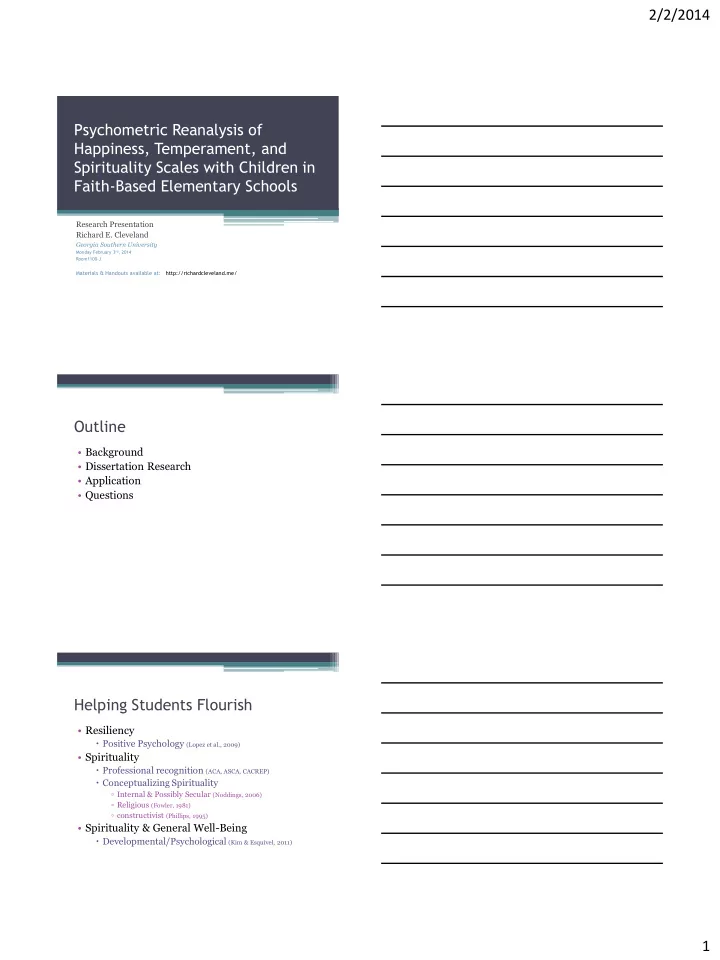
2/2/2014 1 Psychometric Reanalysis of Happiness, Temperament, and Spirituality Scales with Children in Faith-Based Elementary Schools

Research Presentation Richard E. Cleveland

Georgia Southern University

Monday February 3rd, 2014 Room1100-J

Materials & Handouts available at: http://richardcleveland.me/

Outline

  • Background
  • Dissertation Research
  • Application
  • Questions

Helping Students Flourish

  • Resiliency

 Positive Psychology (Lopez et al., 2009)

  • Spirituality

 Professional recognition (ACA, ASCA, CACREP)  Conceptualizing Spirituality

▫ Internal & Possibly Secular (Noddings, 2006) ▫ Religious (Fowler, 1981) ▫ constructivist (Phillips, 1995)

  • Spirituality & General Well-Being

 Developmental/Psychological (Kim & Esquivel, 2011)

slide-2
SLIDE 2

2/2/2014 2 Holder, Coleman & Wallace (2010)

  • Correlations between Spirituality, Religiosity &

Happiness in Children

▫ 3 Happiness (FACES, OHQ-SF, SHS) ▫ 1 Spirituality (SWBQ) ▫ 1 Religiosity (PBS) ▫ 1 Temperament (EAS)

  • Spirituality, but not Religiosity, correlated to

Happiness

But What About Children?

  • Instruments Created/Administered with Adult

Samples

 Dissimilar samples  Developmental level of item wording  Exploratory Factor Analysis

Guiding Questions

  • Revisiting Holder, Coleman & Wallace (2010)
  • Guiding Questions:

▫ Are the instruments psychometrically sound? ▫ Are the derived factors similar to the original theorized structures?

slide-3
SLIDE 3

2/2/2014 3 Sample

  • 2 ES Schools
  • Classroom teacher

administration

  • Return rate approx. 92%

ES1 n ES2 n N Gender Male 110 105 215 Female 118 95 213 Missing 2 7 9 Total 230 207 437 Grade Level 4th Grade 71 62 133 5th Grade 62 75 137 6th Grade 94 70 164 Missing 3 3 Total 230 207 437

  • The FACES Scale (FACES)
  • Oxford Happiness Questionnaire Short Form (OHQ-SF)
  • Subjective Happiness Scale (SHS)
  • Spiritual Well-Being Questionnaire (SWBQ)
  • Practices & Beliefs Scale – Behaviors (PBS-B)
  • Emotionality Activity and Sociability Temperament

Survey (EAS)

Methodology

  • Aggregated Dataset

▫ Descriptive Statistics

  • Instruments

▫ Descriptive Statistics ▫ Reliability & Factorial Validity ▫ Exploratory Factor Analysis (PAF)

slide-4
SLIDE 4

2/2/2014 4 Skewness & Kurtosis

  • EFA Parameters

▫ Skewness <│2│ ▫ Kurtosis <│7│

(Fabrigar & Wegener, 2012)

SWBQ Item #06 “I worship God.”

Parallel Analysis

  • Determining the appropriate

number of factors ▫ Random data generated in a parallel (similar) model ▫ Non trivial components in the model influence both raw & random data ▫ Eigenvalues: Raw > Random ▫ SPSS Syntax O’Connor (2000)

(Fabrigar & Wegener, 2012; Fabrigar, Wegener, MacCallum, & Strahan, 1999; Hayton, Allen, & Scarpello, 2004; O’Connor, 2000)

Results

FACES Scale

(Andrews & Withey, 1976)

  • Likert-type Scale
  • 7 facial drawings
  • Limited

% of Ratings Within Categories of FACES Scale

Dissertation Holder et

  • al. (2010)

Very Unhappy .23 .00 Unhappy 1.83 .00 Somewhat Unhappy 3.21 3.00 Neutral 13.30 7.00 Somewhat Happy 29.82 19.00 Happy 37.16 47.00 Very Happy 14.45 24.00

slide-5
SLIDE 5

2/2/2014 5 Results

PBS-B

(Holder et al., 2010)

  • Indices of sampling adequacy
  • EFA (PAF) no rotation
  • Scree Plot & Parallel Analysis
  • Support theorized

unidimensionality

  • Less than adequate

Factor Loadings (PBS-B)

Item Factor Item 2: I pray or meditate .61 Item 3: I read religious books .53 Item 1: I go to a place of worship .45 Eigenvalue .86 % of Variance 28.74 Cronbach’s Alpha .54

Results

OHQ-SF

(Hills & Argyle, 2002)

  • Indices of sampling adequacy
  • EFA (PAF) no rotation
  • Scree Plot & Parallel Analysis
  • Support theorized

unidimensionality

  • Reasonable

Factor Loadings (OHQ-SF)

Item Factor Item 3: comfortable with my life .75 Item 1: happy with way I am .73 Item 2: life is rewarding .67 Item 6: time to do what I enjoy .54 Item 8: happy memories of the past .53 Item 5: see beauty around me .50 Item 4: think I look attractive .47 Item 7: pay attention .35 Eigenvalue 2.72 % of Variance 33.95 Cronbach’s Alpha .79

Results

SHS

(Lyubomirsky & Lepper, 1999)

  • Indices of sampling adequacy
  • EFA (PAF) no rotation
  • Scree Plot & Parallel Analysis
  • Support theorized

unidimensionality

  • Reasonable

Factor Loadings (SHS)

Item Factor Item 1: usually happy .78 Item 2: happier than most kids .76 Item 3: enjoy life most of time .59 Item 4: want to be happier .12 Eigenvalue 1.55 % of Variance 38.69 Cronbach’s Alpha .60

slide-6
SLIDE 6

2/2/2014 6 Results

SWBQ

(Gomez & Fisher, 2003)

  • Indices of sampling

adequacy

  • EFA (PAF) oblimin rotation
  • Scree Plot & Parallel

Analysis

  • Support theorized 4

dimensional model Factor Inter-Correlation Matrix (SWBQ)

Factor 1(C) 2(E) 3(T) 4(P) 1(C) .40

  • .48

.54 2(E)

  • .23

.41 3(T)

  • .34

4(P) Eigenvalue

6.39 2.26 1.19 .46

% of Variance

31.93 11.27 5.96 2.31

Cronbach’s Alpha

.77 .88 .86 .70

  • Note. C = Communal; E = Environmental; T = Transcendental; P = Personal.

Factor Loadings (SWBQ)

Item 1 (C) 2 (E) 3 (T) 4 (P) h2

Item 19: I am kind to other people (C) .83 .68 Item 17: I respect other people (C) .76

  • .13
  • .10

.60 Item 8: I trust other people (C) .49 .13 .26 Item 1: I love other people (C) .42 .11 .24 .25 Item 3: I forgive other people (C) .42 .11

  • .20

.23 Item 10: I like being in nature (E) .91

  • .13

.85 Item 4: I enjoy nature (E) .91

  • .12

.84 Item 12: I feel peaceful in nature (E) .69 .47 Item 20: I feel special in nature (E) .66 .12 .45 Item 7: I feel joyous when I am outside (E) .51 .28 .33 Item 11: I feel close to God (T)

  • .96

.91 Item: 2: I feel close to God (T)

  • .93

.86 Item 6: I worship God (T)

  • .77

.59 Item 15: I pray (T) .13

  • .57

.35 Item 13: I am at peace with God (T)

  • .57

.21 .36 Item 14: I am joyful (P) .29 .45 .29 Item 18: I have meaning in life (P) .44 .21 Item 5: I really know myself (P) .40 .18 Item 16: I am peaceful (P) .34 .39 .26 Item 9: I leave about myself (P) .18 .33 .14

  • Note. Loadings > .40 are in bold and underlined. Delta = 0.00; Loadings < .10 are omitted; C = Communal; E = Environmental; T =

Transcendental; P = Personal.

Results

SWBQ

(Gomez & Fisher, 2003)

  • Indices of sampling

adequacy

  • EFA (PAF) oblimin

rotation

  • Scree Plot & Parallel

Analysis

  • Support theorized 4

dimensional model

  • Adequate

Factor % Variance (SWBQ)

Factor

Eigenvalue % of Variance Cronbach’s Alpha

Communal

6.39 31.93 .77

Environmental

2.26 11.27 .88

Transcendental

1.19 5.96 .86

Personal

.46 2.31 .70

slide-7
SLIDE 7

2/2/2014 7 Results

EAS

(Buss & Plomin, 1984)

  • Indices of sampling

adequacy

  • EFA (PAF) oblimin

rotation

  • Scree Plot & Parallel

Analysis

Factor Inter-Correlation Matrix (EAS) Factor 1 2 3 4 5 6

1 .19

  • .06

.43

  • .31
  • .16

2 .12 .21 .06

  • .36

3

  • .14

.02

  • .24

4

  • .30
  • .06

5 .01 6 Eigenvalue 4.43 1.65 .98 .83 .59 .41 % of Variance 22.14 8.25 4.90 4.16 2.95 2.04

Factor Loadings (EAS – Initial Rotated Extraction) Item 1 2 3 4 5 6 h2

Item 16R: I get upset easily (ED) .78 .60 Item 8R: I get angry easily (EA) .77 .60 Item 18: It takes a lot to upset me (EA) .64 .40 Item 13R: I get annoyed easily (EA) .51 .26 Item 1: I like to be with people (S) .79 .63 Item 15: I like to work with other people (S) .69 .47 Item 20: I would rather spend time with people than do anything else (S) .43 .18 Item 10: I am always doing things (A) .56 .32 Item 2: I usually seem to be in a hurry (A) .53 .28 Item 7: I like to be busy (A) .00 Item 11R: I feel nervous about things that happen every day (ED) .72 .52 Item 4R: I am usually stressed (ED) .53 .28 Item 6R: I often feel alone (S) .52 .27 Item 9R: I feel frustrated a lot (ED) .49 .50 .48 Item 12: I usually feel confident (EF) .40 .16 Item 3R: I am easily frightened (EF)

  • .70

.48 Item 14R: I panic when I get scared (EF)

  • .55

.30 Item 19: I only have a few fears (EF)

  • .54

.29 Item 5: I let people know when I am unhappy (EA)

  • .48

.23 Item 17: I have a lot of energy (A)

  • .33

.11

  • Note. R = reverse-coded item; EA = Emotionality: Anger; ED = Emotionality: Distress; EF = Emotionality: Fearfulness; A = Activity; S =

Sociability; Loadings > .40 are in bold and underlined; PAF delta = 0.00; loadings < .10 are omitted.

Results

EAS

(Buss & Plomin, 1984)

  • Scree Plot & Parallel

Analysis suggest 2-factor model

  • Oblimin delta increased

for parsimonious solution

Factor Inter-Correlation Matrix (EAS) Delta Value r

  • .20

.05 .00 .05 .20 .06 .40 .06 .60 .08 .80 .24

slide-8
SLIDE 8

2/2/2014 8

Factor Loadings (EAS – Final Rotated Extraction) Item 1 2 h2

Item 16R: I get upset easily (ED) .78

  • .12

.62 Item 8R: I get angry easily (EA) .75 .56 Item 9R: I feel frustrated a lot (ED) .72 .14 .53 Item 14R: I panic when I get scared (EF) .63

  • .33

.50 Item 4R: I am usually stressed (ED) .62 .10 .40 Item 13R: I get annoyed easily (EA) .61 .37 Item 6R: I often feel alone (S) .49 .24 Item 3R: I am easily frightened (EF) .49

  • .26

.31 Item 18: It takes a lot to upset me (EA) .49 .24 Item 11R: I feel nervous about things that happen every day (ED) .49 .24 Item 12: I usually feel confident (EF) .43 .21 .23 Item 2: I usually seem to be in a hurry (A)

  • .36

.13 Item 19: I only have a few fears (EF) .34

  • .11

.13 Item 1: I like to be with people (S) .63 .40 Item 15: I like to work with other people (S) .61 .37 Item 20: I would rather spend time with people than do anything else (S) .53 .28 Item 5: I let people know when I am unhappy (EA)

  • .16

.33 .14 Item 17: I have a lot of energy (A) .12 .31 .11 Item 7: I like to be busy (A) .23 .05 Item 10: I am always doing things (A)

  • .12

.16 .04

  • Note. R = reverse-coded item; EA = Emotionality: Anger; ED = Emotionality: Distress; EF = Emotionality: Fearfulness; A = Activity; S =

Sociability; Loadings > .40 are in bold and underlined; PAF delta = 0.00; loadings < .10 are omitted.

Results

EAS

(Buss & Plomin, 1984)

  • Not supportive of

theorized 5 dimensional model

  • Inadequate

Factor % Variance (EAS)

Factor

Eigenvalue % of Variance Cronbach’s Alpha

Emotionality

4.28 21.41 .81

Sociability

1.52 7.61 .55

Summary of Results

  • Empirical Support

▫ PBS-B, OHQ-SF, SHS, SWBQ

  • Reliability with Children

▫ Lower: PBS-B, SHS, SWBQ ▫ Higher: OHQ-SF

  • Adequate Measures

▫ OHQ-SF, SHS, SWBQ

slide-9
SLIDE 9

2/2/2014 9 Limitations

  • Sampling
  • Instrument Administration
  • EAS Instrument

Sampling

  • Purposeful sampling
  • ES-aged (4th through 6th) respondents
  • Majority identifying as European American/White

Instrument Administration

  • Classroom teach administered
  • Minimal researcher footprint
  • IRB requirements
slide-10
SLIDE 10

2/2/2014 10 EAS (Buss & Plomin, 1984)

  • Based on 4-dimensional model of

temperament (EASI, 1973)

  • High correlations between Emo↔Act

and Soc ↔ Imp

  • Emotionality & Activity items revised,

Impulsivity dropped (EASI-II, ~1975)

  • New York Longitudinal Study paired

with 54 EASI-II items (EAS, 1977)

  • Sociability & Shyness distinct and not a

continuum

  • Sociability revised/renamed Shyness and

“experimental” Sociability created (EAS, 1984)

EASI: Emotionality, Activity, Sociability, & Impulsivity (1973) EASI-II: Emotionality, Activity, & Sociability (~1975) EAS: Emotionality, Activity, & Sociability (1977) EAS: Emotionality, Activity, & Shyness – Experimental Sociability (1984)

Future Research Possibilities

  • Foundation for Correlational Analyses
  • Instrument Refinement

▫ PBS-B ▫ SHS

  • Defining the EAS

▫ Clarifying the most recent version ▫ Administering as self-report with children

  • Psychometrics of Mindfulness Instruments

▫ Exploratory Factor Analysis

Application

  • Empirical Support

▫ Happiness/Subjective Well-Being (SWB) ▫ Spirituality & Religiosity

  • Clinical Settings

▫ Sound Instruments for Children

  • P-12 Educational Settings

▫ “Expansion” of School Climate (Cohen, 2010) ▫ School Improvement Plans (SIP)

slide-11
SLIDE 11

2/2/2014 11 Questions & Conversation

Image retrieved from: http://xkcd.com/