
SLIDE 1
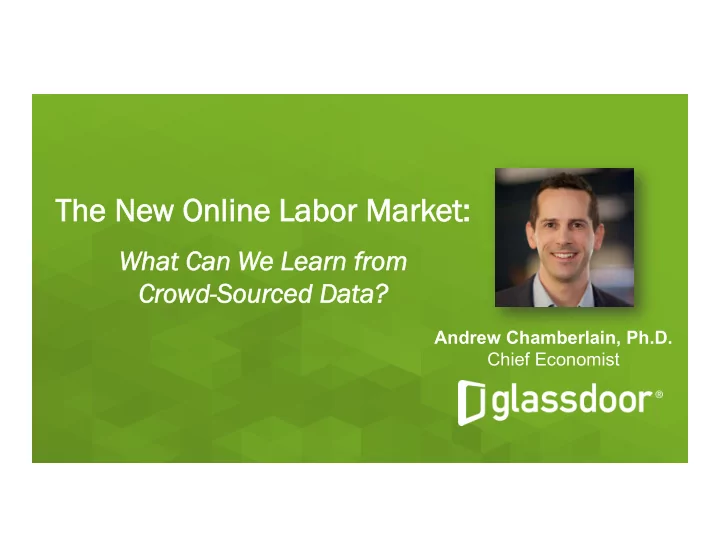
The The Ne New Online w Online Labo Labor Mar r Market: t:
What Can W What Can We Learn fr e Learn from m Cr Crowd-So wd-Sourced Data? urced Data?
Andrew Chamberlain, Ph.D. Chief Economist
The The Ne New Online w Online Labo Labor Mar r Market: t: - - PowerPoint PPT Presentation
The The Ne New Online w Online Labo Labor Mar r Market: t: What Can W What Can We Learn fr e Learn from m Cr Crowd-So wd-Sourced Data? urced Data? Andrew Chamberlain, Ph.D. Chief Economist What do these 5 companies have in common? 2
The The Ne New Online w Online Labo Labor Mar r Market: t:
What Can W What Can We Learn fr e Learn from m Cr Crowd-So wd-Sourced Data? urced Data?
Andrew Chamberlain, Ph.D. Chief Economist
What do these 5 companies have in common?
2
3
4
Crowd-sourced data can offer
market, and creates new
tech world.
5
data?
6
What is Glassdoor?
7
to help people everywhere find a job and company they love
Mission:
8
Reviews Salaries Benefits
“Exceptional benefits package”
Interviews Photos CEO Approval
Powerful Combination
9
The Glassdoor Marketplace
Contributes Builds
Community
Attracts
Audience
Job Seekers & Employers
Content
Jobs + UGC
Employers
Hire Great Talent
Job Seekers
Find the jobs they love!
10
29M
Monthly UUs
10M
Reviews
445K
Companies
190
Countries
50+%
Mobile
11
12
How We Collect Data
The Give-to-Get Model:
This provides a powerful economic incentive to contribute, and overcomes many selection bias problems. Job search
Leave a salary
access. Find Glassdoor
13
14
“Good” salary data should look like this
15
Salaries are famously log-normally distributed
Salary
16
Glassdoor salaries look like this: Census Bureau salaries look like this:
17
“Good” online reviews data should look like this:
A balanced assessment
Not this: Polarized by positive and negative selection bias.
Individual company reviews look like this
18
For most employers, we get a balanced assessment of pros and cons.
Combining those three employers we get:
19
Combining all companies
It’s the “central limit theorem” in action!
Takeaways
20
selection bias.
survey platform.
data.
What are some research ideas using Glassdoor data?
21
22
#1: Do companies with satisfied employees outperform the stock market?
23
dramatically outperform the S&P 500.
employee satisfaction on financial performance.
Sources: Chamberlain, Andrew (2015). “Does Company Culture Pay Off? Analyzing Stock Performance of ‘Best Places to Work’ Companies,” Glassdoor Economic Research report. Huang, Minjie et al. (2015). “Family Firms, Employee Satisfaction, and Corporate Performance,” Journal of Corporate Finance, Vol. 34, pp. 108-127.
24
review and salary report.
wages => 1% higher satisfaction.
and senior leadership.
#2: Does money buy happiness at work?
Source: Mario Nunez, “Does Money Buy Happiness? The Link Between Salary and Employee Satisfaction,” Glassdoor Research, June 2015.
Salary is not the main driver of job satisfaction
25
#3: Do more difficult job interviews improve job matching?
26
and a company review.
matches.
Source: Andrew Chamberlain and Ayal Chen-Zion, “Do Difficult Job Interviews Lead to More Satisfied Workers? Evidence from Glassdoor Reviews,” Glassdoor Economic Research report, October 2015.
27
28
29
interview reviews in six countries.
controlling for business cycle, industry and more. (+3.3 to 3.7 days)
checks, skills tests, presentations, etc. for more complex jobs.
#4: Are hiring delays getting longer? Why?
Source: Andrew Chamberlain, “Why Is Hiring Taking Longer? New Insights from Glassdoor Data,” Glassdoor Economic Research, June 2015.
30
31
32
33
an industry or city.
“revealed network” of competition for talent.
employers are hugely influential in the labor market.
#5: Who Competes for Workers in the Labor Market?
Source: Ayal Chen-Zion, “Who Competes for Job Seekers? Visualizing the Labor Market with Glassdoor Data,” Glassdoor, September 2015.
34
America’s Most Influential Employer: Oracle is the 800-pound gorilla of the labor market.
35
Amazon competes for workers both at tech companies and local Seattle firms.
36
Target’s wage
influential at home improvement stores than traditional retail.
What can economists contribute to the tech world of crowd-sourced data?
37
Why Tech Companies Love Economists
38
trained in social data.
in human behavior –online or offline.
questions and see the big picture in messy data.
39
Qu Questio stions? Ple ns? Please ase re reach o ach out. t.
andrew.chamberlain@glassdoor.com @adchamberlain
Andrew Chamberlain, Ph.D. Chief Economist
glassdoor.com/research
#Glassdoor