2 2 2 If x, y, and z are x y z + + = 1 principal - - PowerPoint PPT Presentation

2 2 2 if x y and z are x y z 1 principal axes of 2 2 2
SMART_READER_LITE
LIVE PREVIEW

2 2 2 If x, y, and z are x y z + + = 1 principal - - PowerPoint PPT Presentation

What equations describe the Index ellipsoid? 2 2 2 If x, y, and z are x y z + + = 1 principal axes of 2 2 2 n n n the crystal. x y z For arbitrary 1 1 1


slide-1
SLIDE 1

1

What equations describe the Index ellipsoid?

OPTI 500, Spring 2012, Lecture 6, Electro-Optic Modulators, Optical Transmitters

2 2 2 2 2 2

1

x y z

x y z n n n

′ ′ ′

′ ′ ′ + + =

2 2 2 2 2 2 1 2 3 2 2 2 4 5 6
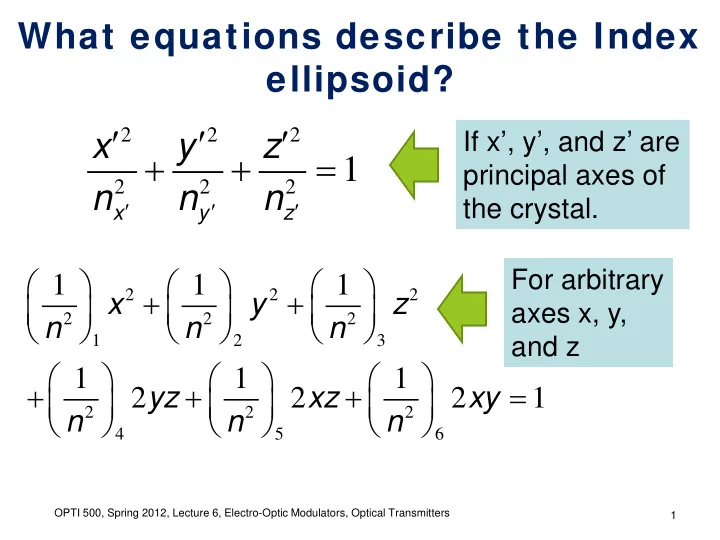
1 1 1 1 1 1 2 2 2 1 x y z n n n yz xz xy n n n       + +                   + + + =            

If x’, y’, and z’ are principal axes of the crystal. For arbitrary axes x, y, and z

slide-2
SLIDE 2
  • The waves that can propagate as linearly

polarized waves have polarization along the major and minor axes of the ellipse perpendicular to the wavevector k.

OPTI 500, Spring 2012, Lecture 6, Electo-Optic Modulators, Optical Transmitters 2

How do w e use the index ellipsoid?

x y z k (0,ny,0) (0,0,nz) (nx,0,0) θ

slide-3
SLIDE 3
  • nx = ny = no
  • There is always a linearly polarized wave, called

the ordinary wave, that “sees” a refractive index no, regardless of the direction of propagation.

OPTI 500, Spring 2012, Lecture 6, Electo-Optic Modulators, Optical Transmitters 3

What is special about uni-axial crystals?

x y z k (0,ny,0) (0,0,nz) (nx,0,0) θ

slide-4
SLIDE 4
  • The magnitude and/or direction of the applied

electric fields.

OPTI 500, Spring 2012, Lecture 6, Electo-Optic Modulators, Optical Transmitters 4

What changes in the modulator to cause constructive interference to become destructive?

Electrode Electrode Metal Electrode x z y Optical Waveguide Optical Input Modulated Optical Output Radiation Modes

slide-5
SLIDE 5
  • A large refractive index enhances the

electro-optic effect.

OPTI 500, Spring 2012, Lecture 6, Electo-Optic Modulators, Optical Transmitters 5

Are there any important corrections to the notes?

( )

2 13

1 2

z

  • z

n E n n r E = −

( )

2 33

1 2

e z e

  • z

n E n n r E = −

( ) ( )

3 13 3 33

1 2 1 2

  • z
  • z

e z e e z

n E n n r E n E n n r E = − = −

slide-6
SLIDE 6

OPTI 500, Spring 2012, Lecture 6, Electo-Optic Modulators, Optical Transmitters 6

How did w e get the equations for LiNbO3?

2 1 2 2 22 13 22 13 2 2 2 3 1 2 33 51 2 4 51 22 2 5 2 6

1 1 1 1 1 1 1 1

z

n n r r r r r n n n r r E r n r n n     ∆            ∆     −                   ∆ ∆ = ∆ =                       = ⋅ ⇒               ∆              −       ∆            ∆       

13 33 2 3

1

z z

E r E n   ∆ =    

slide-7
SLIDE 7

OPTI 500, Spring 2012, Lecture 6, Electo-Optic Modulators, Optical Transmitters 7

How did w e get the equations for LiNbO3?

( )

33 2 3 2 2 3 3 3 3 33 33

1 taking a derivative we find: 1 1 1 2 1 1 and 2 2

z e e e e e z e z e e z

r E n n n n n n n r E n E n n r E   ∆ =       ∆ = ∆ = − ∆     ⇒ ∆ = − = −

slide-8
SLIDE 8

OPTI 500, Spring 2012, Lecture 6, Electo-Optic Modulators, Optical Transmitters 8

How does LiNbO3 compare w ith

  • ther electro-optic materials?

From “Optoelectronics” by Pollock

slide-9
SLIDE 9

OPTI 500, Spring 2012, Lecture 6, Electo-Optic Modulators, Optical Transmitters 9

Can w e have a quadratic electro-

  • ptic effect?

( )

2 1 2

Refractive Index ( ) n E n a E a E Linear Kerr Effect Electro

  • ptic

Effect Pockels Effect = + + −