2/12/2014 Roberta A. Gottlieb, M.D. Roberta A. Gottlieb, M.D. - - PDF document

2 12 2014
SMART_READER_LITE
LIVE PREVIEW

2/12/2014 Roberta A. Gottlieb, M.D. Roberta A. Gottlieb, M.D. - - PDF document

2/12/2014 Roberta A. Gottlieb, M.D. Roberta A. Gottlieb, M.D. Cedars Cedars-Sinai Heart Institute Sinai Heart Institute Barbra Streisand Womens Heart Center Barbra Streisand Womens Heart Center February 7, 2014 February 7, 2014


slide-1
SLIDE 1

2/12/2014 1

Roberta A. Gottlieb, M.D. Roberta A. Gottlieb, M.D.

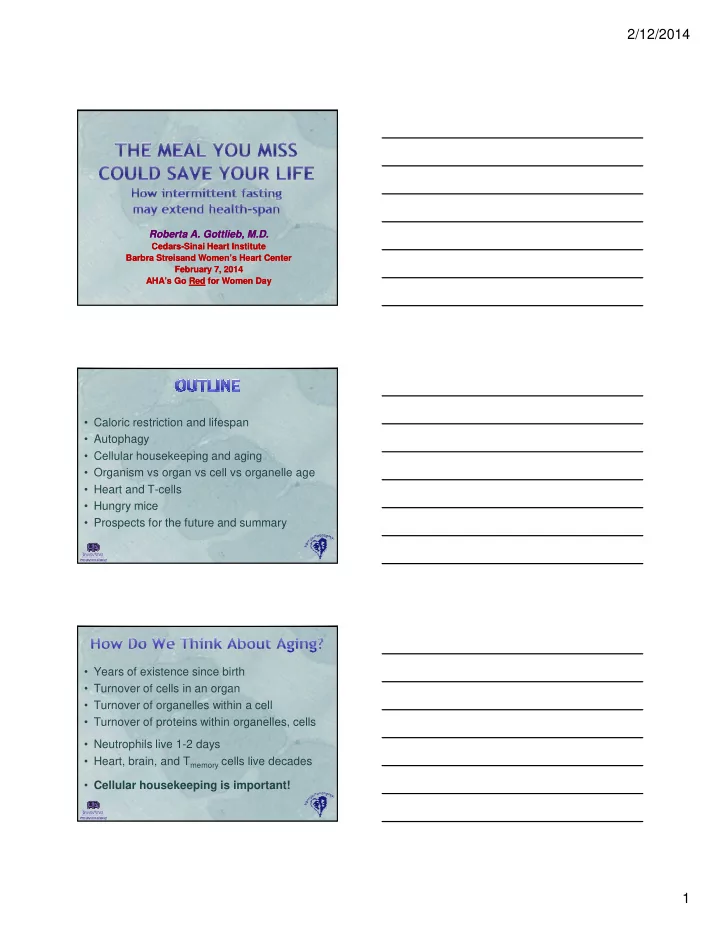
Cedars Cedars-Sinai Heart Institute Sinai Heart Institute Barbra Streisand Women’s Heart Center Barbra Streisand Women’s Heart Center February 7, 2014 February 7, 2014 AHA’s Go AHA’s Go Red Red for Women Day for Women Day

  • Caloric restriction and lifespan
  • Autophagy
  • Cellular housekeeping and aging
  • Organism vs organ vs cell vs organelle age
  • Heart and T-cells
  • Hungry mice
  • Prospects for the future and summary
  • Years of existence since birth
  • Turnover of cells in an organ
  • Turnover of organelles within a cell
  • Turnover of proteins within organelles, cells
  • Neutrophils live 1-2 days
  • Heart, brain, and Tmemory cells live decades
  • Cellular housekeeping is important!
slide-2
SLIDE 2

2/12/2014 2

  • Calorie restriction: 20-40% less than usual,

but with optimal nutrition and vitamins

  • Normal may be 1500-2000 cal/day, so 40%CR

would be 900-1200 cal/day

  • Studies in worms, flies, mice, rats, and rhesus

monkeys show increase in lifespan from CR

  • Benefits due to lower risk of cancer and heart

disease

  • 18 adults voluntarily adopted CR for ~6yr

(ages 35-82 yr)

  • Weight and BMI decreased in first year

(BMI: 2419)

  • Cholesterol and triglycerides decreased to

levels better than most 20-year-olds

  • Fatty streaks in arteries were minimal
  • Reduced abdominal fat and lower CRP
  • In severe CR: anemia, muscle loss,

lethargy, depression

  • In moderate CR: Bone loss and decreased

muscle mass but normalized by exercise

slide-3
SLIDE 3

2/12/2014 3

  • Increased risk of heart disease, high blood

pressure, and stroke

  • Increased risk of type 2 diabetes
  • Increased risk of cancer (uterus, gallbladder,

cervix, ovary, breast, colon, prostate)

  • Double the rate of developing osteoarthritis
  • Increased risk of Alzheimer’s
  • Induced by fasting, exercise, and CR
  • Suppressed by overnutrition, insulin

excess, protein or carbohydrate excess

  • Breaks down proteins and organelles

inside every cell (recycling)

  • Clears out cellular debris
  • Forces recycling of old organelles

Atg5-Atg12

Mitochondrion

LC3 LC3 p62 Beclin-1

Pre-autophagosomal structure Phagophore Autophagosome Lysosome Autophagolysosome

Modified from T. Shintani et al., Science 306, 990 -995 (2004)

slide-4
SLIDE 4

2/12/2014 4

  • Alzheimer’s, Parkinson’s, and heart failure

are characterized by accumulation of damaged mitochondria and protein aggregates

  • Genetic and protein analysis reveals

defects in autophagy in these diseases

  • These conditions are accelerated in obese

individuals

slide-5
SLIDE 5

2/12/2014 5

Adapted from Shirihai, based on Youle & Narendra, Nature Rev. Molec Cell Bio 12, 9-14

PINK1 PINK1 accumulates p62 p62 translocates and recruits LC3/autophagosome LC3/autophagosome Parkin Parkin translocates and ubiquitinates ubiquitinates targets Signaling or stress triggers mitochondrial depolarization Infarct Size (% Area at risk)

20 40 60 80

*

Statin

WT

+

PKO

  • WT
  • PKO

+

Allen Andres, Genaro Hernandez, et al. Antioxidant and Redox Signaling 2013

Parkin KO PINK1 KO Overnutrition Age NFkB NLRP3 Inflammatory cytokines MitoROS

Mitophagy

TLR9

↓ΔΨm

mtDNA

slide-6
SLIDE 6

2/12/2014 6

Phyllis Linton, Chengqun Huang, unpublished data

10 5

IL-1β IL-6 TNF-α Fold Induction

(relative to non-ischemic zone)

Wild type Parkin KO

Excess insulin signaling and nutrient excess (amino acids, fats) suppress autophagy Impaired autophagy prevents cardioprotection via mitophagy, and results in accumulation of inefficient mitochondria that generate excess ROS ROS signaling triggers NFkB translocation and assembly of the inflammasome, leading to cytokine production Inflammatory cytokines exacerbate acute and chronic reperfusion injury through effects on immune cells, fibroblasts, endothelial cells, and cardiomyocytes Impaired mitophagy, ROS, and inflammation exacerbate postinfarction remodeling

TNF TNFa IL IL-

  • 6

IL IL-

  • 18

18

Aging downregulates autophagy gene expression

fibroblasts inflammatory cells

cardiomyocyte

nucleus

cardiomyocyte mitochondria mitochondria ROS endothelial cells

7mo WT 7mo KO 7mo WT+CQ 11mo KO 7mo KO+CQ 11mo KO+CQ

actin LC3-I LC3-II

Mouse i.p. injections: Chloroquine (CQ): 50ug/g Saline: 10ul/g

0.2 0.4 0.6 0.8 1 1.2

cq- cq+

LC3-II / actin Autophagic Flux in Liver Tissue wt a ko a

n= 3 n=3 n=6 n=6

slide-7
SLIDE 7

2/12/2014 7

↓ΔΨ

Parkin TOM70 Parkin WT KO CypD Mitochondria GAPDH Parkin Cytosol WT KO

p<0.0025, n=5 Pixel intensity normalized to Ctrl

Mitochondrial Parkin WT KO

0.5 1.0 1.5 p<0.0025, n=5 Pixel intensity normalized to Ctrl

Cytosolic Parkin WT KO

1 2 3

CyD KO 1 CyD KO 2 WT 1

  • 16 month old C57BL/6 male CyD-/- and WT mice
  • 100% (6/6) of CyD-/- mice developed liver tumors
  • No hepatic tumors detected in age-matched WT mice

Master’s Degree thesis project: Xinghao Zhang