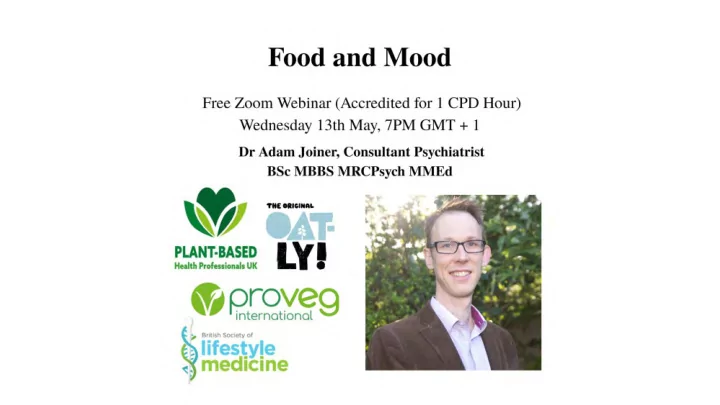
Food & mood Delivered by Dr Adam Joiner P r o m o t i n g s u - - PowerPoint PPT Presentation

food mood
SMART_READER_LITE
LIVE PREVIEW

Food & mood Delivered by Dr Adam Joiner P r o m o t i n g s u - - PowerPoint PPT Presentation

Food & mood Delivered by Dr Adam Joiner P r o m o t i n g s u s t a i n a b l e h e a l t h a n d n u t r i t i o n Learning Objectives Learn about some of the evidence for diet on mental wellbeing Learn about some of the


slide-1
SLIDE 1
slide-2
SLIDE 2

Food & mood

Delivered by Dr Adam Joiner

P r o m o t i n g s u s t a i n a b l e h e a l t h a n d n u t r i t i o n

slide-3
SLIDE 3

Learning Objectives

  • Learn about some of the evidence for diet on mental

wellbeing

  • Learn about some of the evidence for diet on depressive

disorders

  • Increase awareness of biological mechanisms underpinning

the influence of food on mood

P r o m o t i n g s u s t a i n a b l e h e a l t h a n d n u t r i t i o n

slide-4
SLIDE 4

https://www.mentalhealth.org.uk/a-to-z/d/diet-and-mental- health (October 2018)

P r o m o t i n g s u s t a i n a b l e h e a l t h a n d n u t r i t i o n

slide-5
SLIDE 5
slide-6
SLIDE 6
slide-7
SLIDE 7
slide-8
SLIDE 8

Title

slide-9
SLIDE 9

P r o m o t i n g s u s t a i n a b l e h e a l t h a n d n u t r i t i o n Critical Reviews in food science and research

slide-10
SLIDE 10

Association, not causation

slide-11
SLIDE 11

P r o m o t i n g s u s t a i n a b l e h e a l t h a n d n u t r i t i o n

  • 281 people aged 18 to 21; over 21 days
  • Fruit & Veg resulted in greater positive affect
  • Same day and next day
  • 7 to 8 servings for meaningful positive changes
slide-12
SLIDE 12

P r o m o t i n g s u s t a i n a b l e h e a l t h a n d n u t r i t i o n

  • 171 psychology students aged 18 – 25; over 14 days
  • All consume ≤ 3 portions F&V/day
  • Control group; text reminders + vouchers group; 2 F&V group
  • 2 F&V group increased energy, motivation, social measures
  • No changes to mood/anxiety
slide-13
SLIDE 13
slide-14
SLIDE 14
slide-15
SLIDE 15
slide-16
SLIDE 16
slide-17
SLIDE 17

Other studies

  • Systematic review of PB diet for people with type 2

DM1

  • Broad Study: within and between group improvements

in self-esteem2

  • 1. Toumpanakis A, Turball T, Alba-Barba I. Effectiveness of plant-based diets in promoting well-being in the management of type 2 diabetes: A systematic review. BMJ Open Diaebetes Res

Care [Internet]. 2018;6(1):e000534

  • 2. Wright N, Wilson L, Smith M, Duncan B, McHugh P. The BROAD study: A randomised controlled trial using a whole food plant-based diet in the community for obesity, ischaemic heart

disease or diabetes. Nutr Diabetes [Internet]. 2017;7(3). Available from: http://www.embase.com/search/results?subaction=viewrecord&from=export&id=L619864919%0Ahttp://dx.doi.org/10.1038/nutd.2017.3

P r o m o t i n g s u s t a i n a b l e h e a l t h a n d n u t r i t i o n

slide-18
SLIDE 18

Dietary recommendations for the prevention of depression – Opie et al Nutritional Neuroscience 2017;20(3):161-171

1. Follow ‘traditional’ dietary patterns, such as the Mediterranean, Norwegian, or Japanese diet 2. Increase consumption of fruits, vegetables, legumes, wholegrain cereals, nuts, and seeds 3. Include a high consumption of foods rich in omega-3 polyunsaturated fatty acids 4. Replace unhealthy foods with wholesome nutritious foods 5. Limit your intake of processed-foods, ‘fast’ foods, commercial bakery goods, and sweets.

P r o m o t i n g s u s t a i n a b l e h e a l t h a n d n u t r i t i o n

slide-19
SLIDE 19

Food & Depressive Disorders

P r o m o t i n g s u s t a i n a b l e h e a l t h a n d n u t r i t i o n

slide-20
SLIDE 20
  • n=500; diagnosis of moderate or severe depression +1
  • 70% raw, several restrictions, exercise, mindfulness, environment, juicing
  • No control group
  • 334 dropped out (66.8%) à 85% found modifications “too rigorous”; lack of time; family influences
  • Outcomes: “health diaries”
  • After 6 months à 78% of completers decreased/stopped anti-depressant medication
slide-21
SLIDE 21
  • n=67

n=31 diet; n=25 control at 12 weeks

  • MADRS remission 32% (10) vs 8% (2); p<0.001; d=1.16
  • NNT = 4.1
slide-22
SLIDE 22

HELFIMED Trial – Parletta et al

Nutritional Neuroscience 2019;22(7):478-487

  • RCT: Mediterranean-style diet plus fish oil supplements
  • GP diagnosed or self-reported depression
  • Use of Depression Anxiety Stress Scale (DASS-21)
  • High attrition rate (retention: 63% tr; 49% ctrl, at 6 months)
  • Both groups improved scores on DASS-21 (45% tr; 27% ctrl)
  • Correlation between food groups and variety

P r o m o t i n g s u s t a i n a b l e h e a l t h a n d n u t r i t i o n

slide-23
SLIDE 23

P r o m o t i n g s u s t a i n a b l e h e a l t h a n d n u t r i t i o n

n=1,025 12 months follow up

slide-24
SLIDE 24

P r o m o t i n g s u s t a i n a b l e h e a l t h a n d n u t r i t i o n

slide-25
SLIDE 25

Biological Mechanisms in Diet & Depression

P r o m o t i n g s u s t a i n a b l e h e a l t h a n d n u t r i t i o n

slide-26
SLIDE 26

Biological Mechanisms

  • Inflammation
  • Oxidative stress
  • Brain plasticity
  • Gut-brain axis (microbiota)

P r o m o t i n g s u s t a i n a b l e h e a l t h a n d n u t r i t i o n

slide-27
SLIDE 27

Inflammation

  • Low grade inflammation (e.g. raised cytokines)
  • Multi-factorial: diet, obesity, sleep, stress, smoking
  • Whole plant foods reduce inflammation

P r o m o t i n g s u s t a i n a b l e h e a l t h a n d n u t r i t i o n

slide-28
SLIDE 28

Oxidative stress

  • Lower antioxidant levels and and antioxidant capacity in

people with depression compared to controls.

Moylan S et al. Neurosci Biobehav Rev 2014;45, 46–62 Lie T et al. PLoS ONE 2015; 10, e0138904

P r o m o t i n g s u s t a i n a b l e h e a l t h a n d n u t r i t i o n

slide-29
SLIDE 29

Brain Plasticity

  • Hippocampus and neurotrophins (e.g. BDNF)
  • Western diet associated with smaller left hippocampus
  • Polyphenols, Vit-E, O3FA stimulate neurogenesis; diets

high in fat and sugar impair neurogenesis

Jacka et al. BMC Medicine. 2015;13:215 Marx et al. Proceedings of the Nutrition Society. 2017;76:427-436 P r o m o t i n g s u s t a i n a b l e h e a l t h a n d n u t r i t i o n

slide-30
SLIDE 30

Gut-brain axis (microbiota)

P r o m o t i n g s u s t a i n a b l e h e a l t h a n d n u t r i t i o n

  • Implicate in modulation of BDNF, serotonin, HPA stress

response

  • Microbiota-deficient mice reduced BDNF + 5-HT, and

increased stress response

  • Differences in gut microbiota of depressed patients vs healthy

control

  • Faecal transplant to rats
  • Increased interstitial permeability à depression (e.g. high fat

diet)

Marx et al. Proceedings of the Nutrition Society. 2017;76:427-436

slide-31
SLIDE 31

Further Reading

P r o m o t i n g s u s t a i n a b l e h e a l t h a n d n u t r i t i o n

slide-32
SLIDE 32

P r o m o t i n g s u s t a i n a b l e h e a l t h a n d n u t r i t i o n

slide-33
SLIDE 33

P r o m o t i n g s u s t a i n a b l e h e a l t h a n d n u t r i t i o n

slide-34
SLIDE 34
slide-35
SLIDE 35

Please support our work

  • Donate if you enjoyed this webinar

(suggested donation £5): paypal.me/pbhpuk

  • Join as a member – this is open to

everyone

  • Visit pbhp.uk for more information
  • r to donate

THANK YOU