19/06/2019 Disclosure Statement The Imperfect Travel Health - - PDF document

19 06 2019
SMART_READER_LITE
LIVE PREVIEW

19/06/2019 Disclosure Statement The Imperfect Travel Health - - PDF document

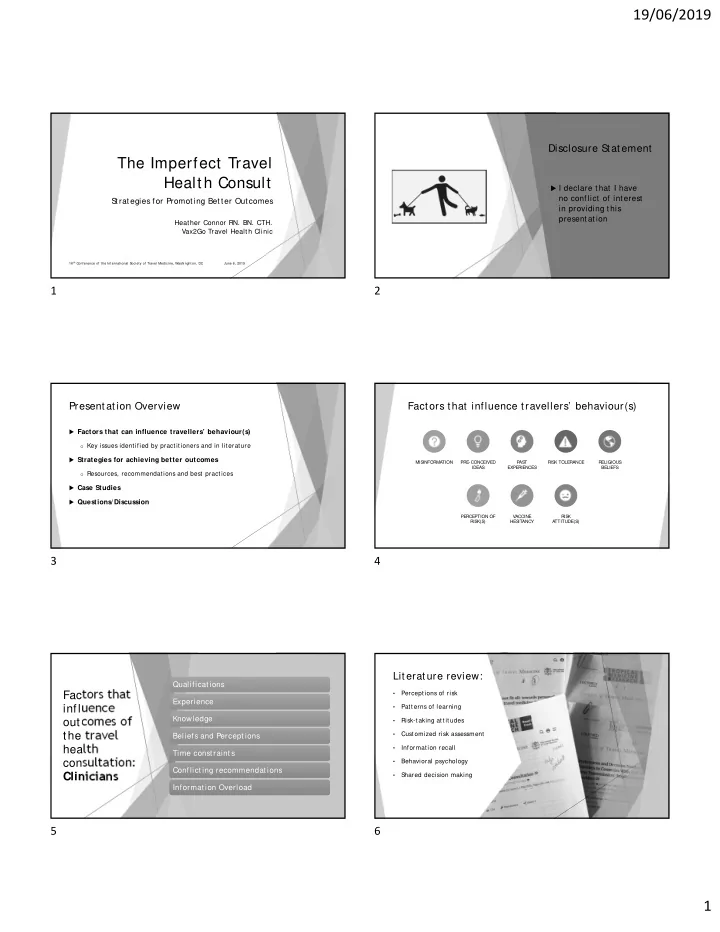
19/06/2019 Disclosure Statement The Imperfect Travel Health Consult I declare t hat I have no conflict of interest Strategies for Promoting Better Outcomes in providing this presentation Heather Connor RN. BN. CTH. Vax2Go Travel Health


slide-1
SLIDE 1

19/06/2019 1 The Imperfect Travel Health Consult

Strategies for Promoting Better Outcomes

June 6, 2019 16t h Conference of t he Int ernat ional Societ y of Travel Medicine, Washinght on, DC

Heather Connor RN. BN. CTH. Vax2Go Travel Health Clinic

Disclosure Statement

 I declare t hat I have

no conflict of interest in providing this presentation

Present at ion Overview

 Factors that can influence travellers’ behaviour(s)

  • Key issues identified by practitioners and in literature

 Strategies for achieving better outcomes

  • Resources, recommendations and best practices

 Case Studies  Questions/Discussion

Factors that influence travellers’ behaviour(s)

MISINFORMATION PRE-CONCEIVED IDEAS P AST EXPERIENCES RISK TOLERANCE RELIGIOUS BELIEFS PERCEPTION OF RISK(S) VACCINE HESITANCY RISK ATTITUDE(S)

Fact ors t hat influence

  • ut comes of

the travel health consultation: Clinicians

Qualificat ions Qualificat ions Experience Experience Knowledge Knowledge Beliefs and Perceptions Beliefs and Perceptions Time const raint s Time const raint s Conflict ing recommendat ions Conflict ing recommendat ions Information Overload Information Overload

Literature review:

  • Perceptions of risk
  • Patterns of learning
  • Risk-taking attitudes
  • Cust omized risk assessment
  • Information recall
  • Behavioral psychology
  • S

hared decision making

1 2 3 4 5 6

slide-2
SLIDE 2

19/06/2019 2

“ Pre-travel medical consultations often rely on blanket medical advice based

  • n destination”

(Farnham et al., 2018) “ Most travel health risks are not vaccine-preventable… but instead depend on modification

  • f risk-taking behaviours based
  • n an accurate risk estimation

and the delivery of advice which effects positive behavioural change.” (Flaherty, 2018)

What can we learn from the literature?

Risk Perception:

 Perceptions of risk vary greatly among travellers  These percept ions may not be realistic/ accurate  Travellers’ perception of risk may not align with clinician’s

(McIntosh, 2015; Bauer, 2005)

What can we learn from the literature?

Methods of learning:

 People have different pat t erns of learning  Learning st yles/ needs of younger t ravelers are oft en

different than those of mature travelers

 Traveller’s previous knowledge and experience need t o be

considered (Bauer, 2005)

What can we learn from the literature?

Suggestions by Irmgard Bauer:

 A few simple questions added t o pre-consult at ion

questionnaire (or asked verbally at start of consult)

 “ What are you most worried about for this trip?

 Did you get sick during or after a previous trip?  What is your view on potential risk(s) for this trip?

What can we learn from the literature?

Attitudes:  Travellers differ fundamentally in their attitudes (behaviour) to risks  Risk-taking attitudes and risk perception are linked to health behaviour  Distinct risk profiles exist among different sub-groups of travellers (Farnham et al., 2018)

7 8 9 10 11 12

slide-3
SLIDE 3

19/06/2019 3

What can we learn from the literature?

Attitudes  Men, backpackers and young t ravellers have a higher willingness to take recreational risk(s) than women, luxury and older travellers  Recommendat ion t o incorporat e a few short quest ions on t he pre-t ravel quest ionnaire, regarding t raveller risk attitudes  Info from t hese quest ionnaires can ident ify high-risk characteristics of the traveller and enable clinicians to provide more specific advice (Farnham et al., 2018)

Main Take Away:

One size does not fit all Strategies for promoting better

  • utcomes

 Clinicians must take a customized approach  Understanding the risk perceptions, attitudes and learning

needs of each t raveller is important

 Travellers should be free t o express concerns, ask

questions and identify their priorities

 Clinicians and travellers work together to make decisions

(shared decision making)

13 14 15 16 17 18

slide-4
SLIDE 4

19/06/2019 4

What is shared decision making?

“ A process in which patients and clinicians work together to make decision and select… treatments… based on clinical evidence that balances risk and expected

  • utcomes with patient

preferences and values” (Nat ional Learning Consortium, 2013)

Tips for shared decision making

From the US Office of the National Coordinator for Health Informat ion Technology:

 Invite the patient to participate  Present opt ions  Provide information on benefits and risks  Assist patients in evaluating opt ions based on t heir goals

and concerns

 Facilitate deliberation and decision making  Assist patients to follow through on decision

Additional strategies for better

  • utcomes

 Electronic, visual and/ or interactive aids  Secure elect ronic messaging and apps  Supplement ary informat ion for t ravelers (e.g., writ t en,

elect ronic)

 Use of plain language  Use of large-size font t o emphasize key point s  Use of icons and/ or colour codes

Case Study: Co-decision making to avoid Zika

Healt hy 28 y.o. male t raveling t o Caribbean

One week st ay on a resort

Height of Zika

  • ut break

Questions ? ?

Heather Connor, RN BN CTH Vax2Go Travel Healt h Clinic hcon5@ Hotmail.com

19 20 21 22 23 24

slide-5
SLIDE 5

19/06/2019 5

Resources

The Pret ravel Healt h Consult at ion Iain B. McInt osh JTM Volume 22, Issue 3, 1 May 2015, p.143-144

Educat ional Issues & Concerns in Travel Healt h Advice: Is all t he effort a wast e of t ime ? Irmgard Bauer JTM 2005; 12:45-52

Does t he Dospert Scale predict risk t aking behaviour during t ravel ? A st udy using smart phones Andrea Farnham Ph.D. et al. JTM, Volume 25, Issue 1, 2018.

The Dospert Scale ( from Blais & Weber 2006 )

One size does not fit all: Towards personalized risk assessment in t ravel medicine. 2018. Gerald T . Flahert y MD JTM, Volume 25, Issue 1,

Resources

Immediat e Recall of Healt h Issues Discussed during t he Pre-Travel Consult at ion Sarah L. McGuinness et al. JTM Volume 22, Issue 3, 1 May 2015, p.145-151

Preferences and Decision Needs of Bost on-Area Travellers t o Count ry wit h Risk of Y ellow Fever Transmission: Implications for health care providers Beth A. Lown MD et al. JTM Volume 21, Issue 4, 1 July 2014

Nat ional Learning Consort ium; Shared Decision Making; December 2013 Fact Sheet www.Healt hIT .Gov

25 26