17/12/15 Licensing Committee 15 December 2015 Appendix to minutes - - PDF document

17 12 15 licensing committee 15 december 2015 appendix to
SMART_READER_LITE
LIVE PREVIEW

17/12/15 Licensing Committee 15 December 2015 Appendix to minutes - - PDF document

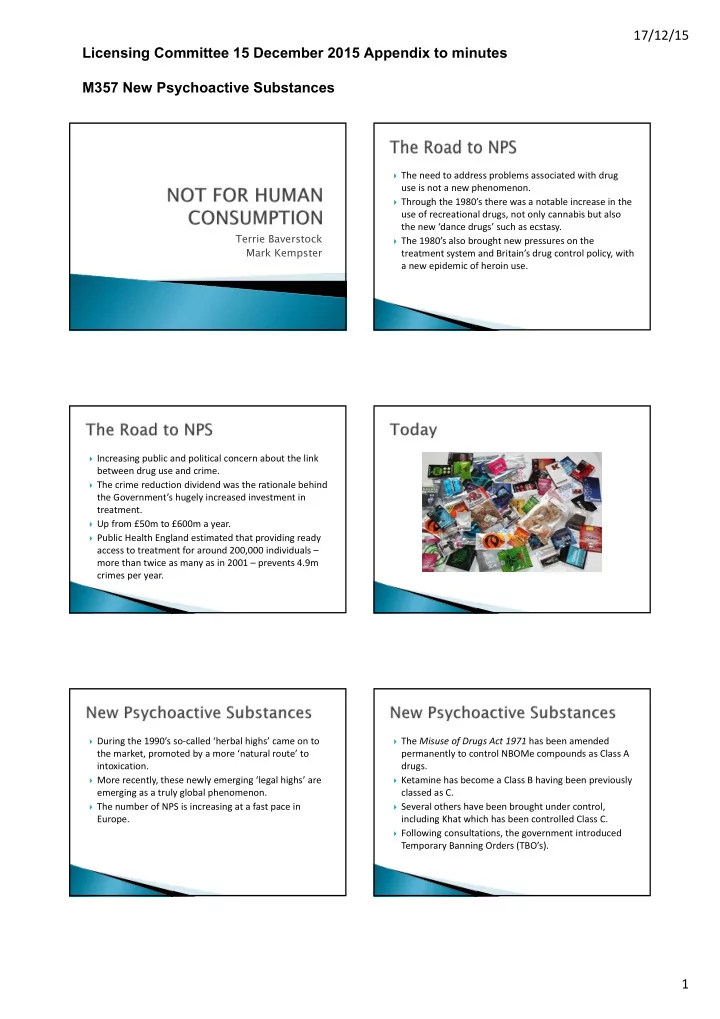
17/12/15 Licensing Committee 15 December 2015 Appendix to minutes M357 New Psychoactive Substances The need to address problems associated with drug use is not a new phenomenon. Through the 1980s there was a notable increase in the use


slide-1
SLIDE 1

17/12/15 1

Terrie Baverstock Mark Kempster

 The need to address problems associated with drug

use is not a new phenomenon.

 Through the 1980’s there was a notable increase in the

use of recreational drugs, not only cannabis but also the new ‘dance drugs’ such as ecstasy.

 The 1980’s also brought new pressures on the

treatment system and Britain’s drug control policy, with a new epidemic of heroin use.

 Increasing public and political concern about the link

between drug use and crime.

 The crime reduction dividend was the rationale behind

the Government’s hugely increased investment in treatment.

 Up from £50m to £600m a year.  Public Health England estimated that providing ready

access to treatment for around 200,000 individuals – more than twice as many as in 2001 – prevents 4.9m crimes per year.

 During the 1990’s so‐called ‘herbal highs’ came on to

the market, promoted by a more ‘natural route’ to intoxication.

 More recently, these newly emerging ‘legal highs’ are

emerging as a truly global phenomenon.

 The number of NPS is increasing at a fast pace in

Europe.

 The Misuse of Drugs Act 1971 has been amended

permanently to control NBOMe compounds as Class A drugs.

 Ketamine has become a Class B having been previously

classed as C.

 Several others have been brought under control,

including Khat which has been controlled Class C.

 Following consultations, the government introduced

Temporary Banning Orders (TBO’s).

Licensing Committee 15 December 2015 Appendix to minutes M357 New Psychoactive Substances

slide-2
SLIDE 2

17/12/15 2

 ‘Legal highs’ contain one or more chemical substances

which produce similar effects to illegal drugs.

 These new substances are not yet controlled under the

Misuse of Drugs Act 1971.

 ‘Legal highs’ cannot be sold for human consumption so

they are often sold as incense, salts or plant food.

 The term ‘legal highs’ is misleading ‐ just the fact that a

substance is sold as ‘legal’ does not mean it is safe.

 Not all NPS are ‘new’ – the new does not mean a new

invention but could refer to a substance that has recently been made available for recreational use.

 Many new drugs appear on the illicit market and then

disappear, usually as a result of little demand.

 There is some evidence that the appeal of some NPS is

sometimes linked to the poor quality of more established illicit substances available on the black market.

 In particular, a reduction in the purity of ecstasy and

cocaine was linked to the increased use of Mephedrone in the UK.

 ‘Legal Highs’ are sold online, in ‘headshops’ or

sometimes alongside controlled substances on the illicit market.

 Reports also suggest that some legal high products

(such as synthetic cannabinoid products) are being sold in a wide range of outlets, including corner shops, pubs and petrol stations.

 As compounds are controlled and substances banned,

their new legal status does not always deter use.

 Most sales are then transferred to street dealers, with

users reporting paying a higher price.

slide-3
SLIDE 3

17/12/15 3

 There has been a steep rise in the number of online

‘shops’ selling both ‘legal’ and ‘illegal’ products to European customers.

 2010 ‐ 170  2011 – 314  2012 – 693  2013 – 651  The internet is also facilitating communication for

people who use NPS and providing access to knowledge, expertise and logistics about these drugs.

 There are a number of sites and moderated discussion

fora and blogs that are used to share information about newer compounds, feedback on the effects of drugs and harm reduction advice.

 PSYCHONAUTS  One of the most common perceptions people have

about NPS is in relation to how harmful they can be.

 This is not helped by the wide availability of substances

– this implies that these products are tested, controlled and hence safe.

 At present there is not clear awareness around dosage,

related risks and side effects.

 Some NPS are stronger than the illegal substances they

mimic.

 For the inexperienced user this may increase their

chances of getting unpleasant side effects.

slide-4
SLIDE 4

17/12/15 4

 There are several sources of data on the prevalence of

NPS/Club Drug use.

 Crime Survey for England and Wales  Smaller surveys focussing on specific subgroups.

 The use of NPS in the general population is low compared

to the use of traditional illicit drugs but that use of NPS is higher in certain subgroups.

 While the number of different NPS detected is

increasing across Europe, it is important to keep things in perspective.

 We don’t have a complete picture of NPS prevalence,

but use of these drugs is lower than more established drugs such as cannabis and powder cocaine.

 However, reports suggest that NPS is higher in some

subgroups such as clubbers and men who have sex with men (MSM) and is more prevalent is rural areas.

 How does this compare with Hertfordshire?  Why?  The survey aims to gather information on what NPS are

being used in Hertfordshire.

 Where people acquire and take NPS, what

psychological and physiological effects people experience after taking different NPS.

 Their understanding of the legalities and whether or

not they know where they can get support.

 The survey has the potential to provide good, accurate

information that we desperately lack.

 It will provide health and education services,

Community Safety Partnerships, drug policy makers and other key stakeholders with detailed information about local prevalence.

 After the survey closes findings will be produced upon

request.

 The survey will be totally anonymous.  Open to all ages.  It has been designed by the Hertfordshire NPS Working

Group.

 Available online and paper copies.

slide-5
SLIDE 5

17/12/15 5

 There are positive signs that our approach is working:

  • Over 2100 people, both professionals and young people have

attended awareness sessions.

  • The Hertfordshire Headshop Protocol.
  • Red or Black – You Lose Campaign.
  • The Hertfordshire Professional Information Network.
  • New Licence Conditions for inclusion in Event Licences.

 We will work to ensure that localised information is

made available at pubs, clubs and other environments with a likelihood of use.

 Conduct a large scale survey to understand what NPS

are bought and used locally, how, where and who by.

 Work with treatment providers to encourage the

collection of data. Encourage those who may not consider themselves ‘drug users’ into treatment.

 Explore ways to work with Hertfordshire’s hospitals,

A&E departments and ambulance service to ensure effective recording of data.

 Work with Emergency Departments and primary care

services for people who need treatment.