
SLIDE 1
12/2/2016 1
1
Disclosures
Title
- Late-Stage Management of Macular Edema Secondary to Retinal Vein
Occlusion: Collective Analyses of the BRAVO, CRUISE, HORIZON, and SHORE Studies Financial Disclosures
- Robert B. Bhisitkul, MD, PhD: Grant support, speakers bureau, and
consultant: Genentech/Roche; consultant: Santen, Inc.; advisory boards: Allergan; Bausch & Lomb.
Late-Stage Management of Macular Edema Secondary to Retinal Vein Occlusion: Collective Analyses of the BRAVO, CRUISE, HORIZON, and SHORE Studies
Robert B. Bhisitkul, MD, PhD Professor of Clinical Ophthalmology University of California San Francisco School of Medicine
3
Key Clinical Questions
In the initial stage of monthly ranibizumab treatment, how quickly did patients with RVO respond? In the later stage of PRN ranibizumab treatment, were the vision gains maintained? In the later stage of PRN ranibizumab treatment, what dosing frequency was required to maintain vision gains and anatomic stability?
4
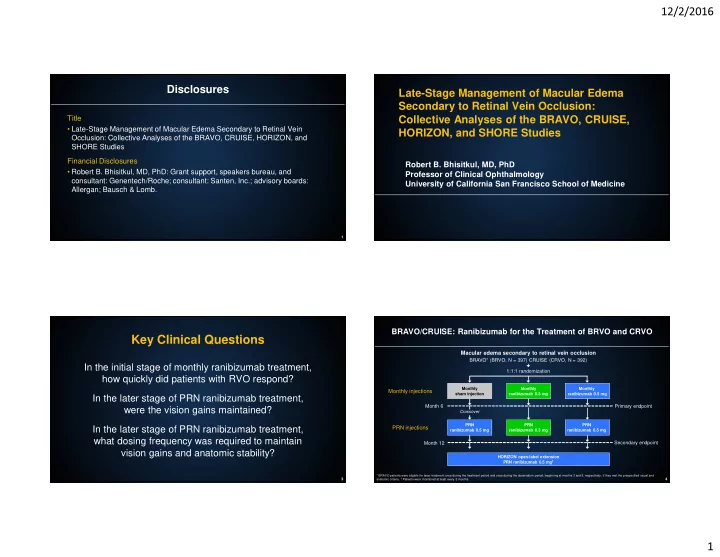
BRAVO/CRUISE: Ranibizumab for the Treatment of BRVO and CRVO
* BRAVO patients were eligible for laser treatment once during the treatment period and once during the observation period, beginning at months 3 and 9, respectively, if they met the prespecified visual and anatomic criteria. † Patients were monitored at least every 3 months.
Primary endpoint
Monthly injections
1:1:1 randomization
Monthly sham injection Monthly ranibizumab 0.3 mg
Month 6
Monthly ranibizumab 0.5 mg
Macular edema secondary to retinal vein occlusion
BRAVO* (BRVO, N = 397) CRUISE (CRVO, N = 392)
HORIZON open-label extension PRN ranibizumab 0.5 mg†
Secondary endpoint Month 12
PRN ranibizumab 0.5 mg Crossover PRN ranibizumab 0.3 mg PRN ranibizumab 0.5 mg
PRN injections