Best Practice CIMIT: 250 medical innovation solutions developed - - PowerPoint PPT Presentation

best practice
SMART_READER_LITE
LIVE PREVIEW

Best Practice CIMIT: 250 medical innovation solutions developed - - PowerPoint PPT Presentation

Best practice examples suggest a translational research center can focus on commercialization of university research and entrepreneurial development Best Practice CIMIT: 250 medical innovation solutions developed Examples: Key 78 had


slide-1
SLIDE 1

Best Practice Examples: Key Observations

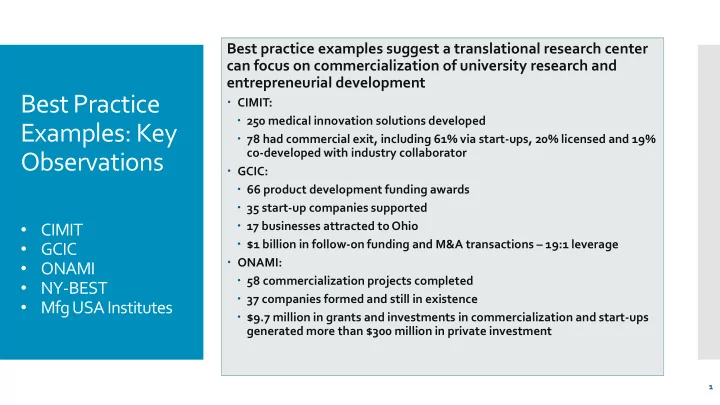
Best practice examples suggest a translational research center can focus on commercialization of university research and entrepreneurial development

 CIMIT:  250 medical innovation solutions developed  78 had commercial exit, including 61% via start-ups, 20% licensed and 19% co-developed with industry collaborator  GCIC:  66 product development funding awards  35 start-up companies supported  17 businesses attracted to Ohio  $1 billion in follow-on funding and M&A transactions – 19:1 leverage  ONAMI:  58 commercialization projects completed  37 companies formed and still in existence  $9.7 million in grants and investments in commercialization and start-ups generated more than $300 million in private investment

1

  • CIMIT
  • GCIC
  • ONAMI
  • NY-BEST
  • Mfg USA Institutes
slide-2
SLIDE 2

Activities Found in Translational Research Centers

2

  • CIMIT
  • GCIC
  • ONAMI
  • NY-BEST
  • Mfg USA Institutes

Activity Best Practice Examples Increase federal research funding

ONAMI provides matching funds for competitive federal grants – helped Oregon State win major federal center

Address industry applied research

All examples are involved in either applied research with consortiums and/or individual companies

Shared use facilities

All provide facilities for prototyping, testing or demo, except CIMIT

Entrepreneurs-in-Residence

All, except Mfg USA Institutes

Proof-of-Concept Funding

All, except Mfg USA Institutes

Broader Business Assistance

CIMIT runs a boot camp for faculty involved in commercialization projects GCIC in attracting out-of-state companies Mfg USA Institutes with broad-based STEM workforce efforts, standards work and focus on building relationships and networks NY-BEST with supply chain connections and broader business assistance

Voice of Customer in Commercialization Model

CIMIT focuses on “clinical pull” Mfg USA Institutes utilizes roadmaps

Supporting Collaborations Across Research Institutions

One novel feature is CIMIT’s “site miners” and “colab” web- based infrastructure to build and manage collaborative teams

slide-3
SLIDE 3

1 | P a g e

Best Practice Examples of Translational Research Centers

Case Studies Developed:

  • Oregon Nanoscience and Microtechnologies Institute (ONAMI)
  • Global Cardiovascular Innovation Center (GCIC)
  • New York Battery & Energy Storage Technology Consortium (NY-BEST)
  • Consortia for Improving Medicine with Innovation & Technology (CIMIT)
  • Manufacturing USA Institutes

Typology

  • Year Founded
  • Mission
  • Governance
  • Institutions Involved
  • Activities:
  • R&D Activities
  • Pre-competitive and federally sponsored R&D
  • Applied R&D – Individual company specific commercial validation and

prototyping

  • Testing & Demonstration
  • Commercialization Activities
  • Market assessment and proof-of-concept funding for advancing new

company

  • New firm advancement/acceleration/incubation
  • Business Funding & Other Assistance including seed stage investments,
  • ther incentives
  • Talent and workforce generation
  • Organizational Funding
  • Results
slide-4
SLIDE 4

2 | P a g e

Best Practice Case Study: Oregon Nanoscience and Microtechnologies Institute

Oregon Nanoscience and Microtechnologies Institute

Year Founded 2006 Mission ONAMI (Oregon Nanoscience and Microtechnologies Institute) is where academia, business and government come together to accelerate research and bring breakthrough ideas to market. It’s where entrepreneurs have access to cutting-edge resources and investors have opportunities to fund groundbreaking technology. Governance Independent non-profit organization; 11 member Board of Directors – 4 research university VPRs/Engineering Deans; 1 national lab (Pacific Northwest National Lab); 6 industry executives Institutions Involved • Oregon State University, University of Oregon and Portland State University – each has funded R&D lab through ONAMI

  • Major corporations, such as Intel, FEI, CH2M Hill,

HP

  • A growing cadre of new and emerging companies,

directly associated with ONAMI R&D Activities Pre- competitive

  • Invested in university research labs – has

established in partnership with universities a network of seven facilities across OSU, PSU, UofOregon

  • Provided matching funds for competitive federal

grants, including equipment as well as research grants and centers

  • Done more in early years – but has sustained

funding for university labs – provided $691k to Oregon State and $226k to Portland State in 2016 Applied R&D • Provides matching grants for industry R&D with universities ($4.5 million in first 7 years or ~650,000 annually)

  • Network of labs able to do wide range of materials

analysis, characterization and fabrication Testing & Demo

  • Not an emphasis in lab network

Commercialization Activities Market Assessment & Proof-of-

  • Offers Launch Funding, a competitive grant

program of up to $75,000 to refine or validate through proof-of-concept and to assist in optimal

slide-5
SLIDE 5

3 | P a g e Oregon Nanoscience and Microtechnologies Institute

Concept company formation. Intended for those with an idea that has commercial value and who intend to form a company.

  • Has on staff an experienced market strategist and

researcher to work with commercialization teams funded New Venture Advancement

  • Has on staff 3 entrepreneurs-in-residence to work

with start-up companies with domain experience in key applications of nanoscience and microtechnologies from advanced materials/semiconductors/sensors/optics to energy generation and storage to life sciences to water Business Funding & Other Assistance

  • Provides pre-seed/seed investment for company

formation of up to $250,000 – intended to bridge initial start-up and angel or venture capital investments Talent and Workforce Development

  • Sponsors and helps match MS and PhD students,

interested in gaining entrepreneurial work experience, for internships with commercialization portfolio companies with funding for a 6-9 month period at $25/hour Organizational Funding • Over the years, state funding has been critical to sustaining ONAMI – with average funding of approximately $2.5 to $3 million

  • In 2016 tax filing, ONAMI reported total revenues
  • f $3.1 million of which $2.4 million was their
  • ngoing state grant. Other revenues generated

from program activities and contract services.

  • Does not own or have an interest in any of the

university lab facilities Results • R&D: Helped grow Oregon’s competitiveness for federal R&D from ~$9 million per year to over $30

  • million. With ONAMI support Oregon State as the

prime with participation of University of Oregon and other research universities awarded an, which NSF Center for Sustainable Materials Chemistry -- $21.5 million, 5 year award, which was renewed through 2021

  • Commercialization:
  • 58 commercialization projects completed
  • 37 companies formed that are still in

existence

slide-6
SLIDE 6

4 | P a g e Oregon Nanoscience and Microtechnologies Institute

  • Grants and investment of $9.7 million in

portfolio companies has generated $400 million in follow-on investments and revenues, of which 78% is private investment, 11% public investment and 11% is revenues

slide-7
SLIDE 7

5 | P a g e

Best Practice Case Study: Global Cardiovascular Innovation Center

Global Cardiovascular Innovation Center

Year Founded 2007 Mission Focused on the formation, attraction, expansion and retention of cardiovascular companies to create jobs and facilitate economic development in the State of Ohio Governance Part of the Cleveland Clinic Foundation, but independently governed by a 4 -member Board of Directors involving representatives from the research, clinical care and investor community. Has a much broader Commercialization Advisory Board comprising BoD members, other physicians from Cleveland Clinic,

  • ther universities (Ohio State, University of Cincinnati,

University of Toledo, UH Cleveland, Stanford) and a majority from industry and venture community. Institutions Involved While led by Cleveland Clinic, GCIC has partnerships with a number of other universities including Case Western, Ohio State, University of Cincinnati, and University of Toledo. R&D Activities Pre- competitive Not a featured activity of GCIC, but available through Cleveland Clinic and other research partners Applied R&D Not a featured activity of GCIC, but available through Cleveland Clinic and other research partners Testing & Demo

  • Offers preclinical facilities for testing the next

generation of cardiovascular interventional and surgical applications, whether devices or

  • procedures. Features two large procedure suites

equipped with latest in imaging, surgical, monitoring and recording equipment, along with conscious testing and telemetry capabilities. Plus four surgical stations for conducting studies on large and small subjects. Commercialization Activities Market Assessment & Proof-of- Concept

  • As part of its commercialization funding to start-up

companies allows for market assessment and other validation of technology directed towards specific, measurable project development activities to advance the commercial opportunity (see below) New Venture Advancement

  • Taps experienced staff to assist start-up companies

with product development to accelerate their commercialization development and success involving engineering, product marketing and
slide-8
SLIDE 8

6 | P a g e Global Cardiovascular Innovation Center

business development.

  • Provides new company incubation through a

50,000 sf life science incubator with customizable lab space. Business Funding & Other Assistance

  • Through its commercialization funding program,

GCIC makes seed stage funding to start-up companies in Ohio developing products to diagnose

  • r treat cardiovascular disease. Awards have

averaged $450,000. They are made on the basis of potential for commercial success, project plan and state economic impact. Funding recommendations made by the Commercialization Advisory Board, but the GCIC BoD makes final award determinations.

  • Company attraction program is a key element of

GCIC’s approach to accelerating biomedical industry growth within Ohio. Assists out-of-state companies establish a base of operations in the state with forgivable loans of up to $500,000 based

  • n reaching employment goals of at least 15 new

full-time Ohio jos within three years of operation and maintain operations for a minimum of 5 years. Targets companies with a cardiovascular line of business or demonstrated expertise in cardiovascular product development. Talent and Workforce Development Not a featured activity Organizational Funding Launched with a $60 million grant from Ohio’s Third Frontier program. No public information on annual expenditures or revenues. Results • 66 product development funding awards totaling $21.5 million

  • 17 businesses attracted to and operating in Ohio
  • GCIC incubator supports 35 companies
  • Greater than 1,000 new jobs to date in companies

funded, attracted or incubated by GCIC

  • Greater than $1 billion in follow-on funding and

M&A transactions, securing a 19:1 leverage of state dollars

slide-9
SLIDE 9

7 | P a g e

Best Practice Case Study: New York Battery & Energy Storage Technology Consortium

New York Battery & Energy Storage Technology Consortium Year Founded 2010 Mission Accelerate the commercial introduction of energy storage technology in New York and build the human capital and expertise to sustain a vibrant commercial energy storage industry in New York by providing value to its members. Governance Independent non-profit, industry membership

  • rganization. There are three types of memberships:

Corporate Organizational member for $1500 per year, Academic, not-for-profit and government organization member for $1,000 per year, or Start-up organization member for $500 per year (organizations with fewer than 25 employees and less than 5 years in business). 17 member Board of Directors, with two ex-officio members from state government sponsors -- NYSERDA and Empire State Development – the other BoD members are elected for two-year staggered terms at the annual meeting, with 5 members from industry, 5 members from universities and 5 members from outside and strategic partners Institutions Involved Many universities are among its members and its Board includes Clarkson, Cornell, Rochester Institute of Technology, Columbia and SUNY. R&D Activities Pre- competitive Facilities members partnering to pursue federal and

  • ther research funding opportunities, but does not

directly support pre-competitive research. Applied R&D • Partners with Rochester Institute of Technology to provide a Battery Prototyping Center focused on the development of emerging energy storage technologies, which is available to BEST members. Features a large dry room with pouch cell assembly equipment and other space available for other moisture sensitive experiments. Works closes with BEST’s testing center to ensure quality and reproducibility in the performance of cells. Testing & Demo

  • Partners with DNV GL, global quality assurance and

risk management company for the oil & gas, power and renewables industries, to provide a testing and commercialization center able to test the complete

slide-10
SLIDE 10

8 | P a g e

New York Battery & Energy Storage Technology Consortium range of battery and energy storage technologies: from single cells to complete systems with cycle capacities up to 240 kW. Systems up to 2 MW can be tested in conjunction with the KEMA Powertest lab in Chalfont, Pennsylvania. Commercialization Activities Market Assessment & Proof-of- Concept Not a featured activity, beyond availability of facilities for prototyping and testing. New Venture Advancement Offers a range of assistance to new ventures, including technical insights and critiques on new technologies being developed, assistance with business planning and market assessment, advice on how to prepare new products for commercialization, facilitating access to energy storage product development and pilot manufacturing resources in NYS, and supporting access to sources of capital and economic development assistance. Business Funding & Other Assistance Maintains a supply chain database to help companies identify, locate and connect with potential partners, suppliers and customers Talent and Workforce Development Not a featured activity Organizational Funding A $1.8 million organization in 2016, funded by a $1.2 million state grant, membership fees and other

  • contributions. $700,000 of NY-BEST funding goes to

support the Prototyping Center at RTI. Results • 150 members

slide-11
SLIDE 11

9 | P a g e

Best Practice Case Study: Consortia for Improving Medicine with Innovation & Technology (CIMIT)

CIMIT Year Founded 1998 Mission CIMIT’s mission is to foster collaboration among clinicians, technologists, and entrepreneurs to accelerate innovation and catalyze the discovery, development, and implementation of innovative healthcare technologies. It has a strong “clinical pull” model Governance While CIMIT functions as a network of 14 academic and medical institution partnering with industry and government and its management reports to an Executive Committee comprised of the presidents and CEOs of each consortium member, it appears to be housed within Mass General Hospital with its grants, staffing and back-office support being run through Mass General Hospital (have an email to confirm) Institutions Involved Original institutions involved in founding CIMIT include: MGH, MIT, Brigham and Women’s Hospital and Draper

  • Labs. Members now also include: Beth Israel

Deaconess Medical Center, Harvard Medical School, Boston Children’s Hospital, Newton-Wellesley Hospital, Partners Healthcare System, Boston Medical, Boston VA, Northeastern University and Boston University. R&D Activities Pre- competitive For new fields that it is helping to define unmet medical needs and potential solutions involving multi- disciplinary efforts – such as operating rooms of the future, point-of-care technologies, accelerating detection and treatment of vulnerable patients and plaques in coronary artery disease, improved trauma care – CIMIT will host a major convening event and/or prepare white papers to define the scope of efforts needed. Does pursue pre-competitive funding from sources such as DoD and NIH. For instance, its work on trauma was for DoD and it received a $9.5 million National Institute of Biomedical Imaging and Bioengineering grant to create point-of-care innovations for primary care.

slide-12
SLIDE 12

10 | P a g e

CIMIT Applied R&D Works on identified projects based on clinical pull model and not specific industry applied research needs … industry can be part of collaborative teams working

  • n solutions

Testing & Demo Again, embedded in the commercialization process around clinical pull on defined projects being advanced to address unmet medical needs … no specific facilities, but leverage those at partner institutions, including possibly industry partners Commercialization Activities Market Assessment & Proof-of- Concept Strong focus on a “clinical pull” model in which an intimate understanding of unmet medical needs is the starting point and then the focus is on identifying collaborators to work on developing and advancing solutions to the problem. Has advanced a staged focus

  • n commercialization on ideas identified to address

unmet medical need by: 1) Pilot and proof of concept/principal stage projects to scientifically and technically de-risk a solution with budgets of up to $100k – requires a practical, collaborative, multi- disciplinary work plan that will solve the unmet medical need if successful; 2 2) Proof-of-value validation stage is designed to show clinical value for the target unmet medical need in order to license the technology or to receive additional funding for prototyping. 1-2 years in duration and require annual budgets of up to $500,000; 3) Commercial accelerator incubation stage projects are for those projects scientifically and technically de-risked and have well-understood market channels, but require further development, investment and business development expertise to attract interest from an entrepreneur or company. Typically 18 months in duration and require $1-2 million in

  • funding. A recent innovation Managed by

entrepreneurs-in-residence (see below). Makes use of site miners, comprised of senior science leaders at participating institutions, who work approximately 1 day per week on CIMIT projects and programs helping to “mine” their institutions for

slide-13
SLIDE 13

11 | P a g e

CIMIT unmet medical needs from clinicians and research investigators with promising ideas. Industry partners also have site miners that look for strategic

  • pportunities for their organizations to engage and

help address key solutions and opportunities. These site miners help to facilitate the formation of collaborative teams to work on identified solutions. They are supported by their member institutions. A recent innovation is to makes use of entrepreneurs- in-residence to manage accelerator teams … these are former CEOs or founders of companies, who take responsibility for the commercialization of projects. Reports that over a 5-year period when instituted this practice raised commercialization success from 27% to 41% and the time to commercial fell from 36 months to 19 months. Another key “infrastructure tool” advanced by CIMIT is a Collaboration Platform for Healthcare Innovation (CoLab) – has steadily evolved since 2009 as a secure, web-based tool with functionality designed to manage projects and support teams …. Is being more widely used than just for CIMIT with 10,000 users and 2,500 private collaborative projects New Venture Advancement Hosts a Healthcare Commercialization Boot Camp for the project teams involved in commercial accelerator stage projects – 10-week program to improve commercialization success; involves 1:1 mentoring from successful entrepreneurs and coaching from

  • ther experts involved in commercialization of health

technologies (regulatory, reimbursement, marketing, etc) and investors. Teams develop and validate go-to- market strategies to help secure licensing agreements and create start-ups. Business Funding & Other Assistance Has supported industry networks in the past to support commercialization … would seek out industry interests and share intelligence on projects. Talent and Workforce Development Not an emphasis of CIMIT

slide-14
SLIDE 14

12 | P a g e

CIMIT Organizational Funding CIMIT members and affiliates contribute membership fees to support its infrastructure. CIMIT receives most

  • f its funds as grants from various philanthropic,

industrial and government sources. In particular, DoD has supported CIMIT since its early days to address the unique needs of warfighters and their families. (reaching out to get more details on funding levels, but not publicly available since housed within MGH). CIMIT does not obtain IP rights to any of the projects that it supports through its various funding vehicles. All IP remains owned by the consortium members. However, CIMIT does participate in the value created by the “Commercial Accelerate Projects” and takes a fraction of the net proceeds in any form generated based on a “pre-money” and investment ratio. Results 600 peer-reviewed and facilitated collaborative projects undertaken 250 solutions developed 78 of the solutions have had a commercial exit with 87% still in the market and 61% commercialized through a start-up, 20% licensed and 19% developed with an industry collaborator who commercialized. A key output of $55 m of CIMIT funding for 228 solutions from 1998-2014 found:

  • 70% still active
  • 49% received follow-on funding amounting to $516

m

  • 27% reached commercialization
  • Additional $597m in commercial investment

generated

  • 458 patents
  • 2,293 peer-reviewed publications
slide-15
SLIDE 15

13 | P a g e

Best Practice Case Study: Manufacturing USA, with specific reference to America Makes as an example

Manufacturing USA Year Founded 2012 Mission The Manufacturing USA program seeks to address the complex, manufacturing-related technology transition challenges that arise between early stage research and technology adoption. America Makes is the first of now 14 manufacturing

  • institutes. It is the national accelerator for additive

manufacturing and 3D printing and is involved in materials, material processing and lightweighting. Governance Each institute represents a public-private partnership with representatives from industry, academia, state and local governments, and the Federal government that co-invest in world-leading technologies and capabilities. For example: America Makes Institutions Involved As of FY 2016, for the 8 operating institutes, there were 830 members of which 548 manufacturing firms, 177 educational institutions, and 105 other

  • rganizations including federal, state, local

government, federal labs and non-profit organizations. Of the 548 manufacturing, 361 or 66% were small businesses. R&D Activities Pre- competitive

  • Typically, each institute creates a roadmap with its

public-private partnership and then conducts pre- competitive research and development projects that span TRL 4 to 7, dealing with validation of technology in a laboratory environment through to demonstrating system prototype in an operational

  • environment. Focus of pre-competitive research is

to reduce the cost, time, and technical uncertainty related to new manufacturing technologies and to improve existing technologies, processes, and products.

  • Each Institute has advanced collaboration among

companies and research institutions through common standardized agreements on IP and partnerships that facilitate joint development of IP and leveraging existing IP.

  • For example, America Makes developed a rigorous

member-driven technology development

slide-16
SLIDE 16

14 | P a g e

roadmapping process based on systems engineering principles to categorize and address the complex barriers hindering the use of additive manufacturing  by end of 2016, more than $97 million in R&D projects either completed or underway that involved 180 unique engaged industry and academic organizations. In FY 2016, 15 R&D projects were completed from high- throughput and ultra-low-costs metal AM systems to AM of bioresorbable biomedical devices. Applied R&D Does not undertake company specific projects, but does generate new technical standards. For example America Makes, in partnership with the American National Standards Institute, launched the Additive Manufacturing Standardization Collaborative to develop standards roadmaps for additive manufacturing to promote coordination, quality and consistency across industry. Testing & Demo Enables testing and demonstration through providing access to equipment, which is especially critical for SMEs. Commercialization Activities Market Assessment & Proof-of- Concept Use of roadmap development to define market needs. New Venture Advancement Not a formalized function found in Manufacturing USA Institutes, though individual entrepreneurs can join or participate in accessing an Institute. Business Funding & Other Assistance Develop innovative methodologies and practices for supply chain integration and introduction of new technologies into supply chains. As a trusted neutral party, able to convene members and guide networking activities among large companies, small-to-medium sized companies and research institutions. Deloitte in its 2017 program evaluation reports that America Makes has grown member connectivity by convening members through working groups, steering committees and the project process, such that they went from 135 organizations connected through 652 relationships in 2013 to 345

  • rganizations connected through 3,634 relationships in

2016.

slide-17
SLIDE 17

15 | P a g e

Talent and Workforce Development A key component of Manufacturing USA Institutes. Deloitte in its 2017 program evaluation found that every Institute was involved in various degrees with:

  • Industry assessment of workforce

supply/demand analyses including talent pipelines in specific advanced technology fields

  • Post-secondary apprenticeship programs that

link industry partners with post-secondary students to create more robust pipelines

  • Credentialing coordination across companies

and educational institutions to ensure baseline skill levels of new graduates

  • Communication engagement events to help

students and their families learn about career

  • pportunities

For example, America Makes reported the following activities:

  • Created a five state regional workforce

roadmap implementation strategy

  • Among its technical project calls, included

efforts for: design for additive mfg course; e- learning courses for metal casting using additive mfg; community college courses on additive mfg and precision tooling; digital on- line additive mfg text book; additive mfg training for medical providers

  • Developed an additive mfg certificate program

with Milwaukee School of Engineering

  • Piloted additive mfg boot camp for veterans

that placed 77% that completed boot camp in additive mfg jobs Organizational Funding Results Significant Co-Investment Matching Federal Program Funds: In FY 2016, $115 million of federal funding matched by non-federal funding of $219 million. This well exceeds the minimum 1:1 match required. Extensive networking – Deloitte in its 2017 program evaluation identified that 9,424 relationships between

  • rganizations were established not only across 753

formal members of Institutes but others totaling1,200 companies, academic institutions, non-profits, government agencies. Of the 753 formal members, 120 were members of more than one Institute

slide-18
SLIDE 18

16 | P a g e

Project milestones met: 82% of key FY 2016 milestones for project technical objectives met STEM activities: 23,560 students participating in Institute projects or Institute programs/training; 3,386 completers of certificates, apprenticeships or training programs led by Institutes and 1,023 teachers or trainers participating in Institute-led training