11 REPRISE Melbourne 6 Hrs Canberra 4 Hrs Mallacoota Sydney 6 Hrs - - PDF document

11
SMART_READER_LITE
LIVE PREVIEW

11 REPRISE Melbourne 6 Hrs Canberra 4 Hrs Mallacoota Sydney 6 Hrs - - PDF document

Mallacoota Community Health Infrastructure & Resilience Fund Inc. (Tax Deductible Charity) PO Box 368 MALLACOOTA VIC 3892 E: secretary@chirf.org ABN: 42 598 645 477 ONE COMMUNITYS JOURNEY: LEARNING TO WORK WITHIN THE HEALTH INDUSTRY


slide-1
SLIDE 1

Mallacoota Community Health Infrastructure & Resilience Fund Inc. (Tax Deductible Charity)

PO Box 368 MALLACOOTA VIC 3892 E: secretary@chirf.org ABN:42 598 645 477

ONE COMMUNITY’S JOURNEY: LEARNING TO WORK WITHIN THE HEALTH INDUSTRY SUPPORTING OUR DOCTORS GIVING OURSELVES A FUTURE

Introduction 2 Homilies? 2 For GP’s, 2 Communities 2 About people 2 For the Government 2 Our Story. 3 Educating the Community 3 A neglected community? 3 Action, sort of! 4 Process 4 Success! And heartening help 5 Broadening the Scope 5 Downsides 5 Lessons 6 Our challenges 6 What have we learnt?:- 6 Some Highlights 7 A Ramble through Some Disappointments 8 HAVE WE CREATED A NEW MODEL ? 10 Opportunity Costs 10 WHAT CAN GOVERNMENTS DO? 11 REPRISE

11

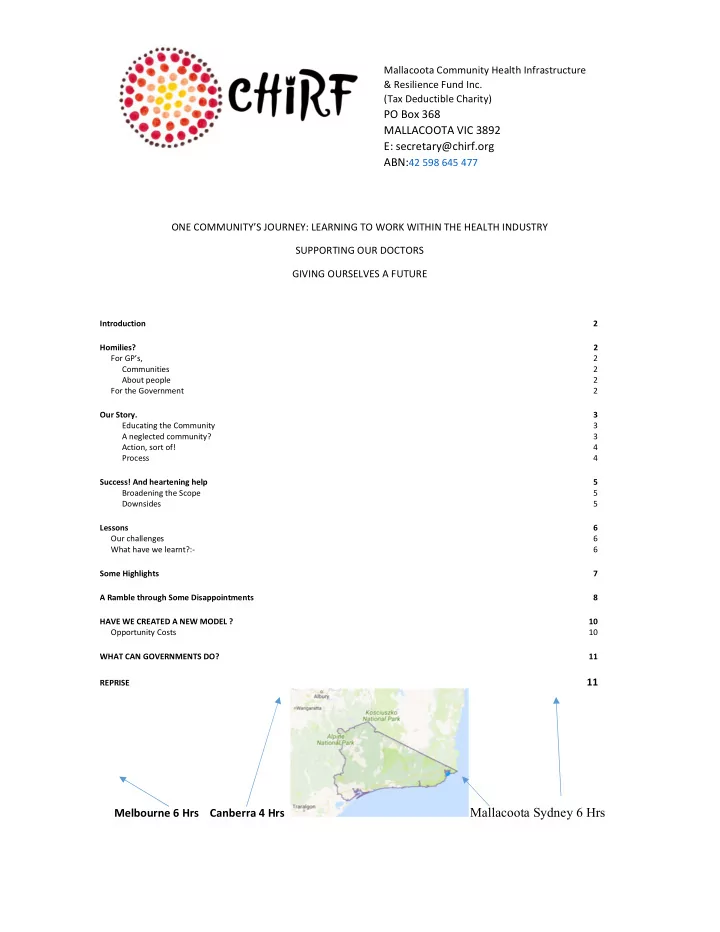
Melbourne 6 Hrs Canberra 4 Hrs

Mallacoota Sydney 6 Hrs

slide-2
SLIDE 2

Introduction

Once upon a time, many years ago, there were three totally committed GPs (General Practitioner) managing a remote practice in Mallacoota. The number was about right for a town of a 1000 or less. Now that remote community always assumed it would be that way. Yet some 1000 days or so ago, it came to pass that two of the GPs decided to leave for personal reasons. The recruited OTD (Overseas Trained Doctor) did not last. Mallacoota is a community of 1063 with half of those over 60. Over the Holiday season that number expands by

  • ver 5000. How many Dr’s do you need?

In February 2016, our remaining sole local GP contacted an unqualified but interested resident. “We have a problem”, she said. The resident recruited a friend to assist in the process of reviewing the scope of the calamity confronting the wilderness town. One GP could not survive alone in such a remote community. Just 38 Years old, highly skilled in remote medicine but without peer support she concluded her practice was not sustainable. One GP could not maintain her health and wellbeing and continue to provide the level of health service to her rural community that her principles and ethics necessitated she give. Medicare Rebates would not support a Clinic, an issue with which you are all familiar. At this time, the remote community was both unaware of the way the health system supported remote communities like ours. Remote, there is a map at the end of the paper but Mallacoota is situated in far eastern Gippsland where the Victorian and NSW Border meets the sea. Surrounded by 200,000 hectares of forest, the nearest hospital is 2 hours away through a lonely highway and only one narrow road in and out. It is an land island in the wilderness.

Homilies?

This paper is a story but contains a strong message about rural and remote communities and what they might need to do to survive in the face of declining medical support. The story is about a few people not giving up and documenting their actions in the trust it will help others. Equally we have drawn out a number of observations about the issues we faced and how we overcame them. Where we might go to in the future and how we are determined to help ourselves. It is not a whinge and any criticism we hope will be taken as constructive. We are of the view that for remote communities the system doesn’t work. We are very happy to use our experience to help

  • thers and without a hint of a smile, help government and governing bodies to a better realisation.

For GP’s,

Communities

  • 1. We need to be engaged in their health delivery infrastructure.
  • 2. We need to be educated more about the health industry.

About people

  • 3. There are no white knights. Capable people need to be sought out and enlisted within rural and remote

communities.

  • 4. Your communities contain valuable resources, identify and do not be scared to engage.

For the Government

  • 1. Communities should not be taken for granted, one health care model does not fit all remote and rural

communities.

slide-3
SLIDE 3
  • 2. The Health Profession and its peak bodies dominates policy development and implementation strategies. We

question whether this is the best way for the future. We acknowledge the difficulties of engaging with communities in this complex area.

  • 3. Every community has a different take on what’s to be done. Some regard market failure as akin to God’s will,

develop learnt helplessness and wait for miracles. Others see a health crisis as an opportunity to innovate and tackle reforms head on, pragmatically. Reformers will be viewed sceptically within their communities unless they deliver on short term goals. In general status quo and decay have the best odds. Change often relies on threat or self-interest.

  • 4. Many residents are highly skilled from former careers.
  • 5. Public agencies can be seduced by organisations that do not rattle cages. The key issue is how to provide and

sustain medical service to remote communities that are helpless unless there is a will to seek development and change. Understanding this Yin and Yang is fundamental to shaping policies that will result in Government interventions and funding decisions that help rather than hurt. And are tailored for the particular place and its peoples.

Our Story.

Educating the Community Research and rapid learning by the two health novices built an understanding of the problem and a decision on the Drs insistence to “go live”. A public meeting was called. Its first decision was not to go without possible solutions. This involved a clash of cultures: public servant vs clinical Dr. Over one third of the population and ABC Backroads TV program1 came to hear Dr Sara Renwick-Lau declare the difficulties she was facing as the only doctor in a town with a permanent population of roughly 1000. A well prepared speech laid it all out explicitly. What the meeting heard shocked the town. Mallacoota, whose population explodes to between 6000 and 8000 during the summer months and for whom the nearest GP alternative was to drive over an hour through lonely forests, was on the verge of NO doctor! This may seem daunting if you’re young. But as 500 of our 1000 are over 60; 85 over 80 it was a death sentence for the town. The nearest hospital was two hours away and incredibly, no aged care facilities. Recruit and retain more Doctors,seek funding and donations (all equipment purchased by CHIRF remains the property of the community) to replace and improve equipment and a goal of reintroducing After Hours was the basic staple put to the audience. RWAV’s business model of Locum system of fixed fees was driving the bulk billing practice broke. Locums fill a gap but in remote communities patients will wait for their regular Dr. Another solution needed to be found The overwhelmed Community was supportive and $5000 in donation came from the floor. A neglected community? An absence of aged care facilities is a tragedy for this wilderness town. Over the last eight years alone, the town lost at least 164 senior citizens alone without these facilities. We have the names . For nearly 52 years committed locals had strived to bring residential aged care to the community. Naysayers have so far won the day. We reflect now on how many had to leave town when they were in need of medical and aged support. They contributed to RSL Auxiliary, Red Cross, Ambulance Auxiliary, P-12 College, and the information service and raised money vainly for the dream. They were active volunteers in the emergency services such as SES, CFA and Ambulance. There are so many that contributed to Mallacoota life as volunteers with the Friends of Mallacoota, Coast Care Group, The Weeding

1 http://ios.tviview.abc.net.au/programs/back-roads/FA1527V003S00

slide-4
SLIDE 4
  • Groups. Clean-up Mallacoota and Beaches Groups, The Historical Society, The Arts Council, The Lions, all the

sporting clubs, Surf Life Saving, MDHSS (Mallacoota District Health and Support Services) as drivers, kitchen hands

  • etc. those that look after the cemetery and so many others we cant mention all. It is a very volunteer driven

community. All of these volunteers were the Real Deal, but in their final twilight years they got a Raw Deal. Nobody thought that Drs were the Real Deal. Nobody. Action, sort of! All at the meeting invited to assist with finding solutions. Predictably there was not a stampede. Health Care was a government problem…they would fix, was a common sentiment. Many residents knew little or were misinformed about the underpinnings of a private practice. The majority just assumed “the Government would fix it”. It’s a private business – “let it collapse”….assuming somebody else will come to fill the gap often shaped their attitudes. In response, we founded Dr Search. It was based on the concept of not treading on the toes of the traditional workforce agencies of which in the formative process we had developed a small understanding of their ‘modus

  • perandi’.

Long experience in government and sporting administration and a clear view of the future based on a temporal assessment focussed the initial advocates. A couple more were recruited. Small, focussed, agile, pragmatic with an

  • bsession for quick decision making, We hit on Medical Conferences like this. If we could leg, rope a Dr or

two…East Gippsland Shire Council stumped up the money to buy us a place on the floor. Our local arts community worked out a presentation for the stand. Wow. We now have our own video. First Hesitant Steps RMA Canberra 2016 was our first foray. We notched no Dr’s but became noticed – “what’s this community doing here? How innovative!”. But a locum pool formed and the networking started including the dawning of our awareness of the importance RVTS (Remote Vocational Training Scheme) would take in our lives. The two specialists” let’s call them “Health Policy Registrars” (Robin Bryant and Dr Tricia Hiley)…also focussed on medium term solutions to the viability of medical services in Mallacoota, business, health care gaps, funding and

  • infrastructure. Mentoring Dr Sara towards a practice that could survive, staffing arrangements, mixed billing,

equipment. It was a 24/7 operation, a huge learning curve, which is yet to flatten as State and Government policy wonks flirted with often inconsistent approaches and understandings about what resources were needed and whether they should even take an interest. This is still the case, I might add. There is a substantial argument about how many Dr’s we actually need! Process So we learned to ROAR. One member was very experienced in government and industry development and regulation, forestry, aviation, shipping, minerals etc. He discovered a new industry and a growing awareness of the dysfunctional basis on which it operated. We started networking - an important part of our approach. The internet, email, social media and Google was our friend again. We went to Parliament House and lobbied Ministers. Community naysayers were gobsmacked when we formed an incorporated charity Mallacoota Community Health Infrastructure and Resilience Fund Inc.(CHIRF) in double quick time, one month, and a little later became a DGR (tax deductible) Health Promotion Charity…How else do you handle donations to a private medical practice? Easy. It has become the vehicle to liaise with both federal and state governments to try and find a solution to the problem. CHIRF is an acronym for Community Health, Infrastructure and Resilience Fund. It is also an important vehicle for access to grants that a private practice cannot access easily.

slide-5
SLIDE 5

In 2017 we soldiered on. We had to be where the doctors are. CHIRF attended two medical conferences, RMA Melbourne and GP 17 Sydney. Letters to each and every Canberra Dr. Zero results.

Success! And heartening help

So a quick step back in time, CHIRF after the Canberra Conference in 2016 started the process that during 2017 helped formed an alliance with RVTS. Mallacoota became the first town in a pilot scheme to enable Drs a community has found to gain Fellowship in either ACRRM (Australian College of Rural and Remote Medicine) or, and via remote supervision. We find the Dr’s, they will include them in RVTS. It is unusual in our experience to find a government organisation with such vision and risk averseness. They saw us, absorbed our issues and came up with a solution. All helped by networking and an open mind. We need more RVTS’. The process was helped by our good friend and mentor Stan Stavros, SBM Stavros. He lives a long way from us but we built up a very close and abiding relationship, without his support and mentoring we might not have

  • survived. So don’t be scared to look outside your boundaries.

So the adjectives role off….Vision, thoughtfulness, understanding and communication. and very effective. RVTS of course did its due diligence and I know CHIRF, DR Search and MMC were given a good going over by Dr Giddings and his key people… a critical part of any process. Seems we passed muster. At GP 17 (RACGP Conference Sydney) we met up with a number of Drs. But Dr Mubashar Sherazi showed an interest in us. We had someone to negotiate with our new found friends in RVTS became comfortable. A rocky path, but Dr Mubashar Sherazi is now ensconced with us, and his family relocated from Calgary and have melded into the town. Finding a Dr. requires the care of a new Doctor. It means ensuring they and their family are happy in the community. Not something to be forgotten. We are in constant contact. Dr Sara also re-registered the Practice for Registrar training. So we have for the past year attracted a Dr who is contracted to the East Gippsland Rural Training Scheme. The community was sad to see Dr Emily Butlin go to her next rotation. Another issue remote communities have Registrars on that program only stay a year and move on. RVTS they stay for the full contracted period. That has obvious implications for continuity and longevity. Having Registrars is where we want the practice to go. It must be more than just treating patients. It needs to have an educational role to provide fulfilment not only for the Drs but for the community. We extend that principle to

  • ther health professionals but we are learning to walk first.

Broadening the Scope Our story only begins rather than ends happily ever after here. Our operation expanded from Dr Search, to health delivery including trying to reintroduce After Hours into the community, a broad scale mental health program including teen health and providing a more solid financial base for the Medical Practice. We are building a new medical centre and actively working for support facilities for after Hours nursing, trauma facility and specialist equipment rooms. CHIRF obtained a grant of $300,000 towards the cost of the building. MIAC (Mallacoota Inlet Aged Care Inc) owner of the property has contributed $250,000 and taken out a loan for the balance, $170,000. CHIRF’s plans for a high care medium care nursing facility will cost around $9.5m. We have plans! This is a story of a one GP medical centre reinventing itself and a GP with a very clear vision that without community involvement in a remote location, failure was certain. The resulting organisation hopes to breathe fresh life into medical delivery in a remote community and into the Residential Aged Care issue, drawing on where government is going and thinking outside the envelope Downsides What has been passed over are the traumas.

slide-6
SLIDE 6

Our work was actively undermined by some. We discovered the half-life of volunteers even with the best of intentions can be short in such a difficult and unknown environment. Tensions within the community with another health provider that had been funded very well over many years taught us change is challenging for many. Many other issues were not really addressed such as  transportation of ailing residents requiring standard medical attendance via air or ambulance to hospital. Ambulance to Bega in NSW or Orbost Vic , 2 hours, Bairnsdale 3 hours or medical facilities across the bordera minimum 1 hour no place to return to for higher care treatment and find your own way home,  no respite palliative or end of life care 24/7 only 9 to 5 five days. Nursing care the same only 5 days a week.  It is very hard to work in a community in competition with other services fears of reprisal can run thick and fast in a small remote town so not many will peer above the parapet on challenging projects.

Lessons

These are our observations based on our experience in this project and born out of Robin Bryants long experience in the Australian Government as a public servant and also in volunteer sports administration nationally and

  • internationally. We mention that because it is the sort of skill set that helps in this situation and drives a search for

quick solutions. Our colleague Dr Tricia Hiley who worked alongside me for 2 years is a specialist in management, an educator and the perfect foil for Dr Sara and I in this process. Dr Sara had a sixth sense when to work with us and when to let us go as we developed our modus operandi and we learnt about the industry.

Our challenges

 Very little knowledge of how the medical profession and industry works  What is the role of the Health Providing Agencies…?  Where do Ministers fit in and how  Public Servants do they have a role, a trade secret?  Is it possible to influence outcomes?  Has the Government got it all under control?  if so where areMallacoota’s GP Registrars, why is the system not requiring people to train in remote communities? Why are we so alone, despite our credentials nobody from GP Training has spoken to us.  Soul Searching…. what can we really expect when we have decided to live in a remote Paradise?  And last but not least we are retired and volunteering.

What have we learnt?:-

  • 1. The Community has no recognition or voice with the traditional government bodies, we were not seen or

recognized as stakeholders. That was a challenge…. a. And I look specifically at ACRRM, RACGP GPHN and RWAV in saying that.

  • 2. Consultants employed to do us over by traditional government bodies had preconceived ideas. We had no

status, myself and my equally highly skilled colleagues. They missed the obvious as a result. We were not part

  • f the health industry and therefore to be tolerated at best. At worst characterized just another community

group trying to play squeaky wheel.

  • 3. One size fits all in the Health System works so well for administrators. Yet remote communities are very, very

different, you have to listen to those who live there. Importantly each will be different. a. Ministers need to learn that lesson and might I say, so do the officials and agencies

  • b. From Robins career he knows it can be done, Ministers trusted him to get on the ground, learn, report

back and advise….sadly it seems not so much today. c. Our community and its interactions and tensions are totally different to the small (168 people) isolated Cann River 45 minutes away.

slide-7
SLIDE 7
  • 4. Communities have a very flakey knowledge of how the health industry works, its hierarchy of needs is

generally based on pain, the hip pocket and the immediate call out at the time: a. Learning the medical system and the various, “funding streams”, different payment models, acronyms *ACRRM RACGP GPRIP, PIP, MBS, PHN support, RWAV, RDAV, Stacking and Packing! Registrars and more has taken a lot of work

*ACRRM (Australian College of Rural and Remote Medicine), RACGP (Royal Australian College of General Practitioners) GPRIP General Practice Rural Incentive Program, PIP (Practice Incentive Payment, MBS( Medical Benefits Schedule) , PHN (Primary Health Network), RWAV (Rural Workforce Agency Victoria), RDAV (Rural Drs Association of Victoria)

  • b. Can this be translated to other communities with needs?
  • 5. The State Government seems less interested in remote communities. Fewer votes. The Victorian Government

still does not recognise us. It still embraces an outdated model of one health provider per remote community to promote an integration and coordination is its answer to market failures. It evinces no interest in private practices and even less interest or process to evaluate the effectiveness of that model a. Reflect! CHIRF, Dr Search is born out of MARKET FAILURE.

  • 6. Medical Practitioners in Private Medical Practices do not have the skill sets to take on the lobbying necessary

to make the gains necessary for survival a. I have been introduced to BUSINESS FOR DOCS and actually sat through an MBS presentation, what an education, an eye opener

  • i. I think there is need a GOVERNMENT for Doctors ….
  • ii. I don’t think the exclusion of communities from the Health Industry politics is all that

productive for the future.

  • 7. The AGPT model is for remote communities too inflexible about borders and regional lines making it tough for

remote areas to access Registrars interested in coming to us. a. Our Registrar had to travel five hours to courses…our Registrar had to go Melbourne but it was only four Hours from Canberra. We salute our regulatory overlords’ impenetrable wall called BORDER and BOUNDARIES.

  • b. Mental health rules and issues vary across the borders Victoria, NSW and ACT. Our practice looks

more and more to the ACT for medical and mental health support. c. ACT is our closest tertiary health locality

  • d. Because of boundaries we can only recruit within EVGPT (Eastern Victoria GP Training. We find this a

frustrating waste of time and money.

Some Highlights

  • 8. In rehearsing the above, you can appreciate how overwhelmed we felt about the open minded and supportive

work of the Foundation for Rural and Regional Renewal (FRRR) and RVTS, the Remote Vocational Training Scheme a. We applied for a grant (GPHN drew our attention to the opportunity, thanks Marg Bogart) and they have shown incredible vision, in our view, in supporting us…….they are helping CHIRF with administration to try and stop volunteers such as us burning out and giving us an opportunity to still contribute our experience and skills…..we are amazed at their understanding and foresight….they have also helped us with funding for a psychologist and an Allied Health Assistant to pilot mental health and chronic disease support programs.

  • b. Their funding was a significant turning point for us and our future. CHIRF now has a solid professional

administrative base. We support the employment of staff for the Medical Centre based on Grants we can access but a private practice can’t. You can ask about that. Others are.
slide-8
SLIDE 8
  • 9. We are happy also to say that after a lot of work and some not inconsiderable pain, GPHN has come on board

and think we can see some substantial prospects for the future. With an open mind and support from the Commonwealth Department we will both be able to develop a new model for health care in a remote

  • community. We would like to work with them as a team, but recognizing our eccentricities.
  • 10. RWAV still puzzles us. They are funded to the tune of about $13m but seem to place few permanent Doctors.

Our engagement with them has been, minimal for a number of reasons. Originally they wouldn’t talk to me on behalf of Dr Sara, I wasn’t a Dr and I wasn’t staff. Could I be recognized as an impatient patient, maybe? What we have done over the past 3 years would have cost RWAV about $200,000 is our professional estimate. We are negotiating some financial support but the community has paid its own way with seed capital from the East Gippsland Shire Council and with some volunteers picking up their own costs. We are building bridges and we make some observations about a way ahead later. a. I note Ewan McPhees recent tweet “ Ewen McPhee 🇧🇻 (@Fly_texan) 24/2/19, 6:23 pm The Truth laid bare - years of poor, or no Workforce Policy in spite of Millions invested in Workforce

  • Agencies. Specialist colleges engaged in turf protection and restraint of trade. Young doctors as
  • pawns. insightplus.mja.com.au/2019/6/career-… ⁦@ACRRM⁩ stands ready to help

NEED we say more except Dr Ewen….look to your communities remember there are 70,000 of you but 16 million of us when it comes to the polling booth. We are still developing the model. It is replicable, with care, skill, professional mentors and a watchful eye on the different operating parameters between remote communities and we trust flexibility with the Agencies. In the end results count, not the process. We are not deliberately being disruptors. But if that’s where we have to go to get results for our community, we will… WE HAVE A PROBLEM AND WE ARE ALL AGED for us and our future. things need to happen NOW.

A Ramble through Some Disappointments

  • 1. Recognising the private practice was failing in a remote community required a total refocus and caused some

considerable questioning in a small community with little knowledge of the implications a. Why not let the private practice fail

  • b. We can drive to Eden in NSW an hour away

c. We can fly doctors in

  • 2. There is already one Health Care provider here let them do it,

a. But they appeared to have no plan, nor a business model that supported the provision of medical services or the search for and support of Doctors

  • b. We have received no support from that provider

c. We can’t even be appointed to its charity, let alone its board.

  • 3. What are the key attributes for a Private Medical Practices to survive?

a. Doctors?

slide-9
SLIDE 9
  • b. Patients?

c. A revenue stream that is capable of meeting the needs of the Practice and not totally reliant on the MBS, Drs need income…as do their support staff!

  • d. A working environment that is conducive to good mental health for all Practice Members?
  • e. Life Style offerings?

f. Infrastructure? g. Equipment?

  • h. Commitment?

i. AND IN A REMOTE COMMUNITY, INVOLVEMENT WITH THE COMMUNITY.

  • 4. It has taken two years for the PHN to recognise us as a player (sic Stakeholder) in providing medical (health)

services, a. to its credit once GPHN realised what was going on, they have given us very considerable support and been understanding of our inadequacies.

  • i. I sympathise with the drivers they face from Canberra.
  • ii. They eventually put a lot of effort into understanding us, and through that process we

developed a good relationship with the former CEO, Marianne Shearer which I trust will carry through to her successor Amanda Proposch and her able lieutenant Marg Bogart.

  • b. Looking at the criteria above for a successful medical practice I have some concerns about other

providers being subsidised to compete with the Medical Practice, c. Many of the dicta from Canberra driving the PHN are anything but reality, I sympathise with GPHN (privately) on this

  • i. I still smile about attending a workshop on the stepped care model for mental health

delivery, I learnt a lot but it was like learning simultaneous equations with more variables than equations. For a remote community with 1000 people and not allied health?

  • ii. the limitations on medium to long term funding create uncertainty
  • iii. that telehealth could ever be the answer to the maidens prayer for a remote

community! Our GPHN is now interested in what we are doing, trying to build a regional workforce model with our friends from nearby towns, particularly Bega Valley Medical Practice..…but across a border. Our job is to get them to recruit the cross border in NSW PHN into our regional cause. GPHN has a huge area with have very limited capacity to delve into the intricacies of small communities…. they need extra funding and organisational capacity and a capacity to focus on such communities. They have the most remote community in Victoria, that needs to be recognised.

  • iv. We have a strong view that the planning models that are imposed on the PHN’s e.g.

.community planning committees are counter productive.

  • v. Communities commonly don’t know enough to properly engage
  • vi. Small communities have serious tensions of their own.

State Borders and AGPT Regions discriminate against remote border towns such as Mallacoota a. the community needs the freedom to recruit across borders

  • b. We have this wonderful Modified Monash Model system of geographical diversity.
  • vii. Perhaps the bureaucracy delivering services needs to be divided up that way.
  • viii. Our request to be treated as a MMM7 was rejected on the basis that the models were

not wrong they said we were an MMM6 and our problems were not with the model. . An issue we are taking up again with the Minister.

slide-10
SLIDE 10

HAVE WE CREATED A NEW MODEL ?

  • 5. CHIRF operates on the basis of being small focused and outcome oriented. Formalities and protocols are out

the door. We have no time for committees and meetings, we communicate on the internet every day but we have a very close watch on our legal obligations.

  • 6. In Victoria we operate without any support from the State Government they have held us very

much at arm’s length. Talk to the hand.

  • 7. CHIRF has morphed from simply looking for Drs to a broader health services needs outlook. It now provides

high level management support for the Practice a. Mentoring, providing a non-medical perspective to problems

  • b. Lobbying

c. Strategic Planning

  • d. Giving access to funding streams not hitherto available
  • e. Planning for a broadening medical support base within the Region

f. Developing Linkages with other Practices to give greater stability, in employment and access to allied health professionals. g. Very importantly we are looking to build a regional model…. we need to be able to share with neighboring communities covering both the Wilderness and Sapphire Coasts and work on common solutions. Our working model is for a small compact group who are prepared to commit, put in. not your classic community engagement I think….but for us it works..its results that are important not just process Within our ageing community we observe a number of volunteer organisations with large membership bases now failing, as they have run out of committed people with little prospect of achieving their goals.

Opportunity Costs

In deciding whether to do something about Mallacoota and similar sized and located communities the first option is to close them down. Let’s just transport or force everyone that can’t cope out to larger towns with facilities. The second option is to look at what the community needs and work out what is the cost of not providing that service. No after-hours service currently results in ambulances being used 3.5 times more than Bairnsdale. Nearly Half a Million in ambulance trips a year, many unnecessarily. If you believe the pundits, half are unnecessary. The additional cost is the patients are left to find their own way home. No effective palliative or end of life care in the community with half the population over 60 and 85 over 80 means many are forced to relocate. 165 left in the last 8 years, a significant cost in relocation, disruption and the social disconnection of leaving friends and family. No aged care facilities. A recent study indicates Mallacoota on the national averages warrants a 25 bed residential aged care facility. Our calculations based on a 15 bed facility showed an economic multiplier of 1.8, that is for every dollar spent, the return to the investor i.e. the government is 1.8 times. The employment implications were substantial and the social benefit calculations we very high. Without much effort it is possible to consider the costs of no Doctors and insufficient medical related services such as chronic disease support, direct mental health support to ultimately be very high for government who wind up bearing the cost. Each of the following carry significant direct and indirect costs  the social disruption  effect on mental health

slide-11
SLIDE 11

 effect on the local economy by people (and their families) spending their money outside the town. In this respect we calculate that on average governments spend approx. $8500 per capita on health care. Our assessment is Mallacoota directly sees less than half this.

WHAT CAN GOVERNMENTS DO?

Governments State and Federal haven’t got it right in focused on working solely within your industry for remote and rural communities. Both Governments need to respect that rural and remote communities need support to engage. There is an article by Helen Razer talking about the ineffectualness of awareness raising2 in the absence of doing something in practice. RWAV should have a special fund to help support community activities such as ours and have that included in their

  • charter. At the moment I think they are irrelevant to our needs. There needs to be a change in the requirements for

employing Locums, fixed fee vs billings percentage. Unless RWAV subsidise the fixed fee. The financial viability of the medical centre is a key plank in our platform, along with the mental health of the staff. AGPT needs to revise its protocols for distributing Registrars for training. That requirement for annual rotation: does it always make sense?, additional support for Registrars in remote locations including internet access More importantly should there be a policy of filling remote then rural community requirements with Registrars before any city positions are filled? More emphasis needs to be placed on Dr’s specialties, I see a discussion going

  • n re Dr’s that have a surgical specialty not wanting to go remote because they can’t use their skill….that is a furphy

.We have a surgically trained Dr and we are now expanding our capacity to handle situations that would have seen them go two hours to hospital for minor work and then find their way home by themselves. GPHN needs greater flexibility in its funding to support the sort of activities we are undertaking to deliver key medical services Their grant application processes are impossible for many remote communities to comprehend. They effectively them locked out. It is all built around professionals in remote rural. Yet there is a dearth of health professionals but plenty of other prepared to take it on and support the overworked GP.(‘s). The grant application process really locks community groups out of contributing to the health framework. The Commonwealth Department of Health needs to understand and support the diversity of our communities and how the needs are different, and be more flexible. EVERY COMMUNITY NEEDS AN OUTSIDE MENTOR NOT A CONSULTANT WHO KNOWS THE INDUSTRY. GOVERNMENTS CAN HELP. BECOMES A FRIEND. Everybody needs to take a step back and reflect. This is not a complete list of what we see as a needs based

  • assessment. The capacity is there to do a full policy analysis of the situation a remote community faces. But is

anyone listening? We have done a full scale Mallacoota Health Check Report that examines all the shortcomings. It is still in draft but designed to give us guidance for the future. It builds on GPHN’s work in this area.

REPRISE

2 https://www.crikey.com.au/2019/02/24/fyi-awareness-raising/

slide-12
SLIDE 12

On the way with the unstinting help of our friend Stan Stavros, we obtained a commonwealth grant that allows us to build a new medical centre to replace the existing circa 50-year-old one. I mentioned it earlier but it is special and we expect will change the medical centrres dynamics considerably. It opens next month.

The property had been purchased by our sister charity Mallacoota Inlet Aged Care (MIAC). MIAC recognized that without Drs

there was no future for the community and particularly the aged. They have kicked in extra funds and a loan from the Bendigo Bank helped get us over the line. We will be working hard to find ways to build a high medium care nursing facility on the same block. Not every remote town has ex public servants, sports administrator, banjo player, academics with a management skill supported by a very small group of people with broad experience in business, catering industry, travel and life…and time in their retirement to make a commitment. The task is daunting We are happy to work with other communities and maybe if our model is seen as a possible fit we can talk to the wonderful people at the Foundation for Rural and Regional Renewal (FRRR)about how we support that. Robin Bryant for and on behalf of my CHIRF colleagues who provide unstinting community effort over the past 3 years and Dr Sara Renwick Lau whose grit and determination got this going. This is the current and past people involved. Sue Brown, Linda Bruce, John Hilvert, Current Board Dr Tricia Hiley, Ondra Bryant, Martin Hiley, Past Board SBM Consulting and Financial Management Stan Stavros. Mentor and Full Time Friend Group HiS, Bertus Froneman Building Design and management Southern Cross Developers John Tyrrell Building Contractor Support Staff Dr Cath Cosgrave, Sharyn Bruce *ACRRM (Australian College of Rural and Remote Medicine) RACGP (Royal Australian College of General Practitioners) GPRIP General Practice Rural Incentive Program, PIP (Practice Incentive Payment, MBS( Medical Benefits Schedule) , PHN (Primary Health Network), RWAV (Rural Workforce Agency Victoria), RDAV (Rural Drs Association of Victoria

slide-13
SLIDE 13

The community of Mallacoota, in the heart of Victoria’s pristine Croajingalong National Park, East Gippsland, seeks suitably qualifjed doctors, nurses and other allied health

  • professionals. If you are looking for that elusive work/life

balance and the professional rewards of working in a remote community, you may be a person for us!

A perfect

work/life balance

slide-14
SLIDE 14
slide-15
SLIDE 15

Mallacoota

CHiRF (Community Health Infrastructure and Resource Fund, a DGR charity) and Mallacoota Medical Centre invites you to consider joining the medical and allied health practice in our new purpose built, and community owned, facility. CHiRF was formed in 2016 and the volunteer workforce was tasked with fjnding more doctors to assist our over-worked sole

  • GP. We now have two doctors and

CHiRF has moved on to other projects such as a Teen Clinic, seeking funding for a high-care facility and an Aged Care facility, establishing a chronic diseases rehabilitation program and employing staff. We are an innovative and forward-thinking community group, unique in our approach.

slide-16
SLIDE 16

We are a remote resort town whose population of 1,000 residents swells to 8,000+ visitors

  • ver summer and Easter.

There’s a thriving local arts scene, a wide range of social and sporting clubs including everything from surfjng and golfjng to book clubs and regular music jam nights; artisan markets, a new contemporary art gallery, music performance spaces, a local radio station and much more. Town amenities and facilities include a Prep to Year 12 College, two supermarkets, various retail

  • utlets, a library, cafés, a non-

commercial airstrip, an ocean access boat ramp and access to the fjsh-fjlled estuary/lake system via two other boat ramps. As shown in the photos, there is also several kilometres of unspoiled beaches to enjoy. Our well-supported mixed- billing medical practice includes an experienced administrative team, a trained nurse and a visiting psychologist. It has a close working relationship with neighbouring Cann River and the Bega Valley Medical Centre across the NSW border. The job itself: We are looking for more doctors with Australian general practice

  • experience. In return we offer:
  • A generous percentage of

billings (negotiable);

  • A fmexible number of sessions

per week;

  • Access to Mallacoota based

funded GP training towards Fellowship with the RVTS to eligible doctors.

  • Access to General Practice

Rural Incentive Program for this MM6 area We are also looking for nurses, nurse practitioners, mental health professionals and aged care workers For further information,contact CHiRF secretary: Robin Bryant 0417 271 852, email: secretary@chirf.org Website: mallacootamedicalcentre.com.au Facebook: Mallacoota Doctor Search

If you are a medical or allied health professional looking for work/life balance in a vibrant little community, then Mallacoota is looking for you.

Our two doctors