11/4/16 Disclosures Consultant: Globus, Medtronic, Orthofix Adult - - PDF document

11 4 16
SMART_READER_LITE
LIVE PREVIEW

11/4/16 Disclosures Consultant: Globus, Medtronic, Orthofix Adult - - PDF document

11/4/16 Disclosures Consultant: Globus, Medtronic, Orthofix Adult Deformity: When to Consider a Royalty: Globus Smaller Procedure Dean Chou, M.D. Professor of Neurosurgery The UCSF Spine Center University of California San Francisco


slide-1
SLIDE 1

11/4/16 1

Adult Deformity: When to Consider a Smaller Procedure

Dean Chou, M.D. Professor of Neurosurgery The UCSF Spine Center University of California San Francisco

Disclosures

  • Consultant: Globus, Medtronic, Orthofix
  • Royalty: Globus

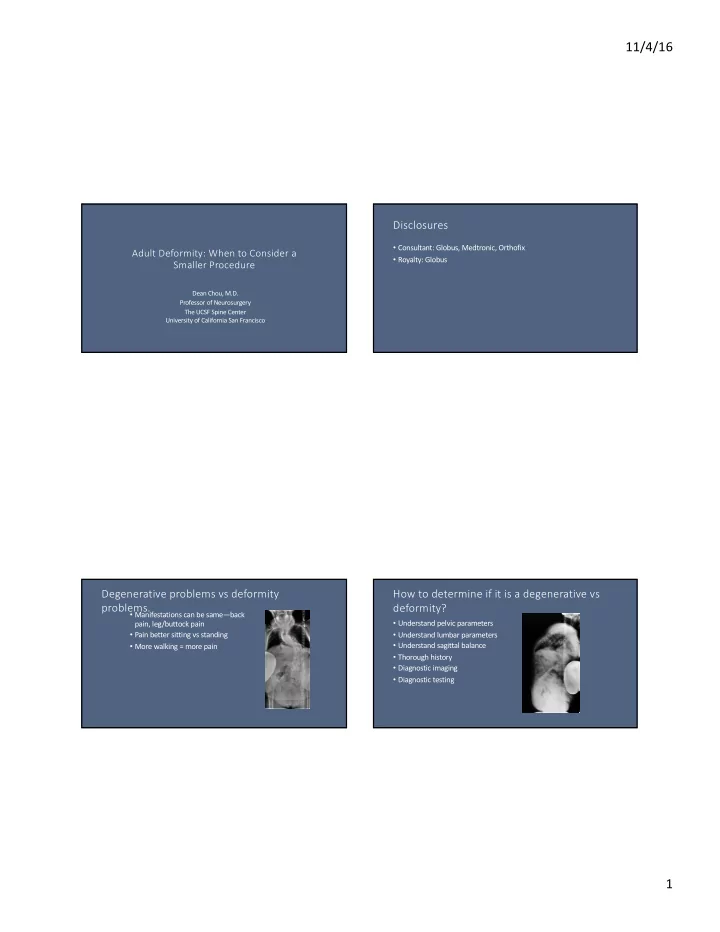
Degenerative problems vs deformity problems.

  • Manifestations can be same—back

pain, leg/buttock pain

  • Pain better sitting vs standing
  • More walking = more pain

How to determine if it is a degenerative vs deformity?

  • Understand pelvic parameters
  • Understand lumbar parameters
  • Understand sagittal balance
  • Thorough history
  • Diagnostic imaging
  • Diagnostic testing
slide-2
SLIDE 2

11/4/16 2

Why it’s important to understand deformity even for a one level fusion

  • 80yo female
  • L4-5 spondylolisthesis
  • Failed conservative care.
  • Underwent single level L4-5 fusion

After an L4-5 fusion Can’t stand up. Falling forward. Patients clearly needing re-alignment surgery 50 yo female s/p multiple prior surgeries

slide-3
SLIDE 3

11/4/16 3

50 yo female s/p multiple prior surgeries

  • +SVA
  • PI/LL Mismatch
  • Coronal imbalance
  • Pseudarthrosis

50 yo female s/p multiple prior surgeries

  • Plan:
  • 1) revision ALIF with more lordosis
  • 2) Asymmetric PSO with

simultaneous coronal and sagittal plane correction with temporary rod

  • 3) short segment rod to further

induce lordosis

  • 4) 4-rod construct.

After asymmetric PSO and revision ALIF 51 yo with prior fusion

slide-4
SLIDE 4

11/4/16 4

Postop at 2 yrs. Post op What about no severe sagittal or coronal balance issues? 2 surgeries done, no standing xrays ever taken

  • 80 yo male with left leg pain
  • Injections—failed
  • PT—failed
  • Laminotomies—failed
  • Repeat laminotomies—failed
  • On high-dose narcotics for left leg radiculopathy
slide-5
SLIDE 5

11/4/16 5

Left parasagittal MRI Mild scoliosis, but severe pain

  • Pre-psoas approach
  • Lateral interbody fusion
  • Percutaneous screws
  • No revision laminectomy

Pain completely gone. No approach- related symptoms. Home POD #2

slide-6
SLIDE 6

11/4/16 6

Principles to keep in mind

  • 36 inch films in all fusion patients
  • Know lordosis you can get with each tool
  • Height restoration for

severe foraminal up- down stenosis

  • Augment fusion rate
  • Correct coronal plane

deformity

Advantages of interbody distraction

Which interbody?

  • ALIF
  • TLIF/PLIF
  • Direct lateral--LIF

ALIF VS TLIF

slide-7
SLIDE 7

11/4/16 7

ALIF vs. TLIF What’s the data show?

ALIF is better than TLI for the foramen and for lordosis

  • Retrospective x-ray

review

  • ALIF improved

foraminal height and segmental lordosis at each level

Hsieh PC, J Neurosurg Spine. 2007 Oct;7(4):379-86

TLIF VS ALIF. Wash U Data

  • TLIFs had great blood loss:
  • 2011 vs. 1281 mL, P = 0.0002
  • Spine (Phila Pa 1976). 2013 Feb 25. [Epub ahead of print]
  • Transforaminal versus Anterior Lumbar Interbody Fusion in Long Deformity Constructs: a matched cohort analysis.
  • Dorward IG, Lenke LG, Bridwell KH, Oʼleary PT, Stoker GE, Pahys JM, Kang MM, Sides BA, Koester LA.

TLIF VS ALIF. Wash U Data

  • ALIFs had more lordosis restoration:
  • 5.6° vs. -1.7°, P<0.0001 at L4-5
  • 2.5° vs. -1.4°, P = 0.022 at L5-S1
  • Spine (Phila Pa 1976). 2013 Feb 25. [Epub ahead of print]
  • Transforaminal versus Anterior Lumbar Interbody Fusion in Long Deformity Constructs: a matched cohort analysis.
  • Dorward IG, Lenke LG, Bridwell KH, Oʼleary PT, Stoker GE, Pahys JM, Kang MM, Sides BA, Koester LA.
slide-8
SLIDE 8

11/4/16 8

TLIF VS ALIF

  • At the L5-S1 level, radiographic results indicated that ALIF was

superior to TLIF in its capacity to restore disc height, lumbar lordosis, sacral slope (decreasing pelvic tilt)

  • J Neurosurg Spine. 2010 Feb;12(2):171-7. doi: 10.3171/2009.9.SPINE09272.
  • Which lumbar interbody fusion technique is better in terms of level for the treatment of unstable isthmic spondylolisthesis?
  • Kim JS, Lee KY, Lee SH, Lee HY.

What’s the data show for lateral surgery?

Lordosis per level is about 3 degrees

  • 43 consecutive patients at HSS
  • 1-year f/u for DDD, spondy, or scoliosis
  • 25 patients with scoliosis
  • scoliosis angle correction was 10.4 degrees (P=0.001,

43%)

  • mean correction of 3.7 degrees (P≤0.001) at each

instrumented disc level in coronal plane

  • 2.8 degrees (P≤0.001) of lordosis at each level
  • Sharma AK,Lateral lumbar interbody fusion: clinical

and radiographic outcomes at 1 year: a preliminary

  • report. J Spinal Disord Tech. 2011 Jun;24(4):242-50.

What about the coronal & sagittal plane?

8 patients with degenerative scoliosis (36 patients total)

  • Pre- and postoperative regional lumbar coronal Cobb angles were 21.4°

and 9.7°, respectively (p = 0.0004).

  • In the sagital plane, the mean segmental Cobb angle measured -5.3°

preoperatively and -8.2° postoperatively (p < 0.0001).

  • The mean pre- and postoperative regional lumbar lordoses were 42.1°

and 46.2°, respectively (p > 0.05).

  • Lateral interbody fusion does not improve regional lumbar lordosis or

global sagittal alignment, despite great coronal correction.

  • Changes in coronal and sagittal plane alignment following minimally

invasive direct lateral interbody fusion for the treatment of degenerative lumbar disease in adults: a radiographic study.

  • Acosta F, J Neurosurg Spine. 2011 Jul;15(1):92-6. Epub 2011 Apr 8.
slide-9
SLIDE 9

11/4/16 9

Remember your tools—even useful in a single level fusion

  • Ponte osteotomies
  • Cantilever
  • Lordose your rod
  • Compression without foraminal

compromise

Smith-Petersen Osteotomy Single-level posterior osteotomy

slide-10
SLIDE 10

11/4/16 10

Degenerative case—avoiding flatback

Degenerative stenosis & back pain

Treatment?

  • Laminectomy alone
  • Laminectomy fusion L2-5
  • Laminectomy fusion L2 to ilium
  • Laminectomy fusion T10 to ilium
  • Laminectomy fusion T2 to ilium

L2 to ilium. Posterior Induce lordosis

slide-11
SLIDE 11

11/4/16 11

One level fusion--revisted

  • 63 yo female with leg pain
  • Patient ambulates cautiously, with a modified gait, in a flexed forward

posture.

  • s/p L4-5 fusion in 1974 at an OSH, who presents to the UCSF Spine

Center with complaints of leg pain

  • The patient has AP and lateral standing scoliosis x-rays which

demonstrate that the patient has a pelvic incidence of 50°, and lumbar lordosis of 20°, a pelvic tilt of 46°, and positive sagittal balance

  • f 11 cm.
slide-12
SLIDE 12

11/4/16 12

Further questioning

  • She has no back pain
  • She can stand “fairly straight”
  • Clinical examination shows knees and hips are straight
slide-13
SLIDE 13

11/4/16 13

Treatment? Treatment plan

  • Pt does not want multi-level fusion
  • Key points are:
  • Fully release segment to correct the slip angle, aka lordosis
  • Do not fuse in the kyphotic position—flat back
  • Even though it’s one segment, get as much as you can
  • Adding on top of prior fusion with kyphosis may tip patient over edge

Single-level lateral fusion with Ponte/Smith Petersen Osteotomy.

slide-14
SLIDE 14

11/4/16 14

Pt ODI down, “I can stand up straight”.

Is it possible just to address the fractional curve only? The majority of disability is nerve compression in most patients

Does everybody need T10 to the pelvis?

The fractional curve

  • 64 yo female
  • s/p 2 decompressions
  • Left leg pain
  • Scoliosis diagnosed as adolescent
  • Back pain manageable

Side bending films

slide-15
SLIDE 15

11/4/16 15

MRI Left leg/buttock pain (L4-5) Failed 2 laminectomies

Candidate for fractional curve treatment only

  • Does not want entire

scoliosis addressed

  • More leg pain than back

pain

  • Pt aware back pain may

still be there

slide-16
SLIDE 16

11/4/16 16

  • L4-S1 ALIF to induce

lordosis

  • L4-S1 lami/fusion
  • Leg pain completely

gone

Does the cobb angle always need to be included in instrumentation?

  • 60 year old nurse
  • Severe back pain and unilateral leg pain
slide-17
SLIDE 17

11/4/16 17

Limited decompression with TLIF

  • L3-4 and L4-5.
  • Pt understood that entire scoliosis not addressed

MIS applications in deformity surgery

slide-18
SLIDE 18

11/4/16 18

79 yo female with left leg pain Fractional curve and MIS L4-S1 ALIF with MIS screws

slide-19
SLIDE 19

11/4/16 19

69 yo with leaning to right, right leg pain, forward lean L3-S1 ALIF L3-pelvis MIS fixation L3 to Pelvis Conclusions

  • Even a single level fusion can have profound effects on the patient
  • Keep deformity principles in mind when counseling patients—not

necessarily change the surgery

  • Deformity techniques can be useful in limited, 1-2 level surgeries
  • Although some patients need large, reconstructive procedures, the

many degenerative spine patients are helped with nerve decompression

  • In patients without sagittal or coronal issues, limited fusion over

compressed nerve levels is an option, especially in elder patients.

slide-20
SLIDE 20

11/4/16 20

  • Thank you.