11/14/2016 Disclosures Research grants to my institution from Merck - - PDF document

11 14 2016
SMART_READER_LITE
LIVE PREVIEW

11/14/2016 Disclosures Research grants to my institution from Merck - - PDF document

11/14/2016 Disclosures Research grants to my institution from Merck and GSK Tuberculosis: Whats New for the HIV Provider Susan Swindells MBBS University of Nebraska Medical Center Omaha, NE December 2016 Case #1 ARS Question #1


slide-1
SLIDE 1

11/14/2016 1

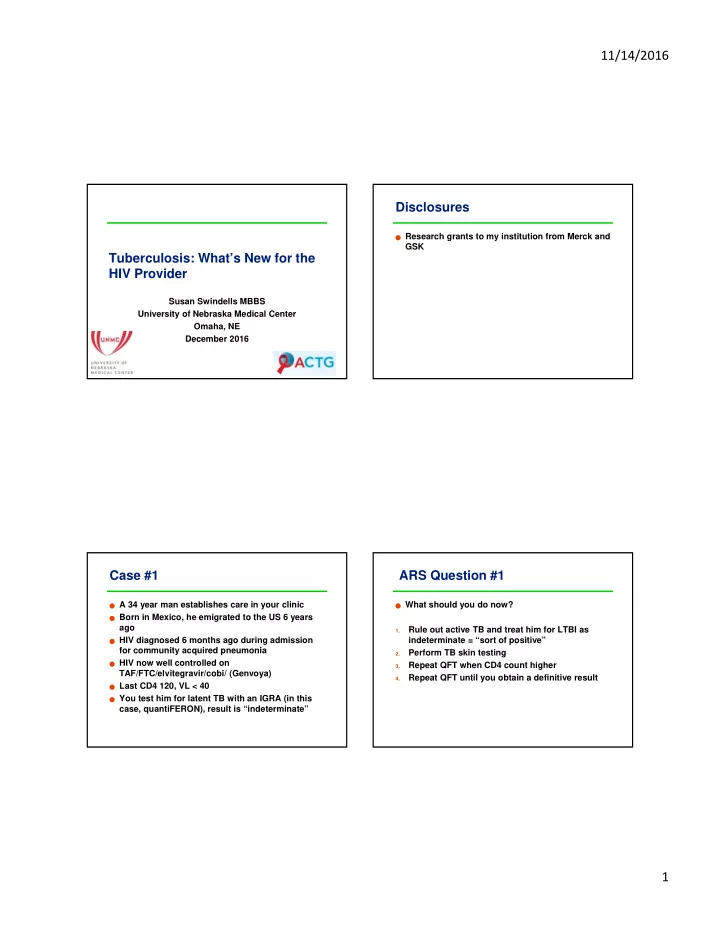
Tuberculosis: What’s New for the HIV Provider

Susan Swindells MBBS University of Nebraska Medical Center Omaha, NE December 2016

Disclosures

 Research grants to my institution from Merck and

GSK

Case #1

 A 34 year man establishes care in your clinic  Born in Mexico, he emigrated to the US 6 years

ago

 HIV diagnosed 6 months ago during admission

for community acquired pneumonia

 HIV now well controlled on

TAF/FTC/elvitegravir/cobi/ (Genvoya)

 Last CD4 120, VL < 40  You test him for latent TB with an IGRA (in this

case, quantiFERON), result is “indeterminate”

ARS Question #1

 What should you do now? 1.

Rule out active TB and treat him for LTBI as indeterminate = “sort of positive”

2.

Perform TB skin testing

3.

Repeat QFT when CD4 count higher

4.

Repeat QFT until you obtain a definitive result

slide-2
SLIDE 2

11/14/2016 2

Recommendations for LTBI testing in HIV

 Risk of progression to TB disease 10x greater in

HIV+

 CDC recommends testing after HIV diagnosis and

then annually if negative and with exposure risk

 If baseline negative, repeat after initiation of ART  No direct test for LTBI, can use TST or IGRA  Neither diagnostic test predicts risk of

progression to active TB

 No benefit to repeating either test once positive

http://www.cdc.gov/tb/publications/ltbi/diagnosis.htm TB Skin Test Induces DTH response if pt infected

Interferon –Gamma release Assay Measures immune response to TB in whole blood

48 to 72 hours later

≥ 5 mm positive in HIV+ pts

TST/IGRA Comparison Both tests ~65-70% sensitive in HIV+

TST

 Requires 2 visits  Interpretation same if pt

had BCG vaccine

 Result will be negative or

positive in mm induration

 Requires training to

administer and interpret

 Testing for anergy not

recommended

 Cheaper than IGRA

IGRA

 Single visit  Unaffected by BCG  Result can be positive,

negative or indeterminate

 Indeterminate more

common with immunosuppression (generally CD4 <200)

 Blood must be processed

in 8-30 h

 Limited data in small

children, recent TB exposure

Case #1 continued

 After 6 months treatment with

TAF/FTC/elvitegravir/cobi CD4 count is 300

 Repeat IGRA is positive  Patient has no signs or symptoms of active TB

and has a normal chest xray

slide-3
SLIDE 3

11/14/2016 3

ARS question 2

  • How should you treat his LTBI?
  • Treat with 9 months of INH
  • Treat with weekly INH/RPT
  • Treatment is not indicated
  • Don’t treat as needs to be further evaluated for active TB

CDC Recommendations for LTBI Treatment in HIV-infected Patients

 INH daily or twice weekly for 9 months  INH + rifapentine weekly for 12 weeks  Rifampin (or rifabutin) daily for 4 months  Monitor patients at least monthly for

hepatitis and other side effects

http://www.cdc.gov/tb/topic/treatment/ltbi.htm

Beware Drug-Drug Interactions

Nucleus Cytoplasm

PXR RXR

RIF RIF PXR RXR

CYP3A4 proximal promoter Phase II enzyme regulatory genes PGP regulatory gene MDR1 protein regulatory gene

DNA mRNA

CYP 3A4 XRE

Dooley et al. (2008) JID 198: 948.

RIFAMPIN: A potent inducer of metabolizing enzymes

This complicates co‐treatment of TB and other diseases tremendously

slide-4
SLIDE 4

11/14/2016 4

LTBI/HIV Treatment Considerations

 Any ART regimen can be used when isoniazid alone

is used for LTBI treatment

 Only efavirenz or raltegravir based regimens (in

combination with either abacavir/lamivudine [ABC/3TC] or tenofovir disoproxil fumarate/emtricitabine [TDF/FTC]) can be used with

  • nce-weekly isoniazid plus rifapentine
  • NOTE: TAF contraindicated

 Check carefully for DDI with rifamycins

  • Can use EFV or double dose DTG with rifampin
  • Can use PI with rifabutin at 150 mg daily or 300 mg 3 times

a week

https://aidsinfo.nih.gov/contentfiles/lvguidelines/adultandadolescentgl.pdf http://www.hiv-druginteractions.org/ Both have free apps

Efficacy of IPT in HIV+ Adults: Risk

  • f TB
  • 11 randomised trials with 8,130 HIV+ participants 
  • verall reduction in TB = 36%, reduction PPD+ = 62%

Woldehanna and Volmink, Cochrane Review 2006

0.95 0.64 TB incidence Death

Relative Risk (Fixed) 95% CI

Reference 1.0

Early ART Prevents TB: The Temprano Trial

  • Patients with CD4 < 800 randomized to

immediate or deferred ART +/‐ IPT

  • Severe HIV morbidity endpoints

Danel, CROI 2015 N=2056 # Events Rate/100 PY HR P value WHO ART 111 4.9 Early ART 64 2,8 0.56 0.0002 No IPT 104 4.7 IPT 71 3.0 0.65 0.005

ART and IPT decreased risk of TB independently

Case #2

 54 year old women is admitted to your hospital with

cough, fever, and weight loss

 Diagnosed with HIV on admission, CD4+ 70, HIV RNA

120K

 CXR shows pleural thickening and diffuse infiltrate  Sputum AFB smear negative, bronch negative for PCP

slide-5
SLIDE 5

11/14/2016 5

How To Diagnose or Exclude TB: Novel Diagnostics Now Available

XPERT MTBRIF: 2 hour molecular test for M.TB diagnosis and rifampin resistance (1) More sensitive than AFB smear Works in children and extrapulmonary TB Screen for MDR and XDRTB Xpert Ultra in development (2)

  • 1. Lawn, Lancet ID, 2013 ;2. Alland, CROI 2015

TB Diagnostic for 2 Centuries HAIN MTBDR plus

  • Diagnosis in 5

hours

  • Identifies RIF and

INH resistance

Sensitivity (95% CI) Xpert +/ TB culture + Overall 85.8% (78.0, 91.2%) 91/106 AFB+/TB culture + 100% ( 94.6, 100%) 67/67 AFB-/TB culture + 61.5% (45.9, 75.1%) 24/39

TB Detection: Sensitivity

TB Detection: Sensitivity

TB Detection: Specificity

Specificity (95% CI) Xpert -/ TB culture - Overall 98.9% (97.6, 99.4%) 591/598 AFB+/TB culture + 100% (51.0, 100 %) 4/4 AFB-/TB culture + 98.8% (97.6, 99.4%) 587/594 US only 99.3% (98.0%, 99.8%) 441/444 AFB+/TB culture + 100% (51%, 100%) 4/4 AFB-/TB culture + 99.3% (98.0%, 99.8%) 437/440

Xpert now FDA approved for use in TB infection control Can take pt out of isolation after 1 or 2 negative tests http://www.fda.gov/NewsEvents/Newsroom/PressAnnouncements/ucm434226.htm

Case #2 Continued

 Your pt is diagnosed with TB by GeneXpert with

culture pending

 Started on treatment for TB with isoniazid,

rifampin, ethambutol and pyrazinamide

 When should you start ART?

slide-6
SLIDE 6

11/14/2016 6

ARS Question #3

 Start ART as soon as possible (within 2 weeks)  Start ART after 8 weeks (end of induction therapy

for TB)

 Start ART in 6 months at end of TB treatment

CAMELIA (Cambodia) SAPIT (South Africa) STRIDE (multicontinent)

Treatment strategy of immediate TB therapy + early ART (2 vs 8 weeks) saves lives and reduces HIV complications

Key characteristics of trials of timing

  • f ART during TB treatment

Study Setting Key enrollment criteria Median CD4 (IQR) Primary endpoint CAMELIA

(Blanc, ANRS)

Cambodia Smear + , CD4 < 200 25 (10 - 56) Death STRIDE

(Havlir, ACTG)

Multi-national Clinical TB, CD4 < 250 77 (36 – 145) AIDS or death SAPIT

(Abdool-Karim, CAPRISA)

South Africa Smear + , CD4 < 500 150 (77 – 254) AIDS or death

NEJM (2011) 365 – Blanc et al., Havlir et al., Abdool Karim et al.

slide-7
SLIDE 7

11/14/2016 7

Current Guidelines

 WHO, ATS and DHHS guidelines all recommend:  Initiation of ART within 2 weeks for CD4 count

<50

 Initiation of ART within 8 weeks for CD4 >50

  • Exception for TB meningitis where increased AE and death

reported with early ART in a randomized trial [Torok CID 2011]

Co-treatment Challenges

 Need for coordination between HIV and TB

programs

 Challenge of adherence to multidrug therapy for

both conditions

  • Less with current compact ART

 Overlapping toxicity

  • Hepatitis, rash, less neuropathy currently

 Drug-drug interactions  IRIS

HIV/TB co‐treatment options for adults

ARV* Rifamycin Dose adjustments Other Issues Preferred Efavirenz Rifampin None Watch for CNS toxicity Lopinavir/ Ritonavir (Darunavir/r) Rifabutin Rifabutin 150 mg once daily Monitor for uveitis; Must coordinate care Alternative Raltegravir Rifampin Raltegravir 400 or 800 mg twice daily Limited clinical experience Dolutegravir Rifampin Dolutegravir 50 mg twice daily Awaiting results of trial in co-infected patients Nevirapine Rifampin Avoid NVP lead-in Hepatotoxicity

*All listed antiretroviral drugs should be given together with two NRTI but not with TAF

Do Not Use Rifamycins With TAF

  • TDF has been studied with RIF without significant

interaction1

  • TAF contraindicated with rifamycins in all package

inserts

  • Based on modeling data with carbamazepine2

– Carbamazepine reduced TAF exposure 55%

  • TAF more influenced by P-Glycoprotein induction than

TDF

– (P-GP = protein that pumps foreign substances out of cells)

1Droste JAH, et al. Antimicrob Agents Chemother 2005 2 Personal communication from Gilead

slide-8
SLIDE 8

11/14/2016 8

Why Not Just Use Rifabutin?

 Cochrane review: “insufficient data to be assured

  • f the effectiveness of rifabutin in TB treatment”1

– Clinical trials comparing RBT to RIF were largely conducted among patients not on ART

 Correct dose uncertain

  • Most PK studies done in healthy volunteers; some data to

suggest 300 mg tiw insufficient in HIV+ pts

 Expensive  No pediatric formulation trials comparing RBT to

RIF were largely conducted among patients not

1Davies GR, Cerri S, Richeldi L. Rifabutin for treating pulmonary tuberculosis (Review). In: The

Cochrane Library, John Wiley & Sons, Ltd., 2010

“If Sustiva is coadministered with rifampin to patients weighing 50 kg or more, an increase in the dose of Sustiva to 800 mg

  • nce daily is recommended.”

Food and Drug Administration - January 6, 2012

Use of EFAVIRENZ with TB treatment

What is the right dose of EFAVIRENZ with TB treatment?

(do we need a dose adjustment?)

EFV alone EFV with RIF

Luetkemeyer et al. Clinical Infectious Diseases (2013) 57: 586.

ACTG Trial A5221 EFV PK Substudy, N= 543

RIF PK TB-Rx No TB-Rx Cmin (ng/mL)* 1.96 (1.24-3.79) 1.80 (1.26-2.63)

*Median (IQR)

A5279: EFV Concentrations in 90 Patients on One Month of Rifapentine + INH for LTBI Treatment

2000 4000 6000 8000 10000

Wk 0_EFV (ng/mL) Wk 2_EFV (ng/mL) Wk 4_EFV (ng/mL) EFV (ng/mL)

Podany, CID 2015

slide-9
SLIDE 9

11/14/2016 9

Case #3 continued

 Your patient with TB starts ART after weeks  10 days later, she has recurrent fever  Worsening dyspnea and cough  A CXR shows progression of the pulmonary infiltrates  You suspect Immune Reconstitution Inflammatory

Syndrome (IRIS)

ARS Question #4

 You start the process of ruling out MDR TB or other OI,

then

 1. start a tapering course of prednisone  2. stop her ART  3. start NSAIDs  4. sit tight and continue ART and TB treatment

Immune Reconstitution Disease

  • More common with early ART
  • More common with low CD4 count
  • Rarely severe or fatal
  • Management:

– Make certain of diagnosis

– Rule out MDR TB or new OI

– Surgical drainage – Non‐steroidal anti‐inflammatory drugs

  • Quality of evidence low

– Prednisone

  • 1.5 mg/kg per day for 2 weeks then 0.75 mg/kg per day for 2

weeks reduces risk of adverse events (Meintjes, AIDS 2010)

TB IRIS

Luetkemeyer et al JAIDS 2014 https://www.ncbi.nlm.nih.gov/pubmed/24226057.

slide-10
SLIDE 10

11/14/2016 10

Summary: Barriers to Overcome

 No “viral load” test for TB  Treatment shortening not successful so far  Better treatment for children needed  Some TB agents in development interact with ART and

some are stalled

Conclusions

 TB can be prevented by treating HIV or by treating latent

TB infection or both

 Major improvements in TB diagnostics  TB and HIV must be treated concurrently, not

sequentially

 Rifamycins remain the cornerstone of effective TB

treatment, but drug-drug interactions complicate HIV co- treatment

 Safe and effective regimens for TB and HIV co-treatment

are available

 Coordination of care is essential  We need more research investment and advocacy