SEQ part 3 / HCLRS one cycle per instruction in this design valP - - PowerPoint PPT Presentation

seq part 3 hclrs
SMART_READER_LITE
LIVE PREVIEW

SEQ part 3 / HCLRS one cycle per instruction in this design valP - - PowerPoint PPT Presentation

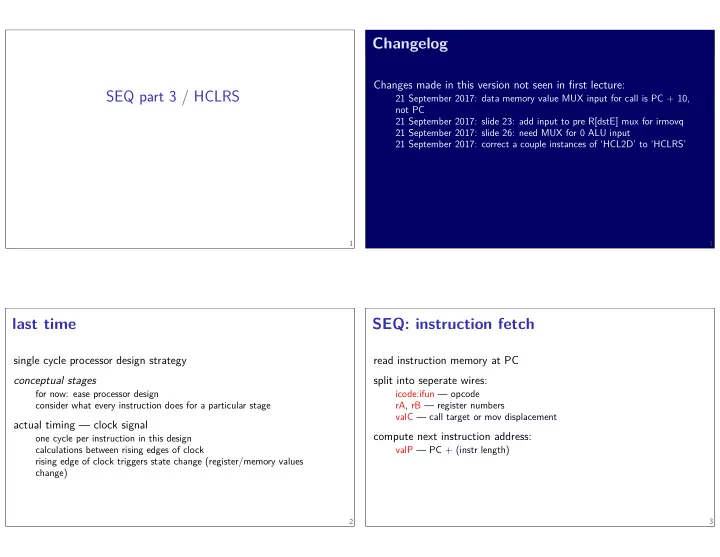
SEQ part 3 / HCLRS one cycle per instruction in this design valP PC + (instr length) compute next instruction address: valC call target or mov displacement rA, rB register numbers icode:ifun opcode split into seperate wires:


slide-1
SLIDE 1

SEQ part 3 / HCLRS

1

Changelog

Changes made in this version not seen in fjrst lecture:

21 September 2017: data memory value MUX input for call is PC + 10, not PC 21 September 2017: slide 23: add input to pre R[dstE] mux for irmovq 21 September 2017: slide 26: need MUX for 0 ALU input 21 September 2017: correct a couple instances of ‘HCL2D’ to ‘HCLRS’

1

last time

single cycle processor design strategy conceptual stages

for now: ease processor design consider what every instruction does for a particular stage

actual timing — clock signal

  • ne cycle per instruction in this design

calculations between rising edges of clock rising edge of clock triggers state change (register/memory values change)

2

SEQ: instruction fetch

read instruction memory at PC split into seperate wires:

icode:ifun — opcode rA, rB — register numbers valC — call target or mov displacement

compute next instruction address:

valP — PC + (instr length)

3

slide-2
SLIDE 2

instruction fetch

PC

Instr. Mem.

register fjle

srcA srcB R[srcA] R[srcB] dstE next R[dstE] dstM next R[dstM]

Data Mem.

ZF/SF Stat

Data in Addr in Data out

valC

0xF 0xF %rsp %rsp rA rB

ALU

aluA aluB valE 8 add/sub xor/and (function

  • f instr.)

write? function

  • f opcode

PC + 10 instr. length + valP

4

SEQ: instruction “decode”

read registers

valA, valB — register values

5

instruction decode (1)

PC

Instr. Mem.

register fjle

srcA srcB R[srcA] R[srcB] dstE next R[dstE] dstM next R[dstM]

Data Mem.

ZF/SF Stat

Data in Addr in Data out

valC

0xF 0xF %rsp %rsp rA rB

ALU

aluA aluB valE 8 add/sub xor/and (function

  • f instr.)

write? function

  • f opcode

PC + 10 instr. length + valP

exercise: which of these instructions can this not work for? nop, addq, mrmovq, popq, call,

6

instruction decode (1)

PC

Instr. Mem.

register fjle

srcA srcB R[srcA] R[srcB] dstE next R[dstE] dstM next R[dstM]

Data Mem.

ZF/SF Stat

Data in Addr in Data out

valC

0xF 0xF %rsp %rsp rA rB

ALU

aluA aluB valE 8 add/sub xor/and (function

  • f instr.)

write? function

  • f opcode

PC + 10 instr. length + valP

exercise: which of these instructions can this not work for? nop, addq, mrmovq, popq, call,

6

slide-3
SLIDE 3

SEQ: srcA, srcB

always read rA, rB? Problems:

push rA pop call ret

extra signals: srcA, srcB — computed input register MUX controlled by icode

7

SEQ: possible registers to read

instruction srcA srcB halt, nop, jCC, irmovq none none cmovCC, rrmovq rA none mrmovq none rB rmmovq, OPq rA rB call, ret none? %rsp pushq, popq rA %rsp MUX srcB

rB %rsp

(none)

F

logic function icode

8

SEQ: possible registers to read

instruction srcA srcB halt, nop, jCC, irmovq none none cmovCC, rrmovq rA none mrmovq none rB rmmovq, OPq rA rB call, ret none? %rsp pushq, popq rA %rsp MUX srcB

rB %rsp

(none)

F

logic function icode

8

SEQ: possible registers to read

instruction srcA srcB halt, nop, jCC, irmovq none none cmovCC, rrmovq rA none mrmovq none rB rmmovq, OPq rA rB call, ret none? %rsp pushq, popq rA %rsp MUX srcB

rB %rsp

(none)

F

logic function icode

8

slide-4
SLIDE 4

instruction decode (2)

PC

Instr. Mem.

register fjle

srcA srcB R[srcA] R[srcB] dstE next R[dstE] dstM next R[dstM]

Data Mem.

ZF/SF Stat

Data in Addr in Data out

valC

0xF 0xF %rsp %rsp rA rB

ALU

aluA aluB valE 8 add/sub xor/and (function

  • f instr.)

write? function

  • f opcode

PC + 10 instr. length + valP

9

SEQ: execute

perform ALU operation (add, sub, xor, and)

valE — ALU output

read prior condition codes

Cnd — condition codes based on ifun (instruction type for jCC/cmovCC)

write new condition codes

10

using condition codes: cmov*

(always) 1 (le) SF | ZF (l) SF

cc

(from instr) rB 0xF dstE

NOT

11

execute (1)

PC

Instr. Mem.

register fjle

srcA srcB R[srcA] R[srcB] dstE next R[dstE] dstM next R[dstM]

Data Mem.

ZF/SF Stat

Data in Addr in Data out

valC

0xF 0xF %rsp %rsp rA rB

ALU

aluA aluB valE 8 add/sub xor/and (function

  • f instr.)

write? function

  • f opcode

PC + 10 instr. length + valP

exercise: which of these instructions can this not work for? nop, addq, mrmovq, popq, call,

12

slide-5
SLIDE 5

execute (1)

PC

Instr. Mem.

register fjle

srcA srcB R[srcA] R[srcB] dstE next R[dstE] dstM next R[dstM]

Data Mem.

ZF/SF Stat

Data in Addr in Data out

valC

0xF 0xF %rsp %rsp rA rB

ALU

aluA aluB valE 8 add/sub xor/and (function

  • f instr.)

write? function

  • f opcode

PC + 10 instr. length + valP

exercise: which of these instructions can this not work for? nop, addq, mrmovq, popq, call,

12

SEQ: ALU operations?

ALU inputs always valA, valB (register values)? no, inputs from instruction: (Displacement + rB)

MUX

aluB

valB valC

mrmovq rmmovq

no, constants: (rsp +/- 8)

pushq popq call ret

extra signals: aluA, aluB

computed ALU input values

13

execute (2)

PC

Instr. Mem.

register fjle

srcA srcB R[srcA] R[srcB] dstE next R[dstE] dstM next R[dstM]

Data Mem.

ZF/SF Stat

Data in Addr in Data out

valC

0xF 0xF %rsp %rsp rA rB

ALU

aluA aluB valE 8 add/sub xor/and (function

  • f instr.)

write? function

  • f opcode

PC + 10 instr. length + valP

14

SEQ: Memory

read or write data memory

valM — value read from memory (if any)

15

slide-6
SLIDE 6

memory (1)

PC

Instr. Mem.

register fjle

srcA srcB R[srcA] R[srcB] dstE next R[dstE] dstM next R[dstM]

Data Mem.

ZF/SF Stat

Data in Addr in Data out

valC

0xF 0xF %rsp %rsp rA rB

ALU

aluA aluB valE 8 add/sub xor/and (function

  • f instr.)

write? function

  • f opcode

PC + 10 instr. length + valP

exercise: which of these instructions can this not work for? nop, rmmovq, mrmovq, popq, call,

16

memory (1)

PC

Instr. Mem.

register fjle

srcA srcB R[srcA] R[srcB] dstE next R[dstE] dstM next R[dstM]

Data Mem.

ZF/SF Stat

Data in Addr in Data out

valC

0xF 0xF %rsp %rsp rA rB

ALU

aluA aluB valE 8 add/sub xor/and (function

  • f instr.)

write? function

  • f opcode

PC + 10 instr. length + valP

exercise: which of these instructions can this not work for? nop, rmmovq, mrmovq, popq, call,

16

SEQ: control signals for memory

read/write — read enable? write enable? Addr — address

mostly ALU output tricky cases: popq, ret

Data — value to write

mostly valB tricky cases: call, push

17

memory (2)

PC

Instr. Mem.

register fjle

srcA srcB R[srcA] R[srcB] dstE next R[dstE] dstM next R[dstM]

Data Mem.

ZF/SF Stat

Data in Addr in Data out

valC

0xF 0xF %rsp %rsp rA rB

ALU

aluA aluB valE 8 add/sub xor/and (function

  • f instr.)

write? function

  • f opcode

PC + 10 instr. length + valP

18

slide-7
SLIDE 7

SEQ: write back

write registers

19

write back (1)

PC

Instr. Mem.

register fjle

srcA srcB R[srcA] R[srcB] dstE next R[dstE] dstM next R[dstM]

Data Mem.

ZF/SF Stat

Data in Addr in Data out

valC

0xF 0xF %rsp %rsp rA rB

ALU

aluA aluB valE 8 add/sub xor/and (function

  • f instr.)

write? function

  • f opcode

PC + 10 instr. length + valP

exercise: which of these instructions can this not work for? nop, pushq, mrmovq, popq, call,

20

write back (1)

PC

Instr. Mem.

register fjle

srcA srcB R[srcA] R[srcB] dstE next R[dstE] dstM next R[dstM]

Data Mem.

ZF/SF Stat

Data in Addr in Data out

valC

0xF 0xF %rsp %rsp rA rB

ALU

aluA aluB valE 8 add/sub xor/and (function

  • f instr.)

write? function

  • f opcode

PC + 10 instr. length + valP

exercise: which of these instructions can this not work for? nop, pushq, mrmovq, popq, call,

20

SEQ: control signals for WB

two write inputs — two needed by popq

valM (memory output), valE (ALU output)

two register numbers

dstM, dstE

write disable — use dummy register number 0xF

MUX

dstE

rB F %rsp

21

slide-8
SLIDE 8

write back (2)

PC

Instr. Mem.

register fjle

srcA srcB R[srcA] R[srcB] dstE next R[dstE] dstM next R[dstM]

Data Mem.

ZF/SF Stat

Data in Addr in Data out

valC

0xF 0xF %rsp %rsp rA rB

ALU

aluA aluB valE 8 add/sub xor/and (function

  • f instr.)

write? function

  • f opcode

PC + 10 instr. length + valP

22

write back (3a)

PC

Instr. Mem.

register fjle

srcA srcB R[srcA] R[srcB] dstE next R[dstE] dstM next R[dstM]

Data Mem.

ZF/SF Stat

Data in Addr in Data out

valC

0xF 0xF %rsp %rsp rA rB

ALU

aluA aluB valE 8 add/sub xor/and (function

  • f instr.)

write? function

  • f opcode

PC + 10 instr. length + valP

23

write back (3b)

PC

Instr. Mem.

register fjle

srcA srcB R[srcA] R[srcB] dstE next R[dstE] dstM next R[dstM]

Data Mem.

ZF/SF Stat

Data in Addr in Data out

valC

0xF 0xF %rsp %rsp rA rB

ALU

aluA aluB valE 8 add/sub xor/and (function

  • f instr.)

write? function

  • f opcode

PC + 10 instr. length + valP

24

SEQ: Update PC

choose value for PC next cycle (input to PC register)

usually valP (following instruction) exceptions: call, jCC, ret

25

slide-9
SLIDE 9

PC update

PC

Instr. Mem.

register fjle

srcA srcB R[srcA] R[srcB] dstE next R[dstE] dstM next R[dstM]

Data Mem.

ZF/SF Stat

Data in Addr in Data out

valC

0xF 0xF %rsp %rsp rA rB

ALU

aluA aluB valE 8 add/sub xor/and (function

  • f instr.)

write? function

  • f opcode

PC + 10 instr. length + valP

26

describing hardware

how do we describe hardware? pictures?

add 1

count

27

circuits with pictures?

yes, something you can do such commercial tools exist, but… not commonly used for processors

28

hardware description language

programming language for hardware (typically) text-based representation of circuit

  • ften abstracts away details like:

how to build arithmetic operations from gates how to build registers from transistors how to build memories from transistors how to build MUXes from gates …

those details also not a topic in this course

29

slide-10
SLIDE 10
  • ur tool: HCLRS

built for this course assumes you’re making a processor somewhat difgerent from textbook’s HCL

30

nop CPU

thePc

Instr. Mem.

add 1 “pc” “i10bytes”

Stat STAT_AOK register pF { thePc : 64 = 0; } p_thePc = F_thePc + 1; pc = F_thePc;

built-in component use is mandatory

Stat = STAT_AOK;

built-in component: AOK: continue HLT: stop

31

nop CPU

thePc

Instr. Mem.

add 1 “pc” “i10bytes”

Stat STAT_AOK register pF { thePc : 64 = 0; } p_thePc = F_thePc + 1; pc = F_thePc;

built-in component use is mandatory

Stat = STAT_AOK;

built-in component: AOK: continue HLT: stop

31

nop CPU

thePc

Instr. Mem.

add 1 “pc” “i10bytes”

Stat STAT_AOK register pF { thePc : 64 = 0; } p_thePc = F_thePc + 1; pc = F_thePc;

built-in component use is mandatory

Stat = STAT_AOK;

built-in component: AOK: continue HLT: stop

31

slide-11
SLIDE 11

nop CPU

thePc

Instr. Mem.

add 1 “pc” “i10bytes”

Stat STAT_AOK register pF { thePc : 64 = 0; } p_thePc = F_thePc + 1; pc = F_thePc;

built-in component use is mandatory

Stat = STAT_AOK;

built-in component: AOK: continue HLT: stop

31

nop CPU

thePc

Instr. Mem.

add 1 “pc” “i10bytes”

Stat STAT_AOK register pF { thePc : 64 = 0; } p_thePc = F_thePc + 1; pc = F_thePc;

built-in component use is mandatory

Stat = STAT_AOK;

built-in component: AOK: continue HLT: stop

31

nop CPU

thePc

Instr. Mem.

add 1 “pc” “i10bytes”

Stat STAT_AOK register pF { thePc : 64 = 0; } p_thePc = F_thePc + 1; pc = F_thePc;

built-in component use is mandatory

Stat = STAT_AOK;

built-in component: AOK: continue HLT: stop

31

nop CPU

thePc

Instr. Mem.

add 1 “pc” “i10bytes”

Stat STAT_AOK register pF { thePc : 64 = 0; } p_thePc = F_thePc + 1; pc = F_thePc;

built-in component use is mandatory

Stat = STAT_AOK;

built-in component: AOK: continue HLT: stop

31

slide-12
SLIDE 12

nop CPU: running

need a program in memory

.yo fjle

tools/yas — convert .ys to .yo tools/yis — reference interpreter for .yo fjles

if your processor doesn’t do the same thing…

can build tools by running make

32

nop CPU: creating a program

create assemby fjle: nops.ys: nop nop nop nop nop assemble using tools/yas nops.ys or make nops.yo

33

nop.yo

more readable/simpler than normal executables: 0x000: 10 | nop 0x001: 10 | nop 0x002: 10 | nop 0x003: 10 | nop 0x004: 10 | nop | loaded into data and program memory parts left of | just comments

34

running a simulator (1)

Usage: ./hclrs [options] HCL-FILE [YO-FILE [TIMEOUT]] Runs HCL_FILE on YO-FILE. If --check is specified, no YO-FILE may be supplied. Default timeout is 9999 cycles. Options:

  • c, --check

check syntax only

  • d, --debug
  • utput traces of all assignments for debugging
  • q, --quiet
  • nly output state at the end
  • t, --testing

do not output custom register banks (for autograding)

  • h, --help

print this help menu

  • -version

print version number

35

slide-13
SLIDE 13

running a simulator (2)

$ ./hclrs nop_cpu.hcl nops.yo +------------------- between cycles 0 and 1 ----------------------+ | RAX: RCX: RDX: 0 | | RBX: RSP: RBP: 0 | | RSI: RDI: R8: 0 | | R9: R10: R11: 0 | | R12: R13: R14: 0 | | register pF(N) thePc=0000000000000000 | | used memory: _0 _1 _2 _3 _4 _5 _6 _7 _8 _9 _a _b _c _d _e _f | | 0x0000000_: 10 10 10 10 10 | +-----------------------------------------------------------------------+ pc = 0x0; loaded [10 : nop] +------------------- between cycles 1 and 2 ----------------------+ ....

36

running a simulator (2)

$ ./hclrs nop_cpu.hcl nops.yo +------------------- between cycles 0 and 1 ----------------------+ | RAX: RCX: RDX: 0 | | RBX: RSP: RBP: 0 | | RSI: RDI: R8: 0 | | R9: R10: R11: 0 | | R12: R13: R14: 0 | | register pF(N) thePc=0000000000000000 | | used memory: _0 _1 _2 _3 _4 _5 _6 _7 _8 _9 _a _b _c _d _e _f | | 0x0000000_: 10 10 10 10 10 | +-----------------------------------------------------------------------+ pc = 0x0; loaded [10 : nop] +------------------- between cycles 1 and 2 ----------------------+ ....

36

running a simulator (2)

$ ./hclrs nop_cpu.hcl nops.yo +------------------- between cycles 0 and 1 ----------------------+ | RAX: RCX: RDX: 0 | | RBX: RSP: RBP: 0 | | RSI: RDI: R8: 0 | | R9: R10: R11: 0 | | R12: R13: R14: 0 | | register pF(N) thePc=0000000000000000 | | used memory: _0 _1 _2 _3 _4 _5 _6 _7 _8 _9 _a _b _c _d _e _f | | 0x0000000_: 10 10 10 10 10 | +-----------------------------------------------------------------------+ pc = 0x0; loaded [10 : nop] +------------------- between cycles 1 and 2 ----------------------+ ....

36

running a simulator (2)

$ ./hclrs nop_cpu.hcl nops.yo +------------------- between cycles 0 and 1 ----------------------+ | RAX: RCX: RDX: 0 | | RBX: RSP: RBP: 0 | | RSI: RDI: R8: 0 | | R9: R10: R11: 0 | | R12: R13: R14: 0 | | register pF(N) thePc=0000000000000000 | | used memory: _0 _1 _2 _3 _4 _5 _6 _7 _8 _9 _a _b _c _d _e _f | | 0x0000000_: 10 10 10 10 10 | +-----------------------------------------------------------------------+ pc = 0x0; loaded [10 : nop] +------------------- between cycles 1 and 2 ----------------------+ ....

36

slide-14
SLIDE 14

nop/halt CPU

thePc

Instr. Mem.

add 1 valP

Stat

M U X STAT_AOK STAT_HLT STAT_INS

extract opcode

register pP { thePc : 64 = 0; } p_thePc = P_thePc + 1; pc = P_thePc; Stat = [ i10bytes[4..8] == NOP : STAT_AOK; i10bytes[4..8] == HALT : STAT_HLT; 1 : STAT_INS; (default case) ];

37

nop/halt CPU

thePc

Instr. Mem.

add 1 valP

Stat

M U X STAT_AOK STAT_HLT STAT_INS

extract opcode

register pP { thePc : 64 = 0; } p_thePc = P_thePc + 1; pc = P_thePc; Stat = [ i10bytes[4..8] == NOP : STAT_AOK; i10bytes[4..8] == HALT : STAT_HLT; 1 : STAT_INS; (default case) ];

37

MUXes in HCLRS

book calls “case expression” conditions evaluated (as if) in order fjrst match is output: result = [

x == 5: 1; x in {0, 6}: 2; x > 2: 3; 1: 4; ];

x = 5: result is 1 x = 6: result is 2 x = 3: result is 3 x = 4: result is 3 x = 1: result is 4

38

nop/halt CPU

thePc

Instr. Mem.

add 1 valP

Stat

M U X STAT_AOK STAT_HLT STAT_INS

extract opcode

register pP { thePc : 64 = 0; } p_thePc = P_thePc + 1; pc = P_thePc; Stat = [ i10bytes[4..8] == NOP : STAT_AOK; i10bytes[4..8] == HALT : STAT_HLT; 1 : STAT_INS; (default case) ];

39

slide-15
SLIDE 15

subsetting bits in HCLRS

extracting bits 2 (inclusive)–9 (exclusive): value[2..9] least signifjcant bit is bit 0

40

bit numbers and instructions

value from instruction memory in i10bytes HCLRS numbers bits from LSB to MSB 80-bit integer, little-endian order: fjrst byte is least signifjcant byte HCLRS bit ‘0’ is least signifjcant bit

41

example

pushq %rbx at memory address x:

A F 2 F

memory at x + 0:

pushq F ; at x + 1: rbx F

x + 0:

A F ; at x + 1: 2 F

as a little-endian 2-byte number in typical English order:

2 F A F

0010 1111 1010 1111

most sig. bit (bit 15) least sig. bit (bit 0)

42

Y86 encoding table

byte: 1 2 3 4 5 6 7 8 9 halt nop 1 rrmovq/cmovCC rA, rB 2 cc rA rB irmovq V, rB 3 F rB rmmovq rA, D(rB) 4 0 rA rB mrmovq D(rB), rA 5 0 rA rB OPq rA, rB 6 fn rA rB jCC Dest 7 cc call Dest 8 ret 9 pushq rA A 0 rA F popq rA B 0 rA F V D D Dest Dest

byte 0: bits 0–7 least sig. 4 bits of byte 0: bits 0–4 most sig. 4 bits of byte 0: bits 4–8 most sig. 4 bits of byte 1: bits 12–16 least sig. 4 bits of byte 1: bits 8–12

43

slide-16
SLIDE 16

Y86 encoding table

byte: 1 2 3 4 5 6 7 8 9 halt nop 1 rrmovq/cmovCC rA, rB 2 cc rA rB irmovq V, rB 3 F rB rmmovq rA, D(rB) 4 0 rA rB mrmovq D(rB), rA 5 0 rA rB OPq rA, rB 6 fn rA rB jCC Dest 7 cc call Dest 8 ret 9 pushq rA A 0 rA F popq rA B 0 rA F V D D Dest Dest

byte 0: bits 0–7 least sig. 4 bits of byte 0: bits 0–4 most sig. 4 bits of byte 0: bits 4–8 most sig. 4 bits of byte 1: bits 12–16 least sig. 4 bits of byte 1: bits 8–12

43

Y86 encoding table

byte: 1 2 3 4 5 6 7 8 9 halt nop 1 rrmovq/cmovCC rA, rB 2 cc rA rB irmovq V, rB 3 F rB rmmovq rA, D(rB) 4 0 rA rB mrmovq D(rB), rA 5 0 rA rB OPq rA, rB 6 fn rA rB jCC Dest 7 cc call Dest 8 ret 9 pushq rA A 0 rA F popq rA B 0 rA F V D D Dest Dest

byte 0: bits 0–7 least sig. 4 bits of byte 0: bits 0–4 most sig. 4 bits of byte 0: bits 4–8 most sig. 4 bits of byte 1: bits 12–16 least sig. 4 bits of byte 1: bits 8–12

43

Y86 encoding table

byte: 1 2 3 4 5 6 7 8 9 halt nop 1 rrmovq/cmovCC rA, rB 2 cc rA rB irmovq V, rB 3 F rB rmmovq rA, D(rB) 4 0 rA rB mrmovq D(rB), rA 5 0 rA rB OPq rA, rB 6 fn rA rB jCC Dest 7 cc call Dest 8 ret 9 pushq rA A 0 rA F popq rA B 0 rA F V D D Dest Dest

byte 0: bits 0–7 least sig. 4 bits of byte 0: bits 0–4 most sig. 4 bits of byte 0: bits 4–8 most sig. 4 bits of byte 1: bits 12–16 least sig. 4 bits of byte 1: bits 8–12

43

Y86 encoding table

byte: 1 2 3 4 5 6 7 8 9 halt nop 1 rrmovq/cmovCC rA, rB 2 cc rA rB irmovq V, rB 3 F rB rmmovq rA, D(rB) 4 0 rA rB mrmovq D(rB), rA 5 0 rA rB OPq rA, rB 6 fn rA rB jCC Dest 7 cc call Dest 8 ret 9 pushq rA A 0 rA F popq rA B 0 rA F V D D Dest Dest

byte 0: bits 0–7 least sig. 4 bits of byte 0: bits 0–4 most sig. 4 bits of byte 0: bits 4–8 most sig. 4 bits of byte 1: bits 12–16 least sig. 4 bits of byte 1: bits 8–12

43

slide-17
SLIDE 17

Y86 encoding table

byte: 1 2 3 4 5 6 7 8 9 halt nop 1 rrmovq/cmovCC rA, rB 2 cc rA rB irmovq V, rB 3 F rB rmmovq rA, D(rB) 4 0 rA rB mrmovq D(rB), rA 5 0 rA rB OPq rA, rB 6 fn rA rB jCC Dest 7 cc call Dest 8 ret 9 pushq rA A 0 rA F popq rA B 0 rA F V D D Dest Dest

byte 0: bits 0–7 least sig. 4 bits of byte 0: bits 0–4 most sig. 4 bits of byte 0: bits 4–8 most sig. 4 bits of byte 1: bits 12–16 least sig. 4 bits of byte 1: bits 8–12

43

nop/halt CPU

thePc

Instr. Mem.

add 1 valP

Stat

M U X STAT_AOK STAT_HLT STAT_INS

extract opcode

register pP { thePc : 64 = 0; } p_thePc = P_thePc + 1; pc = P_thePc; Stat = [ i10bytes[4..8] == NOP : STAT_AOK; i10bytes[4..8] == HALT : STAT_HLT; 1 : STAT_INS; (default case) ];

44

nop/halt CPU

thePc

Instr. Mem.

add 1 valP

Stat

M U X STAT_AOK STAT_HLT STAT_INS

extract opcode

register pP { thePc : 64 = 0; } p_thePc = P_thePc + 1; pc = P_thePc; Stat = [ i10bytes[4..8] == NOP : STAT_AOK; i10bytes[4..8] == HALT : STAT_HLT; 1 : STAT_INS; (default case) ];

44

nop/halt CPU

thePc

Instr. Mem.

add 1 valP

Stat

M U X STAT_AOK STAT_HLT STAT_INS

extract opcode

register pP { thePc : 64 = 0; } p_thePc = P_thePc + 1; pc = P_thePc; Stat = [ i10bytes[4..8] == NOP : STAT_AOK; i10bytes[4..8] == HALT : STAT_HLT; 1 : STAT_INS; (default case) ];

44

slide-18
SLIDE 18

nop/jmp CPU

PC

Instr. Mem.

split

MUX

1 if jmp 0 if nop

icode dest

+ 1 (nop size)

wire valP : 64; wire icode : 4, dest: 64; register pP { thePc : 64 = 0; } icode = i10bytes[4..8]; dest = i10bytes[8..72]; valP = [ icode == NOP : P_thePc + 1; icode == JXX : dest; ]; p_thePc = valP; pc = P_thePc; Stat = [ (icode == NOP || icode == JXX) : STAT_AOK; icode == HALT : STAT_HLT; 1 : STAT_INS; ];

45

nop/jmp CPU

PC

Instr. Mem.

split

MUX

1 if jmp 0 if nop

icode dest

+ 1 (nop size)

wire valP : 64; wire icode : 4, dest: 64; register pP { thePc : 64 = 0; } icode = i10bytes[4..8]; dest = i10bytes[8..72]; valP = [ icode == NOP : P_thePc + 1; icode == JXX : dest; ]; p_thePc = valP; pc = P_thePc; Stat = [ (icode == NOP || icode == JXX) : STAT_AOK; icode == HALT : STAT_HLT; 1 : STAT_INS; ];

45

running nop/jmp/halt

nopjmp.ys:

nop jmp C B: jmp D C: jmp B D: nop nop halt

…assemble with yas

46

nopjmp.yo

nopjmp.yo:

0x000: 10 | nop 0x001: 701300000000000000 | jmp C 0x00a: 701c00000000000000 | B: jmp D 0x013: 700a00000000000000 | C: jmp B 0x01c: 10 | D: nop 0x01d: 10 | nop 0x01e: 00 | halt

47

slide-19
SLIDE 19

nopjmp.yo

nopjmp.yo:

0x000: 10 | nop 0x001: 701300000000000000 | jmp C 0x00a: 701c00000000000000 | B: jmp D 0x013: 700a00000000000000 | C: jmp B 0x01c: 10 | D: nop 0x01d: 10 | nop 0x01e: 00 | halt

47

running nopjmp.yo

$ ./hclrs nopjmp_cpu.hcl nopjmp.yo ... ... +--------------------- (end of halted state) ---------------------------+ Cycles run: 7

48

difgerences from book

wire not bool or int book uses names like valC — not required!

author’s environment limited adding new wires

implement your own ALU

49

difgerences from book

wire not bool or int book uses names like valC — not required!

author’s environment limited adding new wires

implement your own ALU

49

slide-20
SLIDE 20

things in HCLRS

register banks wires things for our processor:

Stat register instruction memory the register fjle data memory

50

things in HCLRS

register banks wires things for our processor:

Stat register instruction memory the register fjle data memory

51

register banks

register xY { foo : width1 = defaultValue1; bar : width2 = defaultValue2; }

two letters: input (X) / Output (Y)

input signals: x_foo, x_bar

  • utput signals: Y_foo, Y_bar

each value has width in bits each value has initial value — mandatory some other signals — stall, bubble

later in semester

52

register banks

register xY { foo : width1 = defaultValue1; bar : width2 = defaultValue2; }

two letters: input (X) / Output (Y)

input signals: x_foo, x_bar

  • utput signals: Y_foo, Y_bar

each value has width in bits each value has initial value — mandatory some other signals — stall, bubble

later in semester

52

slide-21
SLIDE 21

register banks

register xY { foo : width1 = defaultValue1; bar : width2 = defaultValue2; }

two letters: input (X) / Output (Y)

input signals: x_foo, x_bar

  • utput signals: Y_foo, Y_bar

each value has width in bits each value has initial value — mandatory some other signals — stall, bubble

later in semester

52

things in HCLRS

register banks wires things for our processor:

Stat register instruction memory the register fjle data memory

53

wires

wire wireName : wireWidth; wireName = ...; ... = wireName; ... = wireName;

things that can accept/produce a signal

some created implicitly – e.g. by creating register some builtin — supplied components (like instruction memory)

assignment — connecting wires

54

wires and order

wire icode : 4; wire valP : 64; register pP { thePc : 64 = 0; } valP = P_thePC + 1; p_thePc = valP; pc = P_thePc; icode = i10bytes[4..8]; Stat = [ icode == NOP : STAT_AOK; icode == HALT : STAT_HLT; 1 : STAT_INS; ]; wire icode : 4; wire valP : 64; register pP { thePc : 64 = 0; } p_thePc = valP; pc = P_thePc; Stat = [ icode == NOP : STAT_AOK; icode == HALT : STAT_HLT; 1 : STAT_INS; ]; valP = P_thePC + 1; icode = i10bytes[4..8];

  • rder doesn’t matter

wire is connected or not connected

55

slide-22
SLIDE 22

wires and order

wire icode : 4; wire valP : 64; register pP { thePc : 64 = 0; } valP = P_thePC + 1; p_thePc = valP; pc = P_thePc; icode = i10bytes[4..8]; Stat = [ icode == NOP : STAT_AOK; icode == HALT : STAT_HLT; 1 : STAT_INS; ]; wire icode : 4; wire valP : 64; register pP { thePc : 64 = 0; } p_thePc = valP; pc = P_thePc; Stat = [ icode == NOP : STAT_AOK; icode == HALT : STAT_HLT; 1 : STAT_INS; ]; valP = P_thePC + 1; icode = i10bytes[4..8];

  • rder doesn’t matter

wire is connected or not connected

55

wires and order

wire icode : 4; wire valP : 64; register pP { thePc : 64 = 0; } valP = P_thePC + 1; p_thePc = valP; pc = P_thePc; icode = i10bytes[4..8]; Stat = [ icode == NOP : STAT_AOK; icode == HALT : STAT_HLT; 1 : STAT_INS; ]; wire icode : 4; wire valP : 64; register pP { thePc : 64 = 0; } p_thePc = valP; pc = P_thePc; Stat = [ icode == NOP : STAT_AOK; icode == HALT : STAT_HLT; 1 : STAT_INS; ]; valP = P_thePC + 1; icode = i10bytes[4..8];

  • rder doesn’t matter

wire is connected or not connected

55

wires and width

wire bigValueOne: 64; wire bigValueTwo: 64; wire smallValue: 32; bigValueOne = smallValue; /* ERROR */ smallValue = bigValueTwo; /* ERROR */ … wire bigValueOne: 64; wire bigValueTwo: 64; wire smallValue: 32; smallValue = bigValueTwo[0..32]; /* OKAY */ 56

things in HCLRS

register banks wires things for our processor:

Stat register instruction memory the register fjle data memory

57

slide-23
SLIDE 23

Stat register

how do we stop the machine? hard-wired mechanism — Stat register possible values:

STAT_AOK — keep going STAT_HLT — stop, normal shtdown STAT_INS — invalid instruction …(and more errors)

must be set determines if simulator keeps going

58

things in HCLRS

register banks wires things for our processor:

Stat register instruction memory the register fjle data memory

59

program memory

input wire: pc

  • utput wire: i10bytes

80-bits wide (10 bytes) bit 0 — least signifjcant bit of fjrst byte (width of largest instruction)

what about less than 10 byte instructions?

just don’t use the extra bits

60

program memory

input wire: pc

  • utput wire: i10bytes

80-bits wide (10 bytes) bit 0 — least signifjcant bit of fjrst byte (width of largest instruction)

what about less than 10 byte instructions?

just don’t use the extra bits

60

slide-24
SLIDE 24

things in HCLRS

register banks wires things for our processor:

Stat register instruction memory the register fjle data memory

61

register fjle

four register number inputs (4-bit):

sources: reg_srcA, reg_srcB destinations: reg_dstM reg_dstE

no write or no read? register number 0xF (REG_NONE) two register value inputs (64-bit):

reg_inputE, reg_inputM

two register output values (64-bit):

reg_outputA, reg_outputB

62

example using register fjle: add CPU

wire rA : 4, rB : 4, icode : 4, ifunc: 4; register pP { thePC : 64 = 0; } /* PC update: */ pc = P_thePC; p_thePC = P_thePC + 2; /* Decode: */ icode = i10bytes[4..8]; ifunc = i10bytes[0..4]; rA = i10bytes[12..16]; rB = i10bytes[8..12]; reg_srcA = rA; reg_srcB = rB; /* Execute + Writeback: */ reg_inputE = reg_outputA + reg_outputB; reg_dstE = rB; /* Status maintainence: */ Stat = ...

63

example using register fjle: add CPU

wire rA : 4, rB : 4, icode : 4, ifunc: 4; register pP { thePC : 64 = 0; } /* PC update: */ pc = P_thePC; p_thePC = P_thePC + 2; /* Decode: */ icode = i10bytes[4..8]; ifunc = i10bytes[0..4]; rA = i10bytes[12..16]; rB = i10bytes[8..12]; reg_srcA = rA; reg_srcB = rB; /* Execute + Writeback: */ reg_inputE = reg_outputA + reg_outputB; reg_dstE = rB; /* Status maintainence: */ Stat = ...

63

slide-25
SLIDE 25

example using register fjle: add CPU

wire rA : 4, rB : 4, icode : 4, ifunc: 4; register pP { thePC : 64 = 0; } /* PC update: */ pc = P_thePC; p_thePC = P_thePC + 2; /* Decode: */ icode = i10bytes[4..8]; ifunc = i10bytes[0..4]; rA = i10bytes[12..16]; rB = i10bytes[8..12]; reg_srcA = rA; reg_srcB = rB; /* Execute + Writeback: */ reg_inputE = reg_outputA + reg_outputB; reg_dstE = rB; /* Status maintainence: */ Stat = ...

63

register fjle picture

register fjle

reg_srcA reg_srcB reg_dstM reg_dstE next R[dstM] = reg_inputM next R[dstE] = reg_inputE reg_outputA = R[srcA] reg_outputB = R[srcB]

from rA from rB from rB from sum unset (default 0xF = none) unused

64

register fjle picture

register fjle

reg_srcA reg_srcB reg_dstM reg_dstE next R[dstM] = reg_inputM next R[dstE] = reg_inputE reg_outputA = R[srcA] reg_outputB = R[srcB]

from rA from rB from rB from sum unset (default 0xF = none) unused

64

register fjle picture

register fjle

reg_srcA reg_srcB reg_dstM reg_dstE next R[dstM] = reg_inputM next R[dstE] = reg_inputE reg_outputA = R[srcA] reg_outputB = R[srcB]

from rA from rB from rB from sum unset (default 0xF = none) unused

64

slide-26
SLIDE 26

register fjle picture

register fjle

reg_srcA reg_srcB reg_dstM reg_dstE next R[dstM] = reg_inputM next R[dstE] = reg_inputE reg_outputA = R[srcA] reg_outputB = R[srcB]

from rA from rB from rB from sum unset (default 0xF = none) unused

64

things in HCLRS

register banks wires things for our processor:

Stat register instruction memory the register fjle data memory

65

data memory

input address: mem_addr input value: mem_input

  • utput value: mem_output

read/write enable: mem_readbit, mem_writebit

66

reading from data memory

mem_addr = 0x12345678; mem_readbit = 1; mem_writebit = 0; ... = mem_output;

mem_output has value in same cycle

67

slide-27
SLIDE 27

reading from data memory

mem_addr = 0x12345678; mem_readbit = 1; mem_writebit = 0; ... = mem_output;

mem_output has value in same cycle

67

reading from data memory

mem_addr = 0x12345678; mem_readbit = 1; mem_writebit = 0; ... = mem_output;

mem_output has value in same cycle

67

writing to data memory

mem_addr = 0x12345678; mem_input = ...; mem_readbit = 0; mem_writebit = 1;

memory updated for next cycle

68

writing to data memory

mem_addr = 0x12345678; mem_input = ...; mem_readbit = 0; mem_writebit = 1;

memory updated for next cycle

68

slide-28
SLIDE 28

writing to data memory

mem_addr = 0x12345678; mem_input = ...; mem_readbit = 0; mem_writebit = 1;

memory updated for next cycle

68

debugging mode

+------------------- between cycles 0 and 1 ----------------------+ | RAX: RCX: RDX: 0 | | RBX: RSP: RBP: 0 | | RSI: RDI: R8: 0 | | R9: R10: R11: 0 | | R12: R13: R14: 0 | | register pP(N) thePc=0000000000000000 | | used memory: _0 _1 _2 _3 _4 _5 _6 _7 _8 _9 _a _b _c _d _e _f | | 0x0000000_: 10 70 13 00 00 00 00 00 00 00 70 1c 00 00 00 00 | | 0x0000001_: 00 00 00 70 0a 00 00 00 00 00 00 00 10 10 00 | +-----------------------------------------------------------------------+ pc set to 0x0 i10bytes set to 0x137010 (reading 10 bytes from memory at pc=0x0) pc = 0x0; loaded [10 : nop] icode set to 0x1 dest set to 0x1370 Stat set to 0x1 valP set to 0x1 p_thePc set to 0x1 .------------------- between cycles 1 and 2 ----------------------+ ...

69

debugging mode

+------------------- between cycles 0 and 1 ----------------------+ | RAX: RCX: RDX: 0 | | RBX: RSP: RBP: 0 | | RSI: RDI: R8: 0 | | R9: R10: R11: 0 | | R12: R13: R14: 0 | | register pP(N) thePc=0000000000000000 | | used memory: _0 _1 _2 _3 _4 _5 _6 _7 _8 _9 _a _b _c _d _e _f | | 0x0000000_: 10 70 13 00 00 00 00 00 00 00 70 1c 00 00 00 00 | | 0x0000001_: 00 00 00 70 0a 00 00 00 00 00 00 00 10 10 00 | +-----------------------------------------------------------------------+ pc set to 0x0 i10bytes set to 0x137010 (reading 10 bytes from memory at pc=0x0) pc = 0x0; loaded [10 : nop] icode set to 0x1 dest set to 0x1370 Stat set to 0x1 valP set to 0x1 p_thePc set to 0x1 .------------------- between cycles 1 and 2 ----------------------+ ...

69

interactive + debugging mode

$ ./nopjmp_cpu.exe -i -d nopjmp.yo +------------------- between cycles 0 and 1 ----------------------+ | RAX: RCX: RDX: 0 | | RBX: RSP: RBP: 0 | | RSI: RDI: R8: 0 | | R9: R10: R11: 0 | | R12: R13: R14: 0 | | register pP(N) thePc=0000000000000000 | | used memory: _0 _1 _2 _3 _4 _5 _6 _7 _8 _9 _a _b _c _d _e _f | | 0x0000000_: 10 70 13 00 00 00 00 00 00 00 70 1c 00 00 00 00 | | 0x0000001_: 00 00 00 70 0a 00 00 00 00 00 00 00 10 10 00 | +-----------------------------------------------------------------------+ (press enter to continue) set pc to 0x0 pc = 0x0; loaded [10 : nop] set icode to 0x1 set valP to 0x1 set p_thePc to 0x1 set Stat to 0x1 +------------------- between cycles 1 and 2 ----------------------+ ...

70

slide-29
SLIDE 29

interactive + debugging mode

$ ./nopjmp_cpu.exe -i -d nopjmp.yo +------------------- between cycles 0 and 1 ----------------------+ | RAX: RCX: RDX: 0 | | RBX: RSP: RBP: 0 | | RSI: RDI: R8: 0 | | R9: R10: R11: 0 | | R12: R13: R14: 0 | | register pP(N) thePc=0000000000000000 | | used memory: _0 _1 _2 _3 _4 _5 _6 _7 _8 _9 _a _b _c _d _e _f | | 0x0000000_: 10 70 13 00 00 00 00 00 00 00 70 1c 00 00 00 00 | | 0x0000001_: 00 00 00 70 0a 00 00 00 00 00 00 00 10 10 00 | +-----------------------------------------------------------------------+ (press enter to continue) set pc to 0x0 pc = 0x0; loaded [10 : nop] set icode to 0x1 set valP to 0x1 set p_thePc to 0x1 set Stat to 0x1 +------------------- between cycles 1 and 2 ----------------------+ ...

70

quiet mode

$ ./hclrs nopjmp_cpu.hcl -q nopjmp.yo +----------------------- halted in state: ------------------------------+ | RAX: RCX: RDX: 0 | | RBX: RSP: RBP: 0 | | RSI: RDI: R8: 0 | | R9: R10: R11: 0 | | R12: R13: R14: 0 | | register pP(N) { thePc=0000000000000000 } | | used memory: _0 _1 _2 _3 _4 _5 _6 _7 _8 _9 _a _b _c _d _e _f | | 0x0000000_: 10 70 13 00 00 00 00 00 00 00 70 1c 00 00 00 00 | | 0x0000001_: 00 00 00 70 0a 00 00 00 00 00 00 00 10 10 00 | +--------------------- (end of halted state) ---------------------------+ Cycles run: 7

71

HCLRS summary

declare/assign values to wires MUXes with

[ test1: value1; test2: value2 ]

register banks with register iO:

next value on i_name; current value on O_name

fjxed functionality

register fjle (15 registers; 2 read + 2 write) memories (data + instruction) Stat register (start/stop/error)

72

exercise: implementing ALU?

wire aluOp : 2, aluValueA : 64, aluValueB : 64, aluResult : 64; const ALU_ADD = 0b00, ALU_SUB = 0b01, ALU_AND = 0b10, ALU_XOR = 0b11; aluResult = [ aluOp == ALU_ADD : aluValueA + aluValueB; aluOp == ALU_SUB : aluValueA - aluValueB; aluOp == ALU_AND : aluValueA & aluValueB; aluOp == ALU_XOR : aluValueA ^ aluValueB ];

73

slide-30
SLIDE 30
  • n design choices

textbook choices:

memory always goes to ‘M’ port of register fjle RSP +/- 8 uses normal ALU, not seperate adders …

do you have to do this? no you: single cycle/instruction; use supplied register/memory

  • ther logic: make it function correctly

74

comparing to yis

$ ./hclrs nopjmp_cpu.hcl nopjmp.yo ... ... +--------------------- (end of halted state) ---------------------------+ Cycles run: 7 $ ./tools/yis nopjmp.yo Stopped in 7 steps at PC = 0x1e. Status 'HLT', CC Z=1 S=0 O=0 Changes to registers: Changes to memory:

75

circuit: setting MUXes

PC

Instr. Mem.

register fjle

srcA srcB R[srcA] R[srcB] dstE next R[dstE] dstM next R[dstM]

Data Mem.

ZF/SF

Data in Addr in Data out

valC

0xF 0xF %rsp %rsp rA rB

ALU

aluA aluB valE 8 add/sub xor/and (function

  • f instr.)

write? function

  • f opcode

PC + 10 instr. length +

8 9

PC+2 M[PC+1]

rA=8 rB=9 R[8] R[9] aluA + aluB M[PC+2]

add

MUXes — PC, dstM, dstE, aluA, aluB, dmemIn Exercise: what do they select when running addq %r8, %r9? MUXes — PC, dstM, dstE, aluA, aluB, dmemIn Exercise: what do they select for rmmovq? MUXes — PC, dstM, dstE, aluA, aluB, dmemIn Exercise: what do they select for call?

76

circuit: setting MUXes

PC

Instr. Mem.

register fjle

srcA srcB R[srcA] R[srcB] dstE next R[dstE] dstM next R[dstM]

Data Mem.

ZF/SF

Data in Addr in Data out

valC

0xF 0xF %rsp %rsp rA rB

ALU

aluA aluB valE 8 add/sub xor/and (function

  • f instr.)

write? function

  • f opcode

PC + 10 instr. length +

8 9

PC+2 M[PC+1]

rA=8 rB=9 R[8] R[9] aluA + aluB M[PC+2]

add

MUXes — PC, dstM, dstE, aluA, aluB, dmemIn Exercise: what do they select when running addq %r8, %r9? MUXes — PC, dstM, dstE, aluA, aluB, dmemIn Exercise: what do they select for rmmovq? MUXes — PC, dstM, dstE, aluA, aluB, dmemIn Exercise: what do they select for call?

76

slide-31
SLIDE 31

circuit: setting MUXes

PC

Instr. Mem.

register fjle

srcA srcB R[srcA] R[srcB] dstE next R[dstE] dstM next R[dstM]

Data Mem.

ZF/SF

Data in Addr in Data out

valC

0xF 0xF %rsp %rsp rA rB

ALU

aluA aluB valE 8 add/sub xor/and (function

  • f instr.)

write? function

  • f opcode

PC + 10 instr. length +

8 9

PC+2 M[PC+1]

rA=8 rB=9 R[8] R[9] aluA + aluB M[PC+2]

add

MUXes — PC, dstM, dstE, aluA, aluB, dmemIn Exercise: what do they select when running addq %r8, %r9? MUXes — PC, dstM, dstE, aluA, aluB, dmemIn Exercise: what do they select for rmmovq? MUXes — PC, dstM, dstE, aluA, aluB, dmemIn Exercise: what do they select for call?

76

circuit: setting MUXes

PC

Instr. Mem.

register fjle

srcA srcB R[srcA] R[srcB] dstE next R[dstE] dstM next R[dstM]

Data Mem.

ZF/SF

Data in Addr in Data out

valC

0xF 0xF %rsp %rsp rA rB

ALU

aluA aluB valE 8 add/sub xor/and (function

  • f instr.)

write? function

  • f opcode

PC + 10 instr. length +

8 9

PC+2 M[PC+1]

rA=8 rB=9 R[8] R[9] aluA + aluB M[PC+2]

add

MUXes — PC, dstM, dstE, aluA, aluB, dmemIn Exercise: what do they select when running addq %r8, %r9? MUXes — PC, dstM, dstE, aluA, aluB, dmemIn Exercise: what do they select for rmmovq? MUXes — PC, dstM, dstE, aluA, aluB, dmemIn Exercise: what do they select for call?

76

circuit: setting MUXes

PC

Instr. Mem.

register fjle

srcA srcB R[srcA] R[srcB] dstE next R[dstE] dstM next R[dstM]

Data Mem.

ZF/SF

Data in Addr in Data out

valC

0xF 0xF %rsp %rsp rA rB

ALU

aluA aluB valE 8 add/sub xor/and (function

  • f instr.)

write? function

  • f opcode

PC + 10 instr. length +

8 9

PC+2 M[PC+1]

rA=8 rB=9 R[8] R[9] aluA + aluB M[PC+2]

add

MUXes — PC, dstM, dstE, aluA, aluB, dmemIn Exercise: what do they select when running addq %r8, %r9? MUXes — PC, dstM, dstE, aluA, aluB, dmemIn Exercise: what do they select for rmmovq? MUXes — PC, dstM, dstE, aluA, aluB, dmemIn Exercise: what do they select for call?

76

circuit: setting MUXes

PC

Instr. Mem.

register fjle

srcA srcB R[srcA] R[srcB] dstE next R[dstE] dstM next R[dstM]

Data Mem.

ZF/SF

Data in Addr in Data out

valC

0xF 0xF %rsp %rsp rA rB

ALU

aluA aluB valE 8 add/sub xor/and (function

  • f instr.)

write? function

  • f opcode

PC + 10 instr. length +

8 9

PC+2 M[PC+1]

rA=8 rB=9 R[8] R[9] aluA + aluB M[PC+2]

add

MUXes — PC, dstM, dstE, aluA, aluB, dmemIn Exercise: what do they select when running addq %r8, %r9? MUXes — PC, dstM, dstE, aluA, aluB, dmemIn Exercise: what do they select for rmmovq? MUXes — PC, dstM, dstE, aluA, aluB, dmemIn Exercise: what do they select for call?

76

slide-32
SLIDE 32

circuit: setting MUXes

PC

Instr. Mem.

register fjle

srcA srcB R[srcA] R[srcB] dstE next R[dstE] dstM next R[dstM]

Data Mem.

ZF/SF

Data in Addr in Data out

valC

0xF 0xF %rsp %rsp rA rB

ALU

aluA aluB valE 8 add/sub xor/and (function

  • f instr.)

write? function

  • f opcode

PC + 10 instr. length +

8 9

PC+2 M[PC+1]

rA=8 rB=9 R[8] R[9] aluA + aluB M[PC+2]

add

MUXes — PC, dstM, dstE, aluA, aluB, dmemIn Exercise: what do they select when running addq %r8, %r9? MUXes — PC, dstM, dstE, aluA, aluB, dmemIn Exercise: what do they select for rmmovq? MUXes — PC, dstM, dstE, aluA, aluB, dmemIn Exercise: what do they select for call?

76