Part 1: Knowledge Graphs Part 2: Part 3: Knowledge Graph - - PowerPoint PPT Presentation

part 1 knowledge graphs part 2 part 3 knowledge graph
SMART_READER_LITE
LIVE PREVIEW

Part 1: Knowledge Graphs Part 2: Part 3: Knowledge Graph - - PowerPoint PPT Presentation

Part 1: Knowledge Graphs Part 2: Part 3: Knowledge Graph Extraction Construction Part 4: Critical Analysis 1 Tutorial Outline 1. Knowledge Graph Primer [Jay] 2.


slide-1
SLIDE 1

1

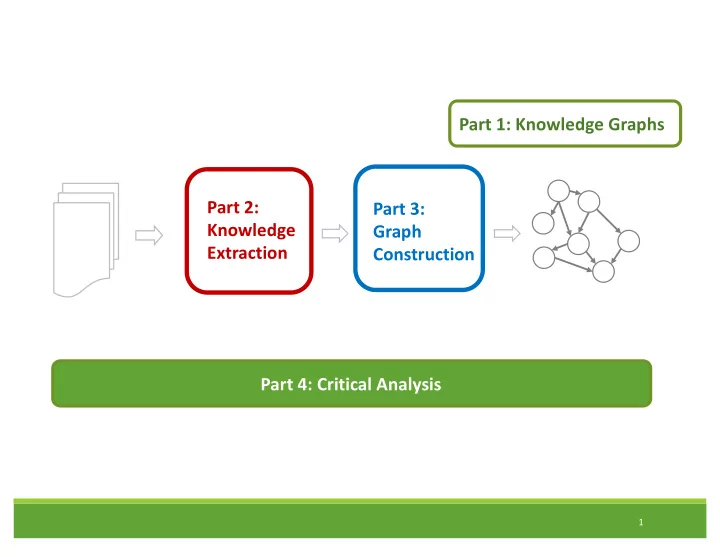
Part ¡2: ¡ Knowledge ¡ Extraction Part ¡3: Graph ¡ Construction Part ¡1: ¡Knowledge ¡Graphs Part ¡4: ¡Critical ¡Analysis
slide-2
SLIDE 2

Tutorial ¡Outline

  • 1. Knowledge ¡Graph ¡Primer ¡

[Jay]

  • 2. ¡ Knowledge ¡Extraction ¡from ¡Text

a. NLP ¡Fundamentals ¡ [Sameer] b. Information ¡Extraction ¡ [Bhavana]

Coffee ¡Break

  • 3. Knowledge ¡Graph ¡Construction

a. Probabilistic ¡Models ¡ [Jay] b. Embedding ¡Techniques [Sameer]

  • 4. Critical ¡Overview ¡and ¡Conclusion ¡ [Bhavana]

2

slide-3
SLIDE 3

Critical Overview

SUMMARY ¡ ¡ ¡ ¡ ¡ ¡ ¡ ¡ ¡ ¡ ¡ ¡ ¡ ¡ ¡ ¡ ¡ ¡ ¡ SUCCESS ¡STORIES ¡ ¡ ¡ ¡ ¡ ¡ ¡ DATASETS, ¡TASKS, ¡SOFTWARES ¡ ¡ ¡ EXCITING ¡ACTIVE ¡RESEARCH ¡ ¡ ¡ ¡ FUTURE ¡RESEARCH ¡DIRECTIONS ¡ ¡ ¡ ¡

3

slide-4
SLIDE 4

Critical Overview

SU SUMMAR ARY

SUCCESS ¡STORIES DATASETS, ¡TASKS, ¡SOFTWARES EXCITING ¡ACTIVE ¡RESEARCH FUTURE ¡RESEARCH ¡DIRECTIONS

4

slide-5
SLIDE 5

Why ¡do ¡we ¡need ¡Knowledge ¡graphs?

  • Humans ¡can ¡explore ¡large ¡database ¡in ¡intuitive ¡

ways

  • AI ¡agents ¡get ¡access ¡to ¡human ¡common ¡sense ¡

knowledge

5

slide-6
SLIDE 6

Knowledge ¡graph ¡construction

  • Who ¡are ¡the ¡entities ¡

(nodes) ¡in ¡the ¡graph?

  • What are ¡their ¡attributes ¡

and ¡types ¡(labels)?

  • How ¡are ¡they ¡related ¡

(edges)?

6

E1 A1 A2 E2 E3 A1 A2 A1 A2

slide-7
SLIDE 7

Knowledge ¡Graph ¡Construction

7

Text

Knowledge ¡ Extraction Graph ¡ Construction

Extraction graph Knowledge graph

slide-8
SLIDE 8

Two ¡perspectives

8

Extraction ¡graph Knowledge ¡graph Who ¡are ¡the ¡entities? ¡ (nodes) What are ¡their ¡ attributes? ¡(labels) How ¡are ¡they ¡related? ¡ (edges)

slide-9
SLIDE 9

Two ¡perspectives

9

Extraction ¡graph Knowledge ¡graph Who ¡are ¡the ¡entities? ¡ (nodes)

  • Named ¡Entity ¡

Recognition

  • Entity ¡Coreference
  • Entity ¡Linking
  • Entity ¡Resolution

What are ¡their ¡ attributes? ¡(labels)

  • Entity ¡Typing
  • Collective ¡

classification How ¡are ¡they ¡related? ¡ (edges)

  • Semantic ¡role ¡

labeling

  • Relation ¡Extraction
  • Link ¡prediction
slide-10
SLIDE 10

Knowledge ¡Extraction

10

John ¡ Lennon Alfred ¡ Lennon Julia ¡ Lennon Liverpool

birthplace childOf childOf

John was born in Liverpool, to Julia and Alfred Lennon.

John was born in Liverpool, to Julia and Alfred Lennon.

Person Location Person Person

NNP VBD VBD IN NNP TO NNP CC NNP NNP

Lennon.. John ¡Lennon...

  • Mrs. ¡Lennon..

.. ¡his ¡mother ¡.. his ¡father Alfred he the ¡Pool

NLP Information Extraction

Extraction ¡graph Annotated ¡text Text

slide-11
SLIDE 11

NLP

John was born in Liverpool, to Julia and Alfred Lennon.

NNP VBD VBD IN NNP TO NNP CC NNP NNP

John was born in Liverpool, to Julia and Alfred Lennon.

Person Location Person Person Lennon.. John ¡Lennon...

  • Mrs. ¡Lennon..

.. ¡his ¡mother ¡.. his ¡father Alfred he the ¡Pool

Sentence Dependency ¡Parsing, Part ¡of ¡speech ¡tagging, Named ¡entity ¡recognition… Document Within-­‑doc ¡Coreference...

slide-12
SLIDE 12

NLP ¡annotations ¡à features ¡for ¡IE

Combine ¡tokens, ¡dependency ¡paths, ¡and ¡entity ¡types ¡to ¡define ¡rules. Argument ¡1 Argument ¡2

,

Person Organization

DT CEO

  • f

appos nmod case det

Bill ¡Gates, ¡the ¡CEO ¡of ¡Microsoft, ¡said ¡…

  • Mr. ¡Jobs, ¡the ¡brilliant ¡and ¡charming ¡CEO ¡of ¡Apple ¡Inc., ¡said ¡…

… announced ¡by ¡Steve ¡Jobs, ¡the ¡CEO ¡of ¡Apple. … announced ¡by ¡Bill ¡Gates, ¡the ¡director ¡and ¡CEO ¡of ¡Microsoft. … mused ¡Bill, ¡a ¡former ¡CEO ¡of ¡Microsoft. and ¡many ¡other ¡possible ¡instantiations…

12

slide-13
SLIDE 13

Information ¡Extraction

Defining ¡domain Learning ¡extractors ¡ Scoring ¡candidate ¡facts Supervised Semi-­‑supervised Unsupervised

13

Fusing ¡multiple ¡extractors

Single ¡extractor

slide-14
SLIDE 14

14

Defining ¡ domain Learning extractors Scoring candidate ¡ facts Fusing ¡ extractors

ConceptNet NELL Knowledge ¡ Vault OpenIE

IE ¡systems ¡in ¡practice

Heuristic ¡rules Classifier

slide-15
SLIDE 15

Knowledge ¡Graph ¡Construction

15

Text

Part ¡2: ¡ Knowledge ¡ Extraction

Extraction graph Knowledge graph

Part ¡3: Graph ¡ Construction

slide-16
SLIDE 16

Issues ¡with ¡Extraction ¡Graph

Extracted ¡knowledge ¡could ¡be:

  • ambiguous
  • incomplete
  • inconsistent

16

slide-17
SLIDE 17

Two approaches for KG construction

PROBABILISTIC ¡MODELS EMBEDDING ¡BASED ¡MODELS

17

slide-18
SLIDE 18

Two approaches for KG construction

PR PROBABILISTIC ¡ ¡MODELS EMBEDDING ¡BASED ¡MODELS

18

slide-19
SLIDE 19

Two ¡classes ¡of ¡Probabilistic ¡Models

GRAPHICAL ¡MODEL ¡BASED ¡

  • Possible ¡facts ¡in ¡KG ¡are ¡

variables

  • Logical ¡rules ¡relate ¡facts
  • Probability ¡ ¡ ¡ ¡ ¡ ¡ ¡satisfied ¡

rules

  • Universal-­‑quantification

RANDOM ¡WALK ¡BASED

  • Possible ¡facts ¡posed ¡as ¡

queries

  • Random ¡walks ¡of ¡the ¡KG ¡

constitute ¡“proofs”

  • Probability ¡ ¡ ¡ ¡ ¡ ¡ ¡path ¡

lengths/transitions

  • Local ¡grounding

19

slide-20
SLIDE 20

Two approaches for KG construction

PROBABILISTIC ¡MODELS EM EMBED EDDING ¡ ¡BAS ASED ED ¡ ¡MODEL ELS

20

slide-21
SLIDE 21

Why ¡embeddings?

Limitation ¡to ¡Logical ¡Relations Computational ¡Complexity ¡of ¡Algorithms

  • Representation ¡restricted ¡by ¡manual ¡design
  • Clustering? ¡Asymmetric ¡implications?
  • Information ¡flows ¡through ¡these ¡relations
  • Difficult ¡to ¡generalize ¡to ¡unseen ¡entities/relations
  • Learning ¡is ¡NP-­‑Hard, ¡difficult ¡to ¡approximate
  • Query-­‑time ¡inference ¡is ¡also ¡NP-­‑Hard
  • Not ¡easy ¡to ¡parallelize, ¡or ¡use ¡GPUs
  • Scalability ¡is ¡badly ¡affected ¡by ¡representation

Embedding ¡ based ¡models

  • Everything ¡as ¡dense ¡vectors
  • Captures ¡many ¡relations
  • Learned ¡from ¡data
  • Learning ¡using ¡stochastic ¡

gradient, ¡back-­‑propagation

  • Querying ¡is ¡often ¡cheap
  • GPU-­‑parallelism ¡friendly
  • Can ¡generalize ¡to ¡unseen ¡

entities ¡and ¡relations

  • Efficient ¡inference ¡at ¡large ¡

scale Limitations ¡of ¡ probabilistic ¡models

slide-22
SLIDE 22

Matrix ¡vs ¡Tensor ¡Factorization

  • No encoding of type information
  • Can only predict for entity pairs that

appear in text together

  • Sufficient evidence has to be seen

for each entity pair

  • Assume low-rank for pairs
  • But many relations are not!
  • Spouse: you can have only ~1
  • Cannot learn pair specific information
slide-23
SLIDE 23

Relation ¡Embeddings

23

slide-24
SLIDE 24

24

Part ¡2: ¡ Knowledge ¡ Extraction Part ¡3: Graph ¡ Construction Part ¡1: ¡Knowledge ¡Graphs

slide-25
SLIDE 25

Critical Overview

SUMMARY

SU SUCCESS ¡ SS ¡STORI RIES

DATASETS, ¡TASKS, ¡SOFTWARES EXCITING ¡ACTIVE ¡RESEARCH FUTURE ¡RESEARCH ¡DIRECTIONS

25

slide-26
SLIDE 26

Success ¡story: ¡OpenIE

  • Key ¡contributions: ¡
  • No ¡need ¡for ¡human ¡defined ¡relation ¡schemas
  • First ¡ever ¡successful ¡open-­‑source ¡open ¡domain ¡IE ¡system
  • ReVerb
  • Input ¡= ¡Clueweb09 ¡corpus (1B ¡web ¡pages)
  • Output ¡= ¡15M ¡high-­‑precision ¡extractions

26

slide-27
SLIDE 27

Success ¡story: ¡OpenIE ¡(ReVerb)

27

  • penie.allenai.org
slide-28
SLIDE 28

Open ¡IE ¡Systems ¡

28

2007 ¡ ¡ ¡ ¡ ¡ ¡ ¡ ¡ ¡ ¡ ¡ ¡ ¡ ¡ ¡ ¡ ¡ ¡ ¡ ¡ ¡ ¡ ¡ ¡ ¡2010 ¡ ¡ ¡ ¡ ¡ ¡ ¡ ¡ ¡ ¡ ¡ ¡ ¡ ¡ ¡ ¡ ¡ ¡ ¡ ¡ ¡ ¡ ¡ ¡2012 ¡ ¡ ¡ ¡ ¡ ¡ ¡ ¡ ¡ ¡ ¡ ¡ ¡ ¡ ¡ ¡ ¡ ¡ ¡ ¡ ¡ ¡ ¡ ¡ ¡ ¡2014 ¡ ¡ ¡ ¡ ¡ ¡ ¡ ¡ ¡ ¡ ¡ ¡ ¡ ¡ ¡ ¡ ¡ ¡ ¡ ¡ ¡ ¡ ¡ ¡ ¡ ¡ ¡ ¡ ¡ ¡ ¡ ¡ ¡2016 OpenIE ¡v ¡1.0 ¡ ¡ ¡ ¡ ¡ ¡ ¡ ¡ ¡ ¡ ¡ ¡ ¡ ¡ ¡ ¡ ¡v ¡2.0 ¡ ¡ ¡ ¡ ¡ ¡ ¡ ¡ ¡ ¡ ¡ ¡ ¡ ¡ ¡ ¡ ¡ ¡ ¡ ¡ ¡ ¡ ¡ ¡ ¡v ¡3.0 ¡ ¡ ¡ ¡ ¡ ¡ ¡ ¡ ¡ ¡ ¡ ¡ ¡ ¡ ¡ ¡ ¡ ¡ ¡ ¡ ¡ ¡ ¡ ¡OpenIE ¡4.0 ¡ ¡ ¡ ¡ ¡ ¡ ¡ ¡ ¡ ¡ ¡ ¡ ¡ ¡ ¡ ¡ ¡ ¡ ¡OpenIE ¡5.0 ¡ TextRunner ¡ ¡ ¡ ¡ ¡ ¡ ¡ ¡ ¡ ¡ ¡ ¡ ¡ ¡ ¡ ¡ReVerb ¡ ¡ ¡ ¡ ¡ ¡ ¡ ¡ ¡ ¡ ¡ ¡ ¡ ¡ ¡ ¡ ¡ ¡ ¡ ¡ ¡ ¡ ¡OLLIE CRF Self-­‑training POS-­‑tag ¡ based relation ¡ extraction Dependency ¡ parse ¡based ¡ extraction SRL-­‑based ¡ extraction; temporal, ¡ spatial ¡ extractions Supports ¡ compound ¡ noun ¡ phrases; ¡ numbers; ¡ lists

Increase ¡in ¡precision, ¡recall, ¡expressiveness

Derived ¡from ¡Prof. ¡Mausam’s ¡slides

slide-29
SLIDE 29

Success ¡story: ¡NELL

  • Key ¡technical ¡contributions: ¡
  • “Never ¡ending ¡learning” ¡paradigm
  • “Coupled ¡bootstrap ¡learning” ¡to ¡reduce ¡semantic ¡drift
  • Input: ¡Clueweb09 ¡corpus (1B ¡web ¡pages)
  • Ontology: ¡~2K ¡predicates

O(100K)constraints ¡between ¡predicates

  • Output: ¡ ¡50 ¡million ¡candidate ¡facts

3 ¡million ¡high-­‑confidence ¡facts

29

slide-30
SLIDE 30

Success ¡story: ¡NELL

30

slide-31
SLIDE 31

Success ¡story: ¡YAGO

  • Key ¡contributions: ¡
  • Rich ¡Ontology: ¡Linking ¡Wikipedia ¡categories ¡to ¡WordNet
  • High ¡Quality: ¡High ¡precision ¡extractions ¡(~95%)

31

slide-32
SLIDE 32

Success ¡story: ¡YAGO

  • Input: ¡Wikipedia ¡infoboxes, ¡WordNet ¡and ¡GeoNames
  • Output: ¡KG ¡with ¡350K ¡entity ¡types, ¡10M ¡entities, ¡120M ¡facts
  • Temporal ¡and ¡spatial ¡information

32

slide-33
SLIDE 33

33

Link

slide-34
SLIDE 34

Success ¡story: ¡ConceptNet

  • Commonsense ¡knowledge ¡base
  • Key ¡contributions: ¡
  • Freely ¡available ¡resource: ¡covers ¡wide ¡range ¡of ¡common ¡sense ¡concepts ¡and ¡

relations ¡organized ¡in ¡a ¡easy-­‑to-­‑use ¡semantic ¡network

  • NLP ¡toolkit ¡based ¡on ¡this ¡resource: ¡supports ¡analogy, ¡text ¡summarization, ¡

context ¡dependent ¡inferences

  • ConceptNet4 ¡was ¡manually ¡built ¡using ¡inputs ¡from ¡thousands ¡of ¡

people

  • 28 ¡million ¡facts ¡expressed ¡in ¡natural ¡language ¡
  • spanning ¡304 ¡different ¡languages

34

slide-35
SLIDE 35

Success ¡story

  • DBPedia ¡is ¡automatically ¡extracted ¡structured ¡data ¡from ¡Wikipedia
  • 17M ¡canonical ¡entities
  • 88M ¡type ¡statements
  • 72M ¡infobox ¡statements

35

slide-36
SLIDE 36

DeepDive

  • Machine ¡learning ¡based ¡extraction ¡system
  • Key ¡contributions:
  • scalable, ¡high-­‑performance ¡inference ¡and ¡learning ¡engine
  • Developers ¡contribute ¡features ¡(rules) ¡not ¡algorithms
  • Combines ¡data ¡from ¡variety ¡of ¡sources ¡(webpages, ¡pdf, ¡figures, ¡tables)

36

slide-37
SLIDE 37

DeepDive

  • Machine ¡learning ¡based ¡extraction ¡system
  • Best ¡Precision/recall/F1 ¡in ¡KBP-­‑slot ¡filling ¡task ¡2014 ¡evaluations ¡

(31 ¡teams ¡participated)

37

slide-38
SLIDE 38

Success ¡stories

38

YAGO

slide-39
SLIDE 39

Critical Overview

SUMMARY SUCCESS ¡STORIES

DA DATASETS, ¡ ¡TASKS, ¡ ¡SOFTWARES

EXCITING ¡ACTIVE ¡RESEARCH FUTURE ¡RESEARCH ¡DIRECTIONS

39

slide-40
SLIDE 40

Datasets

  • KG ¡as ¡datasets
  • FB15K-­‑237 Knowledge ¡base ¡completion ¡dataset ¡based ¡on ¡Freebase
  • DBPedia Structured ¡data ¡extracted ¡from ¡Wikipedia
  • NELL ¡Read ¡the ¡web ¡datasets
  • AristoKB Tuple ¡knowledge ¡base ¡for ¡Science ¡domain
  • Text ¡datasets
  • Clueweb09: ¡1 ¡billion ¡webpages ¡(sample ¡of ¡Web)
  • FACC1: ¡Freebase ¡Annotations ¡of ¡the ¡Clueweb09 ¡Corpora
  • Gigaword: ¡automatically-­‑generated ¡syntactic ¡and ¡discourse ¡structure
  • NYTimes: ¡The ¡New ¡York ¡Times ¡Annotated ¡Corpus
  • Datasets ¡related ¡to ¡Semi-­‑supervised ¡learning ¡for ¡information ¡extraction

Link: ¡entity ¡typing, ¡concept ¡discovery, ¡aligning ¡glosses ¡to ¡KB, ¡multi-­‑view ¡learning

40

slide-41
SLIDE 41

Shared ¡tasks

  • Text ¡Analysis ¡Conference ¡on Knowledge ¡Base ¡Population ¡(TAC ¡KBP)
  • Slot ¡filling ¡task
  • Cold ¡Start ¡KBP ¡Track
  • Tri-­‑Lingual ¡Entity ¡Discovery ¡and ¡Linking ¡Track ¡(EDL)
  • Event ¡Track
  • Validation/Ensembling ¡Track

41

slide-42
SLIDE 42

Softwares: ¡NLP

  • Stanford ¡CoreNLP: ¡a ¡suite ¡of ¡core ¡NLP ¡tools ¡

[link] ¡ ¡ ¡(Java ¡code)

  • FIGER: ¡fine-­‑grained ¡entity ¡recognizer ¡

assigns ¡over ¡100 ¡semantic ¡types ¡ link (Java ¡code)

  • FACTORIE: ¡out-­‑of-­‑the-­‑box ¡tools ¡for ¡NLP ¡and ¡

information ¡integration link (Scala ¡code)

  • EasySRL: ¡Semantic ¡role ¡labeling

link (Java ¡code)

42

slide-43
SLIDE 43

Softwares: ¡Information ¡Extraction

  • Open ¡IE

(University ¡of ¡Washington) ¡ Open ¡IE ¡4.2 link (Scala ¡code) Stanford ¡Open ¡IE ¡link (Java ¡code)

  • Interactive ¡Knowledge ¡Extraction ¡(IKE)

(Allen ¡Institute ¡for ¡Artificial ¡Intelligence) ¡ link (Scala ¡code)

  • Universal ¡schema

link (Java ¡+ ¡Scala ¡code)

43

slide-44
SLIDE 44

Softwares: ¡ Learning ¡&reasoning ¡over ¡Graphs

  • AMIE: ¡Association ¡Rule ¡Mining ¡under ¡Incomplete ¡Evidence ¡in ¡

Ontological ¡Knowledge ¡Bases ¡ link (Java ¡code)

  • PSL: ¡Probabilistic ¡soft ¡logic ¡

link (Java ¡code)

  • ProPPR: ¡Programming ¡with ¡Personalized ¡PageRank

link (Java ¡code)

  • Junto: ¡graph ¡based ¡semi-­‑supervised ¡learning ¡methods

link (Scala ¡code)

44

slide-45
SLIDE 45

Critical Overview

SUMMARY SUCCESS ¡STORIES DATASETS, ¡TASKS, ¡SOFTWARES

EX EXCITING ¡ ¡ACTIVE ¡ E ¡RESEARCH

FUTURE ¡RESEARCH ¡DIRECTIONS

45

slide-46
SLIDE 46

Exciting ¡Active ¡Research

  • INTERESTING ¡APPLICATIONS ¡OF ¡KG
  • MULTI-­‑MODAL ¡INFORMATION ¡EXTRACTION
  • AMBITIOUS ¡PROJECTS

46

slide-47
SLIDE 47

Exciting ¡Active ¡Research

  • IN

INTERESTIN ING ¡A ¡APPLIC ICATIO IONS ¡O ¡OF ¡ ¡KG KG

  • MULTI-­‑MODAL ¡INFORMATION ¡EXTRACTION
  • AMBITIOUS ¡PROJECTS

47

slide-48
SLIDE 48

(1) ¡Exciting ¡active ¡research:

In Interesting ¡ ¡application ¡ ¡of ¡ ¡Knowledge ¡ ¡Gr Graphs phs

The ¡Literome ¡Project ¡[link]

  • Automatic ¡system ¡for ¡extracting ¡genomic ¡knowledge ¡from ¡PubMed ¡

articles

  • Web-­‑accessible ¡knowledge ¡base ¡ ¡

48

Literome: ¡PubMed-­‑Scale ¡Genomic ¡Knowledge ¡Base ¡in ¡the ¡Cloud, ¡Hoifung ¡Poon ¡et ¡al., ¡Bioinformatics ¡2014

slide-49
SLIDE 49

(1) ¡Exciting ¡active ¡research:

In Interesting ¡ ¡application ¡ ¡of ¡ ¡Knowledge ¡ ¡Graphs

49

Chronic ¡disease ¡management: ¡ develop ¡AI ¡technology ¡for ¡predictive ¡and ¡preventive ¡ personalized ¡medicine ¡to ¡reduce ¡the ¡national ¡ healthcare ¡expenditure ¡on ¡chronic ¡diseases ¡ (90% ¡of ¡total ¡cost)

slide-50
SLIDE 50

Exciting ¡Active ¡Research

  • INTERESTING ¡APPLICATIONS ¡OF ¡KG
  • MU

MULTI-­‑

  • ­‑MO

MODAL ¡ ¡IN INFORMATIO ION ¡ ¡ EX EXTRACTION

  • AMBITIOUS ¡PROJECTS

50

slide-51
SLIDE 51

(2) ¡Exciting ¡active ¡research:

Mu Multi-­‑

  • ­‑mo

modal ¡ ¡in inform rmatio ion ¡ ¡extractio ion

51

Text Images

Multi-­‑modal ¡Knowledge ¡Graph

slide-52
SLIDE 52

NEI NEIL: ¡ ¡Ex

Extracting ¡ ¡Visual ¡ ¡Knowl wledge ¡ ¡from ¡ ¡Web ¡ ¡Data

52

[Chen ¡et ¡al., ¡"NEIL: ¡Extracting ¡Visual ¡Knowledge ¡from ¡Web ¡Data," ICCV 2013]

slide-53
SLIDE 53

NEI NEIL: ¡ ¡Ex

Extracting ¡ ¡Visual ¡ ¡Knowl wledge ¡ ¡from ¡ ¡Web ¡ ¡Data

53

[Chen ¡et ¡al., ¡"NEIL: ¡Extracting ¡Visual ¡Knowledge ¡from ¡Web ¡Data," ICCV 2013]

slide-54
SLIDE 54

WebChild: ¡Text ¡+ ¡Images

54

[Tandon ¡et ¡al. ¡“Commonsense ¡in ¡Parts: ¡Mining ¡Part-­‑Whole ¡Relations ¡from ¡the ¡Web ¡and ¡Image ¡Tags.” AAAI ’16]

slide-55
SLIDE 55

Exciting ¡Active ¡Research

  • INTERESTING ¡APPLICATIONS ¡OF ¡KG
  • MULTI-­‑MODAL ¡INFORMATION ¡EXTRACTION
  • AM

AMBITIOUS ¡ S ¡PR PROJECTS

55

slide-56
SLIDE 56

(3) ¡Exciting ¡active ¡research:

Am Ambitious ¡ ¡Project

56

Project ¡Aristo

Best ¡KR ¡for ¡Science ¡ domain inference ¡techniques ¡to ¡ answer ¡exam ¡question

slide-57
SLIDE 57

(3) ¡Exciting ¡active ¡research:

Am Ambitious ¡ ¡Project

57

slide-58
SLIDE 58

Aristo ¡Science ¡QA ¡challenge

  • Science ¡questions ¡dataset

~5K ¡4-­‑way ¡multiple ¡choice ¡questions

Frogs ¡lay ¡eggs ¡that ¡develop ¡into ¡tadpoles ¡and ¡then ¡into ¡adult ¡frogs. ¡This ¡sequence ¡of ¡ changes ¡is ¡an ¡example ¡of ¡how ¡living ¡things ¡ ¡_____ (A) ¡go ¡through ¡a ¡life ¡cycle (B) ¡form ¡a ¡food ¡web (C) ¡act ¡as ¡a ¡source ¡of ¡food (D) ¡affect ¡other ¡parts ¡of ¡the ¡ecosystem ¡

58

Science ¡knowledge frog’s ¡life ¡cycle, ¡ metamorphosis Common ¡sense ¡ knowledge frog ¡is ¡an ¡animal, ¡ animals ¡have ¡life ¡cycle

slide-59
SLIDE 59

AI2’s ¡ScienceKB

59

**Upcoming ¡article ¡on ¡``High ¡Precision ¡Knowledge ¡Extraction ¡for ¡Science ¡domain’’ ¡

Existing ¡knowledge ¡graphs

  • Too ¡named ¡entity ¡centric ¡(no ¡domain ¡relevance)
  • Too ¡noisy ¡(not ¡directly ¡usable ¡by ¡inference ¡systems)
slide-60
SLIDE 60

AI2’s ¡ScienceKB

60

3 ¡eat("fox", ¡"rabbit") 2 ¡eat("cat", ¡"mouse") 2 ¡kill("coyote", ¡"sheep") 1 ¡kill("lion", ¡"deer") 21 ¡eat("shark", ¡"fish") 2 ¡catch("cat", ¡"mouse") 5 ¡chase("cat", ¡"mouse") 6 ¡kill("cat", ¡"mouse") 1 ¡kill("fox", ¡"chicken") 3 ¡eat("anteater", ¡"ant") 1 ¡feed-­‑on("bear", ¡"seed") 10 ¡live-­‑in("bear", ¡"Alaska") 11 ¡live-­‑in("bear", ¡"cave") 21 ¡live-­‑in("bear", ¡"forest") 3 ¡live-­‑in("bear", ¡"mountain")

High precision phrasal tuples Final High precision Science KB

Defining ¡ Domain Learning ¡canonical ¡ predicates High ¡precision ¡ tuple ¡extraction

3 ¡eat("fox", ¡"rabbit") 2 ¡eat("cat", ¡"mouse") 2 ¡kill("coyote", ¡"sheep") 1 ¡kill("lion", ¡"deer") 21 ¡eat("shark", ¡"fish") 2 ¡catch("cat", ¡"mouse") 5 ¡chase("cat", ¡"mouse") 6 ¡kill("cat", ¡"mouse") 1 ¡kill("fox", ¡"chicken") 3 ¡eat("anteater", ¡"ant") 1 ¡feed-­‑on("bear", ¡"seed") 10 ¡live-­‑in("bear", ¡"Alaska") 11 ¡live-­‑in("bear", ¡"cave") 21 ¡live-­‑in("bear", ¡"forest") 3 ¡live-­‑in("bear", ¡"mountain")

Open ¡IE ¡ + ¡headword ¡ extraction

Learn ¡& ¡ apply schema mapping ¡rules

Turk ¡ + ¡auto-­‑ scoring

Domain-­‑ appropriate sentences

Reintroduce ¡ phrasal ¡ tuples Domain ¡ vocabulary Text ¡ corpus Search engine

**Upcoming ¡article ¡on ¡``High ¡Precision ¡Knowledge ¡Extraction ¡for ¡Science ¡domain’’ ¡

slide-61
SLIDE 61

AI2’s ¡ScienceKB

61

**Upcoming ¡article ¡on ¡``High ¡Precision ¡Knowledge ¡Extraction ¡for ¡Science ¡domain’’ ¡

AI2’s ¡TupleKB ¡dataset: ¡link > ¡300K ¡common-­‑sense ¡and ¡science ¡facts > ¡80% ¡precision Hybrid ¡Approach: ¡Adding ¡structure ¡to ¡Open ¡domain ¡IE Defining ¡ domain Learning extractors Scoring candidate ¡ facts Open ¡ domain ¡IE Distant ¡ supervision ¡to ¡ add ¡structure

slide-62
SLIDE 62

Aristo ¡ScienceKB

  • AI2’s ¡TupleKB ¡dataset: ¡link
  • Open ¡problems ¡
  • Best ¡KR ¡for ¡Science ¡domain
  • Domain ¡targeted ¡KB ¡completion
  • Measuring ¡recall ¡w.r.t. ¡end ¡task

62

slide-63
SLIDE 63

Critical Overview

SUMMARY SUCCESS ¡STORIES DATASETS, ¡TASKS, ¡SOFTWARES EXCITING ¡ACTIVE ¡RESEARCH

FU FUTURE ¡ ¡RESEARCH CH ¡ ¡DIRECTIONS

63

slide-64
SLIDE 64

Future ¡Research ¡ Directions

GOING ¡BEYOND ¡FACTS CONTINUOUSLY ¡LEARNING ¡AND ¡ SELF-­‑CORRECTING ¡SYSTEMS

64

slide-65
SLIDE 65

(1) ¡Future ¡research ¡directions: ¡

Going ¡beyond ¡facts

  • Most ¡of ¡the ¡existing ¡KGs ¡are ¡designed ¡to ¡represent ¡and ¡extract ¡binary ¡

relations ¡à good ¡enough ¡for ¡search ¡engines

  • Applications ¡like ¡QA ¡demand ¡in ¡depth ¡knowledge ¡about ¡higher ¡level ¡

structures ¡like ¡activities, ¡events, ¡processes

65

slide-66
SLIDE 66

Future ¡research ¡directions: ¡

Going ¡beyond ¡facts

  • Fact: ¡ ¡Individual ¡knowledge ¡tuples

(plant, ¡take ¡in, ¡CO2)

  • Event ¡frame: ¡

more ¡context ¡how, ¡when, ¡where?

  • Processes: ¡ ¡

representing ¡larger ¡structures, ¡sequence ¡of ¡events ¡ e.g. ¡Photosynthesis

66

subject plant predicate Take ¡in

  • bject

CO2 time daytime

[ ¡Modeling ¡Biological ¡Processes ¡for ¡Reading ¡Comprehension, ¡Berant ¡et ¡al., ¡EMNLP ¡2014 ¡] ¡ ¡

slide-67
SLIDE 67

(2) ¡Future ¡research ¡directions: ¡

Online ¡KG ¡Construction

  • One ¡shot ¡KG ¡construction ¡à Online ¡KG ¡construction
  • Consume ¡online ¡stream ¡of ¡data
  • Temporal ¡scoping ¡of ¡facts
  • Discovering ¡new ¡concepts ¡automatically
  • Self-­‑correcting ¡systems

67

slide-68
SLIDE 68

(2) ¡Future ¡research ¡directions: ¡

Online ¡KG ¡Construction

  • Continuously ¡learning ¡and ¡self-­‑correcting ¡systems
  • [Selecting ¡Actions ¡for ¡Resource-­‑bounded ¡Information ¡Extraction ¡using ¡

Reinforcement ¡Learning, ¡Kanani ¡and ¡McCallum, ¡WSDM ¡2012]

  • Presented ¡a ¡reinforcement ¡learning ¡framework ¡for ¡budget ¡constrained ¡information ¡extraction
  • [Never-­‑Ending ¡Learning, ¡Mitchell ¡et ¡al. ¡AAAI ¡2015]
  • Tom ¡Mitchell ¡says ¡“Self ¡reflection ¡and ¡an ¡explicit ¡agenda ¡of ¡learning ¡subgoals” ¡is ¡an ¡important ¡

direction ¡of ¡future ¡research ¡for ¡continuously ¡learning ¡systems.

68

slide-69
SLIDE 69

Future……

69

slide-70
SLIDE 70

Future……

70

Future ¡KG ¡ construction ¡ system Consume ¡

  • nline ¡streams ¡
  • f ¡data

Represent ¡ context ¡beyond ¡ facts Supports ¡ humanity Corrects ¡its ¡

  • wn ¡mistakes
slide-71
SLIDE 71

Thank ¡You

71