Tutorial Overview https://kgtutorial.github.io Part 1: Knowledge - - PowerPoint PPT Presentation

tutorial overview
SMART_READER_LITE
LIVE PREVIEW

Tutorial Overview https://kgtutorial.github.io Part 1: Knowledge - - PowerPoint PPT Presentation

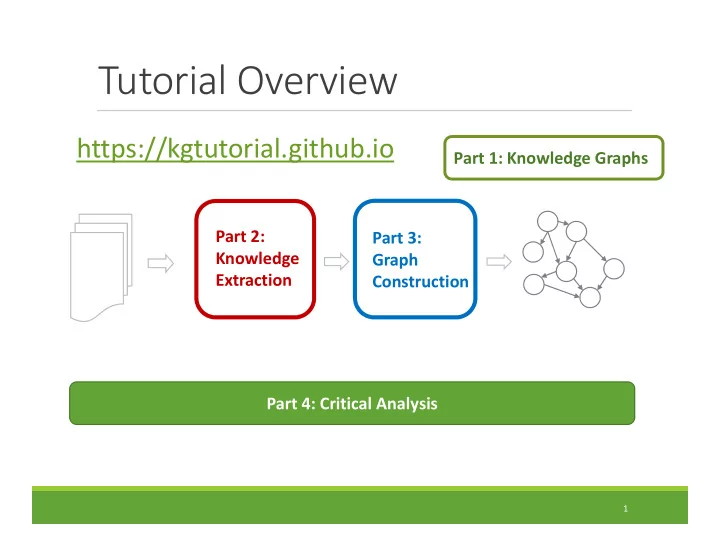
Tutorial Overview https://kgtutorial.github.io Part 1: Knowledge Graphs Part 2: Part 3: Knowledge Graph Extraction Construction Part 4: Critical Analysis 1 Tutorial Outline 1. Knowledge Graph Primer [Jay] 2. Knowledge Extraction Primer


slide-1
SLIDE 1

Tutorial Overview

1

Part 2: Knowledge Extraction Part 3: Graph Construction Part 1: Knowledge Graphs Part 4: Critical Analysis
https://kgtutorial.github.io

slide-2
SLIDE 2

Tutorial Outline

  • 1. Knowledge Graph Primer

[Jay]

  • 2. Knowledge Extraction Primer

[Jay] Coffee Break

  • 3. Knowledge Graph Construction

a. Probabilistic Models [Jay] b. Embedding Techniques [Sameer]

  • 4. Critical Overview and Conclusion [Sameer]

2

slide-3
SLIDE 3

Critical Overview

SUMMARY SUCCESS STORIES DATASETS, TASKS, SOFTWARES EXCITING RESEARCH DIRECTIONS

3

slide-4
SLIDE 4

Critical Overview

SUMMARY SUCCESS STORIES DATASETS, TASKS, SOFTWARES EXCITING RESEARCH DIRECTIONS

4

slide-5
SLIDE 5

Why do we need Knowledge graphs?

  • Humans can explore large database in intuitive

ways

  • AI agents get access to human common sense

knowledge

5

slide-6
SLIDE 6

Knowledge graph construction

  • Who are the entities

(nodes) in the graph?

  • What are their attributes

and types (labels)?

  • How are they related

(edges)?

6

E1 A1 A2 E2 E3 A1 A2 A1 A2

slide-7
SLIDE 7

Knowledge Graph Construction

7

Text

Knowledge Extraction Graph Construction

Extraction graph Knowledge graph

slide-8
SLIDE 8

Two perspectives

8

Extraction graph Knowledge graph Who are the entities? (nodes)

  • Named Entity

Recognition

  • Entity Coreference
  • Entity Linking
  • Entity Resolution

What are their attributes? (labels)

  • Entity Typing
  • Collective

classification How are they related? (edges)

  • Semantic role

labeling

  • Relation Extraction
  • Link prediction
slide-9
SLIDE 9

Knowledge Extraction

9

John Lennon Alfred Lennon Julia Lennon Liverpool

birthplace childOf childOf

John was born in Liverpool, to Julia and Alfred Lennon.

John was born in Liverpool, to Julia and Alfred Lennon.

Person Location Person Person

NNP VBD VBD IN NNP TO NNP CC NNP NNP

Lennon.. John Lennon...

  • Mrs. Lennon..

.. his mother .. his father Alfred he the Pool

NLP Information Extraction

Extraction graph Annotated text Text

slide-10
SLIDE 10

Information Extraction

Defining domain Learning extractors Scoring candidate facts Supervised Semi-supervised Unsupervised

10

Fusing multiple extractors

Single extractor

slide-11
SLIDE 11

Knowledge Graph Construction

11

Text

Part 2: Knowledge Extraction

Extraction graph Knowledge graph

Part 3: Graph Construction

slide-12
SLIDE 12

Issues with Extraction Graph

Extracted knowledge could be:

  • ambiguous
  • incomplete
  • inconsistent

12

slide-13
SLIDE 13

Two approaches for KG construction

PROBABILISTIC MODELS EMBEDDING BASED MODELS

13

slide-14
SLIDE 14

Two approaches for KG construction

PROBABILISTIC MODELS EMBEDDING BASED MODELS

14

slide-15
SLIDE 15

Two classes of Probabilistic Models

GRAPHICAL MODEL BASED

  • Possible facts in KG are

variables

  • Logical rules relate facts
  • Probability satisfied

rules

  • Universal-quantification

RANDOM WALK BASED

  • Possible facts posed as

queries

  • Random walks of the KG

constitute “proofs”

  • Probability path

lengths/transitions

  • Local grounding

15

slide-16
SLIDE 16

Illustration of KG Identification

Ontology:

Dom(albumArtist, musician) Mut(novel, musician)

Uncertain Extractions:

.5: Lbl(Fab Four, novel) .7: Lbl(Fab Four, musician) .9: Lbl(Beatles, musician) .8: Rel(Beatles,AlbumArtist, Abbey Road)

Entity Resolution:

SameEnt(Fab Four, Beatles)

Beatles Fab Four Abbey Road musician

Rel(AlbumArtist)

Lbl musician Fab Four Beatles novel Abbey Road SameEnt (Annotated) Extraction Graph After Knowledge Graph Identification

PUJARA+ISWC13; PUJARA+AIMAG15

slide-17
SLIDE 17

Random Walk Illustration

17

Query: R(Lennon, PlaysInstrument, ?)

slide-18
SLIDE 18

Two approaches for KG construction

PROBABILISTIC MODELS EMBEDDING BASED MODELS

18

slide-19
SLIDE 19

Why embeddings?

Limitation to Logical Relations Computational Complexity of Algorithms

  • Representation restricted by manual design
  • Clustering? Asymmetric implications?
  • Information flows through these relations
  • Difficult to generalize to unseen entities/relations
  • Learning is NP-Hard, difficult to approximate
  • Query-time inference is also NP-Hard
  • Not easy to parallelize, or use GPUs
  • Scalability is badly affected by representation

Embedding based models

  • Everything as dense vectors
  • Captures many relations
  • Learned from data
  • Learning using stochastic

gradient, back-propagation

  • Querying is often cheap
  • GPU-parallelism friendly
  • Can generalize to unseen

entities and relations

  • Efficient inference at large

scale Limitations of probabilistic models

slide-20
SLIDE 20

Relation Embeddings

20

slide-21
SLIDE 21

21

Part 2: Knowledge Extraction Part 3: Graph Construction Part 1: Knowledge Graphs

slide-22
SLIDE 22

Critical Overview

SUMMARY

SUCCESS STORIES

DATASETS, TASKS, SOFTWARES EXCITING RESEARCH DIRECTIONS

22

slide-23
SLIDE 23

Success stories

23

YAGO

slide-24
SLIDE 24

Success story: OpenIE (ReVerb)

24

  • penie.allenai.org
slide-25
SLIDE 25

Success story: NELL

25

slide-26
SLIDE 26

Success story: YAGO

  • Input: Wikipedia infoboxes, WordNet and GeoNames
  • Output: KG with 350K entity types, 10M entities, 120M facts
  • Temporal and spatial information

26

slide-27
SLIDE 27

27

Link

slide-28
SLIDE 28

Success story

  • DBPedia is automatically extracted structured data from Wikipedia
  • 17M canonical entities
  • 88M type statements
  • 72M infobox statements

28

slide-29
SLIDE 29

DeepDive

  • Machine learning based extraction system
  • Best Precision/recall/F1 in KBP-slot filling task 2014 evaluations

(31 teams participated)

29

slide-30
SLIDE 30

30

Defining domain Learning extractors Scoring candidate facts Fusing extractors

ConceptNet NELL Knowledge Vault OpenIE

IE systems in practice

Heuristic rules Classifier

slide-31
SLIDE 31

Critical Overview

SUMMARY SUCCESS STORIES DATASETS, TASKS, SOFTWARES EXCITING RESEARCH DIRECTIONS

31

slide-32
SLIDE 32

Datasets

  • KG as datasets
  • FB15K-237 Knowledge base completion dataset based on Freebase1
  • DBPedia Structured data extracted from Wikipedia
  • NELL Read the web datasets
  • AristoKB Tuple knowledge base for Science domain
  • Text datasets
  • Clueweb09: 1 billion webpages (sample of Web)
  • FACC1: Freebase Annotations of the Clueweb09 Corpora
  • Gigaword: automatically-generated syntactic and discourse structure
  • NYTimes: The New York Times Annotated Corpus
  • Datasets related to Semi-supervised learning for information extraction

Link: entity typing, concept discovery, aligning glosses to KB, multi-view learning

32

1see Dettmers et al, 2017 for details (https://arxiv.org/pdf/1707.01476.pdf)

slide-33
SLIDE 33

Shared tasks

  • Text Analysis Conference on Knowledge Base Population (TAC KBP)
  • Slot filling task
  • Cold Start KBP Track
  • Tri-Lingual Entity Discovery and Linking Track (EDL)
  • Event Track
  • Validation/Ensembling Track

33

slide-34
SLIDE 34

Software: NLP

  • Stanford CoreNLP: a suite of core NLP tools

[link] (Java code)

  • FIGER: fine-grained entity recognizer

assigns over 100 semantic types link (Java code)

  • FACTORIE: out-of-the-box tools for NLP and

information integration link (Scala code)

  • EasySRL: Semantic role labeling

link (Java code)

34

slide-35
SLIDE 35

Software: Extracting and Reasoning

  • Open IE

(University of Washington) Open IE 4.2 link (Scala code) Stanford Open IE link (Java code)

  • Interactive Knowledge Extraction (IKE)

(Allen Institute for Artificial Intelligence) link (Scala code)

  • PSL: Probabilistic soft logic

link (Java code)

  • ProPPR: Programming with Personalized PageRank

link (Java code)

35

slide-36
SLIDE 36

Critical Overview

SUMMARY SUCCESS STORIES DATASETS, TASKS, SOFTWARES EXCITING RESEARCH DIRECTIONS

36

slide-37
SLIDE 37

Exciting Active Research

  • INTERESTING APPLICATIONS OF KG
  • MULTI-MODAL INFORMATION EXTRACTION
  • KNOWLEDGE AS SUPERVISION
  • COMMON KNOWLEDGE

37

slide-38
SLIDE 38

Exciting Active Research

  • INTERESTING APPLICATIONS OF KG
  • MULTI-MODAL INFORMATION EXTRACTION
  • KNOWLEDGE AS SUPERVISION
  • COMMON KNOWLEDGE

38

slide-39
SLIDE 39

Interesting application of Knowledge Graphs

The Literome Project [link]

  • Automatic system for extracting genomic knowledge from PubMed

articles

  • Web-accessible knowledge base

39

Literome: PubMed-Scale Genomic Knowledge Base in the Cloud, Hoifung Poon et al., Bioinformatics 2014

slide-40
SLIDE 40

Interesting application of Knowledge Graphs

40

Chronic disease management: develop AI technology for predictive and preventive personalized medicine to reduce the national healthcare expenditure on chronic diseases (90% of total cost)

slide-41
SLIDE 41

Exciting Active Research

  • INTERESTING APPLICATIONS OF KG
  • MULTI-MODAL INFORMATION EXTRACTION
  • KNOWLEDGE AS SUPERVISION
  • COMMON KNOWLEDGE

41

slide-42
SLIDE 42

Knowledge Base Completion

Table from Dettmers, et al. (2017)

Scoring Function

slide-43
SLIDE 43

Multimodal KB Embeddings

Encoder Object

Scoring Function

Lookup CNN LSTM FeedFwd Entity Images Text Numbers, etc.

slide-44
SLIDE 44

Exciting Active Research

  • INTERESTING APPLICATIONS OF KG
  • MULTI-MODAL INFORMATION EXTRACTION
  • KNOWLEDGE AS SUPERVISION
  • COMMON KNOWLEDGE

44

slide-45
SLIDE 45

Knowledge as Supervision

Learning Algorithm

Learned Model User Update Model

X husband of Y => spouseOf(X,Y)

45

Learning Algorithm

Learned Model User Update Model

spouseOf(Barack, Michelle)

Problem 1: Each annotation takes time Problem 2: Each annotation is a drop in the ocean Many different options

  • Generalized Expectation
  • Posterior Regularization
  • Labeling functions in SNORKEL
slide-46
SLIDE 46

Exciting Active Research

  • INTERESTING APPLICATIONS OF KG
  • MULTI-MODAL INFORMATION EXTRACTION
  • KNOWLEDGE AS SUPERVISION
  • COMMON KNOWLEDGE

46

slide-47
SLIDE 47

Aristo Science QA challenge

  • Science questions dataset

~5K 4-way multiple choice questions

Frogs lay eggs that develop into tadpoles and then into adult frogs. This sequence of changes is an example of how living things _____ (A) go through a life cycle (B) form a food web (C) act as a source of food (D) affect other parts of the ecosystem

47

Science knowledge frog’s life cycle, metamorphosis Common sense knowledge frog is an animal, animals have life cycle

slide-48
SLIDE 48

Future……

48

Future KG construction system Consume

  • nline streams
  • f data

Represent context beyond facts Supports humanity Corrects its

  • wn mistakes
slide-49
SLIDE 49

Thank You

49

Jay Pujara jaypujara.org jay@cs.umd.edu @jay_mlr Sameer Singh sameersingh.org sameer@uci.edu @sameer_

slide-50
SLIDE 50

Two perspectives

50

Extraction graph Knowledge graph Who are the entities? (nodes) What are their attributes? (labels) How are they related? (edges)

slide-51
SLIDE 51

Natural Language Processing

John was born in Liverpool, to Julia and Alfred Lennon.

NNP VBD VBD IN NNP TO NNP CC NNP NNP

John was born in Liverpool, to Julia and Alfred Lennon.

Person Location Person Person Lennon.. John Lennon...

  • Mrs. Lennon..

.. his mother .. his father Alfred he the Pool

Sentence Dependency Parsing, Part of speech tagging, Named entity recognition… Document Within-doc Coreference...

slide-52
SLIDE 52

NLP annotations  features for IE

Combine tokens, dependency paths, and entity types to define rules. Argument 1 Argument 2

,

Person Organization

DT CEO

  • f

appos nmod case det

Bill Gates, the CEO of Microsoft, said …

  • Mr. Jobs, the brilliant and charming CEO of Apple Inc., said …

… announced by Steve Jobs, the CEO of Apple. … announced by Bill Gates, the director and CEO of Microsoft. … mused Bill, a former CEO of Microsoft. and many other possible instantiations…

52

slide-53
SLIDE 53

Success story: OpenIE

  • Key contributions:
  • No need for human defined relation schemas
  • First ever successful open-source open domain IE system
  • ReVerb
  • Input = Clueweb09 corpus (1B web pages)
  • Output = 15M high-precision extractions

53

slide-54
SLIDE 54

Open IE Systems

54

2007 2010 2012 2014 2016 OpenIE v 1.0 v 2.0 v 3.0 OpenIE 4.0 OpenIE 5.0 TextRunner ReVerb OLLIE CRF Self- training POS-tag based relation extraction Dependency parse based extraction SRL-based extraction; temporal, spatial extractions Supports compound noun phrases; numbers; lists

Increase in precision, recall, expressiveness

Derived from Prof. Mausam’s slides

slide-55
SLIDE 55

Success story: NELL

  • Key technical contributions:
  • “Never ending learning” paradigm
  • “Coupled bootstrap learning” to reduce semantic drift
  • Input: Clueweb09 corpus (1B web pages)
  • Ontology: ~2K predicates

O(100K)constraints between predicates

  • Output: 50 million candidate facts

3 million high-confidence facts

55

slide-56
SLIDE 56

Success story: YAGO

  • Key contributions:
  • Rich Ontology: Linking Wikipedia categories to WordNet
  • High Quality: High precision extractions (~95%)

56

slide-57
SLIDE 57

Success story: ConceptNet

  • Commonsense knowledge base
  • Key contributions:
  • Freely available resource: covers wide range of common sense concepts and

relations organized in a easy-to-use semantic network

  • NLP toolkit based on this resource: supports analogy, text summarization,

context dependent inferences

  • ConceptNet4 was manually built using inputs from thousands of

people

  • 28 million facts expressed in natural language
  • spanning 304 different languages

57

slide-58
SLIDE 58

DeepDive

  • Machine learning based extraction system
  • Key contributions:
  • scalable, high-performance inference and learning engine
  • Developers contribute features (rules) not algorithms
  • Combines data from variety of sources (webpages, pdf, figures, tables)

58

slide-59
SLIDE 59

Future……

59

slide-60
SLIDE 60

Aristo ScienceKB

  • AI2’s TupleKB dataset: link
  • Open problems
  • Best KR for Science domain
  • Domain targeted KB completion
  • Measuring recall w.r.t. end task

60

slide-61
SLIDE 61

(1) Future research directions:

Going beyond facts

  • Most of the existing KGs are designed to represent and extract binary

relations  good enough for search engines

  • Applications like QA demand in depth knowledge about higher level

structures like activities, events, processes

61

slide-62
SLIDE 62

(2) Future research directions:

Online KG Construction

  • One shot KG construction  Online KG construction
  • Consume online stream of data
  • Temporal scoping of facts
  • Discovering new concepts automatically
  • Self-correcting systems

62

slide-63
SLIDE 63

(2) Future research directions:

Online KG Construction

  • Continuously learning and self-correcting systems
  • [Selecting Actions for Resource-bounded Information Extraction using

Reinforcement Learning, Kanani and McCallum, WSDM 2012]

  • Presented a reinforcement learning framework for budget constrained information extraction
  • [Never-Ending Learning, Mitchell et al. AAAI 2015]
  • Tom Mitchell says “Self reflection and an explicit agenda of learning subgoals” is an important

direction of future research for continuously learning systems.

63

slide-64
SLIDE 64

AI2’s ScienceKB

64

**Upcoming article on ``High Precision Knowledge Extraction for Science domain’’

Existing knowledge graphs

  • Too named entity centric (no domain relevance)
  • Too noisy (not directly usable by inference systems)
slide-65
SLIDE 65

AI2’s ScienceKB

65

3 eat("fox", "rabbit") 2 eat("cat", "mouse") 2 kill("coyote", "sheep") 1 kill("lion", "deer") 21 eat("shark", "fish") 2 catch("cat", "mouse") 5 chase("cat", "mouse") 6 kill("cat", "mouse") 1 kill("fox", "chicken") 3 eat("anteater", "ant") 1 feed-on("bear", "seed") 10 live-in("bear", "Alaska") 11 live-in("bear", "cave") 21 live-in("bear", "forest") 3 live-in("bear", "mountain")

High precision phrasal tuples Final High precision Science KB

Defining Domain Learning canonical predicates High precision tuple extraction

3 eat("fox", "rabbit") 2 eat("cat", "mouse") 2 kill("coyote", "sheep") 1 kill("lion", "deer") 21 eat("shark", "fish") 2 catch("cat", "mouse") 5 chase("cat", "mouse") 6 kill("cat", "mouse") 1 kill("fox", "chicken") 3 eat("anteater", "ant") 1 feed-on("bear", "seed") 10 live-in("bear", "Alaska") 11 live-in("bear", "cave") 21 live-in("bear", "forest") 3 live-in("bear", "mountain")

Open IE + headword extraction

Learn & apply schema mapping rules

Turk + auto- scoring

Domain- appropriate sentences

Reintroduce phrasal tuples Domain vocabulary Text corpus Search engine

**Upcoming article on ``High Precision Knowledge Extraction for Science domain’’

slide-66
SLIDE 66

AI2’s ScienceKB

66

**Upcoming article on ``High Precision Knowledge Extraction for Science domain’’

AI2’s TupleKB dataset: link > 300K common-sense and science facts > 80% precision Hybrid Approach: Adding structure to Open domain IE Defining domain Learning extractors Scoring candidate facts Open domain IE Distant supervision to add structure

slide-67
SLIDE 67

Future research directions:

Going beyond facts

  • Fact: Individual knowledge tuples

(plant, take in, CO2)

  • Event frame:

more context how, when, where?

  • Processes:

representing larger structures, sequence of events e.g. Photosynthesis

67

subject plant predicate Take in

  • bject

CO2 time daytime

[ Modeling Biological Processes for Reading Comprehension, Berant et al., EMNLP 2014 ]

slide-68
SLIDE 68

(3) Exciting active research:

Ambitious Project

68

slide-69
SLIDE 69

(2) Exciting active research:

Multi-modal information extraction

69

Text Images

Multi-modal Knowledge Graph

slide-70
SLIDE 70

NEIL: Extracting Visual Knowledge from Web Data

70

[Chen et al., "NEIL: Extracting Visual Knowledge from Web Data," ICCV 2013]

slide-71
SLIDE 71

NEIL: Extracting Visual Knowledge from Web Data

71

[Chen et al., "NEIL: Extracting Visual Knowledge from Web Data," ICCV 2013]

slide-72
SLIDE 72

WebChild: Text + Images

72

[Tandon et al. “Commonsense in Parts: Mining Part-Whole Relations from the Web and Image Tags.” AAAI ’16]

slide-73
SLIDE 73

Knowledge Base Completion

Link Prediction Entity Prediction

slide-74
SLIDE 74

Restrictions in the Model

Each object has a vector representation:

  • Limits number of objects
  • Large number of parameters
  • Is not compositional (doesn’t generalize)

What about other kinds of objects?

  • Dates and Numbers: should generalize
  • Text: Names and Descriptions
  • Images: Portraits, Posters, etc.
slide-75
SLIDE 75

Multimodal KB Embeddings

Encoder Object Lookup CNN LSTM FeedFwd Entity Images Text Numbers, etc.

slide-76
SLIDE 76

Augmenting Existing Datasets

MovieLens-100k-plus Relations 13 Users 943 Movies 1682 Posters 1651 Ratings 100,000 YAGO3-10-plus Relations 37 → 45 Entities 123,182 Structure Triples 1,079,040 Numbers (Years) 1651 Descriptions 107,326 Images 61,246