
SLIDE 1
#10: Planar & Spherical
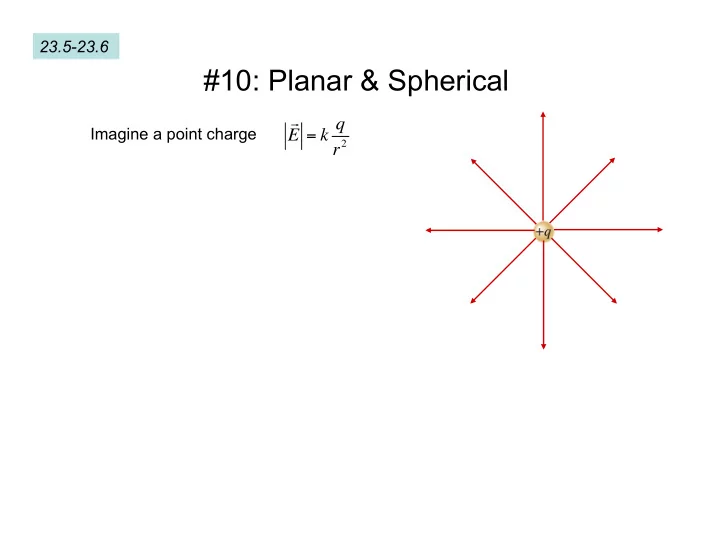
Imagine a point charge
E = k q r2
23.5-23.6
#10: Planar & Spherical E = k q Imagine a point charge r 2 - - PowerPoint PPT Presentation
23.5-23.6 #10: Planar & Spherical E = k q Imagine a point charge r 2 Hollow conducting shell E = k q Imagine a point charge r 2 Now surrounded with a neutral conducting shell Whats the electric field? There can be no electric
Imagine a point charge
E = k q r2
23.5-23.6
The field inside the conductor is zero, but the conductor has no effect on the field outside the conductor! A Faraday cage shield from fields originating from outside. Fields originating inside a Faraday cage freely transmit through the cage You cell phone needs an external antenna to receive, but not to transmit! Imagine a point charge
E = k q r2
Now surrounded with a neutral conducting shell What’s the electric field? There can be no electric field inside the conductor Field outside is the same What if there are charges/fields outside?
What if it is not a point charge, but a thin, uniformly-charged spherical shell (radius R)? Same arguments for apply for r>R: Spherical symmetry
Theorem 1: Any spherically symmetric charge distribution acts on particles
center of the shell.
What about r<R?
Theorem 2: Any spherically symmetric charge distribution exerts no force on a particle inside the shell.
Therefore, we can find the electric field within any sphericially symmetric charge distribution
For a uniform charge distribution:
ρ = Q V = Q 4 3 πR3 $ % & ' ( )
−1
−1 4
3
Consider a spherical Gaussian surface
Spherical symmetry
A. EA = EB = EC B. EA < EB < EC C. EC < EB < EA D. EB = EC < EA The figure below shows 3 solid uniform charge distributions each with total charge Q. Rank the electric field at Point P.
A solid sphere of radius a is concentric with a spherical conducting shell of inner radius 2a and outer radius 2.40a. The sphere has a net uniform charge q1; the shell has a net charge q2 = -q1. What is the magnitude of the electric field at radial distances (a) r = 0, (b) r = 0.5 a, (c) r = a, (d) r = 1.50a, (e) r = 2.30a, and (f) r = 3.50a? What is the net charge on the (g) inner and (h) outer surface of the shell? (i) Finally, sketch the electric field as a function of radius.
A solid sphere of radius a is concentric with a spherical conducting shell of inner radius 2a and outer radius 2.40a. The sphere has a net uniform charge q1; the shell has a net charge q2 = -2q1. What is the magnitude of the electric field at radial distances (a) r = 0, (b) r = 0.5 a, (c) r = a, (d) r = 1.50a, (e) r = 2.30a, and (f) r = 3.50a? What is the net charge on the (g) inner and (h) outer surface of the shell? (i) Finally, sketch the electric field as a function of radius.
The figure below shows a cross section through a very large nonconducting slab of thickness d = 9.4 mm and uniform volume charge density ρ =5.8 fC/m3. The origin of the x axis is at the slab's
2.0 mm, 4.7 mm and 20 mm?