10/8/2014 Setting TACs for IIIa herring EU Herring TACs David C.M. - - PDF document

10 8 2014
SMART_READER_LITE
LIVE PREVIEW

10/8/2014 Setting TACs for IIIa herring EU Herring TACs David C.M. - - PDF document

10/8/2014 Setting TACs for IIIa herring EU Herring TACs David C.M. Miller, IMARES PAC WG I, Den Haag, 1 October 2014 Biological advice Biological units JUVENILES ICES provides advice on catch levels that can be sustained by particular


slide-1
SLIDE 1

10/8/2014 1

Setting TACs for IIIa herring

David C.M. Miller, IMARES PAC WG I, Den Haag, 1 October 2014

EU Herring TACs Biological advice

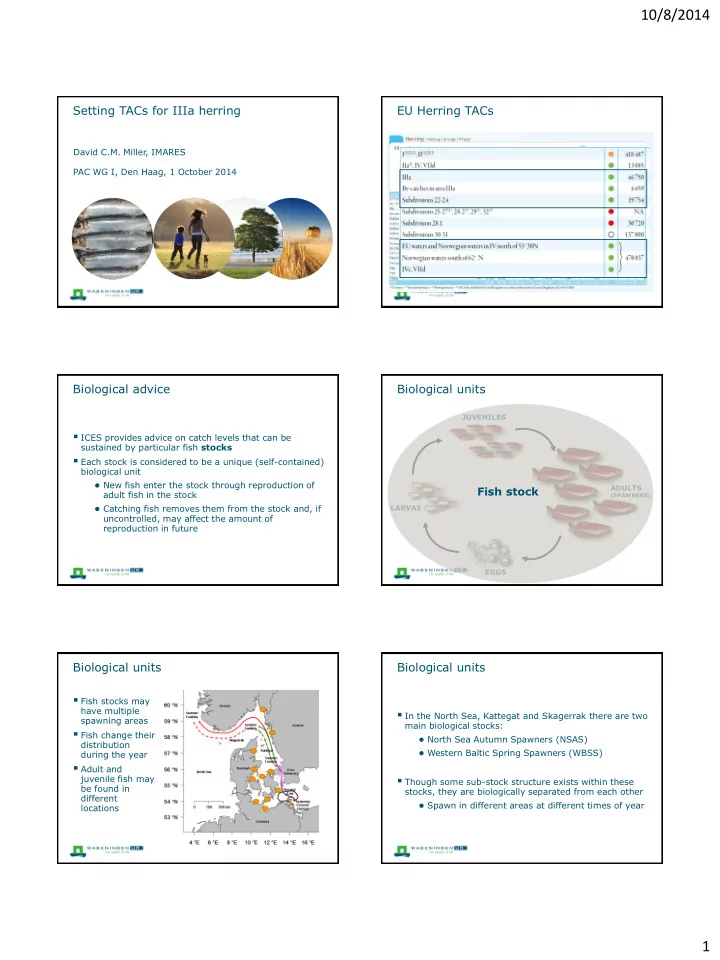
  • ICES provides advice on catch levels that can be

sustained by particular fish stocks

  • Each stock is considered to be a unique (self-contained)

biological unit

  • New fish enter the stock through reproduction of

adult fish in the stock

  • Catching fish removes them from the stock and, if

uncontrolled, may affect the amount of reproduction in future

Biological units

LARVAE JUVENILES ADULTS

(SPAWNERS)

EGGS

Fish stock

Biological units

  • Fish stocks may

have multiple spawning areas

  • Fish change their

distribution during the year

  • Adult and

juvenile fish may be found in different locations

Biological units

  • In the North Sea, Kattegat and Skagerrak there are two

main biological stocks:

  • North Sea Autumn Spawners (NSAS)
  • Western Baltic Spring Spawners (WBSS)
  • Though some sub-stock structure exists within these

stocks, they are biologically separated from each other

  • Spawn in different areas at different times of year
slide-2
SLIDE 2

10/8/2014 2

Biological advice vs management

  • Biological advice is given as the amount of catch

that a STOCK can sustain

  • Management is given as the amount of catch that

can be taken in each AREA

Stocks may be found in more than one management area

NSAS and WBSS herring stocks

NSAS WBSS

IV IIIa 22-24

Herring in IIIa

  • There is no single

biologically unique herring stock in IIIa

  • Herring in this

area are a mix of NSAS and WBSS herring

  • Therefore advice for

catches in this area needs to consider the development of both the NSAS and WBSS herring stocks

NSAS Mix WBSS

Herring in IIIa: TACs

  • Different fleets operating in different areas catch fish

from one or both of the stocks

Dividing stock TACs between management areas

22-24

IV IIIa

TAC NSAS TAC WBSS

50% 50% ???% ?%

  • The WBSS herring

TAC is divided in two:

  • 50% -> IIIa
  • 50% -> 22-24
  • Evaluations will be

conducted to determine what proportion of the NSAS TAC should be allocated to IIIa

TAC transfers

  • In addition, up to

50% of the IIIa TAC can be transferred to fisheries in area IV

  • This happens

after the NSAS and WBSS TACs have been split to determine the IIIa TAC

22-24

IV IIIa

TAC NSAS TAC WBSS

50% 50% ???% ?%

slide-3
SLIDE 3

10/8/2014 3

Herring in IIIa: TACs

  • We can separate out (afterwards) how much of the catch

in IIIa was NSAS and how much was WBSS

  • This can be used to determine what proportion of each

TAC should be allocated to IIIa. e.g.:

Year Total Catch NSAS Catch NSAS (C-fleet,IIIA) % Catch NSAS

(C-fleet,IIIA) + IV flex

%

2006 498970 11650 2.3 17158 3.4 2007 386690 16370 4.2 20096 5.2 2008 244920 9250 3.7 11344 4.6 2009 161900 5060 3.1 6078 3.7 2010 173850 11980 6.9 12895 7.4 2011 218090 6610 3.0 21610 9.9 2012 422450 7760 1.8 30260 7.2

3.6 5.9

End

Questions?