
10/4/18 1
A Technician’s Role in Preventing Adverse Drug Events
Christopher Gallegos and Beverly Armour A medication error is defined by the Nation Coordinating Council for Medication Error and Prevention (NCCMERP)
"A medication error is any preventable event that may cause or lead to inappropriate medication use or patient harm while the medication is in the control of the health care professional, patient, or consumer. Such events may be related to professional practice, health care products, procedures, and systems, including prescribing, order communication, product labeling, packaging, and nomenclature, compounding, dispensing, distribution, administration, education, monitoring, and use."
What is a medication error? Adverse Drug Events
Medicines are generally safe when used as prescribed
- r as directed by the label, but there are risks in
taking any medicine. An adverse drug event is when someone is harmed by a medicine. Certain types of adverse drug events are more common for specific medication classes, such as insulin, antibiotics, and
- pioids.
Why Reports of Serious Adverse Drug Events Continue to Grow?
The last four years have seen a 90% increase in the number of serious adverse drug reports received by the Food and Drug Administration (FDA). Investigating the reasons for the four-year trend, we concluded that they could be divided into three groups. Reports for the new drugs not widely used in 2008 accounted for 23%
- f the growth; increasing reports for drugs seen in all four years
accounted for 40%. The substantial remainder (37%) was due to special circumstances involving a few suspect drugs that resulted in greatly increased numbers of reports (ISMP , 2012).
ISMP: Four Identified, Distinctive, and Severe (ADEs) Categories:
- 1. Rhabdomyolysis: the destruction of skeletal muscle cells accompanied by the release of
cellular proteins into the blood, with a substantial risk of causing acute renal failure.
- 2. Serotonin syndrome (SS) and neuroleptic malignant syndrome (NMS): neurologic disorders
caused by drugs that trigger abnormal serotonin levels (with SS) or block dopamine (with NMS), which results in aberrant behavior and thought, muscle spasms, and compromises to the autonomic nervous system.
- 3. Stevens-Johnson syndrome/toxic epidermal necrolysis (SJS/TEN): a disorder in which the
body’s immune system attacks and destroys the skin, producing a condition similar to severe burns.
- 4. Progressive multifocal leukoencephalopathy (PML): an often fatal viral infection of the brain
that occurs when immunosuppressive drugs or human immunodeficiency virus (HIV) compromise the body’s ability to hold a prevalent virus in check.
Cases Reported to FDA for Four Severe Adverse Drug Events in 2017
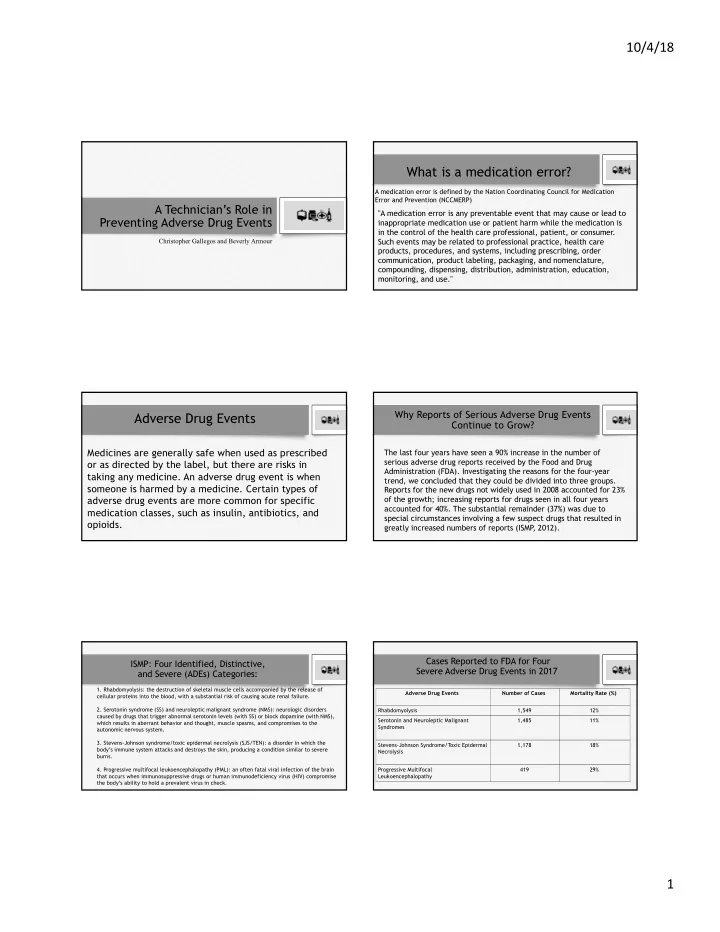
Adverse Drug Events Number of Cases Mortality Rate (%) Rhabdomyolysis 1,549 12% Serotonin and Neuroleptic Malignant Syndromes 1,485 11% Stevens-Johnson Syndrome/Toxic Epidermal Necrolysis 1,178 18% Progressive Multifocal Leukoencephalopathy 419 29%