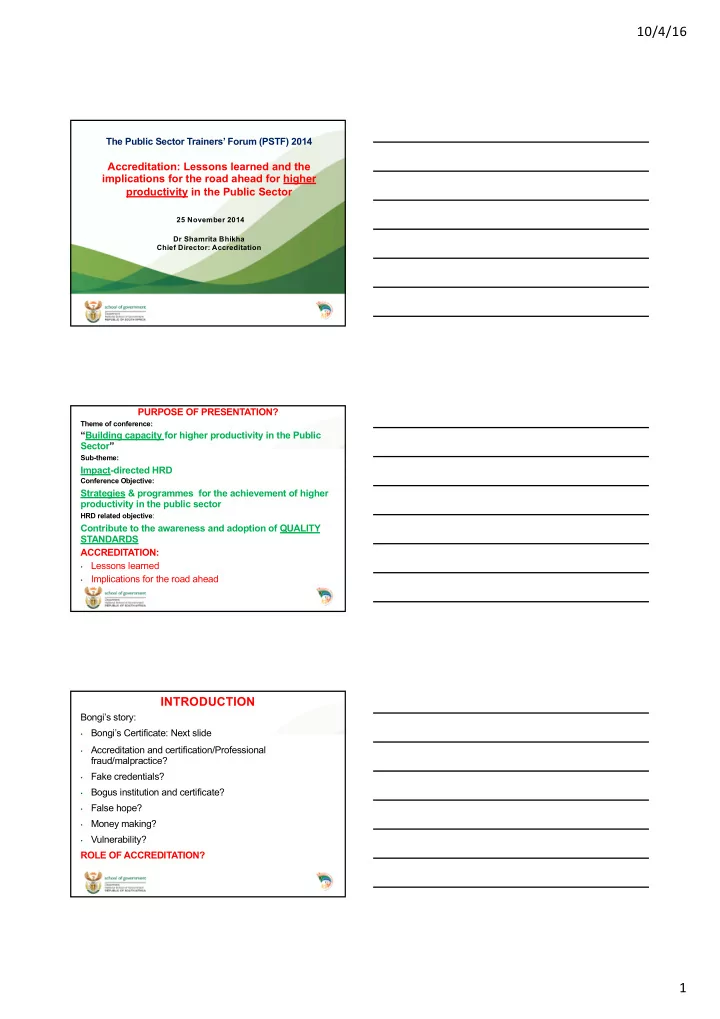
10/4/16 The Public Sector Trainers Forum (PSTF) 2014 Accreditation: - - PDF document

10 4 16
SMART_READER_LITE
LIVE PREVIEW

10/4/16 The Public Sector Trainers Forum (PSTF) 2014 Accreditation: - - PDF document

10/4/16 The Public Sector Trainers Forum (PSTF) 2014 Accreditation: Lessons learned and the implications for the road ahead for higher productivity in the Public Sector 25 November 2014 Dr Shamrita Bhikha Chief Director: Accreditation


slide-1
SLIDE 1

10/4/16 1

The Public Sector Trainers’ Forum (PSTF) 2014

Accreditation: Lessons learned and the implications for the road ahead for higher productivity in the Public Sector

25 November 2014 Dr Shamrita Bhikha Chief Director: Accreditation

PURPOSE OF PRESENTATION?

Theme of conference:

“Building capacity for higher productivity in the Public Sector”

Sub-theme:

Impact-directed HRD

Conference Objective:

Strategies & programmes for the achievement of higher productivity in the public sector

HRD related objective:

Contribute to the awareness and adoption of QUALITY STANDARDS ACCREDITATION:

  • Lessons learned
  • Implications for the road ahead

INTRODUCTION

Bongi’s story:

  • Bongi’s Certificate: Next slide
  • Accreditation and certification/Professional

fraud/malpractice?

  • Fake credentials?
  • Bogus institution and certificate?
  • False hope?
  • Money making?
  • Vulnerability?

ROLE OF ACCREDITATION?

slide-2
SLIDE 2

10/4/16 2

PUBLIC COLLEGE OF SOUTH AFRICA CERTIFICATE

This is to certify that Has successfully met the requirements for the

IN DECEMBER 2012

The Certificate was conferred at a Graduation ceremony held on 15 April 2013

Registrar

BONGI MFENGU

Certificate in Public Administration

Head: Education Services

15 April 2012

ACCREDITATION – BUIDING CAPACITY – IMPROVED PRODUCTIVITY:

ACCREDITATION BUILDING CAPACITY IMPROVED PRODUCTIVITY

BUILDING CAPACITY

CAPACITY: competent, able/fit, qualified Building capacity: INTENT

  • 1994: Public Service Act: Training Institution
  • 1995:White Paper on Transforming the Public Service. Chapter 13: Human

Resource Development and Training: 13.1 Human Resource Development and Capacity Building

  • September 1997: White Paper on Transforming Public Service Delivery – Build

Capacity

  • 2001: Public Service Regulations: Training and Education
  • 2001-2004: White Paper on Human Resource Management in the Public Service

– build capacity of public service

  • 2013: The National Development Plan, Vision 2030 highlights the need for

capable public service to consistently deliver high quality services to the citizens

  • f South Africa.
  • 2014-2019: Outcome 12 in the Medium Term Strategic Framework (MSTF) 2014-

2019 underlines the importance of “An efficient, effective & development-

  • riented Public Service.
slide-3
SLIDE 3

10/4/16 3

HIGHER PRODUCTIVITY?

Higher Productivity?

  • High- of great or specified upward extent, of exalted (raised, place high in rank,

power) quality

  • Productivity – capacity to produce, quality or state of being.

(The Concise Oxford Dictionary, 1964) Minister Collins Chabane:

  • The National School of Government “will be the central pillar in professionalising

the public service for higher productivity, be an engine of innovation in public service, and mobilise thought, best practice and optimal use of resources to ensure demonstrable return on investment: (Minister Collins Chabane, MP . Minister for Public Service and Administration. NSG Annual Report 2013/14). Phase 5 (2014-2019) - Productivity and Efficiency Measurement through Evidence Based Policy, Planning and Practices- (Reflections on the South African Public Service Transformation journey since 1994 and road ahead. Panel Discussion Input by Mr Collins Chabane, MP , Minister for Public Services and Administration. 14 Nov 2014.)

ACCREDITATION SYSTEM

THEORY & PRACTICE

THEORY?

  • Meaning?
  • Why?
  • Principles?
  • Legislation & policies?

PRACTICE?

How does it affect me as a training institution? Process: Who? How, When?

ACCREDITATION?

MEANING The certification, usually for a particular period of time, of a person, body, or an institution as having the capacity to fulfill a particular function in the quality assurance system set up by relevant legislation/policy. (regulated environment)

slide-4
SLIDE 4

10/4/16 4

ACCREDITATION?

WHY?

  • ASSURES EET community: institution & programmes meet certain standards
  • f quality – CONFIDANT, INTEGRITY
  • Credible, recognised nationally/internationally
  • Enhances educational quality by improving effectiveness of ETD institutions

and ensuring that these institutions meet standards established by ETD community, and serves as a common denominator of shared values and practices among diverse ETD institutions.

  • Provides an assessment of an institutions effectiveness in the fulfilment of its

mission, its compliance with legal requirements, and its continuing efforts to enhance the quality of learning, programme and services.

  • Based on reasoned judgement, the process stimulates evaluation and

improvement, while providing a means of continuing accountability to its constituents and the public.

  • Product is a public statement of an institution’s continuing capacity to provide

effective programmes and services based on agreed-upon requirements – principles/values/ philosophy of accreditation.

ACCREDITATION?

PRINCIPLES/VALUES

v People centred v Consistent high quality v Partners v Simple v Improve

THEORY

LOOKING BACK:

Ø

All sector- specific training, including training for the public sector, welfare and sports, will take place within the national framework to ensure that skills acquired are nationally recognised, portable and contribute to career-pathing.

Ø

The provision of education and training within development programmes should have recognition within the national education and training system. (Ready to Govern: ANC policy guidelines for a democratic South Africa. 31 May 1992)

  • “The anticipated outcome will be a new system of public service training and

education that will be strategically linked to the NQF and SAQA …” (White Paper on Public Service Training and Education, July 1995) (White Paper on the Transforming Public Service Delivery, 18 Sept 1997)

slide-5
SLIDE 5

10/4/16 5

LEARNING PROVISION CYCLE of NSG

Design Development Approval Delivery Review and evaluation Planning

LESSONS LEARNED

REGULATORY FRAMEWORKS: Legislation/Policies:

1.

SAQA Act 1995

2.

ETQA Regulations, 1998

3.

ETQA Policies, Procedures, Criteria & Guidelines

4.

NQF Act 2008. Quality Councils

5.

QCTO Policies

6.

CHE: Policies & Frameworks

LESSONS LEARNED

PARTNERS:

SAQA NQF DHET CHE QCTO UMALUSI DBE PEOPLE: SERVICES PROVIDERS: CAPACITATE/ TRAIN PUBLIC SERVANTS

slide-6
SLIDE 6

10/4/16 6

LESSONS LEARNED: NSG – ACCREDITED

Institutional accreditation:

  • PSETA, February 2014
  • Full accreditation - 4 Feb 2014 to 31 March 2016

Programme accreditation:

  • 60 % ETQA – short learning programmes
  • PSETA
  • ETDP
  • Services Seta
  • LG Seta
  • SABPP

QCTO – CIP LESSONS LEARNERD:QMS POLICIES: UNDERPIN ACCREDITATION 1.ETD QMS POLICIES

  • 2. Curriculum and Learning Programme Management Policy
  • 3. Assessment Management Policy
  • 4. Certification Management Policy
  • 5. Learner Management Policy
  • 6. ETD Staff Management Policy
  • 7. Finance, Administration and Physical Resource

Management Policy

LESSONS LEARNED

Institutional Accreditation: SAMDI – PALAMA – NSG

  • Lack of timely feedback
  • Promises not honoured
  • Different understandings of legislation and policies

Programme Accreditation:

  • PSETA, ETDP SETA, Services SETA, LG SETA, SABPP

, QCTO

  • Standardisation: criteria and guidelines
  • Complex
  • Feedback/communication
  • Competence – understanding of legislation
  • Managing change/transitions
  • Managing relationships
  • Management Information System
slide-7
SLIDE 7

10/4/16 7

ROAD AHEAD TO IMPROVE ACCREDITATION

v

Privilege implementation just as much as strategy, legislation, policies

v

Improved and sustained communication amongst partner organisations

v

Improved understanding of legislations and Policies

v

Dedicated unit for Quality Management and Development/Total Quality Management – Quality Assurance and Accreditation

v

More Capable staff to implement – training on NQF

v

Improved transition management

v

Stronger and sustained support systems

v

Stronger management of monitoring/control & reporting systems

v

Improved Management Information System

v

Improved Accountability Management

v

Strengthen enforcement of regulations – system to penalise institutions

v

More transparency, accountability, ethics

v

Facilitate more strongly public access to information on accreditation

v

Improved systems, processes & people

v

Create a Consortium for Accreditation

ROAD AHEAD TO IMPROVE ACCREDITATION

SIMPLIFY SIMPLIFY SIMPLIFY INCREASE INFORMATION CAMPAIGNS CONCLUSION

BILLBOARD: We offer three kinds of service: ACCREDITED CHEAP FAST You can pick any two ACCREDITED service CHEAP will not be FAST. ACCREDITED service FAST will not be CHEAP . FAST service CHEAP will not be ACCREDITED. ???

slide-8
SLIDE 8

10/4/16 8

CONCLUSION

“ACCREDITATION (Quality) is never an accident; it is always the result of high intention, sincere effort, intelligent direction and skilful execution; it represents the wise choice of many alternatives”. (Will A Foster)

Our Accreditation System – let us make it work for Building Capacity for Higher Productivity in the Public Sector SUCH THAT …

POOR Service Delivery- Unhappy People

IMPROVED Service Delivery: Happy People

slide-9
SLIDE 9

10/4/16 9

QUESTIONS & DISCUSSIONS