Update on the Copper BLM vs. MLR performance (Biotic Ligand Model - - PowerPoint PPT Presentation

update on the copper blm vs mlr performance
SMART_READER_LITE
LIVE PREVIEW

Update on the Copper BLM vs. MLR performance (Biotic Ligand Model - - PowerPoint PPT Presentation

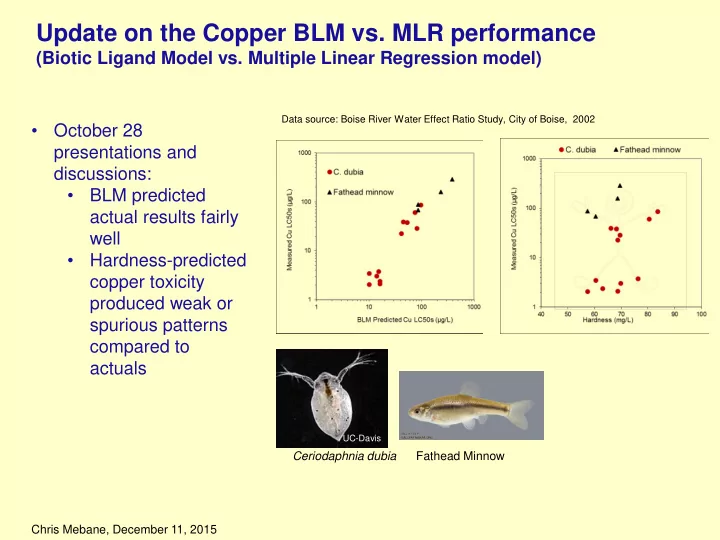
Update on the Copper BLM vs. MLR performance (Biotic Ligand Model vs. Multiple Linear Regression model) Data source: Boise River Water Effect Ratio Study, City of Boise, 2002 October 28 presentations and discussions: BLM predicted


slide-1
SLIDE 1

Update on the Copper BLM vs. MLR performance

(Biotic Ligand Model vs. Multiple Linear Regression model)

Data source: Boise River Water Effect Ratio Study, City of Boise, 2002

UC-Davis

  • October 28

presentations and discussions:

  • BLM predicted

actual results fairly well

  • Hardness-predicted

copper toxicity produced weak or spurious patterns compared to actuals

Ceriodaphnia dubia Fathead Minnow Chris Mebane, December 11, 2015

slide-2
SLIDE 2

However, NMFS (2014) BiOp did not unequivocally endorse the 2007 Cu BLM

  • Areas where 2007 BLM performance was not optimal:
  • Soft water
  • May be overly sensitive to DOC
  • Not fatal flaws
  • NMFS review tried to look at the totality of the hardness-

criteria vs. alternatives

  • Even with the softwater & DOC concerns, overall

performance of 2007 BLM was so much better than hardness-criteria, it was a reasonable alternative, with caveats

slide-3
SLIDE 3

1 10 100 1 000 10 000 1 10 100 1 000 Measured Cu LC50s (µg/L) Hardness mg/L) Measured Cu LC50s for fathead minnows versus hardness Hard (Ryan wt. al. 2004) Soft (Welsh et al. 1993,1996) Soft (Sciera et al. 2004) Soft (Van Genderen et al. 2005, 48- hr) Variable hardness (Erickson et al 1996)

Hardness performance with fathead minnow in diverse waters: pretty bad

  • With enough data, we

see copper toxicity does tend to decrease with increasing hardness, but with great uncertainty

  • Example: At hardness of

20 mg/L, confidant that dangerous copper concentrations (LC50s) will occur somewhere between 2 and 400 µg/L

(Figure from NMFS 2014 BiOp, PDF p. 456)

slide-4
SLIDE 4

1 10 100 1 000 10 000 1 10 100 1 000 10 000 Predicted Cu LC50s (µg/L) Measured Cu LC50s (µg/L) Hard (Ryan wt. al. 2004) Soft (Welsh et al. 1993,1996) Soft (Sciera et al. 2004) Soft (Van Genderen et al. 2005, 48-hr)

BLM performance with fathead minnow in diverse natural waters: a lot better but biased

  • BLM was strongly

correlated with actual model results, but …

  • BLM results were

systematically high- biased in soft water

  • High bias → copper was

actually more toxic in softwater than predicted

(Figure from NMFS 2014 BiOp, PDF p. 455)

slide-5
SLIDE 5

1 10 100 1000 10000 1 10 100 1000 10000 Predicted Cu EC50, µg/L Observed Cu EC50, µg/L

Diamond et al. 1997 Lind et al. 1978 Ryan et al. 2004 Sciera et al. 2004 Welsh et al. 1993 Erickson et al. 1996

Copper

  • P. promelas

Acute EC50s

MLR performance with fathead minnow in diverse natural waters: pretty good

  • Statistical model

self-corrects for systematic bias

(Figure courtesy of David DeForest and Kevin Brix, 9Dec2015)

slide-6
SLIDE 6

1 10 100 1000 10000 1 10 100 1000 10000 Predicted Cu EC50, µg/L Observed Cu EC50, µg/L

Diamond et al. 1997 Lind et al. 1978 Ryan et al. 2004 Sciera et al. 2004 Welsh et al. 1993 Erickson et al. 1996

Copper

  • P. promelas

Acute EC50s

MLR & BLM performance contrasted in diverse natural waters

1 10 100 1 000 10 000 1 10 100 1 000 10 000 Predicted Cu LC50s (µg/L) Measured Cu LC50s (µg/L) Hard (Ryan wt. al. 2004) Soft (Welsh et al. 1993,1996) Soft (Sciera et al. 2004) Soft (Van Genderen et al. 2005, 48-hr)

slide-7
SLIDE 7

The BLM is highly sensitive to DOC

Rainbow trout LC50s (actual)

  • With these data, BLM too sensitive to DOC
  • Implications of too steep of a response slope:
  • Low DOC values, model over-predicts toxicity (over protective)
  • Higher DOC values, model under-predicts toxicity (under protective)

Rainbow trout LC50s (BLM)

(Figure from: Welsh, P.G., J. Lipton, C.A. Mebane, and J.C.A. Marr. 2008. Influence of flow-through and renewal exposures on the toxicity of copper to rainbow trout. Ecotoxicology and Environmental Safety. 69(2): 199-208. http://dx.doi.org/10.1016/j.ecoenv.2007.04.003

Rainbow Trout (Other lines – trying alternatives in the BLM to dampen the DOC response)

slide-8
SLIDE 8

50 100 150 200 250 300 350 5 10 15 20 Cu EC50, µg/L DOC, mg/L

Observed BLM - Ryan (2005) LA50 Pooled MLR

Acute D. magna pH ~7

The MLR has a shallower DOC-toxicity slope than does the BLM

(Figure courtesy of David DeForest and Kevin Brix, May2015)

slide-9
SLIDE 9

BLM MLR

  • Overall, performance generally similar
  • On the whole, the MLR tends to be slightly

more protective (More blue in the surface plots above)

  • BLM may over-respond to DOC
  • MLR “tones down” the DOC response

(Figure courtesy of David DeForest and Kevin Brix, May2015)

The strengths of the MLR go beyond administrative convenience

  • Suggestions to group:
  • Question of which BLM version or MLR

surrogate is not ripe for decision today

  • Revisit at the April 2016 meeting
  • In the interim – complete report from Brix and

DeForest will be distributed for review