
SLIDE 1
Meghan Baker, Spring 2017
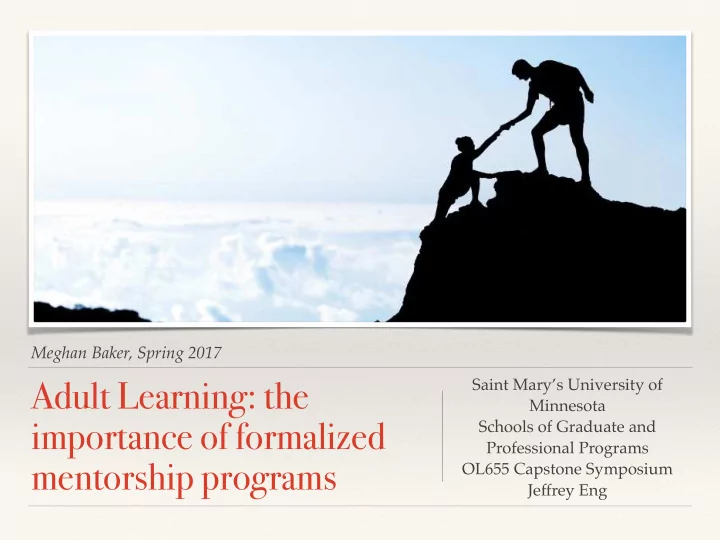
Adult Learning: the importance of formalized mentorship programs
Saint Mary’s University of Minnesota Schools of Graduate and Professional Programs OL655 Capstone Symposium Jeffrey Eng
Adult Learning: the Saint Marys University of Minnesota importance - - PowerPoint PPT Presentation
Meghan Baker, Spring 2017 Adult Learning: the Saint Marys University of Minnesota importance of formalized Schools of Graduate and Professional Programs mentorship programs OL655 Capstone Symposium Jeffrey Eng Introduction of topic
Meghan Baker, Spring 2017
Saint Mary’s University of Minnesota Schools of Graduate and Professional Programs OL655 Capstone Symposium Jeffrey Eng
❖ Problem Statement: Formalized training programs fail
❖ Context: rise of millennial population within workforce,
❖ Scope of research question: individual engagement,
❖ Goal of project: ❖ Foundation for strategy proposal within my organization ❖ Develop communication skills to effectively present proposal before
Executive Leadership
❖ Gain approval for Test & Learn ❖ Impacts: ❖ Develop a program within organization to enhance current adult
learning via formalized classroom training, through mentorship
❖ Provide a way for adult learners to transfer formal training skills in to
real-life execution within their job
❖ Aspects of leadership used to create research questions: ❖ Analysis of results and complex strategic decisions ❖ Creative thinking for problem solving ❖ Partnership with various Lines of Business to gain
❖ Skills to develop during process: ❖ Clear communication of strategy ❖ Understanding of results and adjust accordingly ❖ Success measure: approval to conduct Test & Learn of
❖ New questions: ❖ How to maximize organizational savvy skills and collaborative
skills, to influence key stakeholders to approve this strategy.
❖ Development goals: ❖ Enhance ability to act in strategic leadership capacity versus an
execution leadership capacity
❖ Influence need for strategy through strong communication of
recommendation
❖ Utilize this experience to continue developing and presenting
strategies to leadership
❖ Research question: how do
mentorship programs impact adult learning?
❖ Literature review: ❖ Engagement ❖ Development of learning
community
❖ Enhance Skill development
❖ Recommendation: Formalized organizational
❖ Challenges of proposal: ❖ Conflicting and
concurrent work that is taking team member mindshare
❖ Impact of intense change
management currently under work
❖ Time commitment of
project
❖ Analytical principles used to develop strategy ❖ Assessment of current organizational environment for
❖ Understand the Diversity and Inclusion impacts that can
❖ Creative strategies to address unique situations across
❖ Awareness of individual communication skills, through
❖ Ethical and legal impacts of potential strategic initiative ❖ Research and results: recommendation of Test & Learn
❖ Necessary approvals of
strategy:
❖ Multidivisional structure ❖ Support and awareness ❖ Role of middle manager in
process
❖ Standardization of process
(Jones, 2013)
❖ Engagement ❖ Job Clarity ❖ Mutually beneficial ❖ Development of learning
community
❖ Shared culture ❖ Enhance Skill development ❖ Communication skills ❖ Execution in real-life/practice
❖ Job Clarity ❖ Assignment/role clarity (Gunn, et al., 2017) ❖ Organizational mentorships create job satisfaction due to better understanding of role
through others experiences (Hartmann, Rutherford, Friend & Hamwi, 2016)
❖ Mentor: “I can share my experience from which you can benefit” (Williams, 2016) ❖ Role modeling of activities by mentor ❖ Mentor becomes “advisor, agent, confidant, role model, sponsor and teacher” (Gotian,
2016)
❖ Open-ended questions to understand concerns/needs (Gotian, 2016) ❖ Mutually Beneficial for mentor/mentee ❖ Communication skills develop (Gunn, et, al., 2017) ❖ Fulfillment and growth as a leader (Steward, et al., 2016)
❖ Shared culture ❖ Development of learning
community
❖ “Human survival is almost
totally dependent on relationships with other people, and these relationships are dependent on learning.” (Abbott & Ryan, 2000)
❖ Communication skills: ❖ Asking questions about what’s needed, becoming a
❖ Constructive feedback, guided goal setting, stretching
❖ Mentor leadership skills develop as relationship grows:
❖ Time and place to practice ❖ “Best practice” sharing (Stewart, et al., 2016) ❖ Bridge between training and real life (Stewart, et al., 2016) ❖ “Practice helps mentees progress from a cognitive
understanding of how to be more effective to actual skills and behaviors.” (Welsh & Dixon, 2016)
❖ Learn about how organization functions: ❖ e.g.: communication, emotional intelligence, political savvy,
teamwork (Eliades, 2017)
❖ Coaching vs. mentoring ❖ Mindshare of impacted
audience
❖ Intense change management
❖ Recommend Test & Learn activity of a structured mentorship programs that will allow for a
workplace as they transition from classroom setting into job execution.
❖ Structured program: Must be purposeful in creation (Palmer, 2009) ❖ Same goals and tasks (Abbott, 2000) ❖ Nomination and assessment conducted by regional leadership ❖ Keeping small allows for relationships to grow: over and under socialization (Abbott, et
al., 2000)
❖ 6-9 Month program ❖ Test & Learn- two strategies: ❖ Manager decides if new to position employee participates ❖ All new employees partake as a part of continued learning outside of formal education
❖ Abbott, J., & Ryan, T. (2000). Community as the Web of Learning. ❖ Eliades, A. B. (2017). Mentoring Practice and Mentoring Benefit 6: Equipping for Leadership and Leadership Readiness -- An Overview
and Application To Practice Using Mentoring Activities. Pediatric Nursing, 43(1), 40-42.
❖ Gaul, P. P. (2016). Millennials Need Training to Manage More Effectively. TD: Talent Development, 70(3), 20. ❖ Gotian, R. (2016). MENTORING THE MENTORS: JUST BECAUSE YOU HAVE THE TITLE DOESN'T MEAN YOU KNOW WHAT YOU
ARE DOING. College Student Journal, 50(1), 1-4.
❖ Gunn, F., Lee, S.., & Steed, M. (2017). Student Perceptions of Benefits and Challenges of Peer Mentoring Programs: Divergent Perspectives
From Mentors and Mentees. Marketing Education Review, 27(1), 15-26. doi:10.1080/10528008.2016.1255560
❖ HARTMANN, N. N., RUTHERFORD, B. N., FRIEND, S. B., & HAMWI, G. A. (2016). MENTORING'S IMPACT ON SALESPERSON JOB
SATISFACTION DIMENSIONS. Marketing Management Journal, 26(1), 35-50.
❖ Jones, G.R., (2013). Organizational Theory, Design, and Change. Saddle River, New Jersey: Prentice Hall. ❖ Palmer, P.J. (2009). A hidden wholeness: The journey toward an undivided life. San Francisco, CA: Jossey-Bass. ❖ Stewart, J., & Harrison, T. (2016). Top 3 Advantages of Mentorship in the Workplace. Armed Forces Comptroller, 61(4), 14. ❖ Welsh, E. T., & Dixon, P. M. (2016). Improving Mentoring Outcomes: Examining Factors outside the Relationship. Journal Of Managerial
Issues, 28(3/4), 231-247.
❖ WILLIAMS, E. (2016). The importance of coaching and mentoring for young professionals. Logistics & Transport Focus, 18(10), 24-26. ❖ Zeivots, S. S. (2016). Emotional highs in adult experiential learning. Australian Journal Of Adult Learning, 56(3), 353-373.