
10/29/2019
Problems caused by mutual exclusion
2
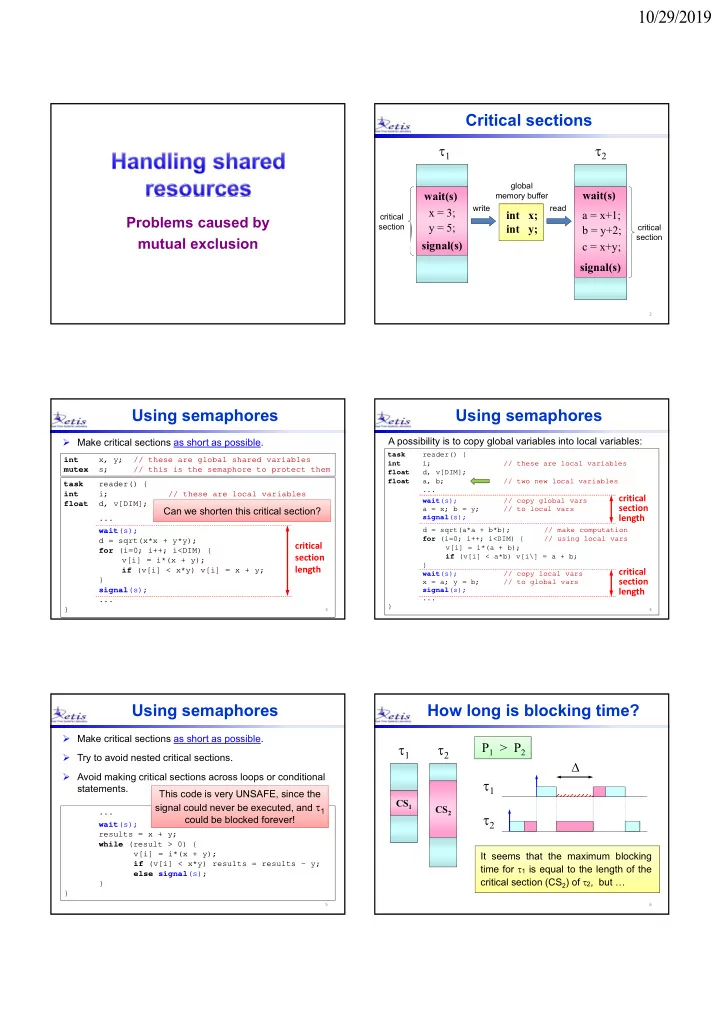
Critical sections
2 1
global memory buffer write read
x = 3; y = 5; a = x+1; b = y+2; c = x+y; int x; int y; wait(s) signal(s) wait(s) signal(s)
critical section critical section
3
Using semaphores
- Make critical sections as short as possible.
task reader() { int i; // these are local variables float d, v[DIM]; ... wait(s); d = sqrt(x*x + y*y); for (i=0; i++; i<DIM) { v[i] = i*(x + y); if (v[i] < x*y) v[i] = x + y; } signal(s); ... } int x, y; // these are global shared variables mutex s; // this is the semaphore to protect them
critical section length Can we shorten this critical section?
4
Using semaphores
A possibility is to copy global variables into local variables:
task reader() { int i; // these are local variables float d, v[DIM]; float a, b; // two new local variables ... wait(s); // copy global vars a = x; b = y; // to local vars signal(s); d = sqrt(a*a + b*b); // make computation for (i=0; i++; i<DIM) { // using local vars v[i] = i*(a + b); if (v[i] < a*b) v[i\] = a + b; } wait(s); // copy local vars x = a; y = b; // to global vars signal(s); ... }
critical section length critical section length
5
Using semaphores
- Make critical sections as short as possible.
- Try to avoid nested critical sections.
... wait(s); results = x + y; while (result > 0) { v[i] = i*(x + y); if (v[i] < x*y) results = results - y; else signal(s); } }
This code is very UNSAFE, since the signal could never be executed, and 1 could be blocked forever!
- Avoid making critical sections across loops or conditional
statements.
6
How long is blocking time?
CS1
1 2
CS2
P1 > P2
1 2
It seems that the maximum blocking time for 1 is equal to the length of the critical section (CS2) of 2, but …