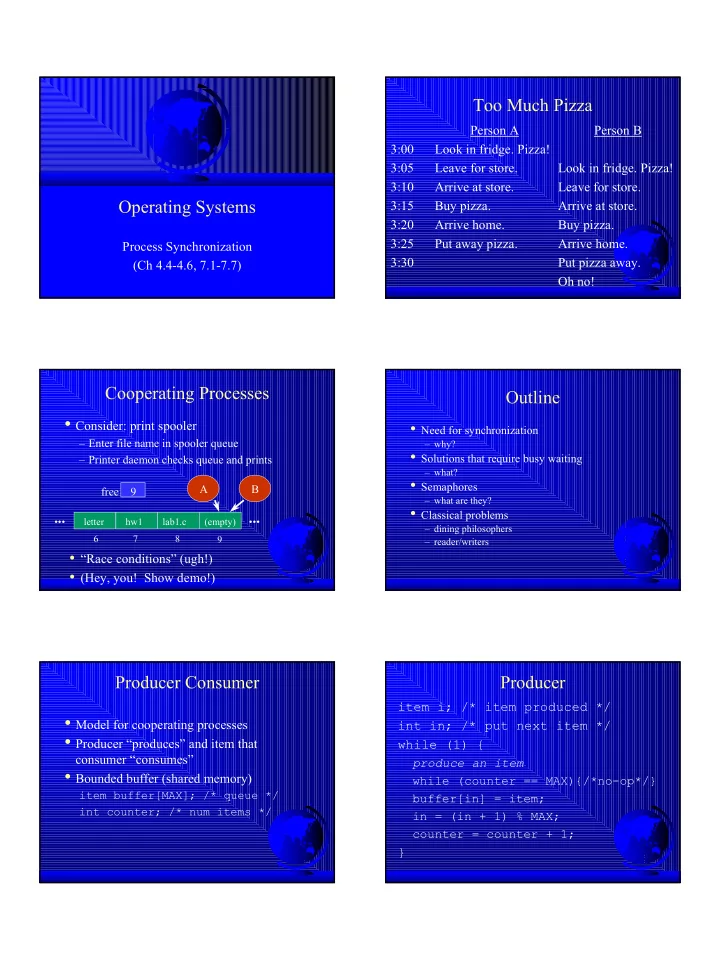
Consumer Trouble! item i; /* item consumed */ P: R1 = counter - - PDF document

consumer trouble
SMART_READER_LITE
LIVE PREVIEW

Consumer Trouble! item i; /* item consumed */ P: R1 = counter - - PDF document

Too Much Pizza Person A Person B 3:00 Look in fridge. Pizza! 3:05 Leave for store. Look in fridge. Pizza! 3:10 Arrive at store. Leave for store. Operating Systems 3:15 Buy pizza. Arrive at store. 3:20 Arrive home. Buy pizza. 3:25


slide-1
SLIDE 1

1

Operating Systems

Process Synchronization (Ch 4.4-4.6, 7.1-7.7)

Too Much Pizza

3:00 3:05 3:10 3:15 3:20 3:25 3:30 Person A Look in fridge. Pizza! Leave for store. Arrive at store. Buy pizza. Arrive home. Put away pizza. Person B Look in fridge. Pizza! Leave for store. Arrive at store. Buy pizza. Arrive home. Put pizza away. Oh no!

Cooperating Processes

  • Consider: print spooler

– Enter file name in spooler queue – Printer daemon checks queue and prints

  • “Race conditions” (ugh!)
  • (Hey, you! Show demo!)

letter hw1 lab1.c

... ...

(empty)

A B

6 7 8

free 9

9

Outline

  • Need for synchronization

– why?

  • Solutions that require busy waiting

– what?

  • Semaphores

– what are they?

  • Classical problems

– dining philosophers – reader/writers

Producer Consumer

  • Model for cooperating processes
  • Producer “produces” and item that

consumer “consumes”

  • Bounded buffer (shared memory)

item buffer[MAX]; /* queue */ int counter; /* num items */

Producer

item i; /* item produced */ int in; /* put next item */ while (1) {

produce an item while (counter == MAX){/*no-op*/} buffer[in] = item; in = (in + 1) % MAX; counter = counter + 1;

}

slide-2
SLIDE 2

2

Consumer

item i; /* item consumed */ int out; /* take next item */ while (1) {

while (counter == 0) {/*no-op*/} item = buffer[out];

  • ut = (out + 1) % MAX;

counter = counter - 1; consume the item

}

Trouble!

{R1 = 5} {R1 = 6} {R2 = 5} {R2 = 4} {counter = 4} {counter = 6} R1 = counter R1 = R1 + 1 R2 = counter R2 = R2 -1 counter = R2 counter = R1 P: P: C: C: C: P:

Critical Section

  • Mutual Exclusion

– Only one process inside critical region

  • Progress

– No process outside critical region may block other processes wanting in

  • Bounded Waiting

– No process should have to wait forever (starvation)

  • Note, no assumptions about speed!

First Try: Strict Alternation

int turn; /* shared, id of turn */ while(1) { while (turn <> my_pid) { /* no-op */} /* critical section */ turn = your_pid /* remainder section */ }

Second Try

int flag[1]; /* boolean */ while(1) { flag[my_pid] = true; while (flag[your_pid]) { /* no-op */} /* critical section */ flag[my_pid] = false; /* remainder section */ } int flag[1]; /* boolean */ int turn; while(1) { flag[my_pid] = true; turn = your_pid; while (flag[your_pid] && turn==your_pid){ /* noop */} /* critical section */ flag[my_pid] = false; /* remainder section */ }

Third Try: Peterson’s Solution

slide-3
SLIDE 3

3

Multiple-Processes

  • “Bakery Algorithm”
  • Common data structures

boolean choosing[n]; int num[n];

  • Ordering of processes

– If same number, can decide “winner”

Multiple-Processes

choosing[my_pid] = true; num[my_pid] = max(num[0],num[1] …)+1 choosing[my_pid] = false; for (j=0; j<n; j++) { while(choosing[j]) { } while(num[j]!=0 && (num[j],j)<(num[my_pid],my_pid)){} } /* critical section */ num[my_pid] = 0;

Synchronization Hardware

  • Test-and-Set: returns and modifies atomically

int Test_and_Set(int &target) { int temp; temp = target; target = true; return temp; }

Using Test_and_Set

while(1) { while (Test_and_Set(lock)) { } /* critical section */ lock = false; /* remainder section */ }

  • All the solutions so far have required

“Busy Waiting” … what is that?

Outline

  • Need for synchronization

(done)

– why?

  • Solutions that require busy waiting

(done)

– what?

  • Semaphores

– what are they?

  • Classical problems

– dining philosophers – reader/writers

Semaphores

  • Do not require “busy waiting”
  • Semaphore S (shared, often initially =1)

– integer variable – accessed via two (indivisible) atomic operations

wait(S): S = S - 1 if S<0 then block(S) signal(S): S = S + 1 if S<=0 then wakeup(S)

slide-4
SLIDE 4

4

Critical Section w/Semaphores

semaphore mutex; /* shared */ while(1) { wait(mutex); /* critical section */ signal(mutex); /* remainder section */ } (Hey, you! Show demo!)

Semaphore Implementation

  • Disable interrupts

– Why is this not evil? – Multi-processors?

  • Use correct software solution
  • Use special hardware, i.e.- Test-and-Set

Design Technique: Reducing a Problem to a Special Case

  • Simple solution not adequate

– ex: disabling interrupts

  • Problem solution requires special case

solution

– ex: protecting S for semaphores

  • Simple solution adequate for special case
  • Other examples:

– name servers, on-line help

Trouble!

Process A wait(S) wait(Q) … Process B wait(Q) wait(S) … signal(S) /* cr */ wait(S) wait(S) /* cr */ wait(S) /* cr */

Classical Synchronization Problems

  • Bounded Buffer
  • Readers Writers
  • Dining Philosophers

Dining Philosophers

  • Philosophers

– Think – Sit – Eat – Think

  • Need 2 chopsticks to

eat

slide-5
SLIDE 5

5

Philosopher i: while (1) { /* think… */ wait(chopstick[i]); wait(chopstick[i+1 % 5]); /* eat */ signal(chopstick[i]); signal(chopstick[i+1 % 5]); }

Dining Philosophers

(Other solutions?)

Other Solutions

  • Allow at most N-1 to sit at a time
  • Allow to pick up chopsticks only if both are

available

  • Asymmetric solution (odd L-R, even R-L)

Readers-Writers

  • Readers only read the content of object
  • Writers read and write the object
  • Critical region:

– No processes – One or more readers (no writers) – One writer (nothing else)

  • Solutions favor Reader or Writer

Readers-Writers

Shared: semaphore mutex, wrt; int readcount; Writer: wait(wrt) /* write stuff */ signal(wrt);

Readers-Writers

Reader: wait(mutex); readcount = readcount + 1; if (readcount==1) wait(wrt); signal(mutex); /* read stuff */ wait(mutex); readcount = readcount - 1; if (readcount==0) signal(wrt); signal(mutex);

Monitors

  • High-level construct
  • Collection of:

– variables – data structures – functions – Like C++ class

  • One process active inside
  • “Condition” variable

– not counters like semaphores

slide-6
SLIDE 6

6

Monitor Producer-Consumer

monitor ProducerConsumer { condition full, empty; integer count; /* function prototypes */ void enter(item i); item remove(); } void producer(); void consumer();

Monitor Producer-Consumer

void producer() { item i; while (1) { /* produce item i */ ProducerConsumer.enter(i); } } void consumer() { item i; while (1) { i = ProducerConsumer.remove(); /* consume item i */ } }

Monitor Producer-Consumer

void enter (item i) { if (count == N) sleep(full); /* add item i */ count = count + 1; if (count == 1) then wakeup(empty); } item remove () { if (count == 0) then sleep(empty); /* remove item into i */ count = count - 1; if (count == N-1) then wakeup(full); return i; }

Other Process Synchronization Methods

  • Sequencers
  • Path Expressions
  • Serializers
  • ...
  • All essentially equivalent in terms of
  • semantics. Can build each other!

Trouble?

  • Monitors and Regions attractive, but ...

– Not supported by C, C++, Pascal ...

+ semaphores easy to add

  • Monitors, Semaphores, Regions ...

– require shared memory – break on multiple CPU (w/own mem) – break distributed systems

  • In general, Inter-Process Communication

(IPC)

– Move towards Message Passing

Inter Process Communication

  • How does one process communicate with

another process? Some of the ways:

– shared memory – read/write to shared region

+ shmget(), shmctl() in Unix + Memory mapped files in WinNT/2000

– semaphores - signal notifies waiting process – software interrupts - process notified asynchronously – pipes - unidirectional stream communication – message passing - processes send and receive messages.

slide-7
SLIDE 7

7

Pipes

  • One process writes, 2nd process reads

% ls | more

  • Shell:

1 create a pipe 2 create a process for ls command, setting stdout to write side of pipe 3 create a process for more command, setting stdin to read side of pipe

Shell ls more 1 stdout 2 3 stdin

(Hey, see sample code!)

The Pipe

  • Bounded Buffer

– shared buffer (Unix 4096K) – block writes to full pipe – block reads to empty pipe

b l a h . c \0 write fd read fd

The Pipe

  • Process inherits file descriptors from parent

– file descriptor 0 stdin, 1 stdout, 2 stderr

  • Process doesn't know (or care!) when reading

from keyboard, file, or process or writing to terminal, file, or process

  • System calls:

– read(fd, buffer, nbytes) (scanf() built on top) – write(fd, buffer, nbytes) (printf() built on top) – pipe(rgfd) creates a pipe

+ rgfd array of 2 fd. Read from rgfd[0], write to rgfd[1]

  • (Hey, show sample code!)

Message Passing

  • Communicate information from one process

to another via primitives:

send(dest, &message) receive(source, &message)

  • Receiver can specify ANY
  • Receiver can block (or not)

Producer-Consumer

void Producer() { while (TRUE) { /* produce item */ build_message(&m, item); send(consumer, &m); receive(consumer, &m); /* wait for ack */ }} void Consumer { while(1) { receive(producer, &m); extract_item(&m, &item); send(producer, &m); /* ack */ /* consume item */ }}

“Rendezvous”

Consumer Mailbox

void Consumer { for (i=0; i<N; i++) send(producer, &m); /* N empties */ while(1) { receive(producer, &m); extract_item(&m, &item); send(producer, &m); /* ack */ /* consume item */ } }

slide-8
SLIDE 8

8

New Troubles with Messages? New Troubles with Message Passing

  • Scrambled messages (checksum)
  • Lost messages (acknowledgements)
  • Lost acknowledgements (sequence no.)
  • Process unreachable (down, terminates)
  • Naming
  • Authentication
  • Performance (from copying, message

building)

Software Interrupts

  • Similar to hardware interrupt.
  • Processes interrupt each other (often for

system call)

  • Asynchronous! Stops execution then restarts

– cntl-C – child process completes – alarm scheduled by the process expires

+ Unix: SIGALRM from alarm() or setitimer()

– resource limit exceeded (disk quota, CPU time...) – programming errors: invalid data, divide by zero

Software Interrupts

  • SendInterrupt(pid, num)

– type num to process pid, – kill() in Unix – (NT doesn’t allow signals to processes)

  • HandleInterrupt(num, handler)

– type num, use function handler – signal() in Unix – Use exception handler in WinNT/2000

  • Typical handlers:

– ignore – terminate (maybe w/core dump) – user-defined

  • (Hey, show demos!)

Unreliable Signals

  • Before POSIX.1 standard:

signal(SIGINT, sig_int); ... sig_int() { /* re-establish handler */ signal(SIGINT, sig_int); }

  • Another signal could come before

handler re-established!