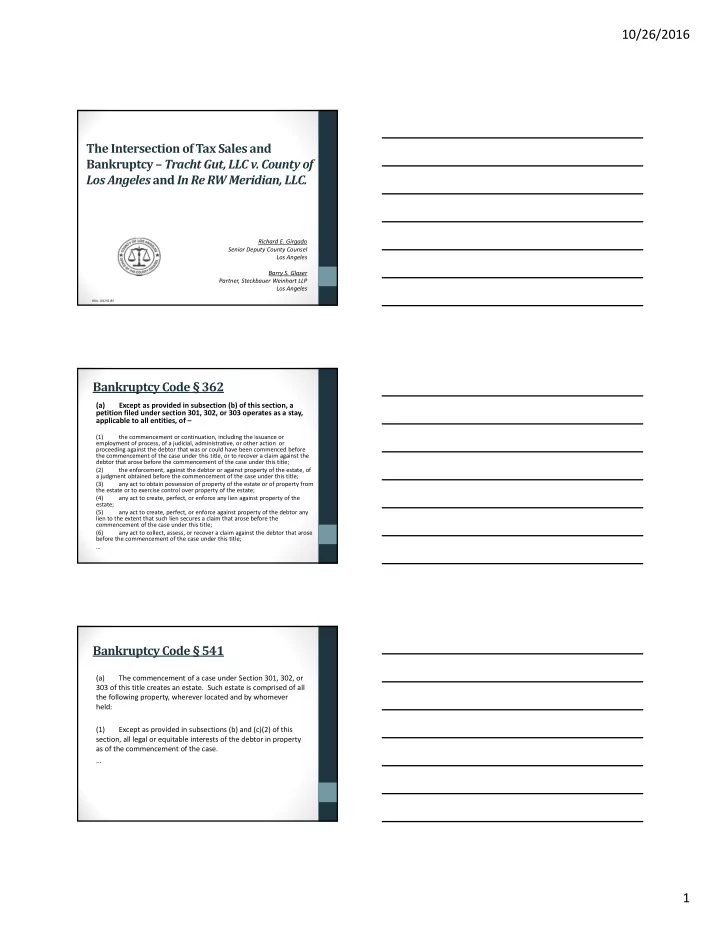
10/26/2016 The Intersection of Tax Sales and Bankruptcy Tracht Gut, - - PDF document

10 26 2016
SMART_READER_LITE
LIVE PREVIEW

10/26/2016 The Intersection of Tax Sales and Bankruptcy Tracht Gut, - - PDF document

10/26/2016 The Intersection of Tax Sales and Bankruptcy Tracht Gut, LLC v. County of Los Angeles and In Re RW Meridian, LLC. Richard E. Girgado Senior Deputy County Counsel Los Angeles Barry S. Glaser Partner, Steckbauer Weinhart LLP Los Angeles


slide-1
SLIDE 1

10/26/2016 1

The Intersection of Tax Sales and Bankruptcy – Tracht Gut, LLC v. County of Los Angeles and In Re RW Meridian, LLC.

Richard E. Girgado Senior Deputy County Counsel Los Angeles Barry S. Glaser Partner, Steckbauer Weinhart LLP Los Angeles

  • HOA. 101292185

Bankruptcy Code § 362

(a) Except as provided in subsection (b) of this section, a petition filed under section 301, 302, or 303 operates as a stay, applicable to all entities, of –

(1) the commencement or continuation, including the issuance or employment of process, of a judicial, administrative, or other action or proceeding against the debtor that was or could have been commenced before the commencement of the case under this title, or to recover a claim against the debtor that arose before the commencement of the case under this title; (2) the enforcement, against the debtor or against property of the estate, of a judgment obtained before the commencement of the case under this title; (3) any act to obtain possession of property of the estate or of property from the estate or to exercise control over property of the estate; (4) any act to create, perfect, or enforce any lien against property of the estate; (5) any act to create, perfect, or enforce against property of the debtor any lien to the extent that such lien secures a claim that arose before the commencement of the case under this title; (6) any act to collect, assess, or recover a claim against the debtor that arose before the commencement of the case under this title; …

Bankruptcy Code § 541

(a) The commencement of a case under Section 301, 302, or 303 of this title creates an estate. Such estate is comprised of all the following property, wherever located and by whomever held: (1) Except as provided in subsections (b) and (c)(2) of this section, all legal or equitable interests of the debtor in property as of the commencement of the case. …

slide-2
SLIDE 2

10/26/2016 2

Bankruptcy Code § 548

(a)(1) The trustee may avoid any transfer (including any transfer to or for the benefit of an insider under an employment contract) of an interest of the debtor in property, or any

  • bligation (including any obligation to or for the benefit of an

insider under an employment contract) incurred by the debtor, that was made or incurred on or within 2 years before the date

  • f the filing of the petition, if the debtor voluntarily or

involuntarily – (A) made such transfer or incurred such obligation with actual intent to hinder, delay, or defraud any entity to which the debtor was or became, on or after the date that such transfer was made or such obligation was incurred, indebted; or (B)(i) received less than a reasonably equivalent value in exchange for such transfer or obligation; and …

Revenue and Taxation Code § 2605

The following taxes on the secured roll are due and payable November 1:

(a) All taxes on personal property. (b) Half the taxes on real property, and if the amount is not evenly divisible by two, the odd cent is also due and payable unless the roll shows the odd cent as part of the second installment.

Revenue and Taxation Code § 2606

The second half of taxes on real property on the secured roll is due and payable February 1.

slide-3
SLIDE 3

10/26/2016 3

Revenue and Taxation Code § 2617

All taxes due November 1, if unpaid, are delinquent at 5 p.m., or on the close of business, whichever is later, on December 10, and thereafter a delinquent penalty of 10 percent attaches to them.

Revenue and Taxation Code § 2618

The second half of taxes on real property, if unpaid, is delinquent at 5 p.m., or on the close

  • f business, whichever is later, on April 10, and

thereafter a delinquent penalty of 10 percent attaches to it.

Revenue and Taxation Code § 4103

(a) Redemption penalties are the sum of the following: (1) Beginning July 1st of the year of the declaration of tax default,

  • n the declared amount of defaulted taxes at the rate of 1 ½ percent a

month to the time of redemption. If the last day of any month falls on a Saturday, Sunday, or legal holiday, the additional penalty of 1 ½ percent shall attach after the close of business on next the business day. (2) …. (b) For purposes of an administrative hearing or any claim in a bankruptcy proceeding pertaining to the property being redeemed, the assessment of penalties determined pursuant to subdivision (a) with respect to the redemption of that property constitutes the assessment of interest.

slide-4
SLIDE 4

10/26/2016 4

Revenue and Taxation Code § 3436

At 12:01 a.m. on July 1, the taxes, assessments, penalties, and costs on real property except tax‐defaulted property and possessory interests, which have not been paid shall by

  • peration of law be declared in default.

Revenue and Taxation Code § 126

“Tax‐defaulted property” is real property which is subject to a lien for taxes which, by

  • peration of law and by declaration of the tax

collector, are in default and from which the lien

  • f the taxes for which it was declared tax‐

defaulted has not been removed. Where used in this division or in any other provision of law, …

Revenue and Taxation Code § 3691‐ 3731.1

(a)(1)(A) Five years or more, or three years or more in the case of nonresidential commercial property, after the property has become tax defaulted, the tax collector shall have the power to sell and shall attempt to sell in accordance with Section 3692 all or any portion of tax‐ defaulted property that has not been redeemed, without regard to the boundaries of the parcels, as provided in this chapter, unless by other provisions of law the property is not subject to sale. Any person, regardless of any prior or existing lien on, claim to, or interest in, the property, may purchase at the sale. …

slide-5
SLIDE 5

10/26/2016 5

Publication & Notices (Generally)

  • 3351‐3731.1

Revenue and Taxation Code § 4101

Tax‐defaulted property may be redeemed until the right of redemption is terminated.

Revenue and Taxation Code § 4102

The amount necessary to redeem shall be paid in lawful money

  • f the United States and is the sum of the following:

(a) The total amount of all prior year defaulted taxes. (b) Delinquent penalties and costs. (c) Redemption penalties. …

slide-6
SLIDE 6

10/26/2016 6

Revenue and Taxation Code § 3707

(a)(1) The right of redemption terminates at the close of business on the last business day prior to the date of the sale. (2) If the tax collector approves a sale as a credit transaction and does not receive full payment on or before the date upon which the tax collector requires pursuant to Section 3693.1, the right of redemption is revived on the next business day following that date. (b) Notwithstanding any other provision of law, any remittance sent by mail for redemption of tax‐defaulted property must be received in the tax collector’s office prior to the time established in paragraph (1) of subdivision (a). (c) The sale shall be deemed complete when full payment has been received by the tax collector. (d) The right of redemption revives if the property is not sold.

Revenue and Taxation Code § 3698.5

(a) Except as provided in Section 3698.7, the minimum price at which property may be offered for sale pursuant to this chapter shall be an amount not less than the total amount necessary to redeem, plus costs and the outstanding balance of any property tax postponement loan. For purposes of this subdivision: (1) The “total amount necessary to redeem” is the sum of the following: (A) The amount of defaulted taxes. (B) Delinquent penalties and costs. (C) Redemption penalties. (D) A redemption fee. (2) “Costs” are those amounts described in subdivision (c) of Section 3704.7, subdivisions (a) and (b) of Section 4112, Sections 4672, 4672.1, 4672.2, 4673, and subdivision (b) of Section 4673.1.

Revenue and Taxation Code § 3693

(a) … Unless otherwise specified by the tax collector, payment is due on or before the close of auction.

slide-7
SLIDE 7

10/26/2016 7

Revenue and Taxation Code § 3693.1

Notwithstanding Section 3693, the tax collector may make the sale of any property sold under this chapter a cash or deferred‐ payment transaction. If the tax collector approves the sale as a deferred‐payment transaction, the tax collector may require a deposit in the amount of five thousand dollars ($5,000) or 10 percent of the minimum bid price, whichever is greater. The balance of the purchase price shall be paid by any method of payment authorized by Section 2502, 2503.2, or 2504, as specified by the tax collector and within a period specified by the tax collector not to exceed 90 days from the date of the close of auction … Failure on the part of the successful bidder to consummate the sale within the period specified by the tax collector shall result in the forfeiture of the deposit and all rights he or she may have with respect to that property. Any forfeiture of deposit shall be distributed to the County general fund and shall not apply to outstanding delinquent

  • taxes. Upon forfeiture the right of redemption shall revive.

Revenue and Taxation Code § 4676

(a) When excess proceeds from the sale of tax‐defaulted property exceed on hundred fifty dollars ($150), the County shall provide notice of the right to claim the excess proceeds … (b) No later than 90 days after the sale of the property, the County shall mail written notice of the right to claim excess proceeds to the last known mailing address of parties of interest, as defined in Section 4675. The County shall make a reasonable effort to obtain the name and last known mailing address of parties of interest.

Revenue and Taxation Code § 4675

(a) Any party of interest in the property may file with the County a claim for the excess proceeds, in proportion to his or her interest held with others of equal priority in the property at the time of sale, at any time prior to the expiration

  • f one year following the recordation of the tax collector’s deed

to the purchaser. (b) After the property has been sold, a party of interest in the property at the time of the sale may assign his or her right to claim the excess proceeds only by a dated, written instrument that explicitly states that the right to claim the excess proceeds is being assigned, …

slide-8
SLIDE 8

10/26/2016 8

Revenue and Taxation Code § 4675 (cont.)

(e)(1) … For the purposes of this article, parties of interest and their order of priority are: (A) First, lienholders of record prior to the recordation of the tax deed to the purchaser in the order of their priority. (B) Second, any person with title of record to all or any portion of the property prior to the recordation of the tax deed to the purchaser.

Revenue and Taxation Code § 4674

… any excess proceeds not claimed under Section 4675 may be transferred to the County general fund.