
SLIDE 1
10/17/2016 1
CSE373: Data Structures and Algorithms
AVL Trees
Steve Tanimoto Autumn 2016
This lecture material represents the work of multiple instructors at the University of Washington. Thank you to all who have contributed!
Review: Binary Search Trees (BST)
4 12 10 6 2 11 5 8 14 13 7 9
- Structure property (binary tree)
– Each node has 2 children – Result: keeps operations simple
- Order property
– All keys in left subtree smaller than node’s key – All keys in right subtree larger than node’s key – Result: easy to find any given key
Autumn 2016 2 CSE373: Data Structures & Algorithms
BST: Efficiency of Operations?
Autumn 2016 CSE373: Data Structures & Algorithms 3
- Problem: operations may be inefficient if BST is
unbalanced.
- Find, insert, delete
– (n) in the worst case
- BuildTree
– (n2) in the worst case How? 1 1 2 1 2 3
Observation
- BST: the shallower the better!
Solution: Require and maintain a Balance Condition that 1. Ensures depth is always O(log n) – strong enough! 2. Is efficient to maintain – not too strong!
Autumn 2016 4 CSE373: Data Structures & Algorithms
How can we make a BST efficient?
- When we build the tree, make sure it’s balanced.
- BUT…Balancing a tree only at build time is insufficient because
sequences of operations can eventually transform our carefully balanced tree into the dreaded list
- So, we also need to also keep the tree balanced as we perform operations.
Potential Balance Conditions
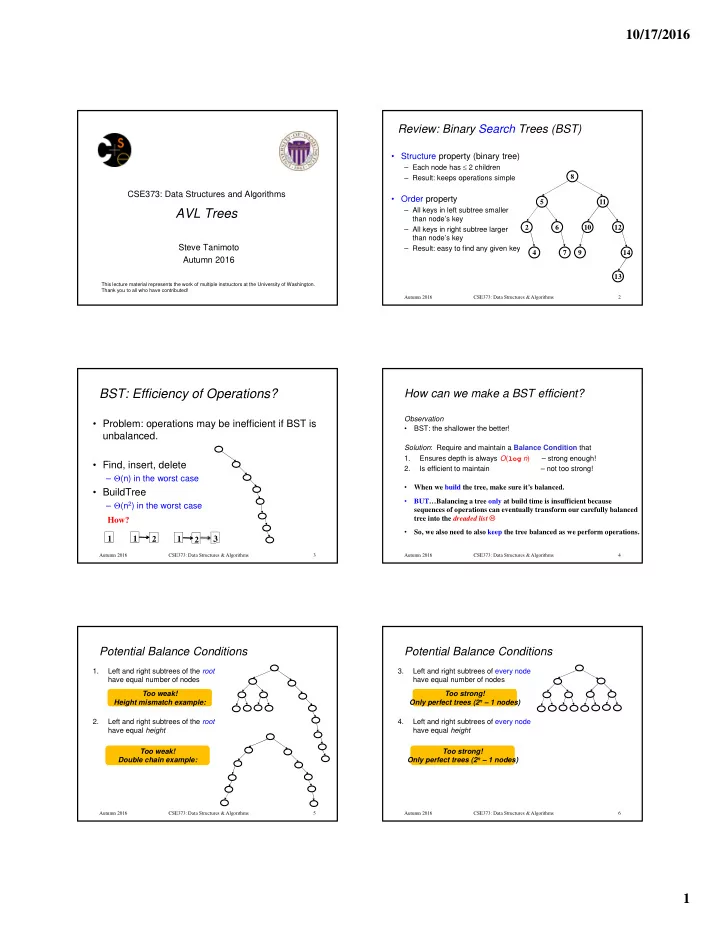
1. Left and right subtrees of the root have equal number of nodes 2. Left and right subtrees of the root have equal height Too weak! Height mismatch example: Too weak! Double chain example:
Autumn 2016 5 CSE373: Data Structures & Algorithms
Potential Balance Conditions
3. Left and right subtrees of every node have equal number of nodes 4. Left and right subtrees of every node have equal height Too strong! Only perfect trees (2n – 1 nodes) Too strong! Only perfect trees (2n – 1 nodes)
Autumn 2016 6 CSE373: Data Structures & Algorithms