1 Virtual Channel Connection Uses Advantages of Virtual Paths (VP) - - PowerPoint PPT Presentation

1 virtual channel connection uses
SMART_READER_LITE
LIVE PREVIEW

1 Virtual Channel Connection Uses Advantages of Virtual Paths (VP) - - PowerPoint PPT Presentation

Chapter 11. ATM and Frame Relay ATM: Cell Switching ATM: a method of packet switching Overview of ATM A virtual circuit packet switching technique with QoS Protocol Architecture guarantee. Used in both WAN and LAN settings


slide-1
SLIDE 1

1

EE 4272 Spring, 2003

Chapter 11. ATM and Frame Relay

  • Overview of ATM
  • Protocol Architecture
  • ATM Logical Connections
  • ATM Cells
  • ATM Service Categories
  • ATM Adaptation Layer (AAL)
  • Cell Transmission
  • Frame Relay

EE 4272 Spring, 2003

  • ATM: a method of packet switching
  • A virtual circuit packet switching technique with QoS

guarantee.

  • Used in both WAN and LAN settings
  • Signaling (connection setup) Protocol: Q.2931
  • Packets of small fixed size are called cells

5-byte header + 48-byte payload

  • Similarities between ATM and other packet switching

Transfer data of packets Multiple logical connections over single physical interface

ATM: Cell Switching

EE 4272 Spring, 2003

Protocol Architecture

  • User plane: Provides

for user information transfer

  • Control plane: Call and

connection control

  • Management plane

Plane management:

whole system functions

Layer management:

Resources and parameters in protocol entities

  • AAL layer: interface

between other transfer protocol & ATM

EE 4272 Spring, 2003

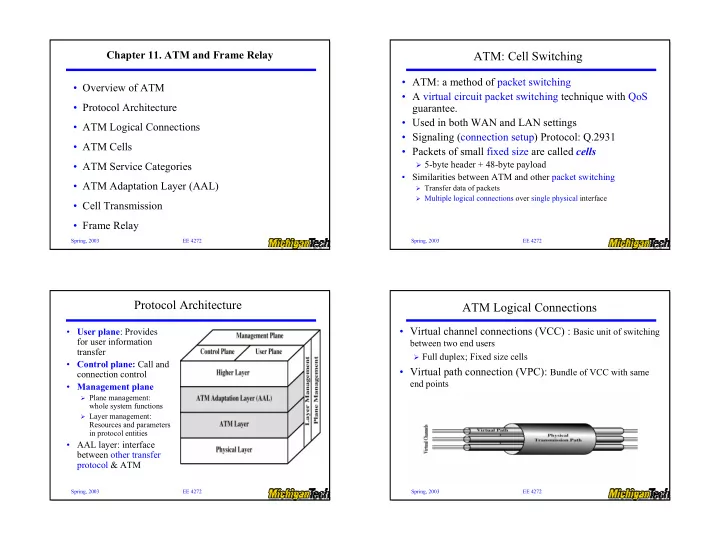
ATM Logical Connections

  • Virtual channel connections (VCC) : Basic unit of switching

between two end users

Full duplex; Fixed size cells

  • Virtual path connection (VPC): Bundle of VCC with same

end points

slide-2
SLIDE 2

2

EE 4272 Spring, 2003

Advantages of Virtual Paths (VP) & Virtual Channels (VC)

  • Two-level hierarchy of

virtual connection: many VC are inside one VP, ATM along that VP behave as if there is only one connection. Less connection-state information stored in the

  • ATMs. The VCI is unique

locally inside the same VP.

  • Simplified network

architecture

  • Reduced processing &

Short connection setup time

EE 4272 Spring, 2003

Virtual Channel Connection Uses

  • Between end users

End to end user data Control signals VPC provides overall capacity

VCC organization done by end users

  • Between end user and network

Control signaling

  • Between network entities

Network traffic management Routing

EE 4272 Spring, 2003

ATM Cells

  • Fixed size: 5 bytes

header; 48 bytes data

  • Small cells reduce

queuing delay for high priority cells

  • Easier to implement

switching of fixed size cells in hardware

EE 4272 Spring, 2003

Variable vs Fixed-Length Packets

  • Fixed-Length Easier to Switch in Hardware

Hardware to do simple jobs: processing packet is simpler if

you know their size.

  • No Optimal Length :

if small: high header-to-data overhead if large: low resource utilization Compromise: 48 bytes = (32+64)/2

slide-3
SLIDE 3

3

EE 4272 Spring, 2003

Header Format

  • Generic flow control (GFC)

Only at user to network interface Controls flow only at this point

  • Virtual path identifier (VPI)
  • Virtual channel identifier (VCI)
  • Payload type (PT)

e.g. user info or network management

  • Cell loss priority (CLP)
  • Header error control (CRC-8)

EE 4272 Spring, 2003

ATM Service Categories

  • Real time: Amount of delay & Variation of delay (jitter)

Constant bit rate (CBR): e.g., uncompressed audio and video Real time variable bit rate (rt-VBR) : e.g. compressed video

  • Can statistically multiplex connections
  • Non-real time: overall data transmission rate

Non-real time variable bit rate (nrt-VBR): e.g. critical web transaction such as bank trans. Available bit rate (ABR): Application specifies peak cell rate (PCR) and minimum cell rate (MCR); Spare capacity shared among all ABR sources Unspecified bit rate (UBR) -> best-effort service: e.g.text/data/image transfer

EE 4272 Spring, 2003

ATM Bit Rate Services

EE 4272 Spring, 2003

ATM Adaptation Layer (AAL)

  • Support for information transfer protocol not based
  • n ATM

Supported Application types General data service IP over ATM Multiprotocol encapsulation over ATM (MPOA)

  • AAL Service

Segmentation and re-assembly Handle transmission errors Handle lost and misinserted cells Flow control and timing

slide-4
SLIDE 4

4

EE 4272 Spring, 2003

Segmentation and Reassembly

  • ATM Adaptation Layer (AAL): 4 types by ITU

AAL 1 and 2 designed for applications that need guaranteed

bit rate: e.g., voice, video

AAL 3/4 designed for packet data ( connection-oriented such

as X.25, or connectionless such as IP)

AAL 5 is an alternative standard for packet data

AAL A TM AAL A TM

… …

Variable-length protocols (e.g., IP) Information needed for reassemble @ destination

EE 4272 Spring, 2003

Transmission of ATM Cells

  • ATM Data Rate:

622.08Mbps 155.52Mbps 51.84Mbps 25.6Mbps

  • Physical Layers for ATM

Run over several different physical media & physical-layer

protocols (e.g., SONET, FDDI, wireless physical layers).

The standard ways of carrying ATM cells inside a

SONET/SDH frame have been defined

EE 4272 Spring, 2003

STM-1 Payload for SDH-Based ATM Cell Transmission

EE 4272 Spring, 2003

ATM is in danger?!

  • In LAN network, it competes with Gigabit Ethernet
  • In WAN network, it competes with IP
  • Many of its innovations in high-speed switching, traffic

management, and QoS will survive in an IP-networking framework

slide-5
SLIDE 5

5

EE 4272 Spring, 2003

Frame Relay

  • Designed to be more efficient than X.25
  • Developed before ATM
  • Larger installed base than ATM
  • ATM now of more interest on high speed networks

EE 4272 Spring, 2003

Frame Relay Background - X.25

  • Call control packets, in band signaling
  • Multiplexing of virtual circuits at layer 3 (routing)
  • Both layer 2 and 3 include flow and error control
  • Considerable overhead
  • Not appropriate for modern digital systems with high

reliability (e.g. optical transmission with less errors)

EE 4272 Spring, 2003

Frame Relay – Differences with X.25

  • Call control carried in separate logical connection

(recall common channel signaling)

  • Multiplexing and switching at layer 2
  • No hop-by-hop (link layer) error or flow control
  • End to end flow and error control (if used) are done

by higher layer (layer 3 or above)

  • Single user data frame sent from source to

destination and ACK (from higher layer) sent back

  • ITU-T recommend frame relay above 2Mbps