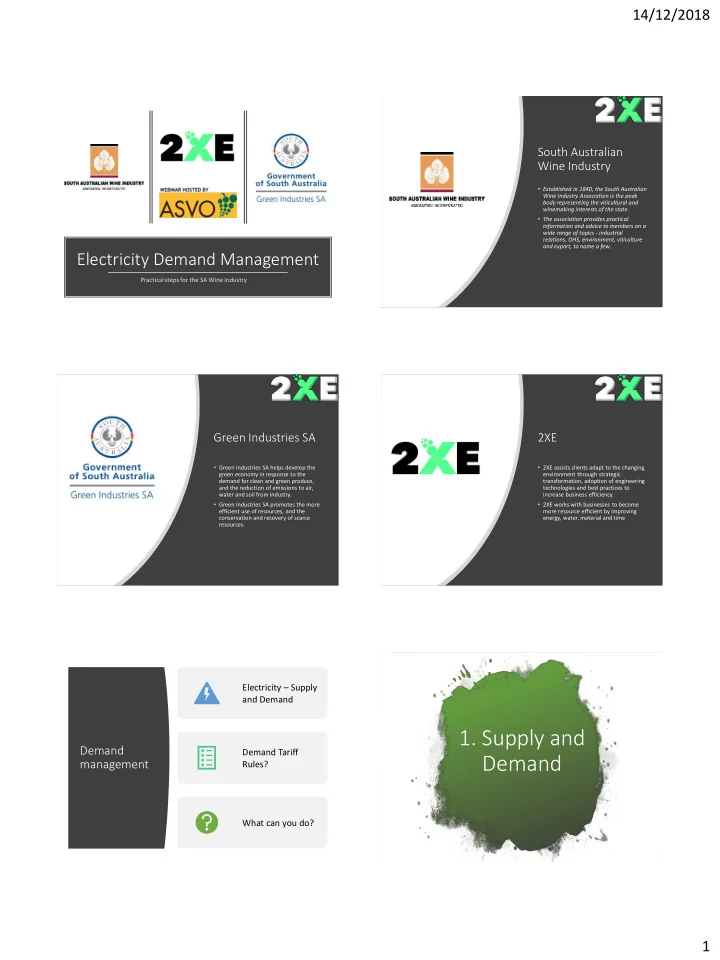
1. Supply and Demand Demand Tariff Demand management Rules? - - PDF document

1 supply and
SMART_READER_LITE
LIVE PREVIEW

1. Supply and Demand Demand Tariff Demand management Rules? - - PDF document

14/12/2018 South Australian Wine Industry Established in 1840, the South Australian Wine Industry Association is the peak body representing the viticultural and winemaking interests of the state. The association provides practical


slide-1
SLIDE 1

14/12/2018 1

Electricity Demand Management

Practical steps for the SA Wine Industry

South Australian Wine Industry

  • Established in 1840, the South Australian

Wine Industry Association is the peak body representing the viticultural and winemaking interests of the state.

  • The association provides practical

information and advice to members on a wide range of topics - industrial relations, OHS, environment, viticulture and export, to name a few.

Green Industries SA

  • Green Industries SA helps develop the

green economy in response to the demand for clean and green produce, and the reduction of emissions to air, water and soil from industry.

  • Green Industries SA promotes the more

efficient use of resources, and the conservation and recovery of scarce resources.

2XE

  • 2XE assists clients adapt to the changing

environment through strategic transformation, adoption of engineering technologies and best practices to increase business efficiency.

  • 2XE works with businesses to become

more resource efficient by improving energy, water, material and time

Demand management

Electricity – Supply and Demand Demand Tariff Rules? What can you do?

  • 1. Supply and

Demand

slide-2
SLIDE 2

14/12/2018 2

Electricity distribution

Continual state of change Electricity demand varies every minute Electricity supply by renewablesvaries every minute Electricity supply by all

  • ther sources needs to

balance demand

Supply and Demand Supply and Demand Supply and Demand Supply and Demand Supply and Demand

slide-3
SLIDE 3

14/12/2018 3

Cost of electricity

Your retailer will set a price for your electricity The actual cost of electricity will vary A LOT 1c/kWh - $1.kWh in the real market High demand = expensive electricity Low demand = cheap electricity

Supply and Demand Supply and Demand

Both use 500kWh per day

0.0 50.0 100.0 12:00 AM 2:00 AM 4:00 AM 6:00 AM 8:00 AM 10:00 AM 12:00 PM 2:00 PM 4:00 PM 6:00 PM 8:00 PM 10:00 PM kWh

Low demand, high demand

Low Demand High Demand

  • Highest quantity of electricity in single a single instant
  • Occurs when EVERYONE is using intensive equipment

(Air Conditioners, refrigeration, electrolysis, etc)

  • Cause huge strain on transmission infrastructure

(lines, substation, transformers, etc.)

  • 2017/2018 Second warmest summer on record
  • Need infrastructure to keep up with demand
  • No longer use rolling blackouts to decrease demand

What is peak demand and why is it important

Peak demand – TV pickup

slide-4
SLIDE 4

14/12/2018 4

Demand management Tariffs 2015 – Why?

Aging infrastructure Heat waves / home AC ‘peaks’ Sizing infrastructure Incentivise customers Change behaviour Balanced, flattened load

Background – demand tariff rollout

2015 – 2017 Automatic roll-over of all large businesses (>160MWh) to demand 2017 – 2020 Second wave - small business customers (<160MWh) Transition Transition period prior to full demand

What does this mean for the wine industry?

  • If you’re not already on a

demand tariff, you soon will be

  • Need to come up with strategies

to manage demand charges

  • To manage demand charges, you

need to understand the rules

  • 2. Demand

Tariffs and

  • pportunities

Comparison of old and new bills

0.0 50.0 100.0 12:00 AM 2:00 AM 4:00 AM 6:00 AM 8:00 AM 10:00 AM 12:00 PM 2:00 PM 4:00 PM 6:00 PM 8:00 PM 10:00 PM

Low demand, high demand

Low Demand High Demand

Both use 500kWh per day

$1,000 $10,000

slide-5
SLIDE 5

14/12/2018 5

What is a demand charge (average over 30 minutes)

Mon Tue Wed Thu Fri Sat Sun 1:00 AM 2:00 AM 3:00 AM 4:00 AM 5:00 AM 6:00 AM 7:00 AM 8:00 AM 9:00 AM 10:00 AM 11:00 AM 12:00 PM 1:00 PM 2:00 PM 3:00 PM 4:00 PM 5:00 PM 6:00 PM 7:00 PM 8:00 PM 9:00 PM 10:00 PM 11:00 PM 12:00 AM

Agreed Annual Demand Period

(November - March, local time)

0.0 50.0 100.0 12:00 AM 2:00 AM 4:00 AM 6:00 AM 8:00 AM 10:00 AM 12:00 PM 2:00 PM 4:00 PM 6:00 PM 8:00 PM 10:00 PM

Low demand, high demand

Low Demand High Demand

Both use 500kWh per day

$1,000 $1,000 (plus anytime demand)

Business Network Tariff

TWO MAIN CATEGORIES (NO CHOICE) SMALL BUSINESS (LESS THAN 160MWH PER ANNUM) LARGE BUSINESS (GREATER THAN 160MWH PER ANNUM) TWO TARIFF TYPES (CHOICE) AGREED ACTUAL

Agreed Tariff

Mon Tue Wed Thu Fri Sat Sun 1:00 AM 2:00 AM 3:00 AM 4:00 AM 5:00 AM 6:00 AM 7:00 AM 8:00 AM 9:00 AM 10:00 AM 11:00 AM 12:00 PM 1:00 PM 2:00 PM 3:00 PM 4:00 PM 5:00 PM 6:00 PM 7:00 PM 8:00 PM 9:00 PM 10:00 PM 11:00 PM 12:00 AM

Anytime Demand

(all year round, local time)

Agreed Annual Demand Period

(November - March, local time)

Agreed Tariff

Components Measurement Charging parameter Fixed $/customer/day Fixed supply charge per annum Usage $/kWh Anytime based on usage Demand $/kVA/day Maximum demand charge based on average maximum demand (30mins) November to March between 12pm – 9pm on working days and charged in a declining block

  • Block 1: 0-1,000kVA, charged at a higher rate
  • Block 2: >1,000kVA, charged at a lower rate

Additional Demand $/kVA/day Maximum demand charge if anytime demand exceeds agreed demand (Additional demand – Anytime demand – Annual demand) and is charged at a lower rate.

One peak over 30 minutes sets your annual demand

slide-6
SLIDE 6

14/12/2018 6

Agreed Use

Actual Tariff

Mon Tue Wed Thu Fri Sat Sun 1:00 AM 2:00 AM 3:00 AM 4:00 AM 5:00 AM 6:00 AM 7:00 AM 8:00 AM 9:00 AM 10:00 AM 11:00 AM 12:00 PM 1:00 PM 2:00 PM 3:00 PM 4:00 PM 5:00 PM 6:00 PM 7:00 PM 8:00 PM 9:00 PM 10:00 PM 11:00 PM 12:00 AM

Off-peak Demand period

(all year round, local time)

Shoulder Demand Period

(all year round, local time)

Peak Demand Period

(November - March, local time)

Actual Tariff

Components Measurement Charging parameter Fixed $/customer/day Fixed supply charge per annum Usage $/kWh Anytime based on usage Demand $/kVA/day Maximum demand charge based on average maximum demand (30mins)

  • Shoulder: 12pm – 4pm on working days, all year round
  • Peak: 4pm – 9pm on working days, November – March

Currently Off-peak demand is measured, however not charged.

Actual Use

Tariff structures Tariff structures

slide-7
SLIDE 7

14/12/2018 7

Which one is better? Which is better for you? Agreed

  • r actual?

Hard to work out yourself Hard to get help from retailers or SAPN Best to run data through a simulator Talk with an energy expert

  • 3. Demand

management strategies

What can you do?

Get the right data Understand your electricity use Put management strategies in place Use technology

Getting the right data

Getting the right data

What do your electricity bills tell you? What does your interval meter data tell you? What can submetering tell you? How do you manage demand using data?

slide-8
SLIDE 8

14/12/2018 8

What do your electricity bills tell you?

WHERE ARE THE PROBLEMS? THE SIZE OF THE PROBLEM? THE BUSINESS CASE FOR CHANGE

Energy Bills - Data Energy Bills – Actua ual demand Energy Bills – Agr greed demand What does your interval meter data tell you?

How and when you use electricity Can be used to identify improvement projects

Current State – Interval data

Critical step! Gives you the information you need to understand and manage your energy Hard to get in a useful format 3rd Party energy dashboard are growing

slide-9
SLIDE 9

14/12/2018 9

How do you get your interval data?

  • SAPN (Raw data only

– Not useful)

  • Retail data (Daily

data, but not always 30 minutes)

Not enough info to make a change

Great data!

What can good data give you?

WHEN AND HOW YOUR ARE USING ELECTRICITY WHEN YOU CAN LOAD SHED WHAT CAUSES YOUR ‘PEAK DEMAND’ WHAT IS YOUR ‘POWER FACTOR’ WHICH TARIFF IS THE BEST FOR YOU? WHAT IS YOUR DEMAND FREQUENCY? HOW DO YOU SAVE MONEY

What about sub- metering?

Sub-metering

Whole site Refrigeration system Chiller Pumping Processing Warehouse

slide-10
SLIDE 10

14/12/2018 10

Sub-metering

Detailed energy use of sub- systems Easier to identify

  • pportunities

First step towards automated demand management Helps you conduct preventative maintenance

Submetering Data

Demand-side

  • pportunities

Typical daily demand during vintage

Where is electricity used in your winery?

Refrigeration – biggest area of opportunity

slide-11
SLIDE 11

14/12/2018 11

QUESTION: What makes wineries different?

  • High seasonal use and electricity

costs

  • Huge volumes of thermal storage
  • One of the few industries that

CAN manage demand by changing practices

Regardless of insulation, wine takes time to warm up.

24kL Tank, 40°C day

What can you do?

Conscious decision making about how and when you cool wine A range of

  • pportunities to

choose from Need to have a balanced approach

What you want your demand to look like

Load shifting & Valley filling in refrigeration

Complete the bulk of refrigeration outside of peak period Refrigerate tank farm in zones to reduce peak refrigeration loading Don’t cool tank farm while chilling must or ferments

slide-12
SLIDE 12

14/12/2018 12

Night time chilling (dual setpoint) Load scheduling practices

Cool tank farm in zones. Don’t try to do everything at

  • nce. More efficient and reduces demand

Load Scheduling example (automation)

  • St. Halletts process 3,000 tons annually and began using

the load scheduling module in 2011.

  • Prior to this, power consumption was significantly higher

with maximum demand peaks of 500kVA.

  • VinWizard load scheduling has allowed the winery to shift

power consumption from the hot day hours to the cooler evening hours.

  • This has resulted in a 50% reduction in maximum demand

and major power savings in the range of 25-35%.

Demand shedding when nearing maximum demand

Turn off low priority tanks Increase brine setpoint temperature

Demand shedding

Manual

  • Need to monitor onsite electricity demand
  • Need to be alerted when nearing peak

demand

  • Have a staff member prepared to turn off low-

priority tanks and increase brine temperature set-point

  • Low cost solution – no guaranteed demand

reduction

Automatic

  • Need to monitor onsite electricity demand
  • Need to have an automatic control system to

turn off low-priority tanks and increase brine temperature set-point

  • High cost solution – more likely to reduce peak

demand if correctly configured

Supply-side

  • pportunities
slide-13
SLIDE 13

14/12/2018 13

Power Factor

  • You pay for the

whole glass (kVA)

  • You only get to

drink the beer (kW)

  • The head is waste!

(kVAr)

Power Factor Correction Unit

How can we fix poor power factor? Power Factor Correction Units

Days

On an Agreed Tariff. Maximum demand = 540kVA Power Factor at Maximum demand = 0.7 30% of demand is being wasted! New Maximum demand = 378kVA Savings = 162kVA Cost saving of ~$20,000 per annum

Time of day Power Factor Correction Solar PV

  • Good if you use energy

all year round

  • Not applicable for

demand management as there is no certainty that the sun will be shining during peaks

Diesel Generators

  • Some generators can supplement

your energy supply – a lot can’t

  • Advanced software systems can

automatically turn Gensets on when demand is nearing peak

  • Correctly implemented demand

shedding can provide large savings

~40c/kWh 20-30c/kWh

Battery Storage

Expensive at the moment, But prices are falling quickly! Similar to gensets, if battery storage systems are correctly integrated they can be used to automatically reduce peak demand.

slide-14
SLIDE 14

14/12/2018 14

What’s on the Horizon?

What is demand response?

Working with retailers to schedule loads Using smart battery storage to secure a reliable source of reserve power Optimise existing assets to curtail usage during peak demand times Install monitoring and remote control capabilities to remotely curtail demand

Summary

Opportunity Summary

Check

  • Check tariff (agreed or actual) and ensure

it’s the most cost effective Install

  • Install monitoring and take advantage of

the information Change

  • Change the way you use electricity for

refrigeration Analyse

  • Analyse your Power Factor and correct it

if necessary Consider

  • Consider the potential of battery

technology and demand response moving forwards

Next Steps – EOI Onsite investigation

WHERE ARE THE OPPORTUNITIES AT YOUR WINERY? ANALYSIS OF YOUR DATA (ELECTRICITY BILLS, INTERVAL DATA, REFRIGERATION LOGS) WHICH TARIFF IS RIGHT FOR YOU? HOW’S YOUR POWER FACTOR INVESTIGATION OF SUBMETERING NO COST / LOW COST PROJECTS BUSINESS CASE (COST / BENEFIT) FOR ADVANCED DEMAND MANAGEMENT SOLUTIONS