1 Elastic Bending Elastic Bending I = Moment of inertia of the - - PowerPoint PPT Presentation

1
SMART_READER_LITE
LIVE PREVIEW

1 Elastic Bending Elastic Bending I = Moment of inertia of the - - PowerPoint PPT Presentation

Cross sectional Shape Selection Mechanical loading and associated components Materials have properties Axial Loading Strength, stiffness, electrical conductivity, etc. Tension ties or tie rods A component or structure is


slide-1
SLIDE 1

1

ME 499-699 Fall 2006 Slides 9 -1

More info: “Materials Selection in Mechanical Design”, Chapters 11 and 12

Cross sectional Shape Selection

Materials have properties

  • Strength, stiffness, electrical conductivity, etc.

A component or structure is a material made into a particular shape Different shapes are more or less efficient for carrying a particular type

  • f loading

An efficient shape is one that uses the least amount of material for a

given strength or stiffness

ME 499-699 Fall 2006 Slides 9 -2

Mechanical loading and associated components

Axial Loading

  • Tension – ties or tie rods
  • Compression – columns

Bending – beams Torsion – shafts Each type of loading has a different failure mode, and some shapes are

more efficient than others for that loading

ME 499-699 Fall 2006 Slides 9 -3

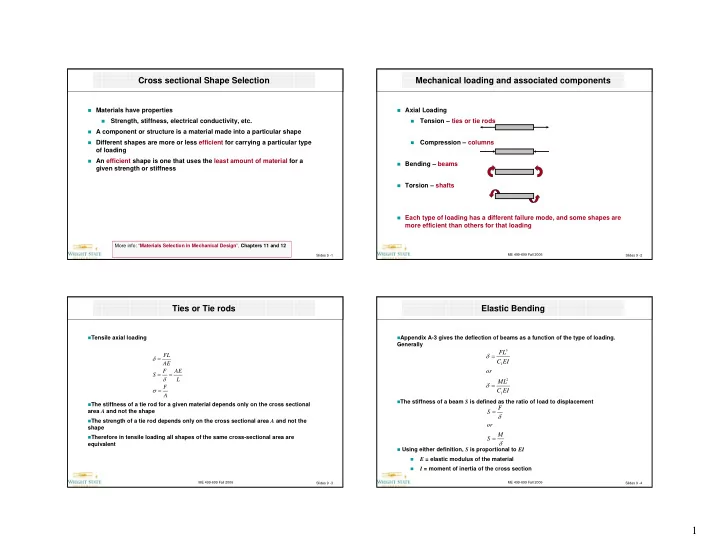
Ties or Tie rods

Tensile axial loading The stiffness of a tie rod for a given material depends only on the cross sectional

area A and not the shape

The strength of a tie rod depends only on the cross sectional area A and not the

shape

Therefore in tensile loading all shapes of the same cross-sectional area are

equivalent A F L AE F S AE FL = = = = σ δ δ

ME 499-699 Fall 2006 Slides 9 -4

Elastic Bending

Appendix A-3 gives the deflection of beams as a function of the type of loading.

Generally

The stiffness of a beam S is defined as the ratio of load to displacement Using either definition, S is proportional to EI

  • E = elastic modulus of the material
  • I = moment of inertia of the cross section

EI C ML

  • r

EI C FL

1 2 1 3

= = δ δ δ δ M S

  • r

F S = =

slide-2
SLIDE 2

2

ME 499-699 Fall 2006 Slides 9 -5

Elastic Bending

I = Moment of inertia of the cross section Table 11.2 gives the section properties of different shapes For a circular cross section If S = C2 EI is the stiffness for another shape with the same cross sectional

area made of the same material and subject to the same loading, then the shape factor for elastic bending is defined as

=

section Cross

dA y I

2

π π π 4 4

2 4 2

A r I r A

O

= = =

2 1 1

4 A I EI C EI C S S

O O e B

π φ = = =

ME 499-699 Fall 2006 Slides 9 -6

Elastic Bending

Derive shape factor for elastic bending of Square cross-section of side a Hollow tube of radius r and thickness t where r >> t For a square cross section For a hollow tube

05 . 1 12 4 = = = = π φ

O sq O sq e B

EI EI S S t r A I EI EI S S

O O e B

= = = =

2

4π φ

ME 499-699 Fall 2006 Slides 9 -7

Elastic Bending - Square cross-section beam

For a square cross-section of side a Compare with a circle with the same area A Shape factor during elastic bending of a square cross-section relative to a circular

cross section of the same area is:

Therefore, a square cross-section is about 5% stiffer than a circular cross-section

12 12

2 4 2

A a I a A

sq

= = =

O sq

I I 12 4π =

( ) ( )

05 . 1 12 4 4 / 12 /

2 2

= = = = = π π φ A A I I S S

O sq O sq e B ME 499-699 Fall 2006 Slides 9 -8

Elastic Bending – Tubular beam

For a tubular beam with radius r and wall thickness t where r >> t Shape factor during elastic bending of a tubular beam relative to a circular cross-

section of the same area is:

Therefore, a thin walled tubular beam with r = 10t is 10 times as stiff as a circular

cross-section beam of the same area t r I rt A

tube 3

2 π π = =

( )

( )

t r rt t r A I I I S S

tube O tube O tube e B

= = = = =

2 3 2

2 4 4 / π π π π φ

slide-3
SLIDE 3

3

ME 499-699 Fall 2006 Slides 9 -9

Elastic Bending

The shape factor φB

e is dimensionless, i.e. it is a pure number that

characterizes the cross-sectional shape relative to a circular cross- section Increasing size with constant shape I sections with φB

e = 10

Hollow tubes with φB

e = 10

ME 499-699 Fall 2006 Slides 9 -10

Elastic Bending

EduPack Level 3 includes

most of the commercially available structural shapes made from different materials.

Using a plot of the moment

  • f inertia versus section

area one can compare different structural shapes

Section area, A (m^2)

1e-4 1e-3 0.01 0.1

Second moment of area (major), I_max (m^4)

1e-11 1e-10 1e-9 1e-8 1e-7 1e-6 1e-5 1e-4 1e-3 0.01 Phi=100 Extruded Aluminum circular hollow (Y.S. 255MPa)-(32x2.6) Hot Rolled Steel (Y.S. 355MPa) Universal Beam-(203x133x25) Hot Fin. Steel (Y.S. 355MPa) Rect.Hollow -(150x150x5.0) Pultruded GFRP Vinyl Ester I-section-(102x51x2.1)

2

4 A I

e B

π φ =

ME 499-699 Fall 2006 Slides 9 -11

Failure in Bending

Failure in bending can be defined as the initiation of plastic deformation

in the beam.

The stress on the top and bottom surfaces of a symmetric beam is given

by

Where c is the distance of the top or bottom surface from the neutral

surface

At yield,

σ = σf = yield stress

c I Z where Z M I Mc = = = σ

ME 499-699 Fall 2006 Slides 9 -12

Failure in Bending

For a circular cross-section

π π π 4 4 4

2 / 3 3 4

A r Z Therefore r c r I

O

= = = =

slide-4
SLIDE 4

4

ME 499-699 Fall 2006 Slides 9 -13

Failure in Bending

Define the shape factor for failure in bending as Derive For a square of side a For a hollow cylinder of radius r and wall thickness t, where r >> t

18 . 1 3 2 = = = π φ

O sq f B

Z Z t r Z Z

O f B

8 = = φ

O f B

Z Z = φ

ME 499-699 Fall 2006 Slides 9 -14

Failure in Bending – Square cross section beam

For a square of side a The shape factor for a square cross section is The square cross section almost 20% stronger than a circular cross-

section ( )

( )

6 6 2 / 12

2 / 3 3 4 2

A a a I Z a I a A

sq

= = = = =

( )

( )

( )

( )

18 . 1 3 2 4 / 6 /

2 / 3 2 / 3

= = = = π π φ A A Z Z

O sq f B ME 499-699 Fall 2006 Slides 9 -15

Failure in Bending – Tubular beam

For a tubular beam with radius r and wall thickness t where r >> t The shape factor for a tubular beam is The tubular beam with r = 10t has a shape factor of 8.9, i.e., the tubular beam is

almost 9 times as strong as a circular cross-section beam t r r I Z t r I rt A

tube 2 3

2 π π π = = = =

( )

( )

( )(

)

t r rt t r A t r Z Z

O tube f B

8 2 4 4 /

2 / 3 2 2 / 3 2

= = = = π π π π π φ

ME 499-699 Fall 2006 Slides 9 -16

Elastic Torsion

During elastic torsion, the angle of twist per unit length is Where T is the torque, J is the polar moment of inertia, and G is the shear modulus of

the material.

The stiffness of a solid circular shaft in torsion ST is defined as the ratio of load to angle

  • f twist per unit length

The shape factor for a different cross section is defined as

JG T = θ π π π 2 2

2 4 2

A r J r A = = = G J T S

O TO

= = θ

( )

π φ 2 /

2

A J GJ GJ S S

O T T e T

O

= = =

slide-5
SLIDE 5

5

ME 499-699 Fall 2006 Slides 9 -17

Elastic Torsion

For a hollow shaft with radius r and wall thickness t where r >> t Shape factor for elastic torsion is Therefore, a thin walled shaft with r = 10t is 10 times as stiff as a circular cross-

section shaft of the same area t r J rt A

3

2 2 π π ≈ =

( )

t r t r t r A t r

e T

= = =

2 2 2 3 2 2 3

4 4 2 / 2 π π π π φ

ME 499-699 Fall 2006 Slides 9 -18

Failure by plastic deformation during Torsion

The shear stress at the surface of a cylindrical shaft subject to a torque T is Failure occurs when the stress reaches the shear yield stress, or one-half of the

tensile yield stress

The shape factor for a shaft of a different cross-section can be defined as

( )

π π π τ 2 2 2 /

2 / 3 3 4

A r Q and r J where Q T r J T J Tr

O O O O O

= = = = = =

O f f

Q T = = 2 σ τ

2 / 3

2 A Q Q Q

O f T

π φ = =

ME 499-699 Fall 2006 Slides 9 -19

Shape factor for failure in Torsion of a Hollow Shaft

For a hollow shaft with radius r and wall thickness t where r >> t Shape factor is Therefore, a thin walled shaft with r = 10t is 4.5 times as strong as a circular cross-

section shaft of the same area t r r J Q t r J rt A

2 3

2 2 2 π π π = = ≈ =

( )

t r rt t r A Q

f T

2 2 2 2 2

2 / 3 2 2 / 3

= = = π π π π φ

ME 499-699 Fall 2006 Slides 9 -20

Homework Assignment

Show that the shape factor of elastic buckling is the same as that for

elastic bending

slide-6
SLIDE 6

6

ME 499-699 Fall 2006 Slides 9 -21

Empirical upper limits for the different shape factors

The limits to the different shape factors derived above based on manufacturing

considerations, as well as competing failure mechanisms is given in Table 11.4

3 <6 Elastomers 1 3 1 5 Wood (solid section) 4 5 8 12 Polymers (nylon) 7 9 26 39 GFRP and CFRP 8 10 31 44 AA 6061 7 13 25 65 Structural Steel Material

( )max

e B

φ

( )max

e T

φ

( )max

f B

φ

( )max

f T

φ

ME 499-699 Fall 2006 Slides 9 -22

Co-selecting shape and material for stiff beams

Suppose it is desired to make a beam with a stiffness of SB and length L with

a minimum mass.

This problem can be translated as

Material Size and Shape of cross section Free variables:

  • Length L is specified
  • Stiffness SB is specified

Constraints Minimize mass m = ρLA is Objective Beam Function

ME 499-699 Fall 2006 Slides 9 -23

Co-selecting shape and material for stiff beams

The stiffness in bending is given by

where C1 depends upon exactly how the load is distributed

If we replace the moment of inertia I by Then

3 1 L

EI C SB = π π φ φ 4 4

2 2

A I since A I I

O E B O E B

= = =

2 3 1

4 A L E C S

e B B

φ π =

ME 499-699 Fall 2006 Slides 9 -24

Co-selecting shape and material for stiff beams

Eliminating A from the equation for mass m we get The material index to be maximized is therefore So if we want to co-select both shape and material for a stiff beam, the basis for comparison

is the material index M, above

( )

⎥ ⎥ ⎦ ⎤ ⎢ ⎢ ⎣ ⎡ ⎟ ⎟ ⎠ ⎞ ⎜ ⎜ ⎝ ⎛ =

2 / 1 2 / 5 2 / 1 1

4 E L C S m

e B B

φ ρ π

( )

ρ φ

2 / 1

E M

e B

=

slide-7
SLIDE 7

7

ME 499-699 Fall 2006 Slides 9 -25

Co-selecting shape and material for other loading

By a similar analysis, for elastic torsion, the material index is For failure in bending it is And for failure in torsion it is

( )

ρ φ

2 / 2

E M

f B

=

( )

ρ φ

2 / 3

E M

f T

=

( )

ρ φ

2 / 1

E M

e T

=

ME 499-699 Fall 2006 Slides 9 -26

Example: The wing-spar of a human powered plane

See example 12.1 in the book The human powered plane is basically a large model airplane capable of flying

under the power of a human being

The design requirement is that the weight (or mass) of the plane be minimized

Material Size and Shape of cross section Free variables:

  • Length L is specified
  • Stiffness SB is specified

Constraints Minimize mass Objective Wing spar Function

ME 499-699 Fall 2006 Slides 9 -27

Example: The wing-spar of a human powered plane

23 10 7 1.5 – 1.6 100 – 160 CFRP 14 20 3 2.8 – 2.82 71 – 73 AA-7075-T6 9 25 1.8 7.82 – 7.84 200 – 210 Steel 12 2 8 0.36 – 0.44 9.8 – 11.9 Spruce 15 2 10 0.17 – 0.24 4.2 – 5.2 Balsa Wood

Modified Material Index (E φB

e)1/2/ ρ

Shape factor φB

e

Material Index

(E1/2/ρ)

Density ρ (Mg/m3) Modulus E (GPa) Material

Without taking shape into account, Balsa wood appears to have the best properties,

and aluminum has a relatively poor performance

If we take shape into account, using typical values of the shape factor for beams of

different materials, CFRP is best, while AA-7075 performs as well as the woods

Early planes were made of balsa, but later designs used aluminum or CFRP (if cost

was not an issue).