
SLIDE 1
1 Caribbean Regional Air Transport Connectivity Project (P170860) - - PowerPoint PPT Presentation
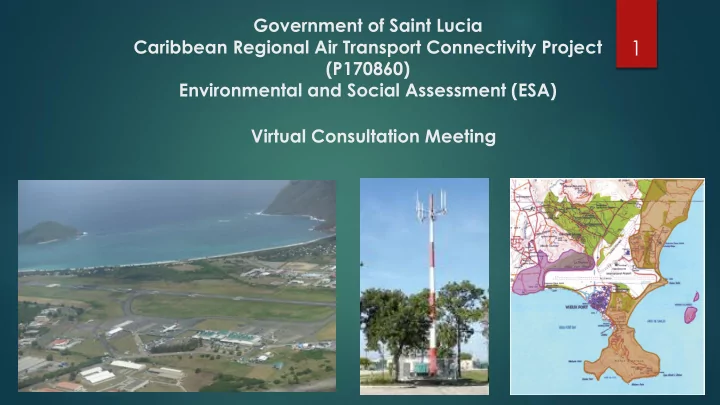
Government of Saint Lucia 1 Caribbean Regional Air Transport Connectivity Project (P170860) Environmental and Social Assessment (ESA) Virtual Consultation Meeting Presentation Outline 2 Introduction 1. Project Implementation Unit (PIU) 2.
1.
Introduction
2.
Project Implementation Unit (PIU)
3.
Project Description:
Duration Cost Project objectives Main environmental/social Risks Mitigation Measures
4.
Public participation
5.
Grievance Redress Mechanism (GRM)
6.
Access to ESA
The location of the project is the Hewanorra
International Airport (UVF) and Vigie Airport (SLU)
The project does not include works related to the
new Airport Terminal Building at UVF
Communications towers at Moule-a-Chique and
Vigie Hill would also have equipment installed
Project Start Date: April 2020 Project End Date: December 2024 Project Cost: USD 45 Million
Specific Project Components:
Component 1: Improvements of UVF Runway Resilience and Operational
Safety
Component 2: Air Traffic Safety and Efficiency Improvements Component 3: Institutional Strengthening Component 4: Project Management Component 5: Contingent Emergency Response Component (CERC)
The proposed project’s main activities are:
1)
Runway resurfacing at Hewanorra International Airport (UVF)
2)
Installation of Runway End Safety Areas (RESAs) at UVF
3)
Drainage improvements at UVF
4)
Air Rescue and Fire Fighting improvements at UVF
5)
Installation of an Instrument Landing System (ILS) at UVF runway
6)
Installation of Automatic Dependent Surveillance - Broadcast (ADS-B surveillance system) for all
7)
Installing two ground stations (receiver antennae) outside the existing airports (most likely on Moule-a-Chique and Vigie Hill)
8)
Air Traffic Control technical studies and updating of UVF Aeronautical Charts
9)
Institutional Strengthening of SLASPA and Department of Civil Aviation
10)
Emergency Response Component
Typical ADS-B Ground Station
ILS (Instrument Landing System) Glide Slope Station ILS (Instrument Landing System) Localizer Antenna Array
Runway and drainage channels at UVF
The potential negative impacts identified for the project can be placed into two categories:
1)
Pre-construction and Construction Phase
2)
Operation Phase It is important to note that there are design details that are not yet known in full until the project is underway and technical studies are completed; therefore, this ESA (assessment) is “preliminary” in nature
The potential negative impacts associated with the project are:
1.
Pre-construction and Construction Phase
Labour Demand, Labor Influx and Worker Health and Safety
The potential negative impacts associated with the project are:
1.
Pre-construction and Construction Phase
Waste Management
wastes can be detrimental to both the terrestrial and marine/riverine environment
entry of these substances into the marine/riverine environment
chemicals.
The potential negative impacts associated with the project are:
1.
Pre-construction and Construction Phase
Water Resource Management and Energy Efficiency
reduce greenhouse gas (GHG) emissions.
(LED) bulbs.
the project.
The potential negative impacts associated with the project are:
1.
Pre-construction and Construction Phase
Air Pollution and Noise Emission
communities and residential areas,
negatively impact surrounding communities
The potential negative impacts associated with the project are:
1.
Pre-construction and Construction Phase
Increased Traffic and Community Safety
Disruption of traffic flow due to the
movement of machinery and equipment and transportation of construction materials
Increased traffic delays Unauthorized persons and public entering
work areas/zones
Roads near UVF
The potential negative impacts associated with the project are:
1.
Pre-construction and Construction Phase
Land Acquisition and Resettlement (ESS5 - Land Acquisition,
Restrictions on Land Use and Involuntary Resettlement):
physical displacement (relocation, loss of residential land or loss of
shelter)
economic displacement (loss of land, assets or access to assets, leading
to loss of income sources or other means of livelihood)
The potential negative impacts associated with the project are:
1.
Pre-construction and Construction Phase
Loss of Natural Habitat and Biodiversity
Inadvertent impacts to Point Sable Marine Protected
Area or La Tourney Nature Reserve
Bird strikes and wildlife intrusion of premises
La Tourney Point Sable
The potential negative impacts associated with the project are:
1.
Pre-construction and Construction Phase
Storm water, Erosion and Sedimentation
Runoff of sediment, oil and grease, or trash into the sea Civil works at the airports resulting in erosion and sedimentation that
could impact off-site coastal and marine/riverine habitat
Construction of access roads and tower pads could produce erosion
and sediment runoff
The potential negative impacts associated with the project are:
1.
Pre-construction and Construction Phase
Indigenous people
Doesn’t apply: there are no persons who meet the definition of
indigenous people present in the project’s airport locations.
The potential negative impacts associated with the project are:
1.
Pre-construction and Construction Phase
Loss of or Damage to Archaeological and Cultural Resources
With any excavation or earth-moving activities, there is the possibility of
coming across or “chance finding” what may appear to be an historical
Historical, cultural, and paleoAmerindian relics exist at Vigie Hill and
Moule-a-Chique
The potential negative impacts associated with the project are:
1.
Pre-construction and Construction Phase
Lack of Disclosure and Stakeholder Engagement
Failure to present to the public, the Environmental Social Assessment
(ESA), Stakeholder Engagement Plan and Grievance Redress Mechanism for the project
The potential negative impacts associated with the project are:
2.
Operation Phase
Potential impacts associated with the airport improvements are
similar to that of the existing operational airport and are not considered further since this will remain unchanged.
Opportunities for improvements will be continuous throughout the
and access control, bird and wildlife management, waste management, water and energy conservation, and other relevant areas.
Our plans for reducing negative impacts
Project Aspect / Impact Mitigation Measure Environmental Assessment
disclosed, and once detailed designs are known and technical studies have been made. Environmental Management Plans (ESMPs)
works at airports and off-site communications towers
as the ESA is updated
contracts for all works
Our plans for reducing negative impacts
Project Impact Mitigation Measures Labor Demand, Labor Influx and Worker Health and Safety
labor laws of Saint Lucia and gender considerations.
acceptable working conditions Waste Management
ESMPs
stored, used, and controlled
Our plans for reducing negative impacts
Project Impact Mitigation Measure Water Resource Management and Energy Efficiency
promote energy efficiency
from the project
conservation Air Pollution and Noise Emission
employed to reduce impacts of dust (e.g. wetting of road surfaces), noise (barriers or personal protection equipment), and air emissions (equipment and vehicle maintenance)
Our plans for reducing negative impacts
Project Impact Mitigation Measure Traffic and Community Safety
secured areas of the two airports and communications towers
transportation of construction materials will be managed to avoid traffic delays in the vicinity
areas and fenced
Plan and Community Health and Safety Plan using information from ESMPs
Security Plan will also be prepared
Our plans for reducing negative impacts
Project Impact Mitigation Measure Land Acquisition and Resettlement
relocation of individuals or households as all works will be within the boundaries of the two existing airports and communications towers
antennae will be located outside the existing airport properties, then any land acquisition will be screened out and excluded Loss of Natural Habitat and Biodiversity
are on lands without essential ecosystem value
will be followed and improved upon
Our plans for reducing negative impacts
Project Impact Mitigation Measure Storm water, Erosion and Sedimentation
any sediment or trash input to coastlines and Point Sable Marine Protected Area
procedures (silt fences, trash traps, berms, revegetation) will be used to prevent erosion and sedimentation that could impact off-site coastal and marine/riverine habitat
used where possible to prevent erosion and sediment runoff
adequate runoff and erosion control
Our plans for reducing negative impacts
Project Impact Mitigation Measure Loss of or Damage to Archaeological and Cultural Resources
contacted for historical or cultural artefacts “chance find”
and Moule-a-Chique will be confirmed and screened during detailed design Disclosure and Stakeholder Engagement
as well as the Stakeholder Engagement Plan (SEP) and Grievance Redress Mechanism (GRM) for the project
Public participation in the project is the responsibility of the Project Implementation Unit (PIU):
PIU will follow the Stakeholder Engagement Plan (SEP) Encourage stakeholders to raise questions or comments about the
project or consultation process
Public disclosure of project information to stakeholders throughout
the life cycle of the project
Convening public consultations (meetings and workshops), where
information will be provided on the project
PIU will receive and record stakeholders’ queries, concerns and
complaints, as well as provide resolutions for project related issues, through the Grievance Redress Mechanism (GRM)
Stakeholders relevant to the Project:
Nearby communities at both airports Public who will make use of airport transportation services Government workers and officials
Saint Lucia Chamber of Commerce
Organization of the Civil Society (Universities, ONGs) Eastern Caribbean Civil Aviation Authority (ECCAA)
Purpose of GRM:
To receive and facilitate the resolution of concerns and grievances
Address communities and individuals who believe that they are
adversely affected by the project
Methods of making complaints, such as in writing, email, telephone
Meeting with the affected party / complainant to find a solution
acceptable to all parties
The Complainant also has the option of approaching the World
Bank, if their grievance cannot be resolved by the Project Implementation Unit.
Project related documents such as Environmental and Social Assessment (ESA),to be made available to the public:
website address TBD In addition, the SLASPA appreciates comments and suggestions in
the following email address within next 30 days with effect from April 7, 2020:
slu.catcopinfo@slaspa.com SLASPA will respond to emails within 3 working days.