SLIDE 1
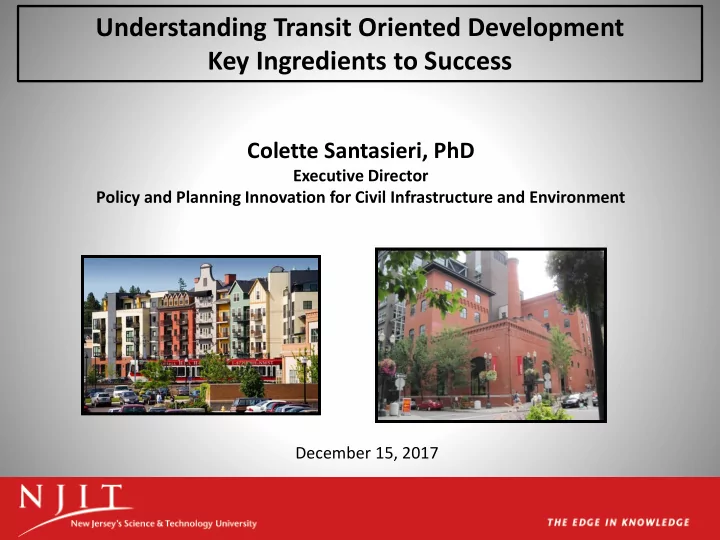
Understanding Transit Oriented Development Key Ingredients to Success
Colette Santasieri, PhD
Executive Director Policy and Planning Innovation for Civil Infrastructure and Environment December 15, 2017
SLIDE 2
Understanding Transit Oriented Development Key Ingredients to Success
How did we get here? A bit of history What is Transit Oriented Development? Key Ingredients to Success
SLIDE 3
A bit of history…
Public transit has had a longstanding tradition of shaping the urban landscape. Residential, retail, and civic uses developed around transit lines and stations. Land use pattern characterized by higher density, mixed uses, compact design, grid street system
SLIDE 4
Live
Shop
Work
Travel A bit of history…
SLIDE 5
A bit of history…
Instead of higher density, mixed use, compact development, grid street system suburban developments are characterized by lower density, single family houses, segregation of land uses, high auto- dependency
SLIDE 6 Del Mar Station, Gold Line LRT, Pasadena, CA
Source: Van Meter, Williams, Pollack LLP
Portland Streetcar, Portland, OR
Source: E. D. Hovee & Company, LLC.
A bit of history…
SLIDE 7
This Instead of This
A bit of history…
SLIDE 8
SLIDE 9 a mixed use community extending for ¼ to ½ mile from a public transit station (a ten minute walk) Transit Oriented Development Features:
- housing, retail, offices, civic
uses, and open space
infrastructure and amenities TOD is a neighborhood - an integrated collection of developments and public amenities.
- higher densities than surrounding areas
- compact design (e.g., narrower streets, grid street system,
smaller building set backs)
SLIDE 10 Common Characteristics of Successful Transit Oriented Developments
comprised of various uses in several buildings unified by a strong public realm and public facilities emphasis on pedestrian amenities/safety attention was paid to the design and quality of the public realm Public sector investment was critical to success. It is not a single building – it is a “place”; it is a destination in and of itself. The local government created a transit supportive plan and implemented physical and regulatory infrastructure to support that development.
A Project Champion(s) led the way.
Avalon Bay, Union City, CA
Source: Union City Redevelopment Agency
SLIDE 11
Key Ingredients to Success Project Champions
Public Sector Investments Respect and Design for the Community Context Commitment and Attention to the Public Realm Demonstrating Density There is no manual, no formula. Every community is different.
SLIDE 12 Assemble a bipartisan team of forward thinking and dedicated community members who have a stake in the successful implementation of the project. Project Champions
private sector: such as
business owners public sector: such as elected officials not-for-profit sector: such as CEO of the hospital or the museum
Hayward City Hall, CA
Source: Van Meter Williams Pollack, LLC
SLIDE 13
prioritize the existing capital improvement fund and prioritize the implementation of infrastructure projects around the transit station area (e.g., streets, traffic signals, lighting, sidewalks, utility upgrades, and storm water drainage) purchase and land-bank underutilized parcels near transit station as funds and land become available
Public Sector Investments (financial and policy) A local government that creates a transit supportive plan and implements physical and regulatory infrastructure to support development makes that municipality more competitive, and ultimately more successful.
locate a civic use (e.g., library, city hall, community center) in the transit station neighborhood rezone or create overlay districts to encourage the desired type of uses and densities
SLIDE 14 Public sector investments show commitment to the desired development in the transit station neighborhood. The private sector (developers, investors) responds to the commitment of the public sector. Public Sector Investments
Del Mar Station, Pasadena, CA Source: Moule & Polyzoides, Architects and Urbanists
SLIDE 15 Examples of Public Sector Investments
Plano, Texas used land-banking procedures—buying up properties over the years as they became available.
Downtown Plano before
Source: DART Department of Economic Development
Downtown Plano after
Source: http://usa.streetsblog.org/2011/12/02/how-to-make-tod-work-in-metro-dallas-plano-shows-the-way /
SLIDE 16 Examples of Public Sector Investments/Contributions
- Arlington Heights, Illinois constructed public parking structures, parks, and infrastructure
in advance of seeking out developers.
- St. Louis Park, Minnesota assembled the land, conducted neighborhood meetings,
created new zoning based upon the meeting outcomes, and conducted traffic and environmental studies before the developer was involved. This streamlined process saved the developer upfront costs and made the municipality an attractive partner for the development.
- Charlotte, North Carolina used bond funds for streetscape improvements, intersection
improvements, street connections, new/improved sidewalks, multi-use trails, and bike lanes.
Paths accessible to bicycles and pedestrians run along the LYNX light-rail line Source: http://urbanland.uli.org/development- business/charlotte-planning-the-area-s-transit-through-2030/
SLIDE 17 Respect and Design for Community Context
Transit oriented development should not be viewed with a one-size-fits-all approach. A thorough understanding of the community’s needs, goals, and fabric is required.
Tampa Historic Replica Streetcar, Tampa, FL Source: Photo taken by Bobak Ha'Eri, February 25, 2006, licensed under CC-BY-SA-2.5 < http://creativecommons. org/licenses/by-sa/2.5/>, from Wikimedia Commons <http://commons.wikimedia.org/wiki/File:YborCityTampaFL01.jpg> Brick Row, Richardson, TX Source: City of Richardson, Office of City Manager
SLIDE 18 Transit/mobility should not be the primary objectives.
Respect and Design for Community Context
The goal should be enhancing/encouraging a more livable community, and not just enhancing/encouraging a transit project.
Pearl Block Townhomes, Portland, OR
Source: Van Meter Williams Pollack, LLP
SLIDE 19 Commitment and Attention to the Public Realm
Developers build projects, but the public sector creates the space.
Paths accessible to bicycles and pedestrians run along the LYNX light-rail line Source: http://urbanland.uli.org/development- business/charlotte-planning-the-area-s-transit-through-2030/ Park Place Condominiums , Portland, OR Source: Van Meter Williams Pollack, LLP
SLIDE 20 A quality public realm: streets, sidewalks, plazas
- r squares will contribute
to the overall character and success of the station neighborhood; will create a lively and well-used pedestrian environment. Commitment and Attention to the Public Realm
Fruitvale Transit Village Plaza, Oakland, CA
Source: Flickr, neigborhoods.org ( Eric Fredericks), used with permission under Attribution-ShareAlike 2.0 Generic (CC BY-SA 2.0)
Successful TOD creates places that become destinations in and of themselves and draw people in.
SLIDE 21 Squares, plazas, and main streets are often used for community functions, such as farmers’ markets, festivals, and movie nights. Commitment and Attention to the Public Realm
Hillsboro Civic Center, OR
Source: Photo by AboutMovies, released into the Public Domain, http://en.wikipedia.org/wiki/File:HillsboroCivicCenter.JPG
Avalon Walnut Creek at Contra Costa Centre, CA
Source: Time Structures, Inc. http://www.timestructures.com/
SLIDE 22 Commitment and Attention to the Public Realm
Rapid Ride Monument, Albuquerque, NM Source: Flickr, Matthew Cohen, used with permission under Creative Commons License, http://www.flickr.com/photos/mister_goleta/4147524 97/ Euclid Corridor, Cleveland, OH Source: Flickr, EMBARQ Brasil, used with permission under Creative Commons License, Attribution-NonCommercial-Share Alike 2.0 Generic (CC BY-NC-SA 2.0), http://www.flickr.com/photos/embarqbrasil/7216610242 Fruitvale Transit Village Streetscape,, Oakland, CA Source: Flickr, neigborhoods.org ( Eric Fredericks), used with permission under Attribution- ShareAlike 2.0 Generic (CC BY-SA 2.0), http://www.flickr.com/photos/neighborhoods/3158131357/
Wide and inviting sidewalks to encourage people to get out of their cars. Public art, way finding features, and landscaping create a sense
SLIDE 23 The Public Realm: Example
The Euclid Corridor Transportation Project: more than a transit project
re-create a sense of place and identity
improve streetscape, urban design, and catalyze redevelopment
developed a public art master plan for
the entire corridor; public art was used as a tool to create continuity in branding throughout the corridor
http://www.gcbl.org http://www.land-studio.org/ http://blog.cleveland.com/
reconstructed Euclid Avenue: included
new sidewalks, on-street parking, roadway improvements, utility and traffic signal upgrades, landscaping, public art, improved lighting, and pedestrian amenities
SLIDE 24
Demonstrating Density It is common for a community to reject a plan for higher density (near the transit station) because they equate the proposed density to a densely populated city. By visually illustrating what 30 units/acre, 50 units per acre, etc. really looks like (with pictures of similar real-worlds developments), citizen concerns may be eliminated.
SLIDE 25 Demonstrating Density
10 units/acre
Hayward, CA Source: Van Meter Williams Pollack, LLP
45 units/acre
Orenco, OR Source: Van Meter Williams Pollack, LLP
SLIDE 26 73 units/acre
Portland, OR Source: Van Meter Williams Pollack, LLP
139 units/acre
Portland, OR Source: Van Meter Williams Pollack, LLP
Demonstrating Density
SLIDE 27 State, regional governments: reduce sprawl, traffic congestion, and auto dependence; improve air quality and other environmental conditions Transit agency: increased ridership Local government and communities: economic revitalization, reduced ecological footprint, and developments that positively impact the community. Private developers: decent rate of return and profit.
Meeting Stakeholder Needs
Each stakeholder in the process must feel that their concerns and needs were addressed.
A successful transit oriented development satisfies all of these requirements.
SLIDE 28